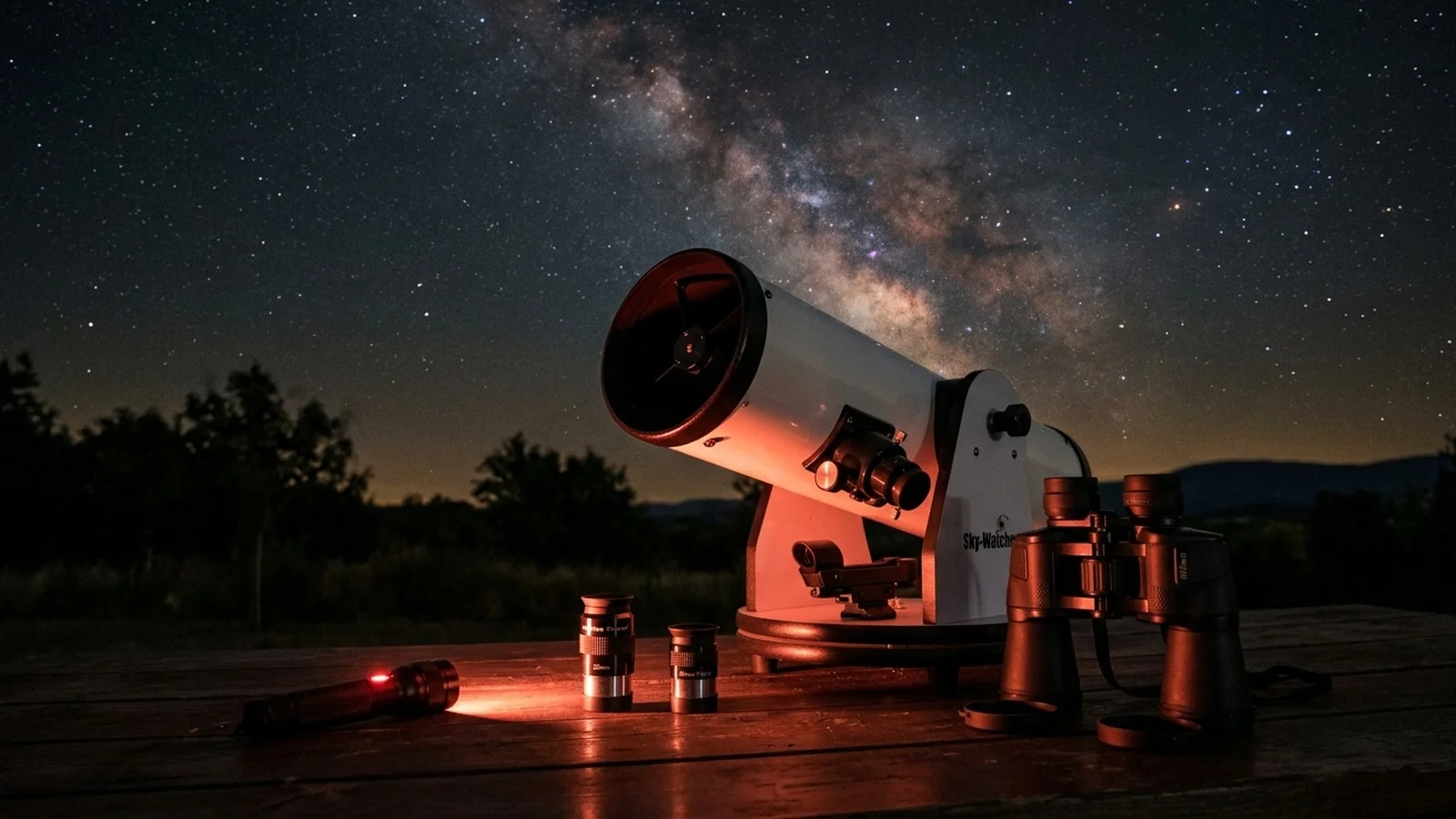
Sky-Watcher Evostar 90 EQ2
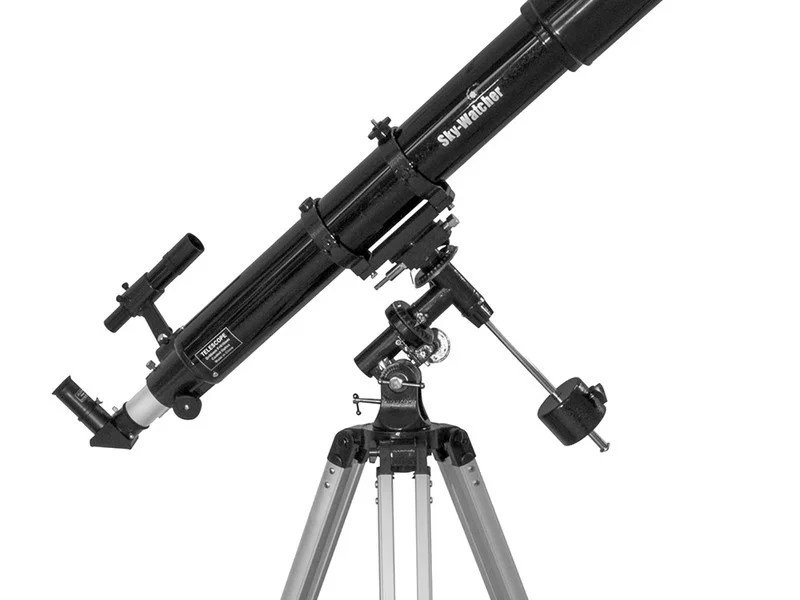
| Sky-Watcher Evostar 90 EQ2 Specifications | |
|---|---|
| Aperture | 90mm (3.5 inches) |
| Focal Length | 900mm |
| Focal Ratio | f/10 |
| Optical Type | Achromatic Refractor |
| Mount Type | EQ2 Equatorial with slow-motion controls |
| Weight | ~8.6kg total (optical tube ~1.4kg) |
| Included Eyepieces | 10mm (90×) & 25mm (36×) · 1.25" |
| Finder | 6×30 external finder scope |
| Focuser | 1.25" rack-and-pinion (smooth, repeatable) |
| Best For | Lunar & planetary observing, learning equatorial mounts, crisp high-contrast views |
Why Choose the Evostar 90 Refractor?
Refractors, telescopes with a primary lens rather than a mirror, are the "classic telescope" design. The Evostar 90 is an achromatic refractor, meaning it has two lens elements (crown and flint glass) that correct for chromatic aberration. Here's what you get:
- No collimation ever. A lens telescope never goes out of alignment. Your 130mm Dobsonian needs mirror collimation two or three times a year. The Evostar 90? Set it up once, forget about it. You're observing, not maintaining.
- No cool-down time. Reflectors have thick mirrors that absorb thermal energy. A 130mm mirror takes 30–40 minutes to reach ambient temperature. The Evostar 90's thin lens cools in 5 minutes. Dark adaptation wins; you're observing faster.
- Crisp, high-contrast views. Refractors excel at lunar and planetary work. The sealed optical tube means zero dust on the optics: your Moon shots are consistently sharp and clean. Tight planetary detail stands out because of the optical contrast.
- Sealed tube = no dust or dew. Unlike open-tube reflectors, refractors have no exposed mirrors. Dust and dew are non-issues. This is especially valuable on damp UK nights.
- The "classic telescope" aesthetic. It looks like a proper telescope: an actual tube with an eyepiece on the side. If you want that visual satisfaction, refractors deliver.
The trade-off: For the same around £229, you could buy a 130mm Dobsonian with 67% more light-gathering power. Refractors cost more per aperture inch. You're paying for optical quality and convenience, not raw light-gathering.
Why Choose an Equatorial Mount?
The EQ2 is a German-style equatorial mount: it tracks the sky by rotating on one axis (the polar axis) aligned north. Once you polar-align it, a single rotation follows celestial objects across the sky. Here's why this matters:
- Single-axis tracking. A Dobsonian requires two hand movements to follow a celestial object (altitude and azimuth). An equatorial mount with slow-motion controls requires one. After 30 seconds, you're not chasing the Moon across the field of view: you're smoothly gliding along with it.
- Teaches fundamental astronomy. Polar alignment teaches you about Earth's rotation, the celestial pole, and equatorial coordinates. It's not busywork: it's understanding how the night sky actually moves. Many beginners skip this and regret it.
- Prepares you for astrophotography. If you ever want to do long-exposure imaging, equatorial mounts are essential. The Evostar 90 won't do astrophotography itself (f/10 is too slow), but learning the EQ2 now saves you learning curve later when you upgrade.
- More stable tracking at high power. Once properly aligned, the EQ2's slow-motion controls are buttery smooth. High magnifications (90× on Jupiter) stay centred without fidgeting.
The trade-off: Equatorial mounts have a learning curve. Polar alignment takes 5 minutes once you know how (YouTube helps). The EQ2 is also heavier and more complex than a Dobsonian. Setup time is longer, maybe 10 minutes instead of 2. If you want "point and shoot" simplicity, a Dob wins.
What Can You See with the Evostar 90?
A 90mm refractor gathers about 2.6× as much light as the human eye. That's less than a 130mm reflector, but the high focal ratio (f/10) and refractor contrast mean your views are sharper and cleaner on planets and the Moon.
The Moon
Stunning. Craters, mountain shadows, rilles, and terminator detail. Refractors are where the Moon shines: no dust, crisp edges, unmistakable detail.
Jupiter
Cloud belts visible, Galilean moons as distinct points, and on steadier nights, storm detail and festoons. The contrast is excellent: belts stand out clearly against the disc.
Saturn
Rings unmistakable. The Cassini Division (gap between main rings) often visible on steady nights at 90×. The globe shows cloud belts and polar regions.
Mars
Small even at opposition, but polar ice caps clear. Albedo markings (dark regions) visible. Not the detail you'd see through a 200mm, but definitely unmistakable.
Bright Star Clusters
The Pleiades, Hyades, Double Cluster in Perseus: all stunning. The 90mm easily resolves hundreds of stars in these fields. Deep-sky is limited by aperture, not by this scope's quality.
Bright Nebulae
M42 (Orion Nebula) visible but subtle: greyish rather than the vibrant green in photos. M31 (Andromeda) a large fuzzy oval. Limit is brightness, not optics.
Note: All observations depend on light pollution, atmospheric steadiness (seeing), and dark adaptation. These are realistic views from a UK dark-sky site. Light pollution drastically cuts deep-sky capability, but lunar and planetary views stay crisp.
Evostar 90 vs Heritage 130P: Which Should You Buy?
You could spend the same around £229 on a 130mm Dobsonian reflector (the Heritage 130P). Both are excellent first scopes: they just prioritize differently. Here's how they compare:
| Factor | Evostar 90 (Refractor) | Heritage 130P (Reflector) |
|---|---|---|
| Light Gathering | 90mm: moderate | 130mm: 67% more |
| Lunar/Planetary | Superior contrast, crisp | Good, but slightly softer |
| Deep-Sky | Limited (small aperture) | Better (more light) |
| Maintenance | None: sealed optics | Collimation every few months |
| Setup Time | 10 minutes (polar align) | 2 minutes (point and shoot) |
| Learning Curve | Moderate (equatorial mount) | Minimal (Dobsonian) |
| Portability | Medium (less balanced) | Better (sits on base) |
| Astrophotography Path | Equatorial mount teaches fundamental skills | Dobs less suited to imaging |
In short: The Evostar 90 is for someone who values lunar and planetary excellence, wants zero maintenance, and doesn't mind learning an equatorial mount. The Heritage 130P is for someone who wants more aperture, easier setup, and simpler operation. Neither is "better": they suit different priorities.
What Buyers Say About the Evostar 90
The Evostar 90 is respected as a solid planetary scope. Stargazers Lounge and CloudyNights threads consistently praise it for lunar and planetary work. Real owners report excellent colour correction (for an achromatic) and enjoyable views at high powers.
EQ2 mount gets mixed reviews. It's adequate but basic. It tracks smoothly once polar-aligned, but the counterweight system feels a bit flimsy, and the head rocks slightly under nudges. Not a deal-breaker, but not premium either. Many owners upgrade to a heavier EQ3 or EQ5 after a year.
The 6×30 finder works fine for learning. It's not a red dot, so there's a learning curve to "star-hopping" (using bright stars as stepping stones). But within a week, you'll be finding targets faster than someone with a red dot finder.
Most forum advice steers beginners toward Dobsonians. The raw aperture advantage is hard to ignore. The Evostar 90's refractor contrast and equatorial mount appeal to experienced amateurs more than true beginners. If you're drawn to the Evostar 90, odds are you know what you want, not just buying the cheapest scope.
Chromatic aberration is minor. Achromatic refractors show a faint purple fringe around bright objects. It's noticeable on the Moon at 90× if you're looking for it, but most observers report it doesn't interfere with enjoyment. Apochromatic refractors eliminate it entirely, but cost 3× as much.
Known Limitations & Trade-offs
- Aperture is limited. 90mm is small by serious standards. A 130mm Dobsonian shows more deep-sky detail. You're limited to bright objects (Moon, planets, bright clusters). Faint galaxies and nebulae struggle. This is the main compromise.
- Chromatic aberration on bright objects. Purple fringing appears around the Moon and bright stars at high powers. It's an achromatic design, not apochromatic: it's corrected but not eliminated. Annoying if you notice it; ignorable if you don't look for it. Avoidable only by spending £600+ on an apochromatic refractor.
- EQ2 mount is lightweight. It works fine, but it's not rock-solid. Vibrations from wind or nudges take a few seconds to settle. In calm conditions it's excellent; on blustery nights you'll notice the instability. Heavier mounts (EQ3, EQ5) solve this but cost more.
- Counterweight system adds bulk. Unlike Dobsonians, you need counterweights to balance the scope. These add 1kg+ to the system weight. Packing for a dark-sky trip is less convenient.
- Polar alignment learning curve. It takes 10 minutes once you know how, but first-time users struggle for 30+ minutes. YouTube helps, but it's an extra skill most beginners don't expect. Dobsonians have zero setup complexity.
- High focal ratio limits deep-sky. f/10 means the eyepieces have limited true field of view. A 25mm eyepiece gives only 3.6° apparent field. The universe feels cramped. A 130mm f/5 Dob with the same eyepiece gives 7.2°. This doesn't affect planetary observing, but it limits nebula/cluster viewing enjoyment.
Evostar 90: Best Upgrades & Accessories
These aren't essential, but they genuinely improve the experience:
Celestron X-Cel LX 9mm
A premium eyepiece for planets. Reveals detail the bundled 10mm can't reach. Crisp, comfortable, and the most popular planetary upgrade. £80–90.
~£85 View at FLO →BST StarGuider 18mm
A wide-field eyepiece (68° apparent field). Makes the high f-ratio less claustrophobic when you want to explore clusters and nebulae. Much easier on the neck than the 25mm.
~£45 View at FLO →Lunar Filter (Moon Filter)
At f/10, the Moon is blindingly bright. A neutral density filter (ND96) cuts glare and reveals shadow detail you'd otherwise miss. Essential for Moon observing. Often a polarizing filter works too.
~£11 View at FLO →EQ3 Equatorial Mount
If after a year you want heavier, more stable tracking, the Sky-Watcher EQ3-2 is a natural upgrade. Same slow-motion controls, but steadier and better suited to larger optics. This is a future path, not essential now.
~£150–200 View at FLO →See our eyepiece guide and accessories roundup for more detailed recommendations on filters, eyepieces, and mount upgrades.
Sky-Watcher Evostar 90: Is It Worth It?
The Evostar 90 is a specialist scope. It's not an "entry point" in the sense of being the absolute cheapest (you can find 60mm refractors for £100). But it's the smallest refractor that serious astronomers recommend for planetary work without frustration.
Stepping up from here means: If you love refractors, apochromatic refractors (90mm APO or 110mm APO) offer zero chromatic aberration, but they cost £400–700. If you want more light-gathering, a 130mm or 150mm Dobsonian is the natural alternative, though you lose the refractor contrast and equatorial mount. Some observers keep both: a refractor for planets, a Dob for deep-sky.
The EQ2 mount itself will eventually feel restrictive. After a year, if you've caught the equatorial-mount bug, the EQ3 or EQ5 (£200–400) offer heavier, smoother tracking: essential if you ever add a second scope or larger optics. Many Evostar 90 owners stay with the scope but upgrade the mount.
The Evostar 90 isn't a stepping stone. It's a complete observing experience with a specific purpose: excellent lunar and planetary views with zero maintenance. Whether you outgrow it depends on whether your interests drift toward deep-sky and larger apertures.