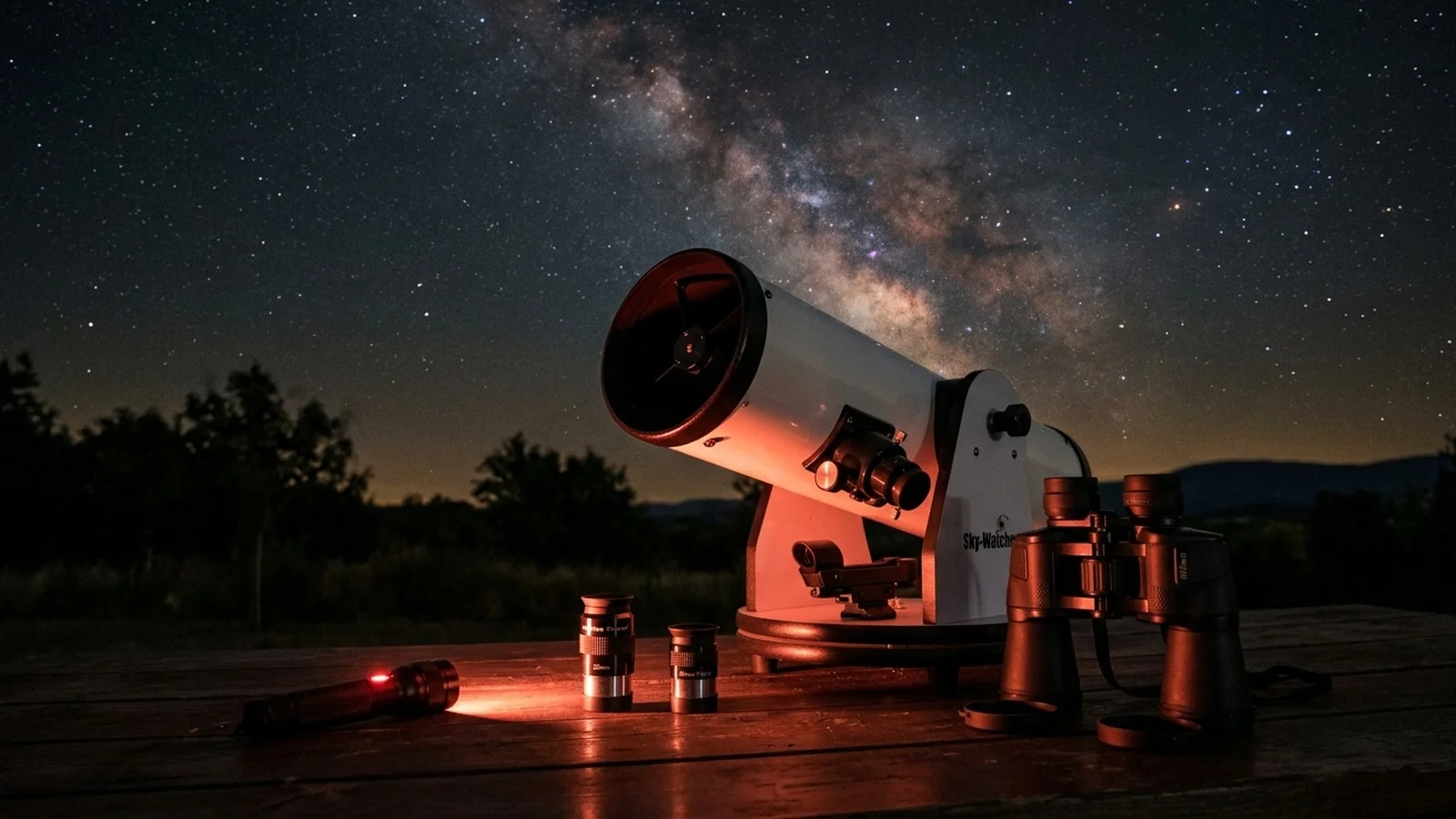
Sky-Watcher Heritage 130P FlexTube
| Sky-Watcher Heritage 130P Specifications | |
|---|---|
| Aperture | 130mm (5.1 inches) |
| Focal Length | 650mm |
| Focal Ratio | f/5.0 |
| Optical Type | Newtonian Reflector |
| Mount Type | Tabletop Dobsonian (FlexTube) |
| Weight | ~5.2kg (optical tube only) |
| Included Eyepieces | 25mm (26×) & 10mm (65×) |
| Focuser | 1.25" Rack & Pinion |
| Finder | Red Dot (basic but adequate) |
| Best For | Planetary & deep-sky viewing, beginners, grab-and-go stargazing |
Who Is the Heritage 130P For?
The Heritage 130P is the telescope for people asking the honest question: "Will I actually use this?" It's small enough to set up in two minutes, light enough to carry in one hand, and costs little enough that if you decide astronomy isn't for you, you haven't spent a fortune finding out.
- Complete beginners who want to see what's actually up there without getting lost in eyepiece filters and collimation drama
- People testing the hobby before committing to a bigger scope: this proves whether you'll spend cold nights outside looking at craters or if it ends up in a shed
- Grab-and-go stargazers who want to take a scope to dark sky sites but don't want to load a car with kit that weighs as much as a small dog
- Second telescope buyers who already own binoculars and want something a bit more capable without the expense of a 200mm Dob
If you're looking for a scope that does everything (planetary, deep-sky, astrophotography, visual observation), this isn't it. But for the price, nothing else shows as much of the night sky as clearly as the Heritage 130P.
If star-hopping by hand doesn't appeal and you'd rather have your phone guide you to targets, the Celestron StarSense Explorer DX130AZ offers similar aperture with a camera-assisted app doing the finding for you.
What Can You See with the Heritage 130P?
A 130mm scope gathers roughly 3.4× as much light as the human eye. That's not enough to overwhelm you with detail, but it's enough to show you what's actually there.
The Moon
Craters, mountains, maria shadows, and terminator detail. You'll spend hours on the Moon alone: it never gets boring.
Jupiter
Cloud belts, the Great Red Spot (on good nights), and all four Galilean moons as distinct discs. Storms change week to week.
Saturn
Rings. Seriously. They're unmistakable. On steady nights, you'll glimpse the Cassini Division: the gap between the main rings.
Mars
Polar ice caps and dark albedo markings during opposition (every 26 months). Otherwise, it looks like a tiny orange disc.
The Orion Nebula (M42)
A greenish-grey cloud with a distinct trapezium of stars inside. It's subtle, not as bright as photos suggest, but unmistakable.
Deep-Sky Objects
M31 Andromeda (fuzzy oval), Pleiades (dozens of stars), Double Cluster in Perseus, Albireo colour-contrast binary in Cygnus.
Note: All observations depend heavily on light pollution, atmospheric transparency, and how dark-adapted your eyes are. These are realistic views from a reasonably dark UK site.
What Buyers Say About the Heritage 130P
Overwhelmingly positive for price. Stargazers Lounge and CloudyNights threads on the Heritage 130P are consistently enthusiastic. Real owners report excellent views and reliable operation for the money.
The bundled eyepieces are adequate but worth upgrading. The 25mm and 10mm work fine for learning, but within a few months most owners replace the 10mm with a BST StarGuider 8mm (£45). It's like fitting better brake pads: suddenly you can see detail you didn't know was there.
You need a sturdy table or surface. The FlexTube sits on the base, which sits on your table. If your table wobbles, so does the scope. Many owners recommend a solid plant stand or small garden table.
Collimation needed occasionally. The mirrors drift out of alignment with temperature changes and rough handling. It's not difficult (YouTube has hundreds of guides), but it's something you'll do two or three times a year.
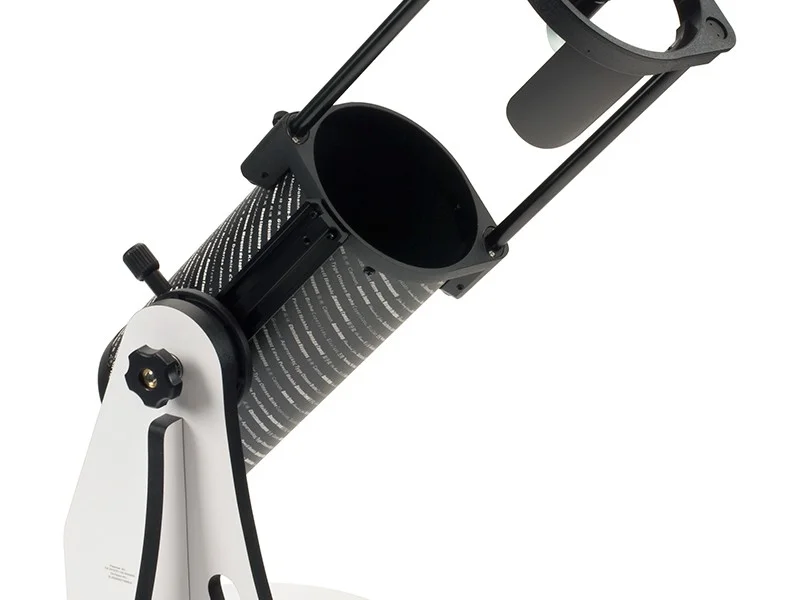
FlexTube design praised for portability. The shroud collapses like a concertina, cutting transport volume by 40%. Combined with the low weight, this is the telescope that actually makes it into the car.
Known Limitations & Tradeoffs
- Spherical mirror, not parabolic. The primary mirror is spherical (cheaper to make) rather than parabolic. This causes slight coma: stars at the field edge look slightly elongated. It's not noticeable at low powers (which is what you'll use at the beginning), but at high magnification you'll see it. Not a deal-breaker, but worth knowing.
- Tabletop design requires a surface. You can't use this on a tripod. You need a table, stool, or bench that's height-adjustable. Cheap garden tables work fine, but uneven surfaces frustrate quick observations.
- Bundled finderscope is basic. The red dot finder is a 1×24 dot sight, fine for learning, but on dark objects it can be hard to centre accurately. Many owners upgrade to a Telrad (£43).
- 1.25" focuser limits future upgrades. Most budget eyepieces use 1.25" barrels, so you're not stuck. But serious astronomy often gravitates toward 2" eyepieces, which this mount doesn't accommodate. Not a problem for the first year, but know the ceiling.
- Aperture isn't huge. 130mm is respectable, but it's at the lower end of "serious" telescopes. A 150mm would be a noticeable step up; so would a 200mm. This scope is good, but it's not the best, and that's okay for a first buy.
Heritage 130P: Best Upgrades & Accessories
All of these are optional, but they transform the experience:
BST StarGuider 8mm Eyepiece
A mid-range eyepiece that reveals detail the bundled 10mm can't quite reach. Sharp, comfortable, and the most popular first upgrade on the forums.
~£45 View at FLO →Telrad Red Dot Finder
A better finder than the basic red dot. Brighter reticle, wider field. Game-changer for locating faint objects.
~£43 View at FLO →Collimation Cap
A simple plastic cap that makes collimating the mirrors 100× easier. You look through a hole instead of trying to centre on your eye.
~£6 View at FLO →Sturdy Observing Stool
A £30 garden stool is the difference between comfortable observations and a sore neck. Cheap but essential.
~£30 View on Amazon →See our eyepiece guide and accessories roundup for more detailed recommendations.
Heritage 130P vs Heritage 150P: Which Should You Buy?
The Heritage 130P is the entry point. It's not the absolute cheapest scope (Sky-Watcher's 76mm Dobsonians are ~£50), but it's the smallest aperture that serious astronomers recommend. Anything smaller feels like looking through a straw.
The next step up is the Heritage 150P (same design, 150mm aperture, ~£220). It shows noticeably more detail: the jump is big enough to feel like a real upgrade. After that, you're looking at the Skyliner 200P (200mm, equatorial mount, around £340), which is an entirely different beast: wider field, brighter clusters, but heavier and more complex.
Many stargazers stay with a 130mm scope for years. It's not a stepping stone: it's a complete observing experience. The step-up question isn't "Do I need more?" but "Do I want to get serious about specific targets?"