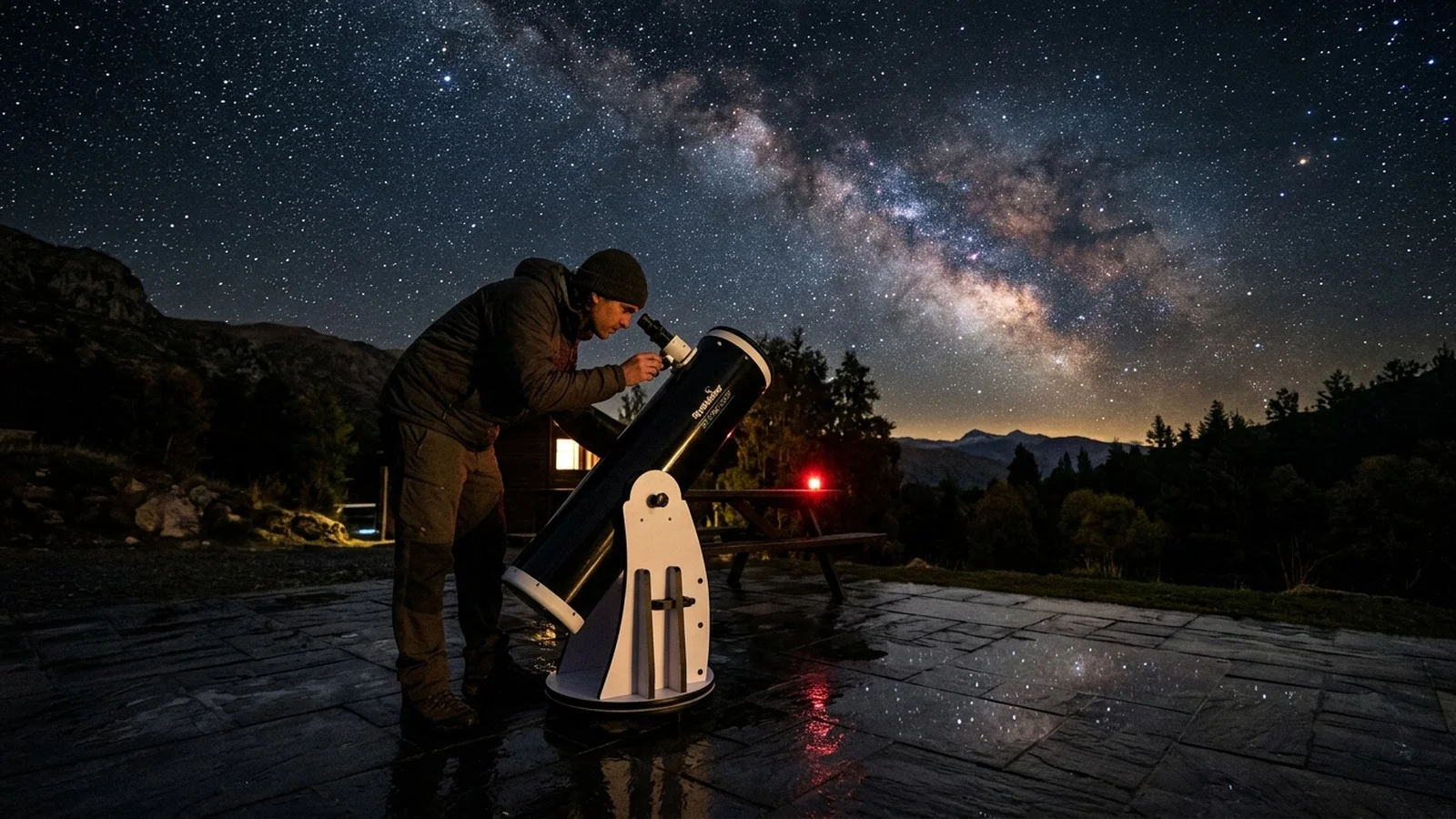
Sky-Watcher Skyliner 200P: Complete Mid-Range Visual Kit
Why the Sky-Watcher Skyliner 200P?
The Skyliner 200P is a 200mm (8-inch) f/6 Newtonian on a traditional Dobsonian rocker-box mount. No motors, no electronics: just a big primary mirror on a smooth-moving mount that any observer can master in a single night. At this aperture you're collecting four times as much light as a 100mm refractor. The Orion Nebula shows structure. M13 resolves to individual stars. Saturn's Cassini Division is crisp. This is where amateur astronomy stops being "nice" and starts being jaw-dropping.
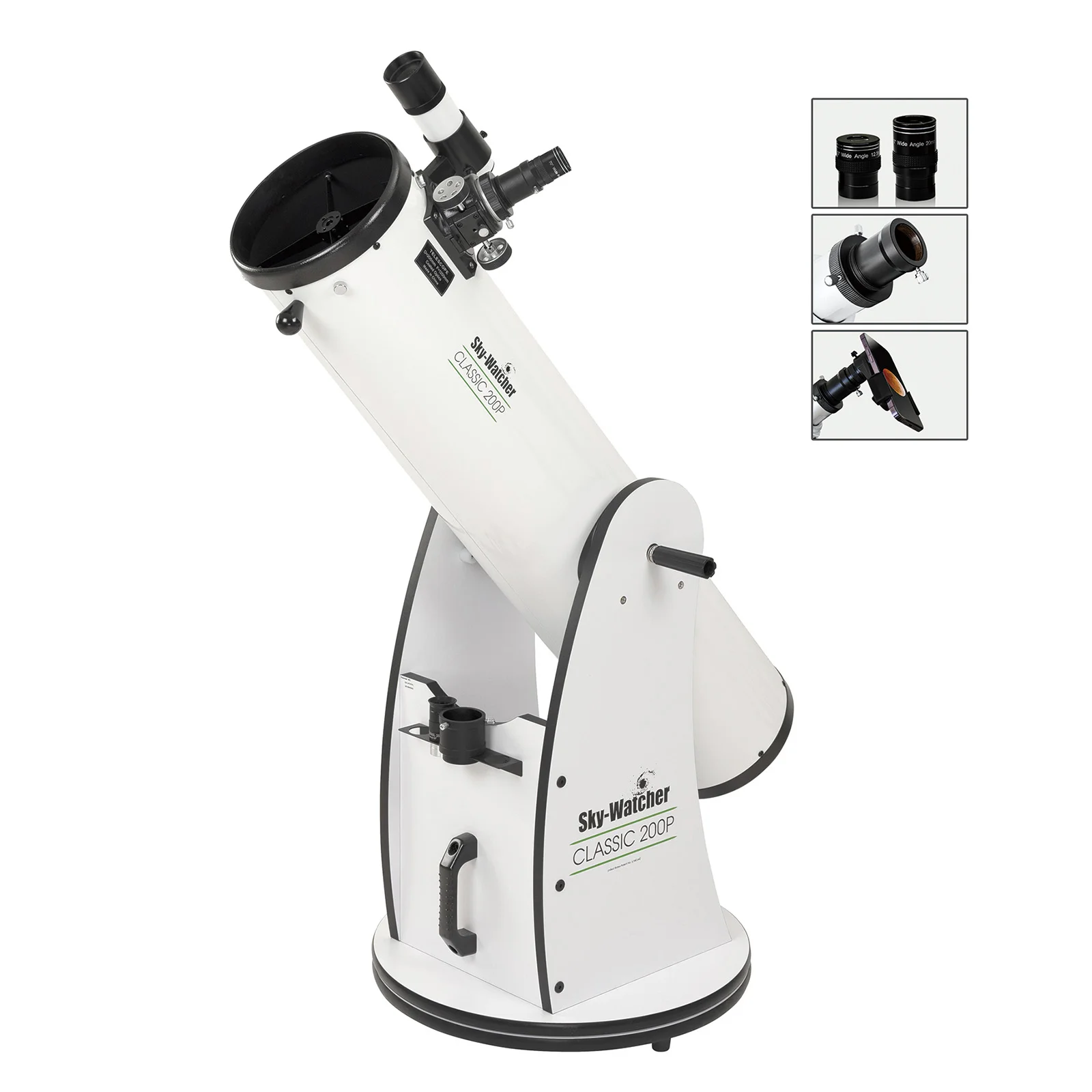
What's Included in This Skyliner 200P Kit?
These are the items that experienced 200P owners say no one should be without: collected from the most recommended threads on Stargazers Lounge.
Telrad Finder
At 200mm aperture you're trying to find objects covering fractions of a degree of sky. The Telrad's three concentric rings (0.5°, 2°, 4°) projected directly onto the sky match the scale on most printed star atlases and Stellarium printouts, making star-hopping to faint DSOs genuinely practical. It's the single most recommended accessory for Dobsonian users on SGL: virtually everyone ends up with one.
BST StarGuider 8mm ED Eyepiece
The 8mm gives you 150× on the Skyliner 200P: the right power for planetary detail, tight double stars, and globular cluster resolution. The BST StarGuider series is the most consistently recommended eyepiece upgrade for UK Dobsonian users: wide 60° field, ED glass, long enough eye relief to be comfortable, and a price that makes buying both focal lengths at once entirely sensible.
BST StarGuider 18mm ED Eyepiece
The 18mm gives you 67×: the wide-field workhorse for sweeping nebulae and open clusters. Together the 8mm and 18mm cover the full range of what a 200P Dobsonian is used for. Both BSTs use the same 60° field of view and consistent ergonomics, so your eye automatically knows where to look when you swap them. Buy both at the same time.
Laser Collimator
A Newtonian reflector needs collimating regularly, especially after transport. A laser collimator projects a bright dot onto the primary mirror and tells you instantly whether your optics are aligned. FLO stocks several; any model works well. The difference in image quality between a perfectly collimated 200P and a slightly off one is substantial, especially at high magnification for planets.
Moon Filter: ND 0.9 (1.25")
The Moon through a 200mm telescope is startlingly bright: bright enough to leave an afterimage. An ND 0.9 neutral density filter cuts the glare to a comfortable level while visibly improving contrast and revealing fine crater detail you'd miss otherwise. It screws onto any 1.25" eyepiece in seconds. Essential for lunar observing at any magnification.
Variable Polarising Filter
Where the fixed ND 0.9 is excellent for most lunar work, a variable polarising filter lets you dial in exactly the brightness you want: useful when the Moon is at different phases, or when the fixed filter makes a gibbous Moon slightly too dark. It also works for planets and bright double stars. Two screwed-together polarising filters you rotate against each other, endlessly adjustable.
Astronomy Observing Chair
A Dobsonian's eyepiece height changes dramatically as you move from the zenith to the horizon. A height-adjustable astronomy observing stool lets you sit at the right level for every target rather than crouching or stretching. Two hours at the eyepiece standing on tiptoe is genuinely miserable. Any sturdy adjustable camping stool works: there's no need to spend a lot.
Red Torch
White light ruins dark adaptation in seconds: 20 minutes to recover. A red torch lets you read a star atlas, note coordinates, or find an eyepiece without destroying the night vision you've spent half an hour building. Variable brightness is useful: very dim for chart reading, brighter for finding a dropped cap in the dark.
Total Cost: £620 to £645
Skyliner 200P + 8 accessories
Optional extras
When you're ready for high-magnification planetary work, the Celestron X-Cel LX 9mm (~£115, FLO) sits between your two BSTs with excellent edge sharpness and long eye relief. A dew shield (~£27, FLO) is worth adding for regular UK observers: a Newtonian's secondary mirror dews up on humid nights and kills contrast quickly. If you find yourself wanting to push to the next level after a few months with the 200P, see the Premium Visual Setup.