Key Takeaways
- At just 11.9 light-years away, Tau Ceti is the nearest single star resembling our Sun — and bright enough to see with the naked eye from the UK
- Tau Ceti's debris disc contains roughly 10 times more comets and asteroids than our Solar System — posing a serious challenge to any life trying to survive there
- A 2025 study using the ESPRESSO spectrograph failed to confirm the previously proposed habitable-zone planet Tau Ceti e — the system's planets remain tantalisingly uncertain
Table of Contents
Our Nearest Sun-Like Neighbour
Look south on a clear November evening and you can see it with your naked eye: a pale, slightly amber-tinted point of light in the constellation Cetus, magnitude 3.5. That unassuming star is Tau Ceti — the nearest single star to our Solar System that resembles our own Sun. Everything within 12 light-years that looks even vaguely Sun-like is either a binary system or Tau Ceti. It stands alone.
Astronomers have been fascinated by Tau Ceti for decades. It is close enough to study in fine detail, Sun-like enough to host a potentially habitable planetary system, and old enough — at roughly 5.8 billion years — that any life there would have had longer to develop than life on Earth has. Yet the more carefully we look, the more complex the picture becomes. Its massive debris disc, unusual chemistry, and the difficulty of confirming any planets around it have kept Tau Ceti firmly in the "intriguing but uncertain" column of the cosmic address book.
Andy Weir's 2021 novel Project Hail Mary — adapted into a film released in March 2026 — sends its protagonist to Tau Ceti to investigate a mysterious stellar anomaly. Weir's choice wasn't random: Tau Ceti really is our nearest Sun-like neighbour, and its uncertain planetary system made it perfect fictional territory. The science in the book is grounded; the Astrophage is not.
Vital Statistics
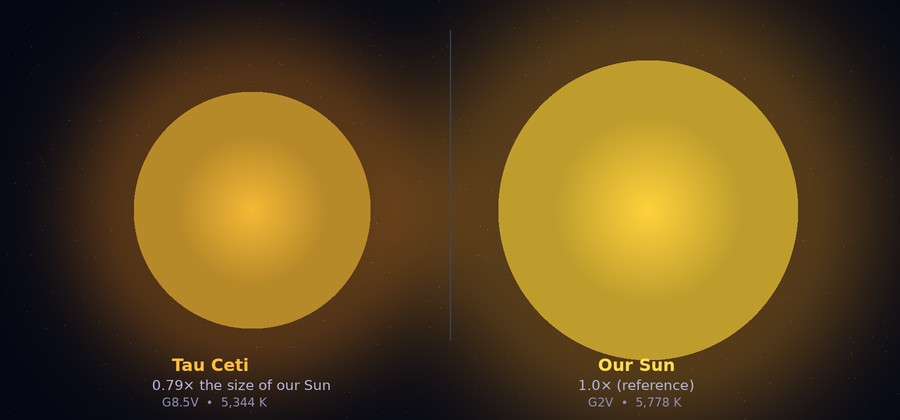
Tau Ceti is noticeably smaller and cooler than our Sun, though it falls firmly in the same G-type class. Its lower luminosity — just 52% of the Sun's output — means that its habitable zone sits closer in. One striking difference is its metallicity: Tau Ceti has only about 30% of our Sun's heavy element content, which has significant implications for the size and composition of any planets it may host.
| Property | Tau Ceti | Our Sun |
|---|---|---|
| Spectral type | G8.5V | G2V |
| Distance from Earth | 11.91 light-years | 8.3 light-minutes |
| Age | ~5.8 billion years | ~4.6 billion years |
| Mass | 0.783 M☉ | 1.0 M☉ |
| Radius | 0.793 R☉ | 1.0 R☉ |
| Luminosity | 0.52 L☉ | 1.0 L☉ |
| Surface temperature | ~5,344 K | ~5,778 K |
| Metallicity [Fe/H] | −0.52 (~30% of Sun) | 0.00 (reference) |
| Visual magnitude | 3.50 (naked eye) | −26.74 |
| Constellation | Cetus | — |
| Debris disc mass | ~10× our Solar System | 1× (reference) |
The Star in Detail
A G-Type Dwarf, But Not Quite Like Our Sun
Tau Ceti is classified G8.5V — a yellow-orange main-sequence star, somewhat cooler and less massive than our G2V Sun. It is in the stable hydrogen-fusing phase of its life and will remain so for billions of years yet. At 5.8 billion years old, it is actually older than our Sun, meaning that any planets it hosts have had more time to evolve.
One of Tau Ceti's most distinctive characteristics is its very low metallicity. Astronomers use the term "metallicity" to describe the abundance of elements heavier than hydrogen and helium in a star — a proxy for how much of these raw materials were available when its planets formed. Tau Ceti has only about 30% of our Sun's metal content. This strongly suggests that any rocky planets in its system would be significantly smaller than Earth, and would lack the geological complexity driven by heavy elements like iron and uranium.
The Debris Disc
In 2004, infrared observations revealed that Tau Ceti is surrounded by a massive debris disc — a vast swarm of comets, asteroids, and dust orbiting the star. Estimates suggest this disc contains roughly ten times more material than the equivalent region of our Solar System. Our own Kuiper Belt and asteroid belt are comparatively sparse.
This is one of the most significant facts about Tau Ceti from an astrobiological perspective. A denser debris disc means dramatically more cometary and asteroid impacts on any inner planets — perhaps 10 times the rate that Earth experienced during the Late Heavy Bombardment around 4 billion years ago. Whether life could gain a foothold between impacts is a genuine open question.
SETI's First Target
In April 1960, astronomer Frank Drake pointed the Green Bank Telescope in West Virginia at two nearby Sun-like stars as part of Project Ozma — the first systematic search for radio signals from extraterrestrial civilisations. The two stars he chose were Epsilon Eridani and Tau Ceti. No signals were detected. Drake went on to develop the famous Drake Equation, and SETI has monitored Tau Ceti periodically ever since.
Light itself — travelling at 300,000 km per second — takes nearly 12 years to reach Tau Ceti. The fastest spacecraft ever launched, NASA's New Horizons probe, travels at about 58,000 km/h. At that speed, reaching Tau Ceti would take approximately 230,000 years. Even the most optimistic proposed interstellar spacecraft concepts would require decades at minimum. It is close by cosmic standards — and still almost incomprehensibly far by any human measure.
The Planetary System
Detecting planets around other stars is extraordinarily difficult. For Tau Ceti, astronomers have used the radial velocity method — measuring tiny wobbles in the star's motion caused by the gravitational tug of orbiting planets. The signals are so small that they require years of data, exquisite instruments, and careful statistical analysis to tease out.
The Candidates
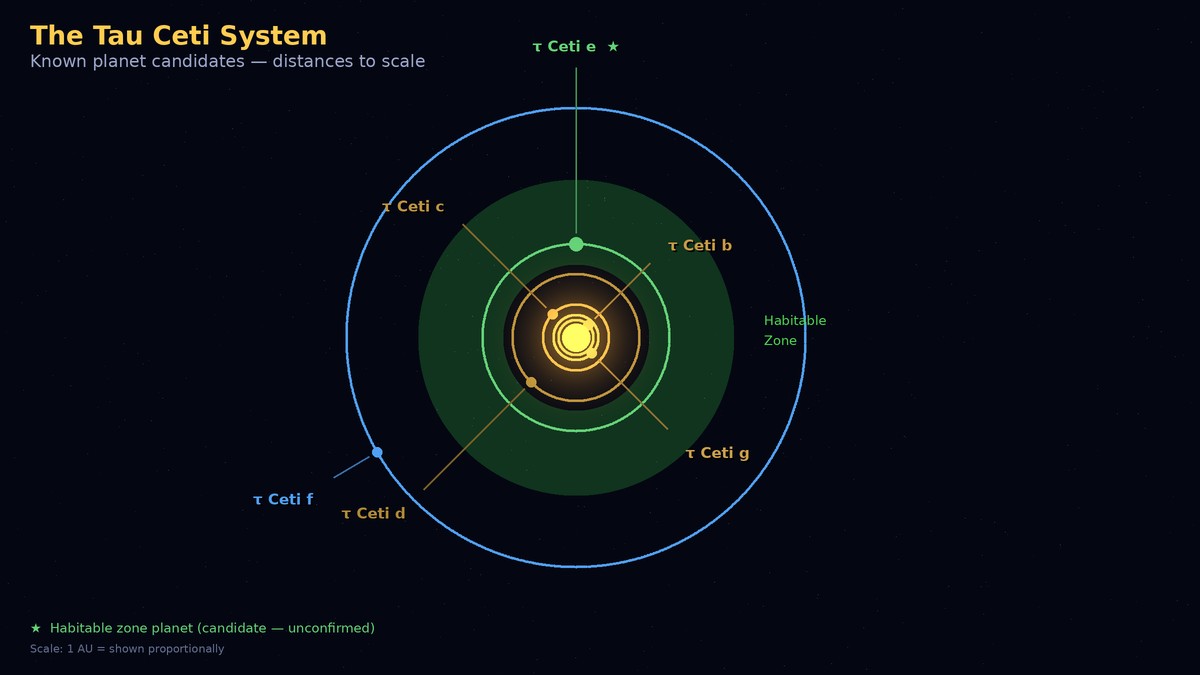
The table below lists the planet candidates identified in studies published between 2012 and 2017. All are detected via radial velocity only — none have been confirmed by transit observations, and all must be treated as unconfirmed until independently verified.
| Planet | Min. Mass (M⊕) | Orbital Distance | Period | Zone |
|---|---|---|---|---|
| Tau Ceti b | ~1.75 | 0.105 AU | 13.9 days | Too hot |
| Tau Ceti g | ~1.75 | 0.133 AU | 20.0 days | Too hot |
| Tau Ceti c | ~1.83 | 0.195 AU | 35.4 days | Too hot |
| Tau Ceti d | ~3.93 | 0.374 AU | 94.1 days | Inner/warm |
| Tau Ceti e ★ | ~3.93 | 0.552 AU | 162.9 days | Inner HZ |
| Tau Ceti f ★ | ~3.93 | 1.35 AU | 636.1 days | Outer HZ |
★ Habitable zone candidates. All listed planets are unconfirmed. Minimum masses shown — true masses depend on orbital inclination, which is unknown.
The 2025 ESPRESSO Challenge
In 2025, a team using ESPRESSO — one of the most precise spectrographs ever built, mounted on the European Southern Observatory's Very Large Telescope in Chile — published a new analysis of Tau Ceti. Their instrument was sensitive enough to detect planets as small as 1.7 Earth masses with orbital periods up to 100 days, and 2–5 Earth mass planets in the habitable zone. The result was sobering: they could not confirm the existence of Tau Ceti e. Planets g and h were near the detection limit; f was below it.
This does not necessarily mean the planets do not exist — some may simply be smaller than current instruments can reliably detect, or the stellar noise (caused by the star's own activity) may be masking the signals. But it does mean the system's planetary architecture remains genuinely unknown. The truth about what orbits Tau Ceti is still out there.
Could Life Exist at Tau Ceti?
Even setting aside the uncertainty about whether any planets actually exist, the question of habitability at Tau Ceti is complicated. There are reasons for both hope and caution.
On the positive side: Tau Ceti is a stable, long-lived star that does not flare dramatically or emit intense X-ray radiation. At 5.8 billion years old, its system has had more time to evolve than ours has. It lies close enough for detailed future study, and its habitable zone — though closer to the star than Earth's orbit — is well-defined.
On the negative side: the debris disc is the elephant in the room. Ten times the cometary and asteroidal bombardment of our Solar System means that any inner planet would be struck with extraordinary frequency. Life on Earth survived the Late Heavy Bombardment, but it was a close-run thing — and our bombardment rate was a fraction of what Tau Ceti's inner planets likely experience. The low metallicity also suggests that any rocky planets would be less geologically active, with less internal heat to drive plate tectonics — a process that many scientists believe is important for long-term climate stability and the carbon cycle.
Stars form with the same composition as the gas cloud from which they condensed — and that composition determines what their planets are made of. Tau Ceti's very low metallicity ([Fe/H] = −0.52) means it formed from an ancient gas cloud poor in heavy elements. Its planets, if they exist, likely have less iron in their cores, less radioactive uranium to drive internal heating, and less of the silicate rock that makes Earth's mantle dynamic. These are not fatal objections to life — but they make Earth-like conditions harder to achieve.
How to Observe Tau Ceti
Tau Ceti is one of the more rewarding naked-eye targets for anyone interested in nearby stars. At magnitude 3.5, it is comfortably visible from most UK locations, though it sits low in the southern sky and benefits from a good southern horizon. Light pollution will affect how well you can see it, but from a reasonably dark site it is not difficult to find.
Finding Tau Ceti
Tau Ceti lies in the constellation Cetus, the Whale. The easiest starting point is the Pleiades (Seven Sisters) in Taurus — one of the most recognisable star clusters in the winter sky. From the Pleiades, sweep roughly south-southwest across Aries and into the southern sky. Tau Ceti is the brightest star in that region, sitting alone without particularly bright neighbours. It transits the meridian (due south, its highest point) at around 22:00 GMT in late November.
Its coordinates are: RA 01h 44m 04s, Dec −15° 56′. The declination of −16° means it barely clears the southern horizon from the north of England (culminating at only ~28° altitude from Edinburgh), but is more comfortably placed from southern England, where it reaches around 38° at its peak from London.
What to Look For
To the naked eye, Tau Ceti appears as a faint but steady pale-yellow point. It does not twinkle as dramatically as stars nearer the horizon because it transits relatively high (from southern England) and its light passes through less atmosphere than stars near the horizon. Through binoculars it shows no disc — it is simply a star — but knowing that you are looking at a system that may harbour planets, one that Frank Drake searched for radio signals in 1960, and one that lies at the other end of a 12-year light-speed journey, adds its own frisson.
| Month | Visibility (UK) | Transit Time (approx.) |
|---|---|---|
| October | Rises in early evening — good | ~00:00 |
| November ★ | Best month — high in early evening | ~22:00 |
| December ★ | Excellent — transits at dusk | ~20:00 |
| January | Visible early evening, setting by ~23:00 | ~18:00 |
| June–August | Too close to the Sun — not visible | Daytime |