Key takeaways
- Rotates on its side with a 98-degree axial tilt, likely from a massive ancient collision
- First planet discovered with a telescope by William Herschel in 1781
- Coldest planetary atmosphere in the solar system at -224°C (-371°F)
Jump to section 9 sections
The Ice Giant of the Outer Solar System
Uranus is the seventh planet from the Sun and one of only two ice giants in our solar system. Unlike the rocky terrestrial planets or the gas giants Jupiter and Saturn, Uranus is composed primarily of water, methane, and ammonia ices surrounding a small rocky core. This unique composition gives Uranus its classification as an ice giant, sharing this distinction only with its neighbor Neptune.
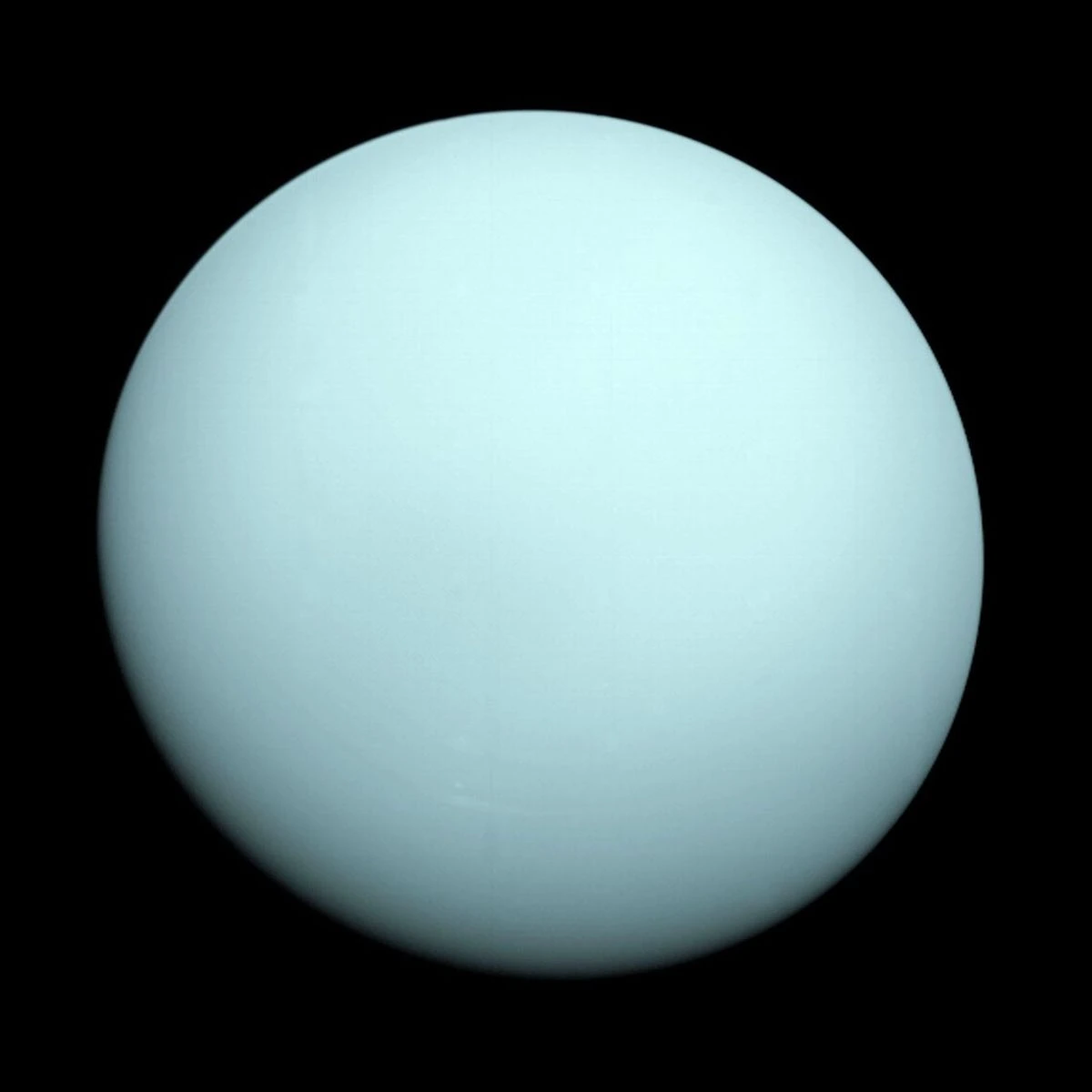
With a diameter of 51,118 kilometers, Uranus is the third-largest planet in our solar system. Despite its massive size, it appears as a small, pale blue-green disk even through powerful telescopes due to its immense distance of 1.8 billion miles from Earth. The planet's icy composition and extreme distance make it one of the coldest places in our solar system, with atmospheric temperatures dropping to -224°C (-371°F).
Ice giants are different from gas giants like Jupiter and Saturn. While gas giants are mostly hydrogen and helium, ice giants have a much smaller proportion of hydrogen and helium, with most of their mass made up of heavier elements forming icy materials under extreme pressure.
Can You See Uranus Tonight from the UK?
Technically yes, for most of the year, but not with the naked eye from a typical UK garden. At magnitude 5.7 Uranus sits right at the naked-eye limit and needs a properly dark sky and a good finder chart. Binoculars show it as a faint greenish star; a telescope at 100x or more turns it into a tiny blue-green disc. It is best in the months around opposition, which currently falls in the autumn.
Our what's visible tonight tool lists Uranus when it is above your horizon, and the observing section further down explains how to star-hop to it.
How Big Is Uranus Compared to Earth?
Uranus is considerably larger than most people expect. Its diameter of 51,118 km makes it about 4 times wider than Earth. That gap grows even more dramatically when you look at volume: you could fit 63 Earths inside Uranus. Its mass is 14.5 times Earth's.
One counterintuitive fact: despite being 14.5 times more massive than Earth, gravity at Uranus's cloud tops is actually slightly lower than Earth's, about 0.9g. This is because the planet is mostly low-density ice and gas spread across an enormous volume. If you could somehow stand on Uranus's cloud layer, you'd weigh slightly less than you do on Earth.
Diameter 4× wider (51,118 km vs 12,756 km) | Mass 14.5× | Volume: 63 Earths | Gravity at cloud tops: 0.9g (lighter than Earth's, despite being far more massive)
Why Does Uranus Rotate on Its Side?
Uranus has the most extreme axial tilt of any planet in our solar system, rotating at an angle of 98 degrees relative to its orbital plane. This means Uranus essentially rolls on its side as it orbits the Sun, with its poles taking turns pointing almost directly at the Sun during its 84-year journey around our star.
This unusual orientation creates the most extreme seasons of any planet. Each pole experiences 42 years of continuous sunlight followed by 42 years of darkness. During the solstices, one pole faces the Sun directly while the other faces away into the darkness of space. Scientists believe this extreme tilt may have resulted from a massive collision with an Earth-sized object billions of years ago during the planet's formation.
Not only is Uranus tilted on its side, but it also rotates in a retrograde direction - opposite to most planets in the solar system. A day on Uranus lasts 17 hours and 14 minutes as the planet spins backward on its unusual axis.
Discovery by William Herschel
Uranus was the first planet discovered with a telescope. On March 13, 1781, British astronomer William Herschel was conducting a systematic survey of the night sky from his garden in Bath, England, when he noticed an unusual object that didn't behave like a star. Initially, Herschel thought he had discovered a comet, but further observations revealed that the object had a circular orbit beyond Saturn.
This discovery doubled the known size of the solar system overnight and marked a pivotal moment in astronomical history. Herschel originally wanted to name the planet "Georgium Sidus" (George's Star) after King George III, but the astronomical community eventually settled on Uranus, continuing the tradition of naming planets after Greek and Roman deities. Uranus is named after the ancient Greek god of the sky, the father of Saturn and grandfather of Jupiter.
The Blue-Green Atmosphere
Uranus's distinctive blue-green color is caused by methane in its atmosphere. The planet's upper atmosphere contains significant amounts of methane gas, which absorbs red light from the Sun and reflects blue and green wavelengths back into space. This gives Uranus its characteristic cyan appearance that sets it apart from all other planets.
The atmosphere is composed primarily of hydrogen (83%) and helium (15%), with about 2% methane and traces of other hydrocarbons. Below the atmosphere, the planet's interior is thought to consist of a dense, hot fluid mixture of water, methane, and ammonia surrounding a small rocky core. Unlike Jupiter and Saturn, Uranus emits very little heat from its interior, making it the coldest planetary atmosphere in the solar system.
The Ring System of Uranus
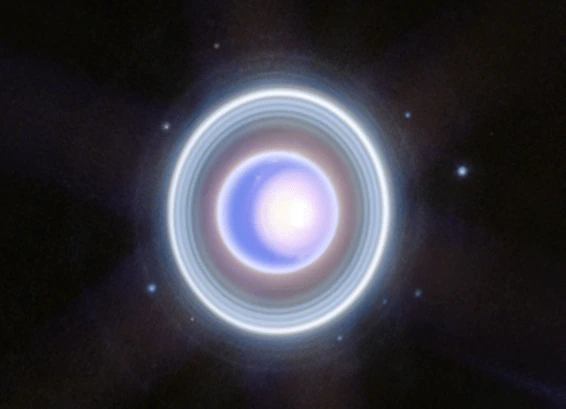
Uranus has a system of 13 known rings, though they are much darker and fainter than Saturn's famous rings. These rings were discovered in 1977 when astronomers observed stars being blocked by something around the planet before Voyager 2's visit in 1986 confirmed their existence. The rings are composed primarily of dark particles ranging in size from micrometers to meters in diameter.
Like the planet itself, the rings of Uranus are tilted at nearly 98 degrees, appearing to orbit the planet vertically when viewed from Earth. The inner rings are narrow and dark, while the outermost rings show variations in color, with some appearing blue or red. Scientists believe these rings may be relatively young, possibly formed from the collision of moons that once orbited the planet.
Extreme Seasons and Climate
The 98-degree axial tilt creates the most unusual seasonal patterns in the solar system. During a Uranian year (84 Earth years), each hemisphere experiences one long summer lasting 42 years when the pole points toward the Sun, followed by an equally long winter when it points away. At the equinoxes, the Sun shines directly over the equator, and both hemispheres experience rapid day-night cycles.
Despite receiving 400 times less sunlight than Earth, Uranus experiences powerful winds reaching speeds of up to 900 km/h (560 mph). The planet's weather patterns are complex and not fully understood, with seasonal changes appearing to influence cloud formation and atmospheric dynamics. Recent observations have shown increasing storm activity in Uranus's atmosphere, possibly related to the planet's approach to equinox.
When Can You See Uranus? (2026)
Uranus reaches opposition on 25 November 2026, when it's closest to Earth and best placed for observation. At magnitude 5.7 it's technically visible to the naked eye under very dark skies, but you'll need to know exactly where to look. Binoculars make it easy to pick out, and a small telescope at 100× reveals a tiny but clearly non-stellar blue-green disc. That disc shape is the giveaway: stars don't show a disc at any magnification.
Magnitude 5.7 at opposition. Technically naked-eye visible under dark skies, but binoculars are much more reliable. A 100mm telescope at 100× shows a small blue-green disc. Surface details are beyond amateur instruments, but the colour and disc shape are clearly visible.
Equipment to see Uranus
Kit we've tested and reviewed in full
Uranus sits at the edge of what's achievable with everyday optics. Under dark skies at opposition, it's just at the naked-eye limit, but from most UK locations you'll want at least binoculars. The goal isn't detail but confirmation: the shift from a twinkling star-like point to a steady blue-green disc is the moment you know you've found it.
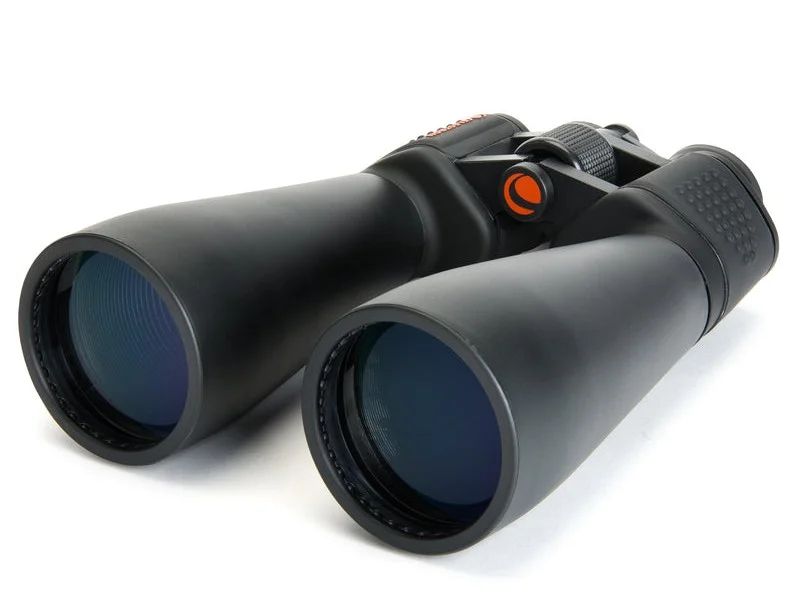
At opposition, 15×70 binoculars show Uranus as a steady blue-grey point: no twinkling, no disc, but clearly not a star once you know what to look for. Use a star chart to narrow down which point is Uranus, then compare it over two nights. The one that moves is your planet. Satisfying confirmation for something 1.8 billion miles away.
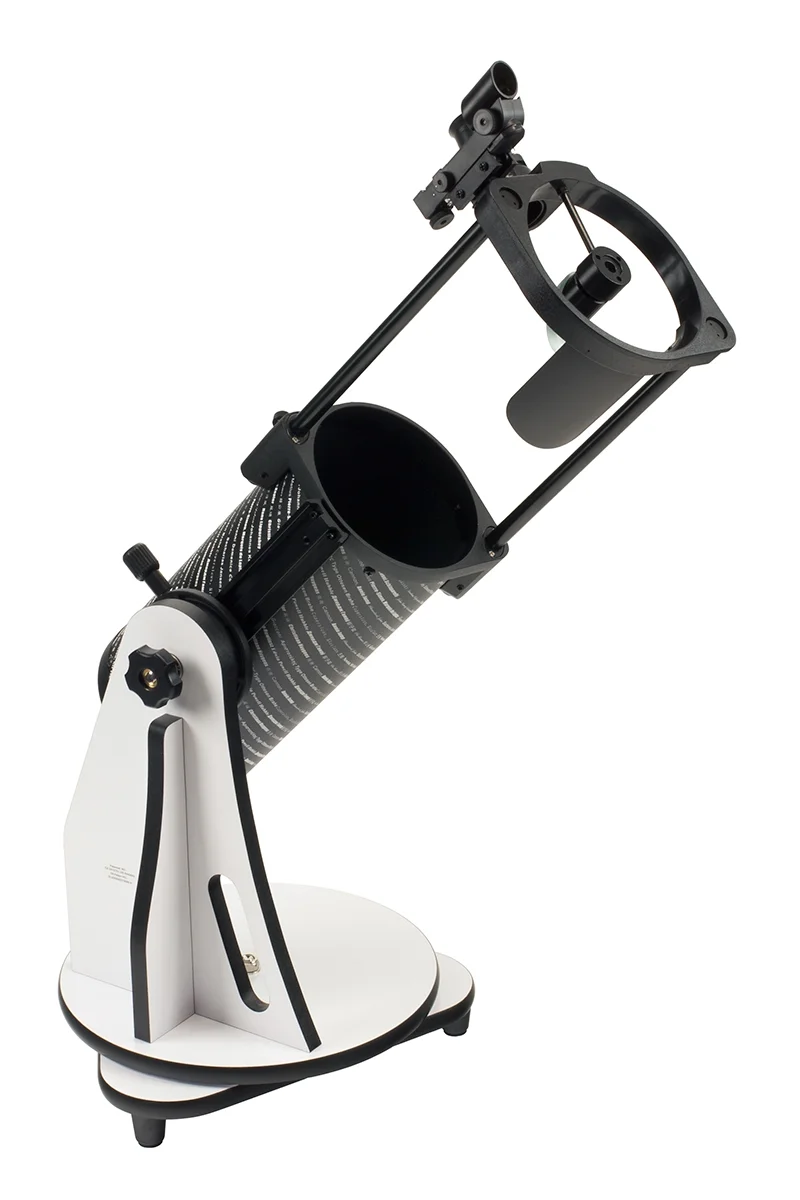
At 100–130× a 130P shows Uranus as a small but clear blue-green disc. No surface features: the atmosphere is uniformly featureless in visible light, but the colour and disc shape are unmistakable. On a good night you can track its position night to night. There's something grounding about seeing a real planet disc at 1.8 billion miles distance.
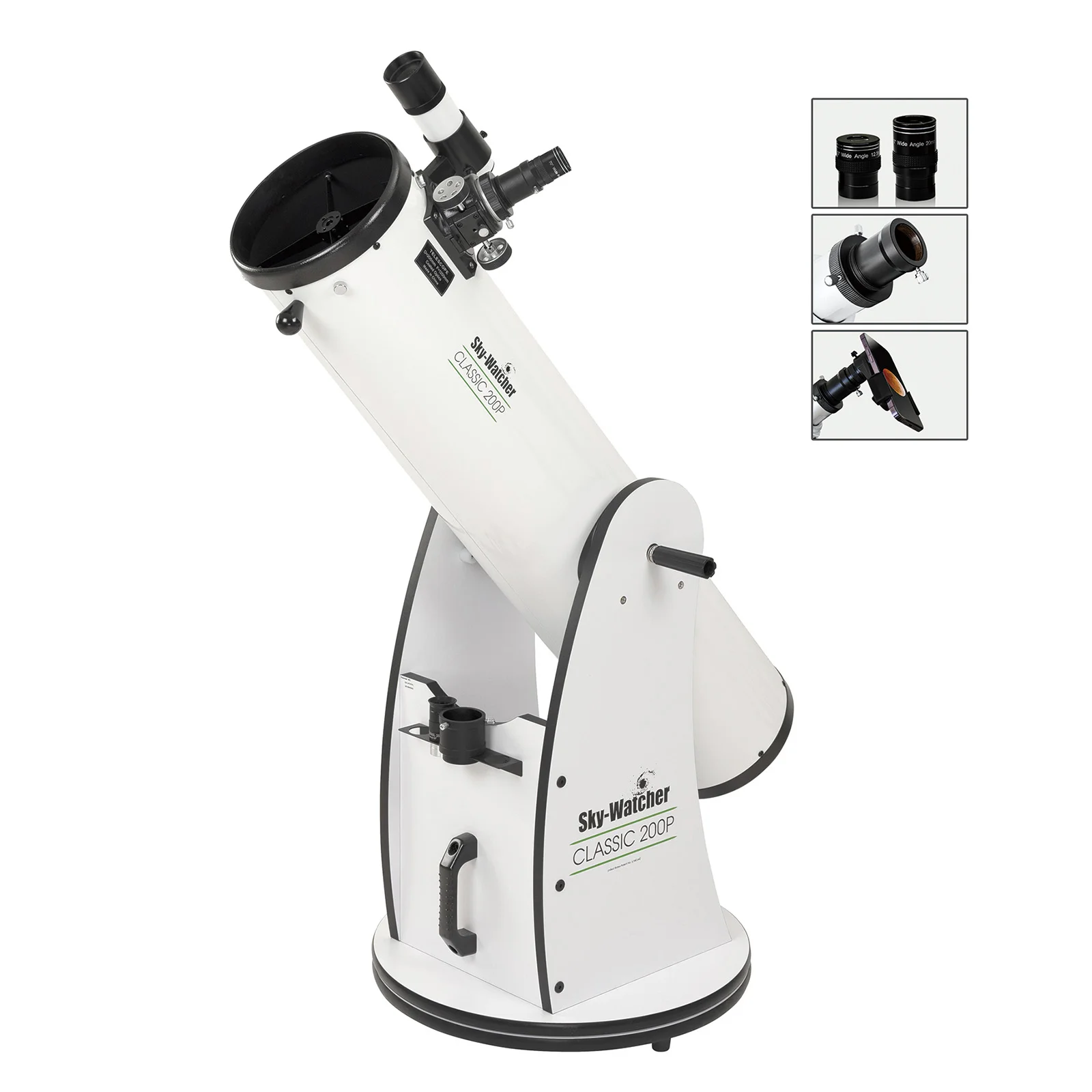
200mm gives a noticeably larger disc and enough light-gathering to push magnification further without the image collapsing. On exceptional nights some observers detect slight limb darkening. The real bonus: Titania and Oberon, Uranus's two brightest moons at magnitude 13.7 and 14.1, become visible as extremely faint points on either side of the planet.
Affiliate links: you pay the same price, we earn a small commission that helps keep WatchTheStars free.