Key takeaways
- Outermost planet, discovered through mathematical predictions in 1846
- Has the strongest winds in the solar system at 2,000 km/h (1,200 mph)
- Deep blue colour from methane in its atmosphere
- 16 known moons including Triton, a captured Kuiper Belt object with active nitrogen geysers
Jump to section 9 sections
The Outermost Planet
Neptune holds the distinction of being the eighth and outermost planet in our solar system. Located at an incredible distance of 2.8 billion miles from the Sun, Neptune represents the edge of our planetary neighbourhood. This distant ice giant takes 165 Earth years to complete a single orbit around the Sun, meaning it has only completed one full orbit since its discovery in 1846.
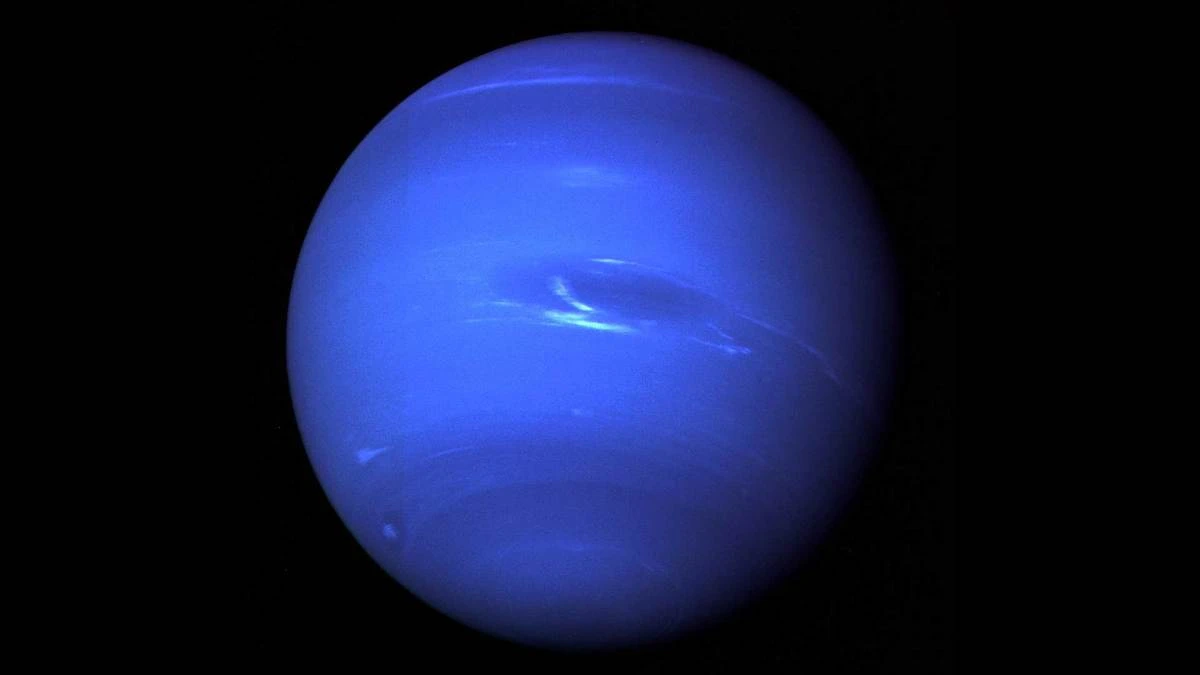
What sets Neptune apart visually is its deep blue colour, caused by methane in its atmosphere that absorbs red light and reflects blue. This gives the planet its distinctive azure appearance, fitting for a world named after the Roman god of the sea.
Neptune was the first planet discovered through mathematical predictions rather than direct observation. Astronomers noticed irregularities in Uranus's orbit and used calculations to predict where an unknown planet must be located.
Can You See Neptune Tonight from the UK?
Not with the naked eye, ever: at magnitude 7.8 Neptune is too faint for anyone's eyes. It is an easy binocular object if you know exactly where to point, and a small telescope at high power shows a tiny blue-grey disc. Like Uranus it is up for most of the year, and best in the months around opposition, which currently falls in early autumn.
Our what's visible tonight tool lists Neptune when it is above your horizon, and the observing section further down explains how to find it against the background stars.
How Big Is Neptune Compared to Earth?
Neptune is considerably larger than Earth, though it looks deceptively small given how far away it sits. Its diameter of 49,528 km makes it about 3.9 times wider than Earth. Its mass is 17 times Earth's, and you could fit 58 Earths inside it by volume.
Gravity at Neptune's cloud tops is 1.14g, slightly stronger than Earth's, despite the planet being so much larger. Neptune is denser than its ice giant twin Uranus, which is why it's actually significantly more massive despite being nearly the same physical size.
Diameter 3.9× wider (49,528 km vs 12,756 km) | Mass 17× | Volume: 58 Earths | Gravity at cloud tops: 1.14g (slightly stronger than Earth's)
Discovered Through Mathematics
Neptune's discovery in 1846 is one of the great moments in mathematical astronomy. When astronomers observed Uranus, they noticed its orbit didn't match their predictions. Something was pulling on Uranus, causing deviations in its path through space.
Two mathematicians working independently, John Couch Adams in England and Urbain Le Verrier in France, used Newton's laws of gravitation to calculate where this unknown planet must be. Le Verrier sent his calculations to Johann Galle at the Berlin Observatory, who found Neptune on his first night of searching, within just one degree of the predicted position. This demonstrated just how precisely Newton's laws of gravity could be applied, and doubled the confirmed extent of the solar system.
The Strongest Winds in the Solar System
Neptune is a world of extremes when it comes to weather. Despite being the farthest planet from the Sun and receiving only a fraction of solar energy, Neptune generates the most powerful winds in our entire solar system. These supersonic winds reach speeds of up to 2,000 kilometers per hour (1,200 miles per hour) - faster than the speed of sound on Earth.
Scientists believe Neptune has an internal heat source that drives these incredible wind speeds. The planet radiates more than twice as much heat as it receives from the Sun, creating powerful atmospheric dynamics that produce these extreme weather systems.
The Mysterious Great Dark Spot
When Voyager 2 flew past Neptune in 1989, it discovered a massive storm system in the planet's southern hemisphere, dubbed the Great Dark Spot. This Earth-sized anticyclonic storm was similar to Jupiter's famous Great Red Spot, with winds reaching 2,400 kilometers per hour around its edges.
However, when the Hubble Space Telescope observed Neptune in 1994, the Great Dark Spot had vanished. In its place, a new dark spot had appeared in the planet's northern hemisphere. These observations revealed that Neptune's atmospheric features are far more transient than Jupiter's long-lived storms, appearing and disappearing over periods of just a few years.
Voyager 2's Historic Flyby
In August 1989, NASA's Voyager 2 spacecraft made its closest approach to Neptune, becoming the first and only spacecraft to visit this distant world. The flyby was the culmination of Voyager 2's 12-year journey through the outer solar system, known as the "Grand Tour."
During its brief encounter, Voyager 2 transformed our understanding of Neptune. It discovered six new moons, revealed the planet's ring system, measured the strength of its magnetic field, and returned the first close-up images of Neptune and Triton. The spacecraft's instruments detected the Great Dark Spot and measured wind speeds that astonished scientists.
Voyager 2's Grand Tour was made possible by a planetary alignment that only occurs once every 176 years. This trajectory allowed the spacecraft to use gravity assists from Jupiter, Saturn, and Uranus to reach Neptune. Without it, the journey would have taken decades longer.
Triton: Neptune's Largest Moon
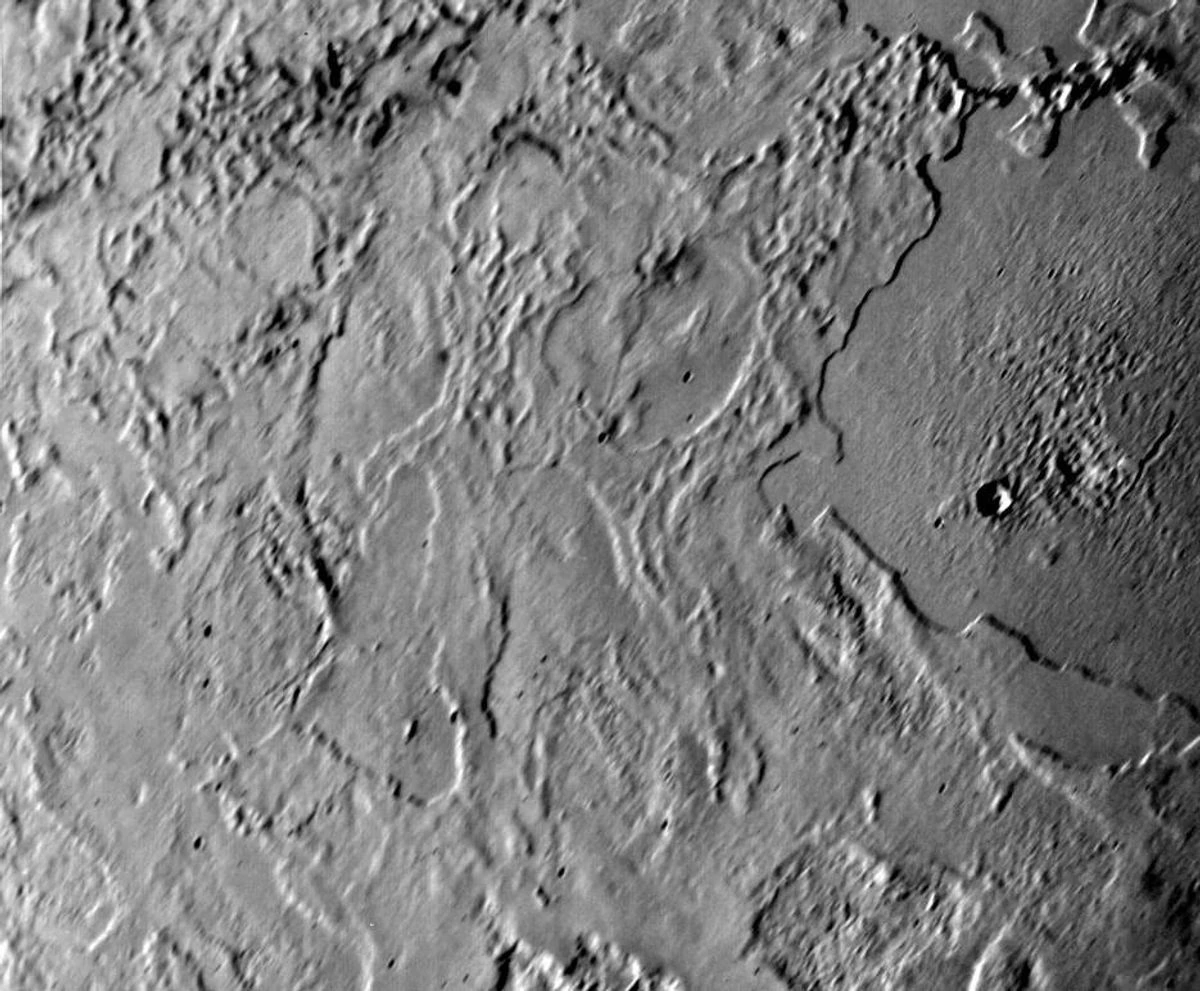
Neptune's largest moon, Triton, is one of the most fascinating objects in the solar system. Discovered just 17 days after Neptune itself, Triton is unique among large moons because it orbits Neptune in a retrograde direction, opposite to the planet's rotation. This strongly suggests that Triton didn't form alongside Neptune but was captured from the Kuiper Belt.
Voyager 2's images revealed that Triton is geologically active, with nitrogen geysers erupting from its surface. With a surface temperature of -235°C (-391°F), Triton is one of the coldest places in the solar system. Despite this frigid environment, it has a thin atmosphere and may harbor a subsurface ocean beneath its icy crust. Scientists believe Triton's orbit is gradually decaying, and in about 3.6 billion years, it will either crash into Neptune or be torn apart by tidal forces, forming a spectacular ring system.
When Can You See Neptune? (2026)
Neptune is not visible to the naked eye. With a magnitude of around 7.8, you need at least binoculars to spot it, and a telescope to appreciate it.
Neptune reached opposition on 26 September 2026 in Pisces, when it was closest to Earth and at its best. It stays well placed through October and November, highest in the south in the late evening, and the dark nights either side of the new Moon on 10 October are the best chance this autumn (our Neptune opposition guide has the finder charts). The next opposition is on 28 September 2027. A telescope at 150× or more shows a distinctly blue-green disc rather than a star point: that disc shape is the most reliable confirmation you've found it. On a good night with 200×+ magnification, Triton may be visible as a faint companion. Neptune moves very slowly across the sky, taking 165 years to orbit the zodiac, so star charts from any decent planetarium app will put you right on it.
Magnitude 7.8 in Pisces, and still well placed in the evening sky through October and November. Binoculars will show it as a faint point. Use a telescope at 150× or more to see the blue disc. Triton may be visible as a faint dot on clear, steady nights. Not visible to the naked eye under any conditions.
Equipment to see Neptune
Kit we've tested and reviewed in full
Neptune sits just beyond naked-eye range at magnitude 7.8: binoculars show it as a faint steady point, a telescope at 150× or more reveals it as a tiny but real blue disc. The challenge is knowing which point you're looking at; a star chart is as important as any optics. But getting your eye on something 2.8 billion miles away is genuinely satisfying.
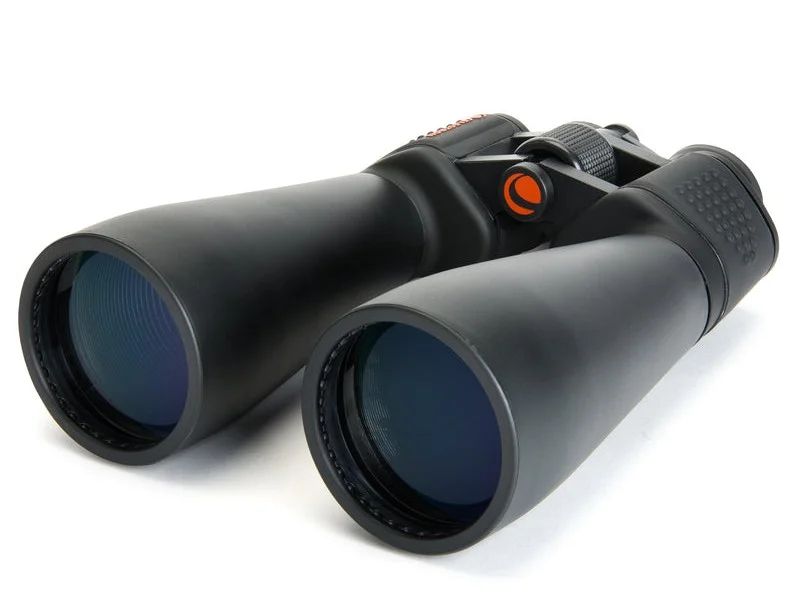
Binoculars are your locating tool. Neptune appears as a faint, steady blue-grey point: it doesn't twinkle the way stars do, which helps once you've narrowed it down. Compare the same field over two nights with a star chart: the point that's moved a tiny fraction is Neptune. Confirming Neptune with binoculars alone puts you in good company: that's essentially how Adams and Le Verrier knew where to look.
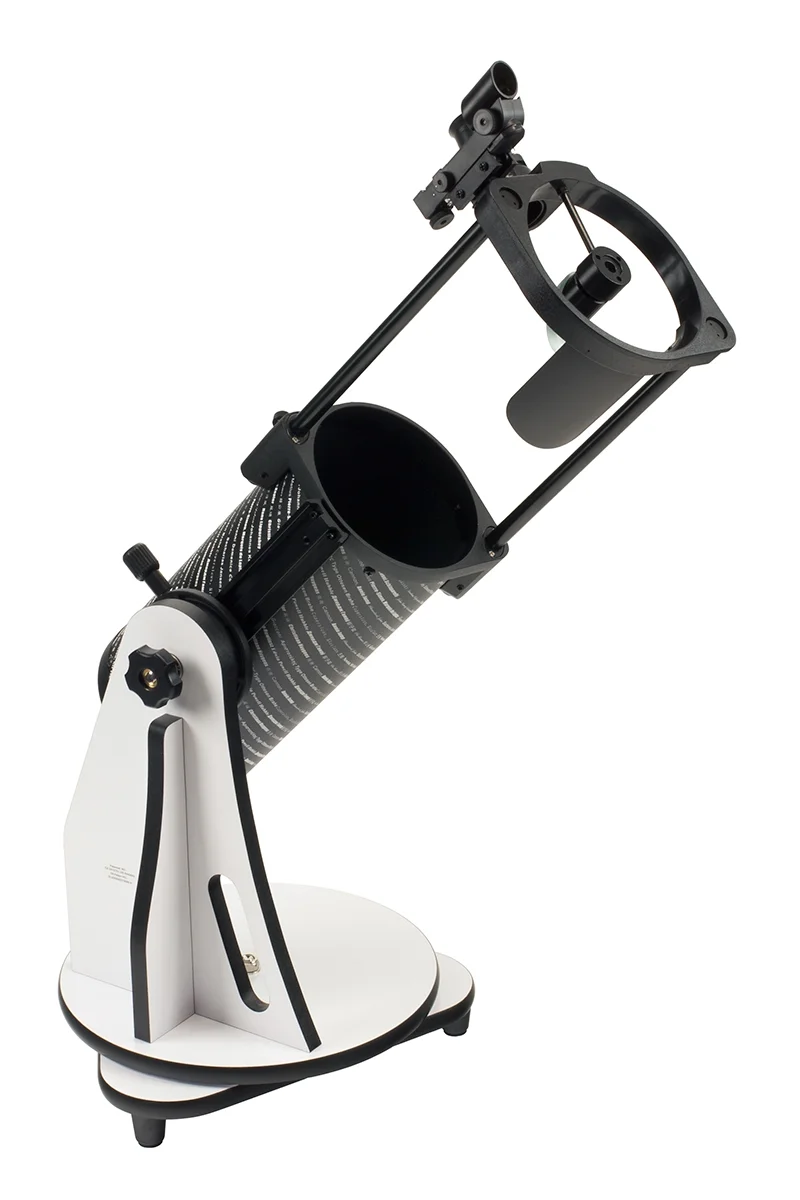
At 150× a 130P begins to show Neptune's disc: tiny at about 2 arcseconds across, but distinctly blue-grey rather than star-white. It's not dramatic, but the colour difference is real and unmistakable on a steady night. Knowing you're looking at a real disc of a planet almost 3 billion miles away changes how it feels through the eyepiece.
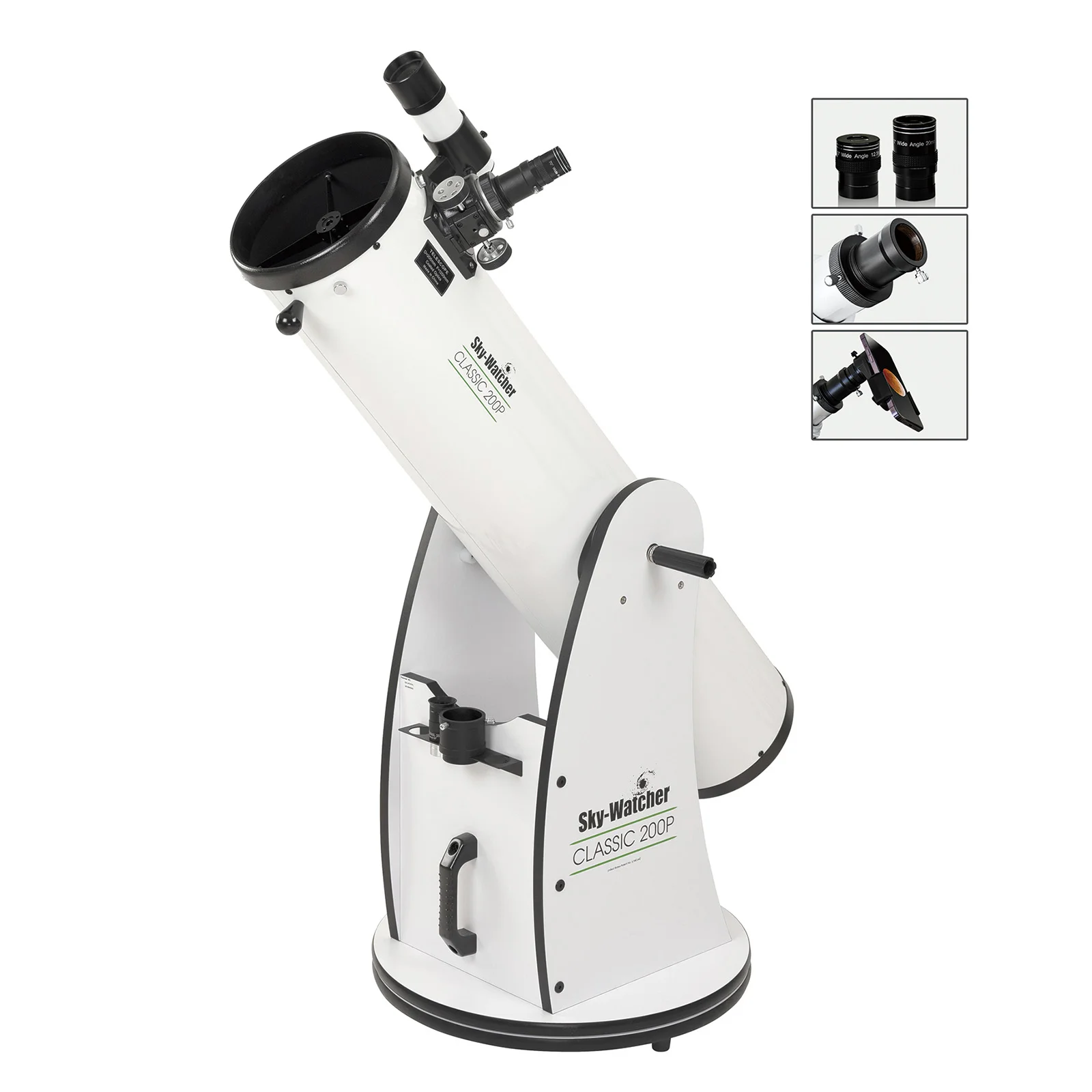
200mm makes the disc clearer and the blue colour more obvious at 200×. The real target at this aperture is Triton: Neptune's largest moon at magnitude 13.5. It sits about 17 arcseconds from Neptune at maximum separation, and on a good, steady night it's visible as an extremely faint point alongside the planet. It's one of the more challenging ticks in backyard observing.
Affiliate links: you pay the same price, we earn a small commission that helps keep WatchTheStars free.