Key takeaways
- Home to Olympus Mons, the tallest mountain in the solar system at 27km high
- Has seasons similar to Earth due to a comparable axial tilt
- One Martian year equals nearly 2 Earth years (687 Earth days)
Jump to section 6 sections
Mars: The Fourth Planet from the Sun
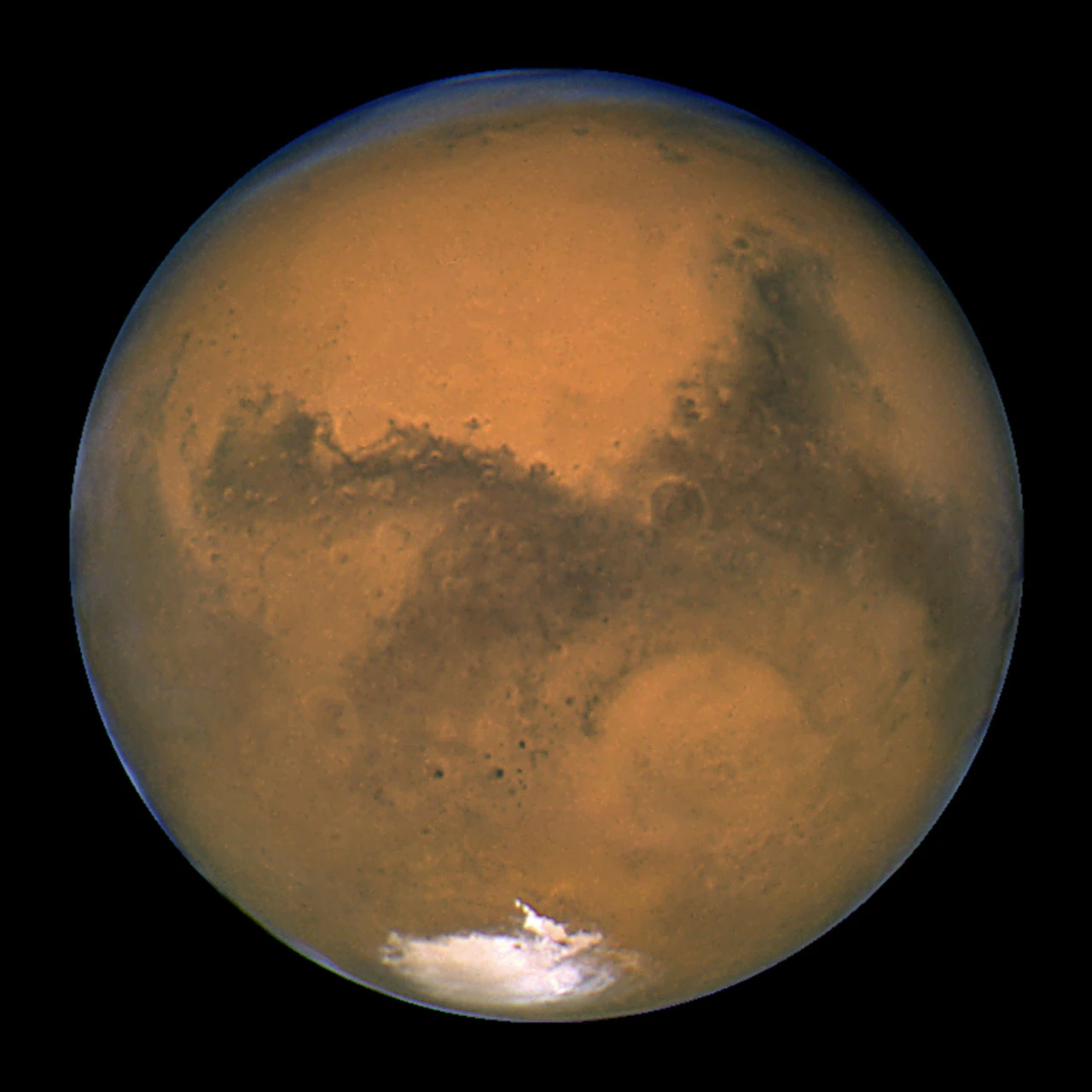
Mars is the fourth planet from the Sun, named after the Roman god of war, most likely because of its red appearance in the sky. At 6,779 km across it is about half Earth's width: a rocky, desert world with a thin atmosphere made mostly of carbon dioxide, and it holds the solar system's most extreme surface features.
Mars has seasons very similar to Earth's: spring, summer, autumn and winter, because its rotational tilt (25.2°) is close to Earth's 23.5°. Because Mars is further from the Sun, it takes nearly twice as long to complete an orbit: one Martian year is 687 Earth days.
Is Mars Visible Tonight from the UK?
It depends where we are in the 26-month cycle. Mars is bright and easy for six months or so either side of opposition, when Earth overtakes it on the inside track, then fades to a faint orange point and finally disappears behind the Sun for a few months. When it is up, look for a distinctly orange-red star that shines steadily instead of twinkling.
As of Wednesday 21 October 2026: Mars rises at about 00:25 in the east-north-east and is 50° up in the south-east as dawn begins (about 06:30). Times are for central England and move by a few minutes a day.
For tonight, put your postcode into our what's visible tonight tool, which shows whether Mars is above your horizon and how bright it is. Our UK night sky this week guide rounds up everything else worth looking for right now, and the observing section further down has the dates of the next opposition.
Mars Surface Features: Olympus Mons and Valles Marineris
Olympus Mons
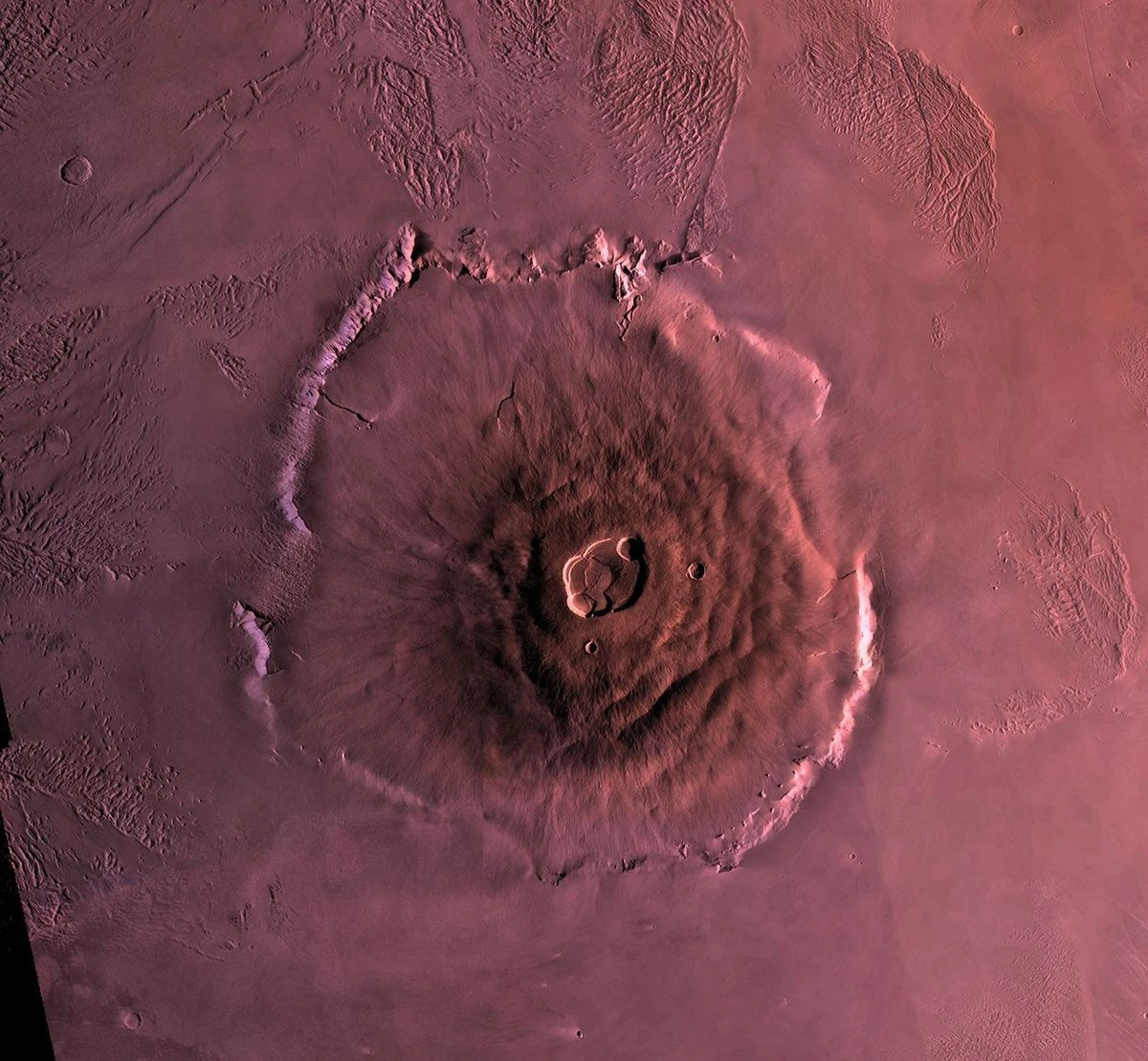
Mars is home to the tallest mountain in the solar system. Olympus Mons stands about 27km (16.8 miles) high, roughly three times the height of Mount Everest (8.8km). It's a shield volcano, similar in shape to those in Hawaii but on an enormous scale: its base is 600km across and it would cover an area the size of France.
Valles Marineris
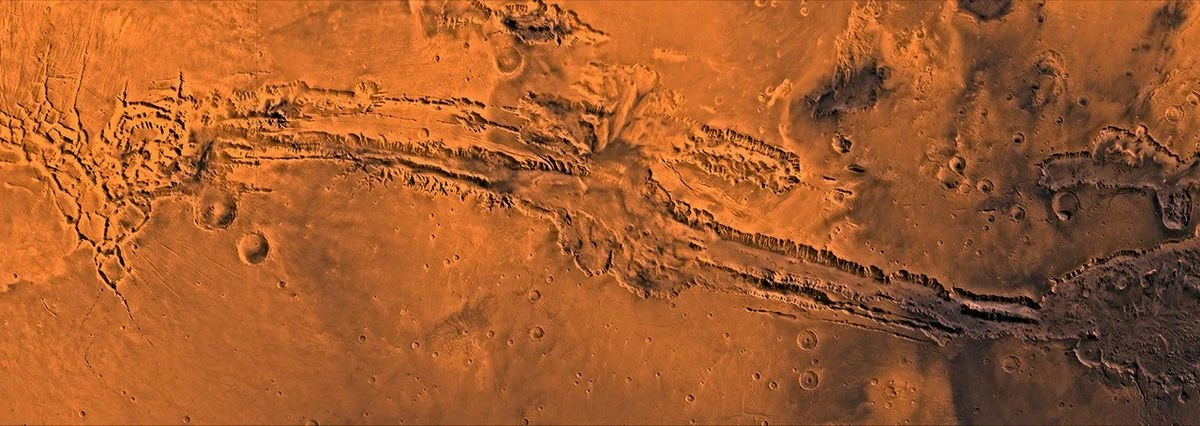
Valles Marineris was named after the Mariner 9 spacecraft that discovered it in 1971–72. It's a canyon system stretching over 4,000km (2,480 miles) long and more than 200km (124 miles) wide, long enough to span the United States from coast to coast. For comparison, the Grand Canyon is about 446km long. Valles Marineris is the largest known canyon in the solar system.
How Big Is Mars Compared to Earth?
Mars is considerably smaller than Earth. Its diameter of 6,779 km is about 53% of Earth's 12,756 km, roughly half the width. In terms of volume, Mars is about one-seventh the size of Earth. Despite being bigger than Mercury, Mars actually has similar surface gravity, about 0.38g, because it has lower density.
- Diameter: 6,779 km vs Earth's 12,756 km (53% of Earth's width)
- Mass: 10.7% of Earth's mass
- Surface gravity: 0.38g (similar to Mercury)
- Surface area: 144.8 million km², close to all of Earth's dry land combined
- Day length: 24h 39m (remarkably similar to Earth's 24h)
- Axial tilt: 25.2° (Earth is 23.5°), which is why Mars has similar seasons
In many ways Mars is the most Earth-like planet. Similar day length, similar axial tilt, similar seasons. Its surface area, though smaller than Earth overall, is close to the total area of Earth's continents. That's one of the main reasons it's the leading candidate for a future crewed mission.
Mars Moons: Phobos and Deimos
Mars has two small moons: Phobos and Deimos. Both were discovered in 1877 by American astronomer Asaph Hall. Where they came from is still debated: they may be captured asteroids, or they may have formed from debris thrown up when something large hit Mars. They're irregularly shaped and very small, nothing like our own Moon.
Phobos
Phobos is the larger of the two, measuring about 22km across. It orbits about 9,400km from the centre of Mars, only about 6,000km above the surface, closer to its planet than any other known moon. This proximity means Phobos completes an orbit in only 7 hours 39 minutes, faster than Mars rotates. The result is that Phobos rises in the west and sets in the east, appearing to cross the sky twice in a single Martian day.
Phobos is slowly losing altitude: drifting about 1.8 metres closer to Mars every century. In roughly 50 million years it will either break apart into a ring or crash into the surface.
Deimos
Deimos is smaller (about 13km across) and much further out, orbiting at 23,460km. It takes about 30 hours to complete one orbit, just over a Martian day, so it moves slowly across the Martian sky and appears as little more than a bright star to any observer on the surface.
Observing Mars: When to See It and What to Look For
Mars moves along the same general path across the sky as the Sun, Moon and other planets (the ecliptic). It orbits the Sun at about 1.52 times Earth's distance, so Earth periodically laps it: passing between Mars and the Sun at an event called opposition, when Mars is at its closest and brightest.
Because Mars orbits outside our own, it can never pass between us and the Sun, so it never shows a crescent the way Venus does. The most it manages is a slightly egg-shaped gibbous disc, about 85% lit, a few months either side of opposition. That's covered in full in why Venus and Mercury have phases but Mars doesn't.
Mars is NOT at opposition in 2026. The most recent opposition was 16 January 2025, and Mars passed behind the Sun on 9 January 2026. It reappeared in the morning sky from late March and brightens steadily through the year as Earth catches up to it, from a faint magnitude +1.3 in summer to around −0.1 by late December. The 2027 opposition (19 February, around magnitude -1.2, 63 million miles) is the one to plan for: see our astronomy events calendar for every other date worth knowing about between now and then.
Mars Opposition Dates
| Date | Distance from Earth | Magnitude |
|---|---|---|
| August 2003 | 34.6 million miles | -2.88 |
| November 2005 | 43.1 million miles | -2.33 |
| December 2007 | 54.7 million miles | -1.64 |
| January 2010 | 61.7 million miles | -1.28 |
| March 2012 | 62.6 million miles | -1.23 |
| April 2014 | 57.4 million miles | -1.48 |
| May 2016 | 46.7 million miles | -2.06 |
| July 2018 | 35.7 million miles | -2.78 |
| October 2020 | 38.5 million miles | -2.62 |
| December 2022 | 51.1 million miles | -1.91 |
| January 2025 | 60.3 million miles | -1.37 |
| February 2027 | 63 million miles | about -1.2 (upcoming) |
Oppositions vary in quality because Mars has a noticeably elliptical orbit. When opposition happens while Mars is near its closest point to the Sun (perihelion), it's also close to Earth, producing the spectacular perihelic oppositions of 2003 and 2018. When it happens near aphelion (furthest from the Sun), like 2012, the distance is considerably greater and the planet appears much smaller in a telescope.
What you need to see Mars
Kit we've tested and reviewed in full
Mars is the most frustrating planet for beginners: it looks like a bright orange star most of the time, and only becomes a proper disc at opposition every two years. When it does, it rewards any telescope you point at it. At its closest in 2003 it was only 34.6 million miles away and even small scopes showed surface detail clearly.
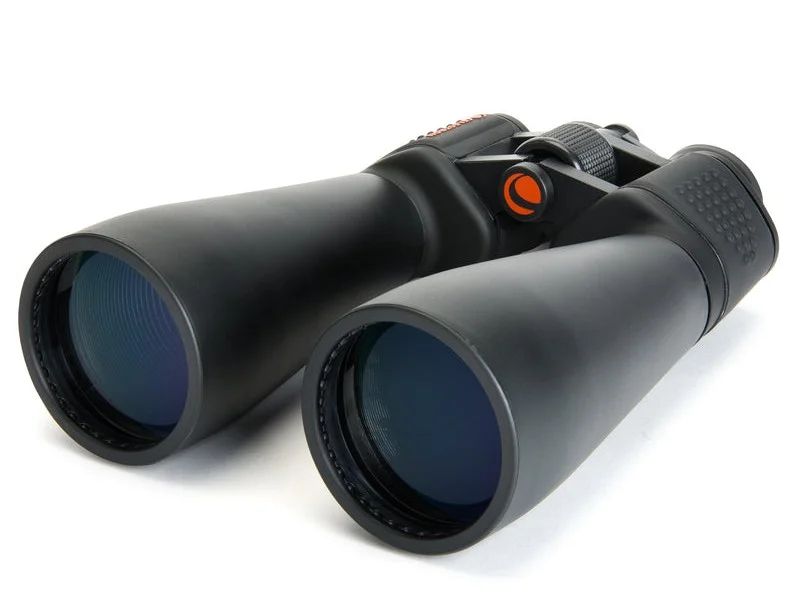
You won't see surface detail, but you will see that Mars is clearly not a star: the orange tint and lack of twinkling are unmistakable. Worth having for when it's not at opposition too, just to track it moving against the stars week to week.
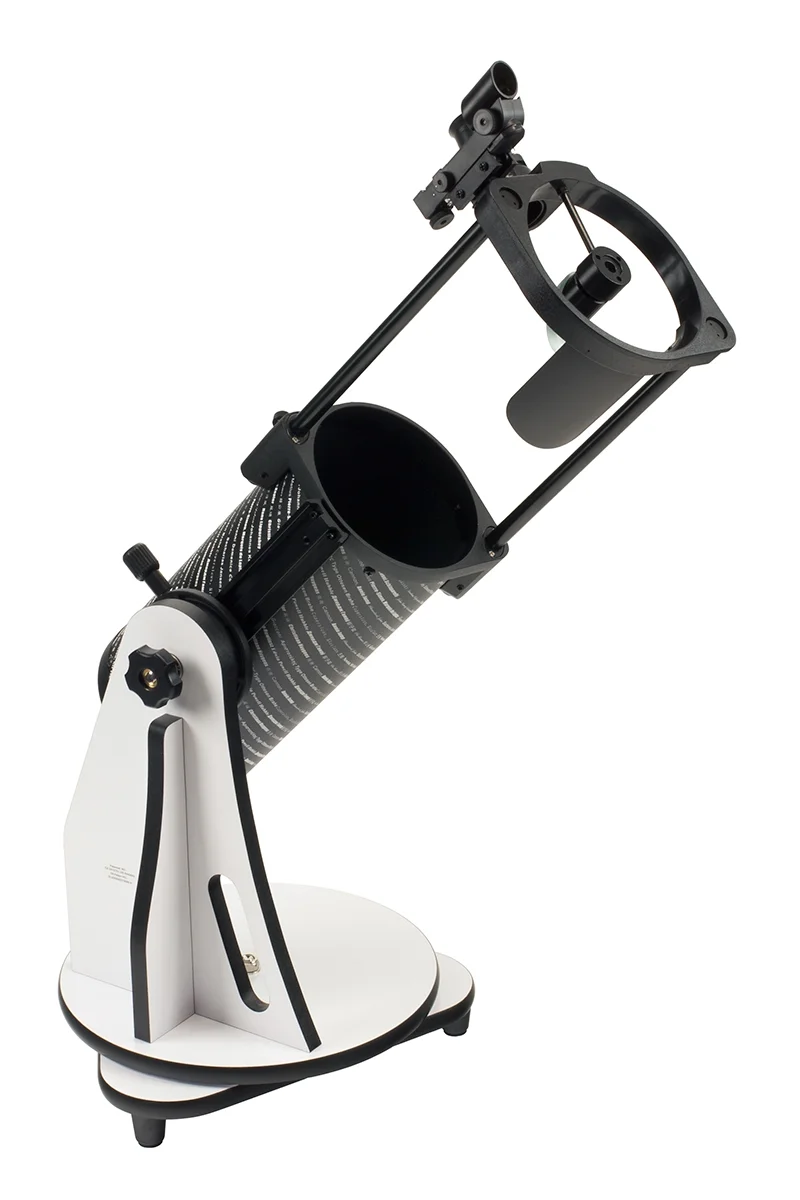
At opposition, 130mm of aperture at 130x will show the polar ice cap as a brilliant white point and the main dark albedo features. During a close opposition like 2003, you'd have been picking out individual regions quite easily. Patience and a steady atmosphere are key.
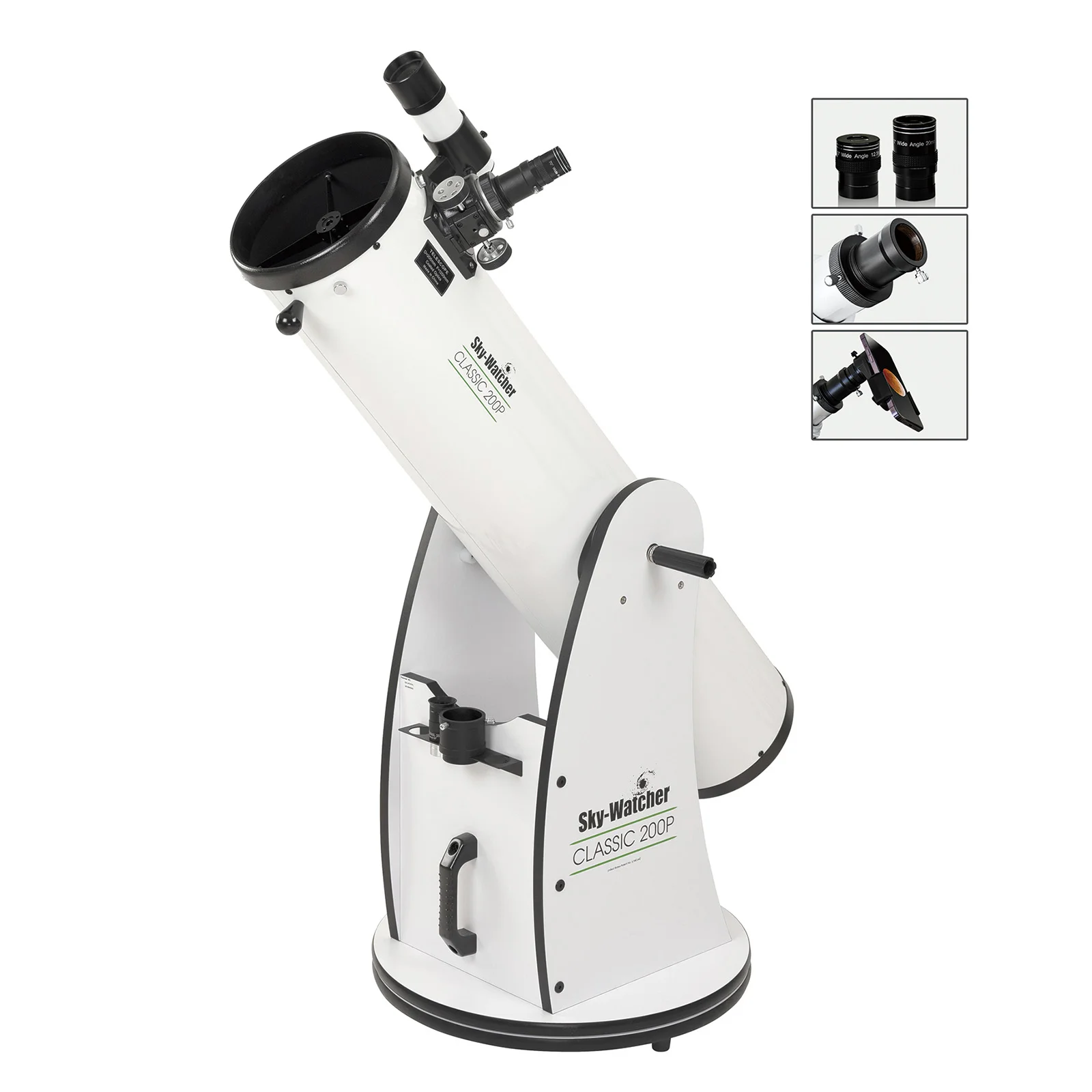
200mm pulls Mars into a real world. At a good opposition you'll see Syrtis Major, the Hellas Basin, both polar caps, and on an exceptional night you might catch the edge of a dust storm. The extra aperture also means you can push magnification higher without the image falling apart.
Affiliate links: you pay the same price, we earn a small commission that helps keep WatchTheStars free.