Key takeaways
- Closest planet to the Sun, orbiting at just 36 million miles (58 million km)
- Most extreme temperature swings in the solar system: from 427°C in the day to −183°C at night
- Smallest planet in the solar system at 38% of Earth's width
- BepiColombo (ESA/JAXA) began its Mercury arrival on 3 September 2026 and enters orbit on 21 November 2026
Jump to section 9 sections
Mercury: The Closest Planet to the Sun
Mercury is the innermost planet in the solar system, orbiting the Sun at an average distance of just 36 million miles (58 million km), about two-fifths of Earth's distance. A year on Mercury lasts only 88 Earth days, making it the fastest planet in the solar system. It travels at around 29 miles per second (47 km/s) in its orbit, which is how the Romans came to name it after their swift-footed messenger god.
Despite being the closest planet to the Sun, Mercury is not the hottest. That title belongs to Venus, whose thick atmosphere traps heat through a runaway greenhouse effect. Mercury has no meaningful atmosphere, so heat is not retained, and temperatures swing violently between the day and night sides.
Mercury is also the smallest planet in the solar system. It looks much like Earth's Moon from space: heavily cratered, grey, and geologically ancient. There are no active volcanoes, no weather systems, and no seasons to speak of.
Can You See Mercury Tonight from the UK?
Usually not, and that is nothing to do with your sky. Mercury never strays more than about 28° from the Sun, so it only shows itself for a couple of weeks at a time, low in the west after sunset or the east before dawn, around each greatest elongation. From the UK the best evening apparitions come in spring and the best morning ones in autumn, when the ecliptic is steep and Mercury sits a little higher above the horizon.
For today's answer, put your postcode into our what's visible tonight tool, which lists the planets above your horizon after dark. The dated apparition guide further down gives this year's windows.
How Hot Is Mercury? Temperature Extremes Explained
Mercury has the most extreme temperature swings of any planet. The sun-facing side reaches up to 427°C, hot enough to melt zinc, lead, and tin. When that same surface rotates into the darkness of Mercury's long night, temperatures drop to −183°C.
That's a swing of over 600°C between day and night on the same patch of ground. The reason is Mercury's lack of atmosphere. On Earth, the atmosphere acts as a blanket: absorbing and redistributing heat, keeping nights warm and days survivable. Mercury has no such buffer. When the Sun sets, heat radiates straight off the surface into space with nothing to hold it in.
Day side: up to 427°C (hot enough to melt zinc and lead). Night side: −183°C. This 600°C swing is the most extreme of any planet in the solar system, caused entirely by the absence of an atmosphere.
Radar observations have also detected water ice in permanently shadowed craters near Mercury's poles. Because these craters never see sunlight, temperatures there stay well below −170°C, even while the equator bakes at 427°C just a few hundred miles away.
How Big Is Mercury Compared to Earth?
Mercury is the smallest planet in the solar system, and it's significantly smaller than Earth. Here's how it compares:
- Diameter: 4,879 km vs Earth's 12,756 km, Mercury is 38% of Earth's width
- Mass: only 5.5% of Earth's mass
- Gravity: 0.38g: you'd weigh 38% of what you weigh on Earth
- Volume: about 14 Mercury-sized bodies would fill the volume of Earth
To put that in perspective, Mercury is actually smaller than two of Jupiter's moons, Ganymede and Callisto. It's only slightly larger than Earth's Moon, which has a diameter of 3,474 km.
Despite its small size, Mercury has a surprisingly large iron core. That core makes up about 85% of the planet's radius, a far higher proportion than any other planet. Scientists think Mercury may once have been much larger but lost most of its mantle in a massive collision early in the solar system's history.
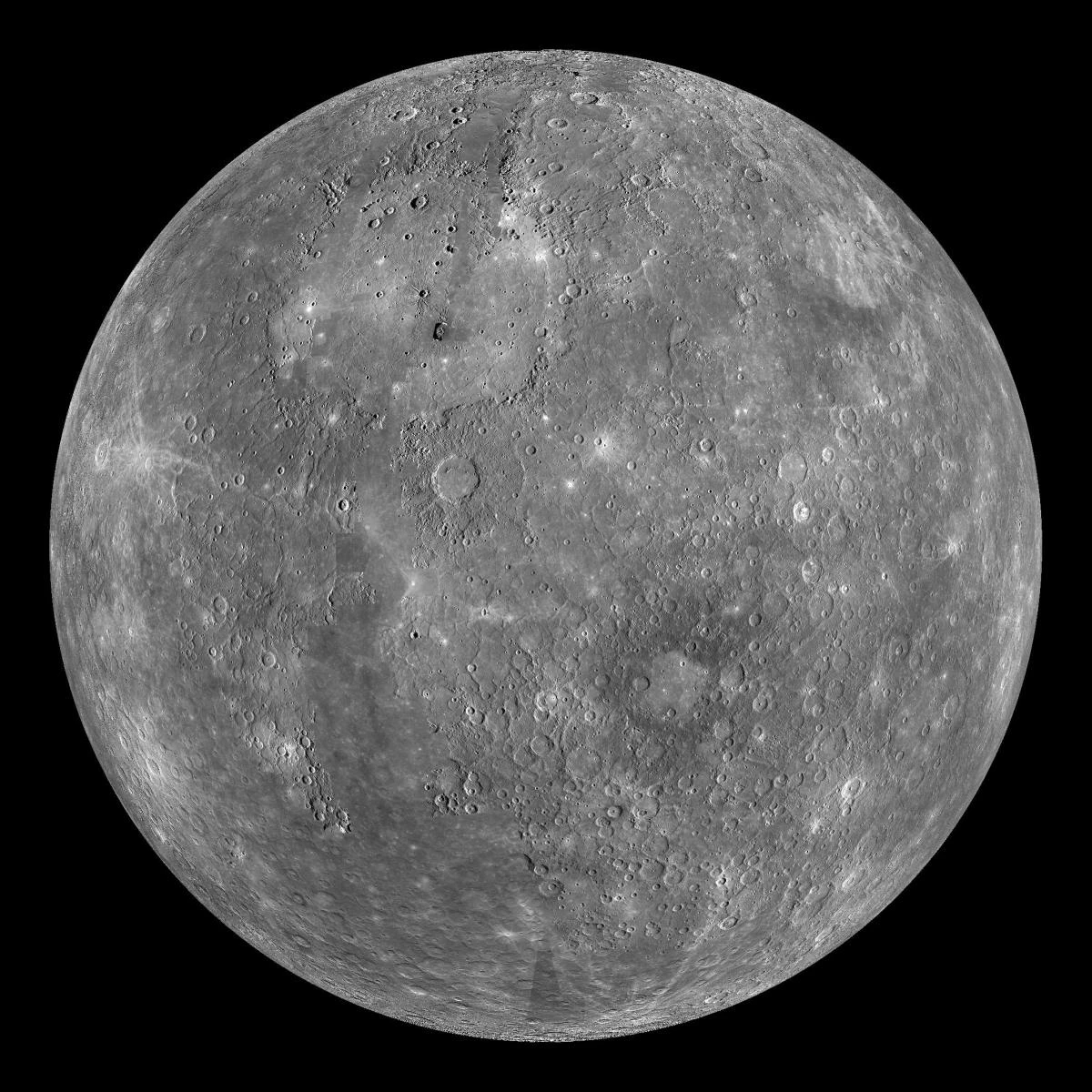
What Is Mercury Made Of? Key Facts About the Planet
Mercury has no air, no moons, and barely any gravity. Here are the key facts:
- No atmosphere: Mercury has only a trace exosphere, a thin collection of atoms blasted off the surface by solar wind and micrometeorite impacts. There's no weather, no clouds, and no wind. Craters formed billions of years ago remain perfectly preserved.
- No moons, no rings: Mercury has neither. Its weak gravity and proximity to the Sun make retaining a moon extremely difficult.
- Slow rotation: Mercury rotates three times for every two orbits around the Sun: a 3:2 spin-orbit resonance. A single solar day (sunrise to sunrise) lasts 176 Earth days.
- A very large iron core: Mercury's core extends to about 85% of the planet's radius, far more than Earth's proportionally. The outer core appears to still be at least partially molten, which generates a weak magnetic field, about 1% the strength of Earth's.
- Heavily cratered surface: The surface resembles the Moon, scarred by billions of years of impacts. The largest known crater is the Caloris Basin, about 1,550 km in diameter, formed by a massive impactor early in Mercury's history.
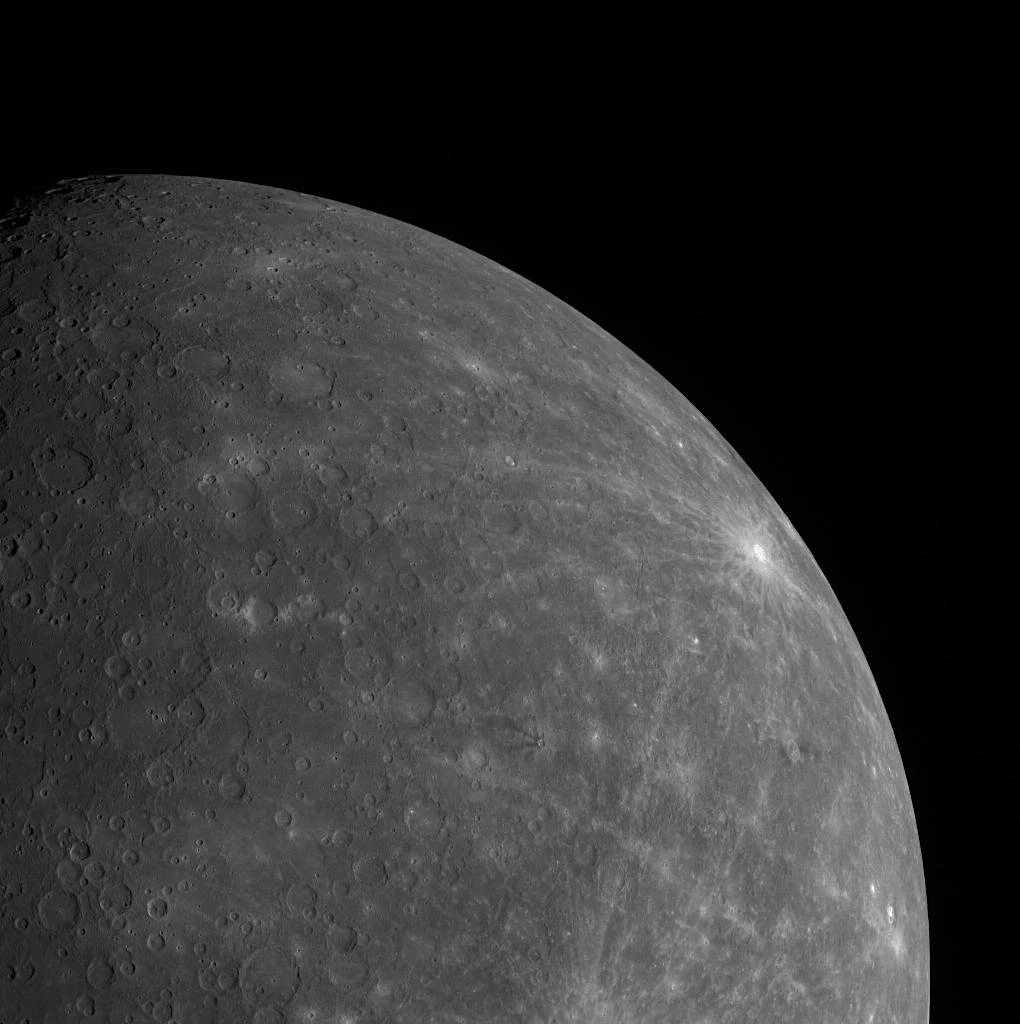
The MESSENGER Mission: NASA's First Mercury Orbiter
Before MESSENGER, almost everything we knew about Mercury came from three flybys by NASA's Mariner 10 spacecraft in 1974–75, which only imaged about 45% of the surface. MESSENGER (MErcury Surface, Space ENvironment, GEochemistry, and Ranging) changed that completely.
Launched in August 2004, MESSENGER took a complex route through the inner solar system, flying past Earth once, Venus twice, and Mercury three times, before finally entering orbit around Mercury in March 2011. It was the first spacecraft ever to orbit the planet.
Over four years in orbit, MESSENGER produced a complete map of Mercury's surface, discovered evidence of ancient volcanic activity, confirmed the presence of water ice in permanently shadowed polar craters, and found that Mercury's core is far larger than previously thought. The mission ended on 30 April 2015 when MESSENGER ran out of propellant and crashed into the planet's surface.
BepiColombo: The Next Mercury Mission
The European Space Agency and JAXA (Japan Aerospace Exploration Agency) launched BepiColombo in October 2018. It's a joint mission consisting of two orbiters, ESA's Mercury Planetary Orbiter and JAXA's Mercury Magnetospheric Orbiter, which will study the planet from different orbits simultaneously.
Like MESSENGER, BepiColombo had to take a long, looping path to reach Mercury, using gravity assists from Earth, Venus, and Mercury itself to slow down enough to enter orbit. It made its final Mercury flyby in January 2025, dropped its transfer module on 3 September 2026 and is captured by Mercury's gravity on 21 November 2026. Our post on BepiColombo's arrival at Mercury has the full timeline.
BepiColombo's scientific goals include understanding why Mercury's core is so disproportionately large, investigating the planet's weak magnetic field, and studying how the planet interacts with the solar wind. The mission is set to operate for at least one Mercury year (88 Earth days) after orbital insertion.
BepiColombo's arrival phase started on 3 September 2026 when its transfer module separated. Mercury's gravity captures the two orbiters on 21 November 2026, and science starts in April 2027. When it does, it will become the first spacecraft at Mercury since MESSENGER's crash-landing in 2015. New imagery and science results should follow within months of arrival.
How to See Mercury in 2026
Mercury is visible to the naked eye but requires knowing when and where to look. Because it never strays more than 28° from the Sun, it's always low on the horizon and only visible during twilight, either just after sunset in the west or just before sunrise in the east.
The best opportunities to see Mercury are during its greatest elongations, when it reaches its maximum angular separation from the Sun. In 2026, the key dates are:
- Evening elongations, 19 February, 15 June and 12 October 2026: Look west after sunset, in the 30–45 minutes after the Sun goes down. February was the best evening showing of the year from the UK, and June's came with Venus and Jupiter nearby. Skip October: the autumn evening ecliptic lies so flat from the UK that Mercury is only 3° up at sunset on 12 October and sets about 25 minutes later, from Plymouth to Edinburgh alike. It is a Southern Hemisphere apparition.
- Morning elongations, 3 April, 2 August and 20 November 2026: Look east before sunrise. The November apparition is the best morning showing for UK observers, with Mercury reaching magnitude −0.5. From about 15 to 25 November it stands 8–10° up in the east-south-east 45 minutes before sunrise (around 6.40am), high enough to catch without binoculars.
Mercury is bright: it typically shines between magnitude −0.5 and +2, depending on its phase and distance. The tricky part isn't brightness; it's knowing exactly where to look in a bright twilight sky with a clear, unobstructed horizon. A planetarium app (SkySafari, Stellarium) pointed at the horizon is the easiest way to locate it.
Find a spot with a clear, flat horizon to the west (for evenings) or east (for mornings). Start looking 20 minutes after sunset or 20 minutes before sunrise. Mercury will look like a bright, slightly pinkish star very close to the horizon. It doesn't twinkle as much as stars do. Planets shine with a steadier light.
Can You See Mercury Through a Telescope?
Mercury is close enough to the Sun that any daytime telescope use requires a proper solar filter. This is not optional: pointing an unfiltered telescope toward the Sun, even briefly, causes immediate and permanent eye damage.
Some cheap refractor telescopes come with a small "sun filter" that screws onto the eyepiece. Do not use these. They sit at the back of the optical tube where heat has already concentrated, and they can crack without warning while you're looking through them. A proper solar filter always goes on the front end of the telescope, blocking sunlight before it enters the optics at all.
Recommended Solar Filters
- Baader AstroSolar Safety Film: the standard choice for amateur astronomers. Available in sheets; you cut it to size and make a simple card-board filter cell for the front of your telescope. Optical density 5.0 (visual) blocks 99.999% of sunlight and gives a natural white/yellow Sun image.
- Dedicated front-mounted solar filters from any reputable astronomy supplier (First Light Optics, Wex Photo Video, FLO), look for filters that explicitly state they meet the ISO 12312-2 safety standard for direct solar viewing.
Through a telescope, Mercury shows phases just like Venus: crescent, half, and gibbous. It never shows much surface detail from Earth because of its small apparent size and the turbulent atmosphere near the horizon. Our guide to why Mercury and Venus have phases but Mars doesn't explains the orbital geometry behind it.
Equipment to see Mercury's phases
Kit we've tested and reviewed in full
Mercury is the trickiest bright planet to observe, always low on the horizon during twilight, fighting atmospheric turbulence. What you're looking for isn't surface detail but the phase: like Venus, Mercury shows a crescent, half-lit, or gibbous disc through a telescope. A solar filter lets you track it in daylight and sidestep the horizon problem entirely.
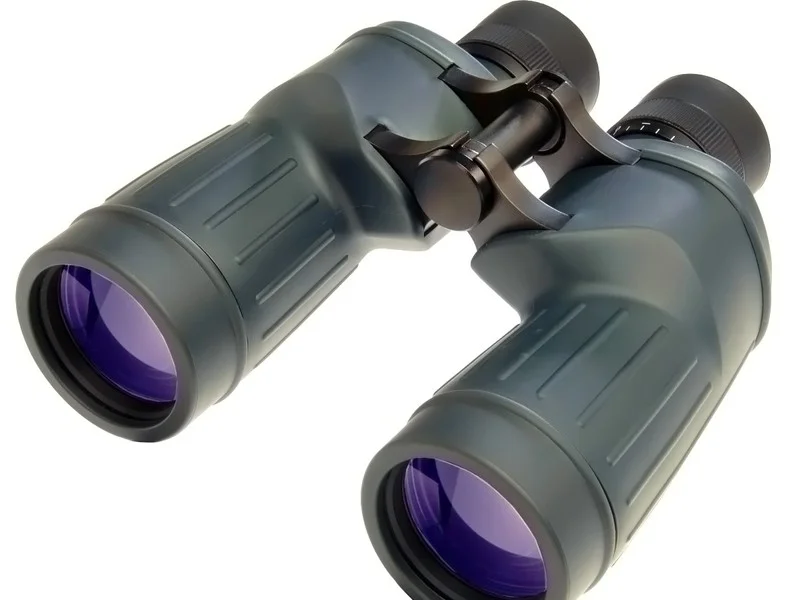
Binoculars are the best first step for Mercury: the wide field helps you locate it quickly before the sky darkens. It'll look like a very bright, steady star low on the horizon. You won't see a disc, but you'll know it's not a star because it doesn't twinkle and it's far too bright for its position.
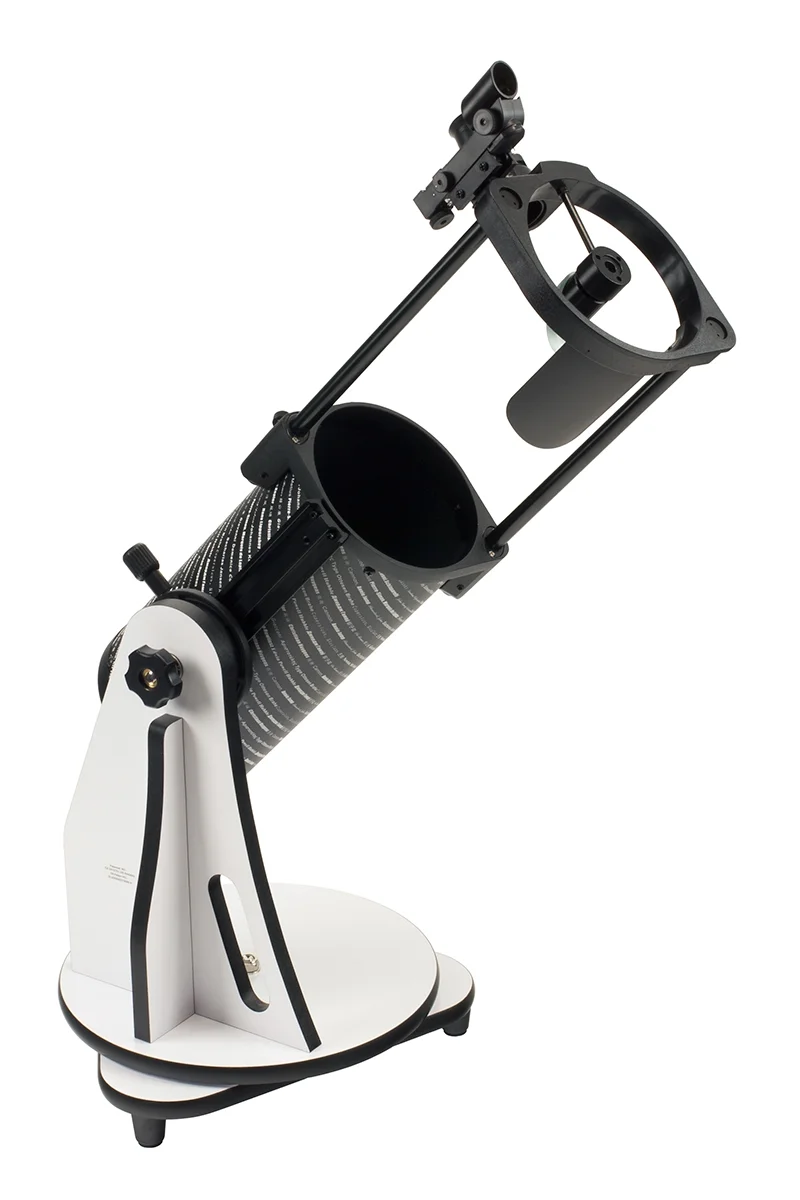
At 80–100× a 130P shows Mercury's phase clearly: you can see whether it's a crescent or gibbous disc, and track it changing over weeks. The image wobbles in the turbulent air near the horizon, but on a steady evening it's worth it. With a front-mounted solar filter you can track Mercury in daylight instead, which is far more comfortable.
Affiliate links: you pay the same price, we earn a small commission that helps keep WatchTheStars free.