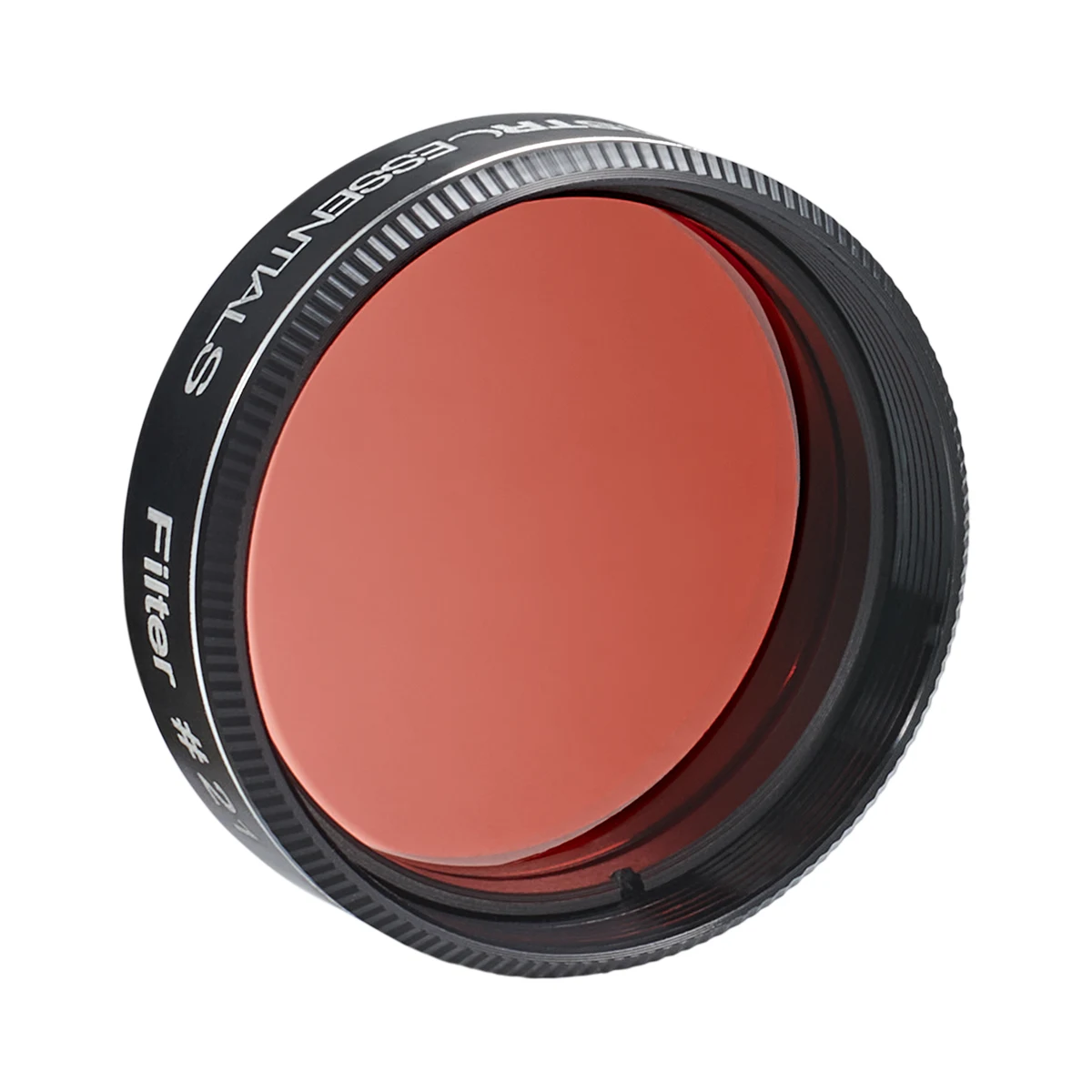
Astro Essentials #21 Orange Filter 1.25"
| Key Specifications | |
|---|---|
| Filter Number | Wratten #21 (Orange) |
| Size | 1.25" barrel |
| Transmission | ~46% (blocks blue wavelengths, passes red/orange/yellow) |
| Best Targets | Mars, Jupiter, Saturn |
| Minimum Aperture | 80mm, works from smaller scopes than the red filter |
| Price | ~£9 |
What Does It Do?
The #21 orange filter blocks blue and violet wavelengths while transmitting red, orange, and yellow. The effect is subtler than the full red (#23A or #25) but more widely applicable: it enhances contrast across all the major planets without darkening the image as aggressively.
At 46% transmission (roughly twice as much light through as the #23A), the orange filter can be used effectively with telescopes from 80mm upwards, making it the most accessible planetary colour filter in the range.
If you're buying your first colour filter and you're not sure which one to start with, the #21 orange is the safest bet. It works on more targets, requires less aperture, and delivers a pleasing improvement in contrast without the dramatic (and sometimes overpowering) effect of a red filter.
Who Is This For?
- Beginners buying their first colour filter: the #21 is the best starting point for overall planetary observation
- Heritage 130P or Heritage 150P owners: these apertures work beautifully with the orange filter on all the gas giants
- Jupiter observers: orange does a particularly nice job on the equatorial belt contrast
- Mars observers with smaller scopes: if you have less than 130mm aperture, the orange filter is preferable to the red
When to Use It
Mars: Enhances dark surface markings (Syrtis Major, Sinus Sabaeus) and polar regions. Less dramatic than the red filter, but works in telescopes from 80mm. Particularly good during the early months of a Mars apparition when the disk is smaller and aperture matters more.
Jupiter: Excellent improvement on the equatorial belts. The NEB and SEB become more distinct, festoons are more visible, and the Great Red Spot appears warmer and more defined. Many Jupiter observers prefer the orange to the red because it doesn't block as much light, leaving more detail visible in fainter features.
Saturn: A gentle improvement on the cloud band contrast. Saturn doesn't respond dramatically to colour filters, but the orange gives a pleasing warmth to the globe and can make the subtle equatorial belts marginally more visible.
Less useful for Venus, Neptune, and Uranus: better to observe these filter-free.
What the Community Says
The most frequently recommended starter filter. Across astronomy forums, the #21 orange consistently comes up as the best first colour filter for beginners who want to try planetary filtering without committing to the more extreme red.
Jupiter is the standout use case. Orange users on Jupiter frequently describe it as a revelation: the belts look sharper and the image has a more defined, contrasty look without sacrificing brightness.
Great value at £9. For less than the price of a coffee, it immediately improves your planetary viewing on the two most rewarding targets in the sky. Virtually every observer who tries one keeps it in their eyepiece case permanently.
Limitations to Know
- More modest improvement than red on Mars. If Mars observation is your primary goal and you have a 130mm+ scope, the #23A red filter will give a more dramatic enhancement. The orange is the compromise choice.
- Still reduces light by ~54%. In very dark skies with a scope at the margins of useful aperture, this might affect image brightness. On 130mm and above it's not an issue.
Related Filters
Astro Essentials #23A Light Red Filter
Stronger effect on Mars: better if you have 130mm+ aperture and Mars is your main target. More dramatic enhancement of dark surface features.
~£9 Read our guide →Astro Essentials #82A Light Blue Filter
The opposite end of the spectrum: enhances blue features. Great for Venus, Mars polar caps, and Jupiter's Great Red Spot.
~£9 Read our guide →Astro Essentials Variable Polarising Filter
Adjustable brightness filter: the right tool for the Moon and very bright planets. Complements colour filters perfectly.
~£24 Read our guide →