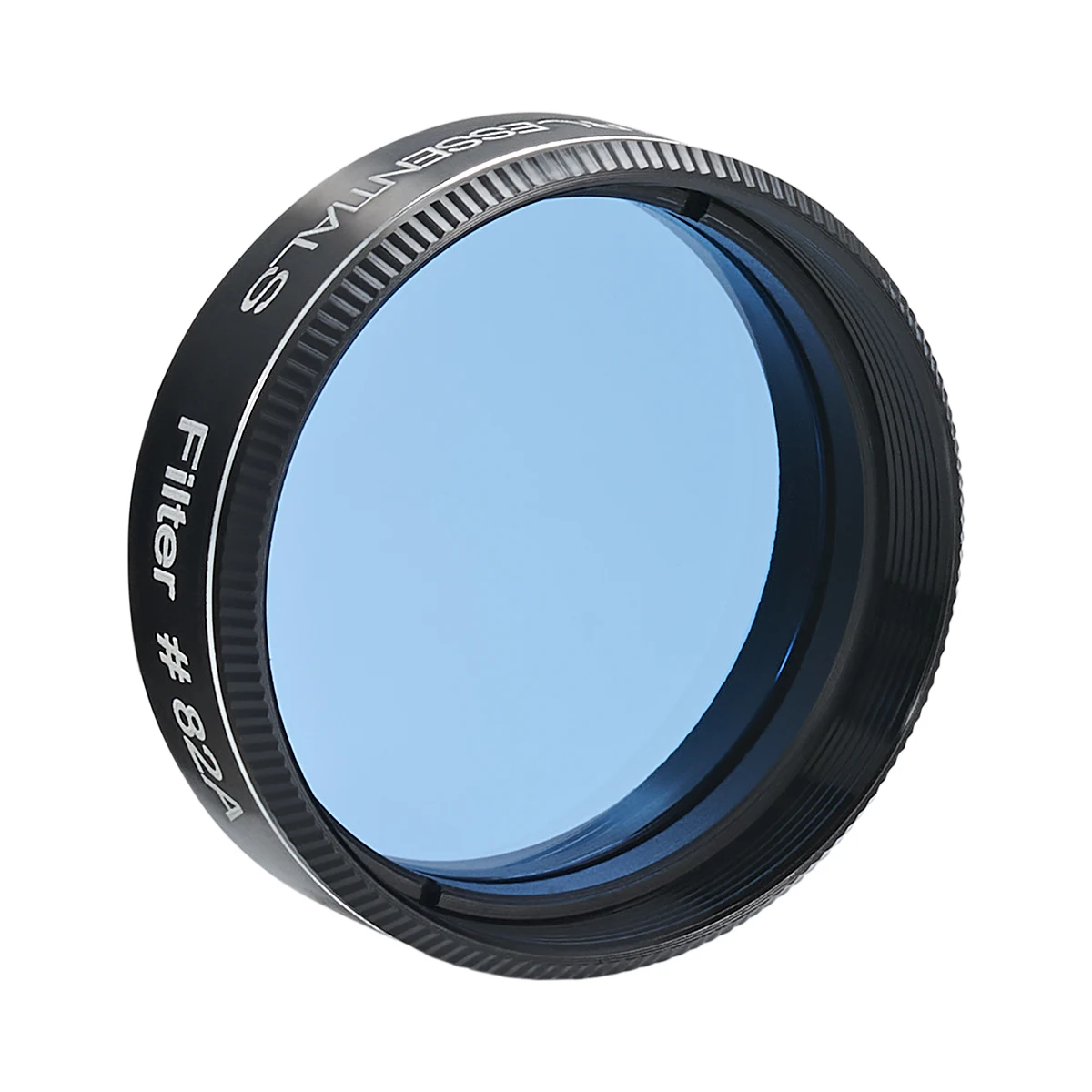
Astro Essentials #82A Light Blue Filter 1.25"
| Key Specifications | |
|---|---|
| Filter Number | Wratten #82A (Light Blue) |
| Size | 1.25" barrel |
| Transmission | ~73% (gentle blue tint, minimal light loss) |
| Best Targets | Venus, Mars (polar caps), Jupiter (GRS) |
| Minimum Aperture | 60mm, works with virtually any telescope |
| Price | ~£9 |
What Does It Do?
The #82A is the lightest filter in the blue range: at 73% transmission it barely dims the image at all, but its gentle blue tint does two important things: it cools down the overwhelming white glare of Venus, making the phase easier to study, and it selectively enhances blue and grey features on other planets that get lost in unfiltered warm light.
This is the classic Venus filter. Venus's clouds reflect sunlight so intensely that through most telescopes it appears as a blinding white disk. The #82A takes the harsh edge off this glare without adding colour cast to the phase. The crescent or gibbous shape becomes much more comfortable to observe, and subtle cloud patterns, normally invisible, occasionally become detectable.
The high 73% transmission means the #82A works with any telescope from 60mm upwards, including all small refractors and beginner Dobsonians.
Who Is This For?
- Venus observers: this is the most-recommended filter for Venus and costs just £9
- Evostar 90 EQ2 or Heritage 130P owners who want to see Venus phases more comfortably
- Mars observers wanting to enhance polar ice caps and cloud hazes
- Jupiter observers who want to make the Great Red Spot more distinct
Note: the Variable Polarising Filter is a better pure brightness-reduction solution for Venus. The #82A is better if you want the colour enhancement effect alongside the brightness reduction, or as an alternative if you already have a VP filter and want different results.
When to Use It
Venus: Screw it in whenever you're observing Venus. The overpowering glare drops to a comfortable level and the phase becomes cleanly defined. During the crescent phases (March–May 2026 for evening Venus) the enhancement is most obvious. Some observers also report occasional glimpses of cloud structure in the Venusian atmosphere, a challenge target even for experienced observers, but the blue filter is your best shot.
Mars (polar caps): On nights of good seeing with 150mm+ aperture, the #82A makes the bright polar caps stand out against the darker surrounding terrain. It also enhances dust storms and atmospheric hazes, which appear as bright bluish patches.
Jupiter (Great Red Spot): The GRS becomes slightly more distinct against the lighter Equatorial Zone under a light blue filter. Not a dramatic effect, but a useful one when the GRS is near the limb and harder to see.
Neptune and Uranus: The light blue filter has minimal effect on these already-blue targets. Observe filter-free.
What the Community Says
The unanimous Venus filter recommendation. Ask any planetary observer for a Venus filter recommendation and the #82A comes up almost universally. It's the gentlest effective filter: just enough to take the edge off without distorting the view.
Useful across multiple targets. Owners find themselves reaching for it for Venus and then discovering it also helps on Mars and Jupiter. Good value as a multi-purpose filter at this price.
Light enough to forget it's there. At 73% transmission, the #82A barely dims the image. Many observers leave it on the eyepiece as a default for bright-target sessions.
Limitations to Know
- Not a brightness-management filter. If Venus is painfully bright through a large telescope (8"+), the #82A alone won't fix it. Pair it with the Variable Polarising Filter or use the #82A alongside observing in twilight rather than full darkness.
- Subtle improvement on most targets. Unlike the red filter on Mars, the effect of the #82A is generally modest rather than dramatic. Manage expectations accordingly.
- Only 1.25". Works with 1.25" eyepieces. A 2" version is available for larger eyepieces if needed.
Related Filters
Astro Essentials #21 Orange Filter
The warm-toned counterpart: enhances belt contrast on Jupiter and Mars surface features. Pairs with blue filter for a complete beginner set.
~£9 Read our guide →Astro Essentials #23A Light Red Filter
The strongest warm filter: best for Mars surface markings with 130mm+ telescopes.
~£9 Read our guide →Astro Essentials Variable Polarising Filter
Better for pure brightness reduction on Venus and the Moon. Complements the #82A if you want both colour enhancement and adjustable brightness control.
~£24 Read our guide →