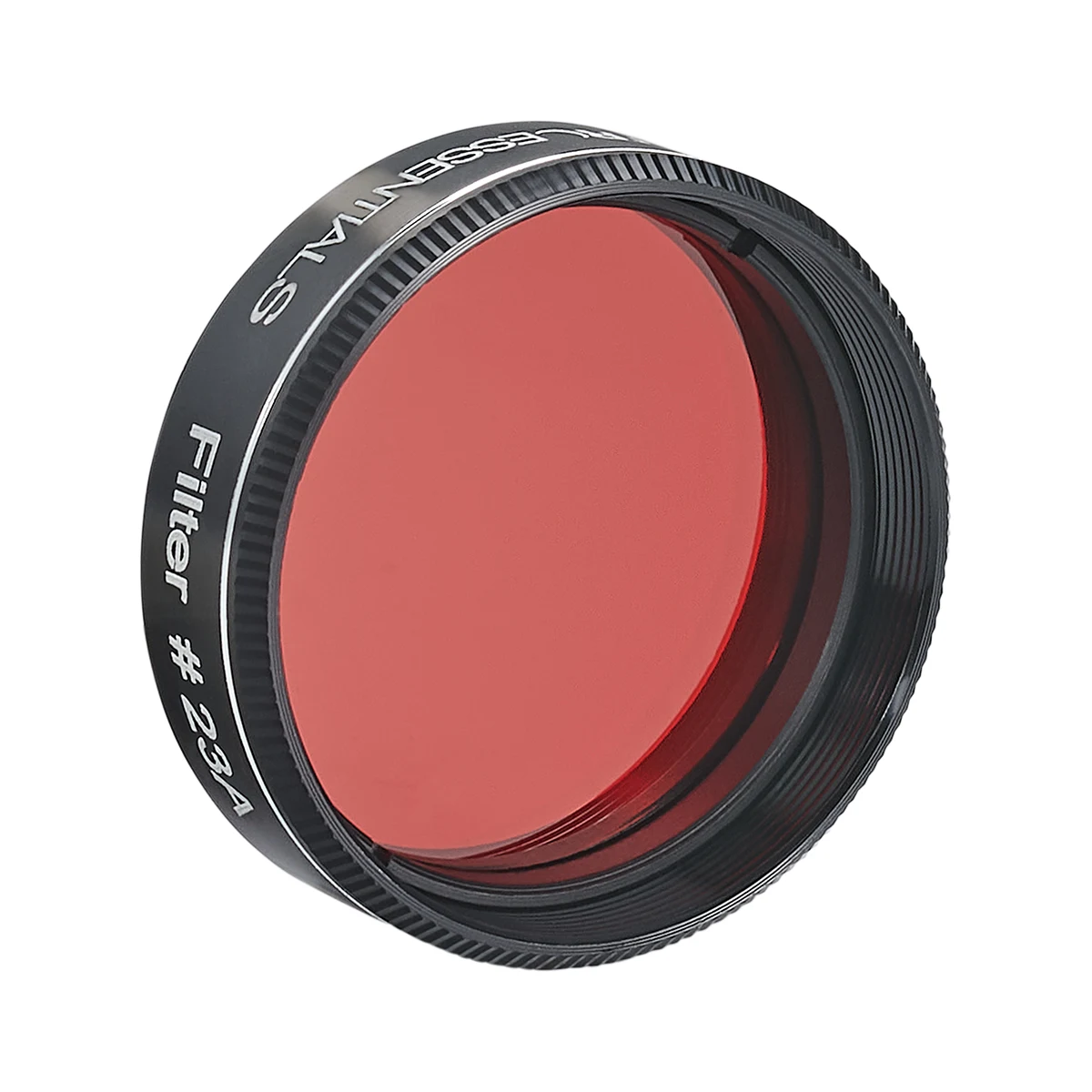
Astro Essentials #23A Light Red Filter 1.25"
| Key Specifications | |
|---|---|
| Filter Number | Wratten #23A (Light Red) |
| Size | 1.25" barrel |
| Transmission | ~25% (blocks blue and green wavelengths) |
| Best Targets | Mars, Jupiter belts |
| Minimum Aperture | 100mm (4"), smaller scopes lose too much light |
| Price | ~£9 |
What Does It Do?
The #23A is a light red filter: it blocks blue and green wavelengths and transmits red and orange. The effect on Mars is dramatic: the reddish desert regions appear brighter and punchier, while the blue-grey polar hazes and sky features become noticeably darker. Dark surface markings like Syrtis Major, Sinus Meridiani, and Hellas become much easier to identify than they are in unfiltered light.
On Jupiter it enhances contrast in the equatorial belts, making the dark NEB and SEB stand out more clearly against the lighter zones. It's less transformative than on Mars, but still a worthwhile addition to an eyepiece case for any planetary observer.
The "light" in Light Red matters. A full red (#25) filter transmits only around 14% of light: too dark for anything less than an 8" telescope. The #23A at ~25% transmission is usable from 4" upwards, which makes it the practical choice for most amateur setups.
Who Is This For?
- Mars observers with 4"+ telescopes: this is the single most useful Mars accessory you can buy for under £10
- Jupiter observers wanting more belt contrast: a secondary use, but genuinely helpful
- Anyone building a planetary filter set: red is usually the first colour filter to buy
If you have a 130mm or larger telescope and you're planning to observe Mars, this filter earns its £9 many times over. Without it, Mars's surface features blend together in a uniform orange haze. With it, the dark markings snap into focus.
When to Use It
Mars: Put it in as soon as Mars is in the eyepiece. Use 100x–200x and look for the dark maria. The difference compared to unfiltered viewing is immediately obvious. Particularly useful for spotting polar cap boundaries and identifying which dark features are rotating into view.
Jupiter: Try it at 100x–150x to enhance the NEB and SEB. The belts become sharper against the Equatorial Zone. The Great Red Spot can appear more distinct. That said, some observers prefer the orange filter (#21) for Jupiter as it's a gentler effect, experiment and see which you prefer.
Not for Saturn, Venus, Neptune, or Uranus: the red filter offers little benefit on these targets and reduces already limited light.
What the Community Says
Biggest impact on Mars. Planetary observers consistently rate red filters as the most immediately impactful colour filter for Mars. First-time users are often surprised at how much more detail is visible compared to unfiltered views.
Light red vs. full red. Many observers who started with a full #25 red filter report switching to the #23A because it works with smaller apertures and the image stays brighter. The lighter cut is almost universally preferred for visual work.
Good build quality at the price. At £9, the Astro Essentials filter delivers consistent optical quality and screws cleanly into 1.25" eyepieces without any issues. It's a simple but well-made piece of kit.
Limitations to Know
- Not for small telescopes. Below 100mm aperture, the 25% transmission means the image gets too dim for comfortable viewing. Stick to unfiltered views with a 60–80mm scope.
- Mars-specific. The dramatic improvement is mainly on Mars. It's a supporting player on other targets. Don't buy it hoping for transformation everywhere.
- Only 1.25". If you use 2" eyepieces, you'd need the 2" version. For planetary work at high magnification, 1.25" eyepieces are most common anyway.
Related Filters
Astro Essentials #21 Orange Filter
A gentler warm-toned filter. Better all-rounder for Jupiter, also useful on Mars. Less dramatic than red but usable with smaller apertures.
~£9 Read our guide →Astro Essentials #82A Light Blue Filter
The opposite effect: enhances blue and grey features. Excellent for Venus phases, Mars polar caps, and Jupiter's Great Red Spot.
~£9 Read our guide →Astro Essentials Variable Polarising Filter
Not a colour filter: adjusts brightness for the Moon and bright planets. Pairs well with colour filters for flexible observing.
~£24 Read our guide →