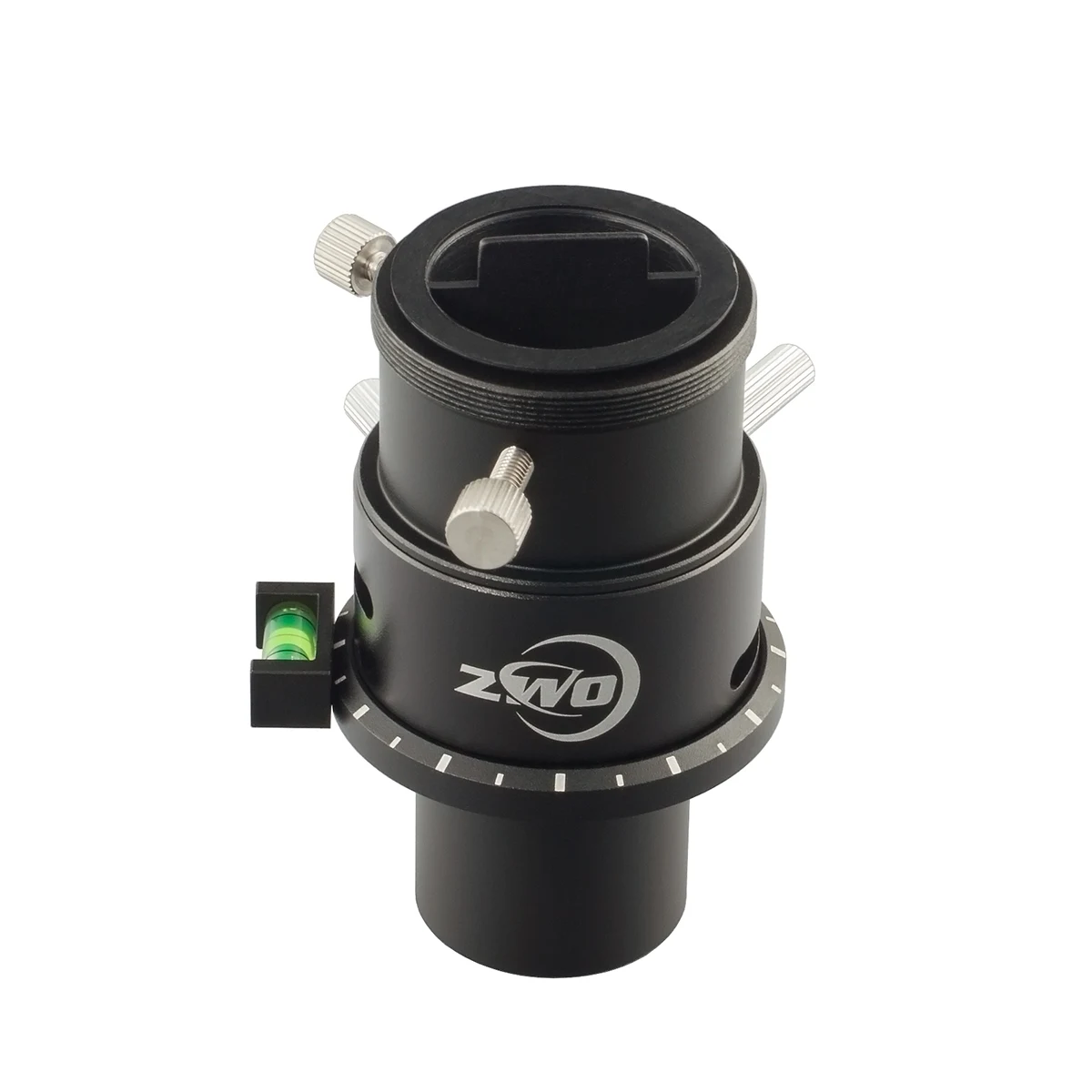
ZWO 1.25" Atmospheric Dispersion Corrector (ADC)
| Key Specifications | |
|---|---|
| Size | 1.25" barrel (fits between telescope and camera) |
| Adjustment | Two rotating prism rings, manually adjusted |
| Best Use | Planetary imaging (Saturn, Jupiter, Mars) |
| Pairs With | ZWO ASI cameras, any planetary camera |
| Altitude Benefit | Most significant below 45° altitude (very relevant in the UK) |
| Price | ~£127 |
What Is Atmospheric Dispersion and Why Does It Matter?
When a planet is anywhere other than directly overhead, Earth's atmosphere acts like a prism. Different wavelengths of light bend by different amounts as they pass through the air, which means the red, green, and blue channels of a planet's image arrive at slightly different positions on your camera sensor. The result is a faint rainbow-like smearing of the planet's edges, most obvious as a blue or violet fringe on one side and a red fringe on the opposite side.
In the UK, Saturn never gets above about 25° altitude at opposition. Jupiter peaks around 40°. At these elevations, atmospheric dispersion is significant and will noticeably blur fine detail in your planetary images even on excellent seeing nights.
An ADC corrects this by passing light through two adjustable prisms that introduce an equal and opposite dispersion, cancelling out the atmosphere's effect. The result is a dramatically sharper, more colour-accurate image, particularly in the blue channel where dispersion is strongest.
Who Is This For?
- Anyone imaging planets in the UK: this is arguably the highest-impact single upgrade for UK planetary imagers given our low planet altitudes
- ZWO ASI camera owners: the ZWO ADC integrates naturally with ZWO cameras and shares the same 1.25" form factor
- Saturn and Jupiter imagers: the biggest payoff is on the planets that never get very high in our sky
- Observers who've noticed colour fringing in their planetary images and want to fix it
This is not a visual observing accessory. It only benefits camera-based imaging. For visual planetary work, the improvement in seeing conditions, collimation, and eyepiece quality will have more impact.
How to Use It
The ZWO ADC inserts between your telescope's focuser and your camera (or Barlow + camera stack). It has two rotating prism rings. To set it up:
- Insert the ADC and point your scope at the target planet
- Rotate both prism rings to roughly the same orientation, pointing toward the zenith (upward direction)
- Zoom into a live preview of the planet at high magnification and look for the colour fringing: it usually appears as blue/violet above and red below (or vice versa depending on orientation)
- Adjust the two prism rings in opposite directions until the colour fringing disappears and the planet's edges look sharp and white
- Re-adjust as the planet moves across the sky and its altitude changes
The correction needed changes as a planet moves. You'll need to re-tune every 15–20 minutes during a long imaging session. Many imagers set it before each capture run.
What the Community Says
"The biggest single improvement I ever made to my planetary imaging." This sentiment appears repeatedly in online forums. Once imagers add an ADC, they often say they can't believe they imaged without one. The improvement in the blue channel in particular is dramatic.
Essential at UK latitudes. UK imagers consistently rate the ADC as more important than additional aperture for planets that stay low in the sky. The atmosphere's dispersion at 20–30° altitude is simply too significant to leave uncorrected.
Pairs beautifully with ZWO cameras. The ZWO ADC fits the ZWO ASI camera ecosystem perfectly. No adapters needed. It screws directly into the camera's nose piece.
Learn curve is short. Most users get comfortable with the adjustment routine within one or two sessions. After that it becomes quick and intuitive.
Limitations to Know
- Imaging only. Minimal benefit for visual observing. The eye integrates colour fringing differently from a camera sensor.
- Manual adjustment. Unlike electronic ADCs, the ZWO requires periodic re-tuning as the planet's altitude changes. A minor inconvenience for a major benefit.
- Adds length to the optical train. You may need to adjust focuser position to compensate. This is usually easy but worth being aware of.
- Less impact on planets above 45°. If you were imaging Jupiter at opposition from tropical latitudes, you'd notice less benefit. In the UK, it's nearly always worth using.
What to Pair It With
ZWO ASI662MC Planetary Camera
The dedicated colour planetary camera that pairs perfectly with this ADC. High frame rate, excellent sensitivity for Saturn and Jupiter detail.
See FLO for price Read our guide →Astro Essentials 2x Barlow
Doubles focal length for more planetary detail. Used between the telescope and ADC in most imaging setups.
See FLO for price Read our guide →Sky-Watcher HEQ5 Pro Mount
Accurate equatorial tracking is essential for planetary imaging sessions. The HEQ5 Pro is the standard choice at this level.
See FLO for price Read our guide →