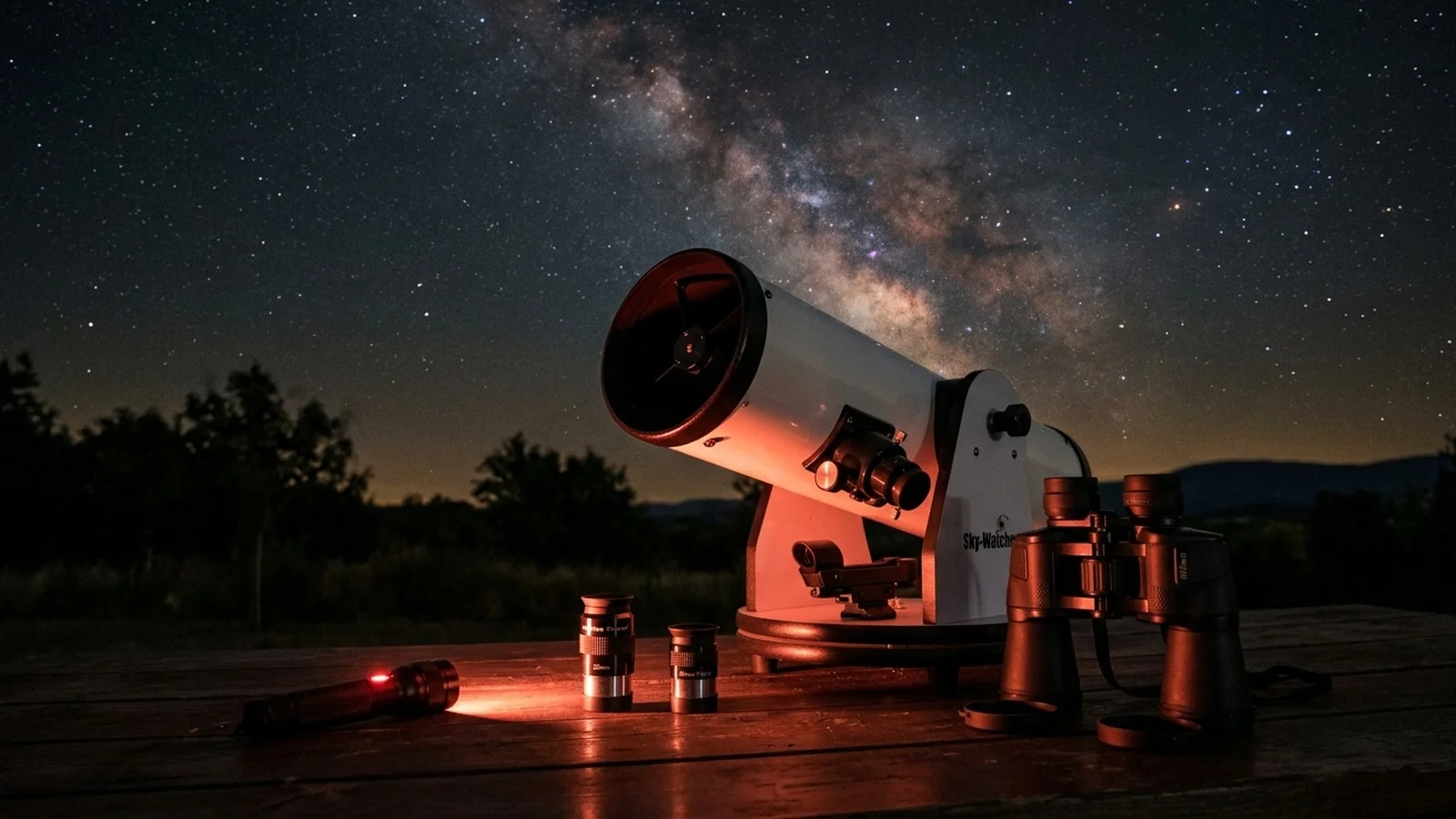
Celestron SkyMaster Pro ED 7×50
| Celestron SkyMaster Pro ED 7×50 Specifications | |
|---|---|
| Magnification | 7× |
| Objective Diameter | 50mm |
| Exit Pupil | 7.1mm (optimal for dark-adapted observing) |
| Field of View | ~7.1° (wide, excellent for Milky Way sweeping) |
| Optics | ED (Extra-low Dispersion) glass: reduced chromatic aberration |
| Coatings | Fully multi-coated · BAK-4 prisms |
| Waterproofing | Waterproof, nitrogen-purged |
| Weight | ~1kg (hand-holdable) |
| Best For | General stargazing, Milky Way, comets, planets, wide-field |
| Price | ~£189 |
Is the Celestron SkyMaster Pro ED 7×50 Good for Astronomy?
The 7×50 specification is the traditional astronomy binocular, and there are good reasons it's endured for decades. The 50mm objectives gather solid amounts of light, and the 7× magnification keeps the image stable enough to hand-hold. Most importantly, it produces a 7.1mm exit pupil: very close to the maximum diameter of a fully dark-adapted human eye.
That large exit pupil means maximum light to your retinas. Stars are brighter, fainter objects are more visible, and the view has a natural, immersive quality that higher-power binoculars can't match. For Milky Way sweeping, comet hunting, or scanning for planets, 7×50 does things a 10×50 can't.
The SkyMaster Pro ED upgrades this proven formula significantly. ED (Extra-low Dispersion) glass reduces chromatic aberration, the colour fringing you sometimes see on bright stars and the Moon's limb, resulting in sharper, more colour-accurate views. BAK-4 prisms and full multi-coating give noticeably better contrast than the standard SkyMaster range.
Who Is the Celestron SkyMaster Pro ED 7×50 For?
- Beginners wanting serious astronomy binoculars: this is the upgrade over entry-level 7×50s that you won't need to replace
- Milky Way and wide-field observers: the 7.1° field is outstanding for star clouds and sweeping the galactic plane
- Comet hunters: wide field, bright image, and grab-and-go convenience make these ideal for newly discovered comets
- Anyone who finds 10×50s too shaky: 7× is considerably more stable to hand-hold, and for most targets the detail difference is smaller than you'd expect
- Planet and Moon observers: 7× gives a wide, detailed view of the Moon's full disc, and picks out Jupiter's moons easily
- Observers who prefer hand-holding: no tripod required, making these genuinely grab-and-go astronomy binoculars
These are the ideal upgrade from the Opticron Adventurer 10×50 if you want ED glass and premium coatings, or if you'd prefer the more stable 7× magnification for extended observing sessions.
What Can You See with the Celestron SkyMaster Pro ED 7×50?
The 7×50 specification won't resolve planetary detail the way a telescope will. That's not the point. What it delivers is a wide, bright, natural view of the sky that reveals far more than the naked eye:
- Jupiter: A tiny but clear disc. Four Galilean moons visible as distinct points on either side.
- Saturn: Distinctly oval, the rings are visible as a flattened shape around the planet, though not individually resolved.
- The Moon: Outstanding at 7×. The full disc fits comfortably in the wide field with room to spare. Larger craters are obvious, the maria are richly detailed.
- Pleiades: Spectacular, all seven sisters resolved with haze around the brightest stars. One of the best binocular targets at any magnification.
- M31 (Andromeda Galaxy): The full extent of the galaxy is visible as an elongated glow with a brighter core. One of the most impressive binocular views in the sky.
- Milky Way: Sweeping along the galactic plane at 7× reveals star clouds, dark nebulae, and thousands of individual stars you can't see naked-eye. The wide field makes this particularly immersive.
- M42 (Orion Nebula): The nebulosity is clearly visible as a soft glow around the Trapezium stars. The full Orion sword fits in the field.
- Open clusters: Hyades, Praesepe, and dozens of open clusters fill the wide field beautifully.
ED Glass: Does It Make a Difference?
ED (Extra-low Dispersion) glass uses special optical elements that bring different wavelengths of light to a common focus more precisely than standard glass. The practical result is reduced chromatic aberration: that purple or cyan fringe you sometimes see on bright stars, the Moon's limb, or planets near the edge of the field.
In standard 7×50 binoculars, chromatic aberration is usually mild and often goes unnoticed. The benefit of ED glass in a binocular is more subtle than in a telescope, but it's real: bright stars appear sharper, edges across the field are crisper, and the overall image has higher perceived contrast. If you're comparing identical specifications side by side, the ED version consistently looks cleaner.
Combined with BAK-4 prisms (better internal geometry than BK-7) and full multi-coating on every air-glass surface, the SkyMaster Pro ED is noticeably superior to standard-range 7×50s at this price point.
What Buyers Say About the Celestron SkyMaster Pro ED 7×50
7×50 is the classic recommendation, and it still holds. On Stargazers Lounge and CN, the 7×50 specification comes up repeatedly as the ideal beginner astronomy binocular. Wide field, bright image, stable enough to hand-hold indefinitely.
ED glass at this price is unusual. Most ED binoculars start significantly higher. The SkyMaster Pro ED brings proper ED optics to an accessible price point, which owners consistently notice in the quality of the image.
Waterproofing matters in the UK. The nitrogen-purged, waterproof body keeps moisture and fog out of the optics on cold or damp nights, a genuine practical advantage for UK observing conditions.
Limitations to Know
- 7× limits close-up planetary detail. For detailed planetary views you need a telescope. Jupiter's moons are visible but its belts are not.
- Heavier than compact binoculars. At ~1kg, these are not pocketable. They're grab-and-go astronomy kit, not everyday binoculars.
- 7.1mm exit pupil benefits younger observers more. The maximum dark-adapted pupil diameter decreases with age. Observers over 40–50 may find a 5–6mm exit pupil (e.g. 10×50) sufficient.
- Wide field means lower magnification. If you prefer more zoom over wider views, the Helios Stellar II 10×50 or SkyMaster 15×70 might suit you better.
Celestron SkyMaster Pro ED 7×50 vs Opticron Adventurer 10×50: Which Should You Buy?
Opticron Adventurer 10×50
Higher magnification, narrower field. Better for picking out faint detail on extended targets like galaxies. Less stable to hand-hold. Good alternative if you prefer 10× power.
~£60 Read our guide →Celestron SkyMaster 15×70
Much larger aperture and magnification, but requires a tripod. The serious step up if you want telescope-level views in binocular form. Not hand-holdable.
~£229 Read our guide →Sky-Watcher Heritage 130P
If you're ready to move to a telescope, the Heritage 130P is the step up that opens up planetary detail and deep-sky object structure the 7×50 can't reach.
~£159 Read our guide →