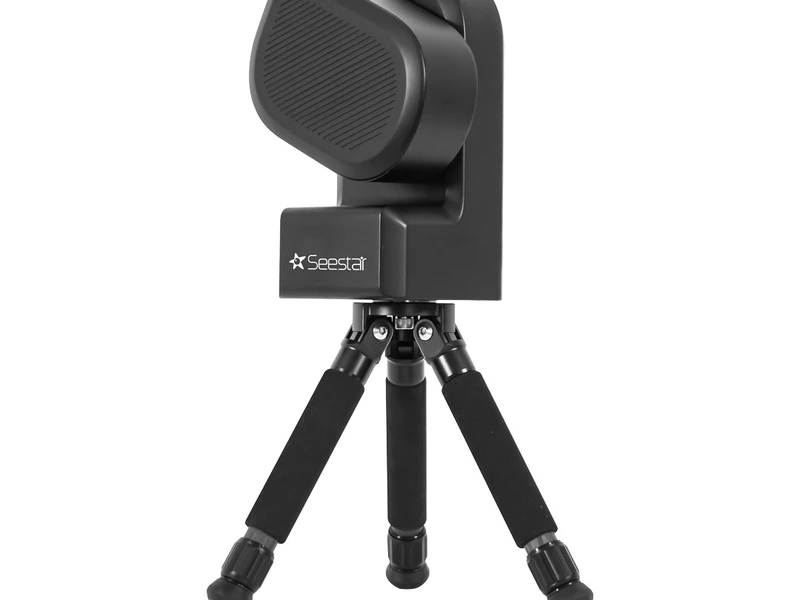
ZWO Seestar S50
Torn between this and the Dwarf 3? Read our Seestar S50 vs Dwarf 3 head-to-head: nebulae, galaxies, the Moon, the Sun, app, battery and UK price, with a verdict for each. There is now a Pro version too: the Seestar S50 Pro (£999) keeps this telescope's 50mm aperture and filter and adds an 8.3MP 4K sensor, a wide-angle camera and a bigger battery.
| Key Specifications: ZWO Seestar S50 | |
|---|---|
| Aperture | 50mm |
| Optical Design | Triplet apochromatic (APO) refractor |
| Focal Length | 250mm (f/5) |
| Sensor | Sony IMX462: 2.1MP, 1/2.8" CMOS |
| Built-in Filter | Dual-band: H-alpha (20nm) + OIII (30nm), switchable |
| Internal Storage | 64GB |
| Mount | Built-in motorised alt-azimuth with tracking |
| Connectivity | Wi-Fi, Bluetooth, USB-C · Seestar app (iOS & Android) |
| Battery | 6,000mAh: ~6 hours per charge |
| Weight | 2.5 kg (including tripod) |
| Included Accessories | Carbon fibre tripod, solar filter, carry case, USB-C cable, dew heater |
| Best For | Nebulae from light-polluted skies, deep-sky imaging, solar observing |
Who Is the Seestar S50 For?
The Seestar S50 is the smart telescope that reviewers consistently recommend first: it's been called the benchmark by BBC Sky at Night, Space.com, and Digital Camera World. It's the right choice if:
- You live under light-polluted skies. This is the S50's headline strength. The built-in dual-band narrowband filter, covering H-alpha and OIII wavelengths, dramatically cuts through light pollution when imaging emission nebulae. Buyers consistently report capturing the Orion Nebula, Rosette Nebula, and Horsehead Nebula from city gardens that would defeat an unfiltered smart telescope. No DwarfLab model includes anything like this as standard.
- You want the most comprehensively reviewed smart telescope available. The S50 has been on the market longer than either Dwarf model and has a larger community. There are thousands of user images, forum threads, and YouTube tutorials to draw on. If you get stuck, someone has already solved your problem.
- You want a complete out-of-the-box kit. The S50 includes a carbon fibre tripod, a solar filter, a carry case, a dew heater, and 64GB of internal storage, none of which come with the DwarfLab models as standard. At £539 all-in, it represents strong value for what you're getting.
- Solar observing interests you. The included 580–630nm solar filter lets you image sunspots and solar features safely. It's a genuinely capable solar telescope as well as a deep-sky one, a combination that no competitor at this price matches.
The S50 is less ideal if the wide-angle dual-lens capability of the Dwarf 3 appeals to you, or if you want the highest-resolution sensor in the smart telescope class: the S50's Sony IMX462 (2.1MP) is the same resolution as the Dwarf Mini's sensor, not the Dwarf 3's 8.3MP IMX678.
For the full target-by-target verdict, see our Seestar S50 vs Dwarf 3 comparison.
The Built-In Dual-Band Filter: Why It Matters
The single most important thing to understand about the Seestar S50 is its built-in dual-band narrowband filter. This is a real optical filter inside the telescope that passes only two narrow bands of light: H-alpha (the red wavelength emitted by hydrogen gas in nebulae) and OIII (the teal-green wavelength from ionised oxygen). Everything else (streetlights, car headlights, the orange glow of an urban sky) is blocked.
The practical effect is dramatic. Targets that a broadband telescope would struggle to pull out of a light-polluted background (the Rosette Nebula, the California Nebula, the Veil Nebula complex) become reachable from back gardens. The Orion Nebula, always a smart telescope showpiece, looks noticeably more structured when imaged through the filter. You get a cooler (bluer-green) colour palette rather than the warmer broadband look, but the contrast and detail in nebula gas is considerably better.
The filter is switchable. The Seestar app automatically engages it for appropriate targets (emission nebulae, primarily), but you can override this for targets like galaxies, star clusters, and the Moon where broadband gives a more natural result. It's a thoughtful implementation. You don't need to understand narrowband imaging theory to benefit from it.
For UK users in particular, this is a significant advantage. Most populated areas in England and Wales sit under Bortle 5–8 skies. The dual-band filter effectively gives you darker-sky results from wherever you are.
What Can You Image?
The S50's optical specifications (50mm aperture, 250mm focal length) are shared with both DwarfLab models. What changes with the built-in filter is what's realistically achievable from typical UK locations.
Emission Nebulae
Where the S50 genuinely excels. The Orion Nebula, Rosette, Lagoon, Eagle, Omega, and California Nebulae all respond well to the narrowband filter. The Horsehead Nebula, notoriously difficult from light-polluted sites, is regularly captured by S50 owners in suburban gardens.
Galaxies
Andromeda (M31) is the standout: the S50's field of view frames it well, and the broadband mode shows the core and dust lanes clearly. M81, M82, and the Whirlpool Galaxy (M51) are all achievable from darker sites.
Star Clusters
Open clusters are quick, satisfying targets. The Pleiades, Double Cluster in Perseus, Beehive (M44), and Hercules Globular (M13) all image well. Clusters don't benefit much from the narrowband filter, so broadband mode is the right choice here.
The Moon
The S50 captures detailed lunar images showing craters, rilles, and mountain ranges. The internal 64GB storage saves raw video of the Moon which can be stacked externally with AutoStakkert! for sharper results than the in-app stacking.
The Sun
With the included solar filter fitted, the S50 images sunspot groups clearly. It's one of very few smart telescopes with solar capability included in the box, and genuinely useful during the current solar maximum period.
Planets
Planetary performance is limited by the 50mm aperture: Saturn's rings and Jupiter's main belts are visible, but don't expect fine detail. The S50 is a deep-sky and nebula specialist first; planets are a bonus rather than a core strength.
What Buyers & Reviewers Say
Rated 4.5/5 by BBC Sky at Night Magazine. Reviewers across BBC Sky at Night, Space.com, Digital Camera World, and AstroBackyard consistently describe it as the benchmark smart telescope: the product everything else is measured against.
The narrowband filter is the most praised feature. Buyers in light-polluted areas (which is most of us in the UK) consistently highlight the filter as a game-changer. Nebula images that should require dark-sky travel turn up from back gardens. This single feature is what drives most S50 recommendations over the DwarfLab models.
ZWO's app and firmware support is responsive. ZWO has a strong track record from their astronomy camera business. Since launch the S50 has received regular firmware updates adding features including mosaic mode (for targets wider than the field of view) and equatorial mode (to reduce field rotation on long sessions).
Battery life is the main limitation flagged. At ~6 hours, the S50's battery is shorter than the Dwarf 3's ~9 hours. Long winter sessions or remote use may require a USB power bank. Connecting one is straightforward and extends runtime indefinitely.
Portrait-orientation sensor can frustrate on wide targets. The sensor sits in portrait (tall) orientation rather than landscape. This is fine for most targets, but wide nebulae like the Andromeda Galaxy or the Pleiades field can feel oddly cropped. Something to be aware of before you try to frame a specific shot.
Known Limitations & Tradeoffs
- 2.1MP sensor: same as the Dwarf Mini. The IMX462 is a capable low-light sensor, but 2.1MP is the same resolution as DwarfLab's entry-level model. The Dwarf 3's Sony IMX678 at 8.3MP produces more detail in extended objects. If maximum resolution is the priority, the Dwarf 3 wins on sensor spec, though the S50's filter advantage often more than compensates in practice.
- ~6 hour battery. Three hours shorter than the Dwarf 3. Fine for most sessions, but for long winter nights you'll want a USB power bank nearby. The carry case doesn't always leave room for one, so plan your kit accordingly.
- Field rotation on long exposures. The S50's alt-az mount creates field rotation: stars in the corners of long stacking sessions trace arcs rather than staying perfectly round. The firmware's equatorial mode reduces this, but doesn't eliminate it entirely. For casual imaging and social-sharing results it's a non-issue; for serious processing it's worth knowing about.
- Portrait sensor orientation. The sensor is mounted portrait (tall) rather than landscape. Works well for most deep-sky targets, but some wide objects (Andromeda, the Pleiades field) are better framed in landscape. You can rotate the telescope body to change orientation, which helps.
- No wide-angle second lens. Unlike the Dwarf 3, there's no simultaneous all-sky or wide-angle capture. The S50 is a single-target telescope. If you want to run a Milky Way timelapse while imaging a nebula, the Dwarf 3 is the only model that does this.
Seestar S50 vs DwarfLab Dwarf 3
These are the two most capable smart telescopes currently available in the UK, and the decision between them comes down to one question: do you prioritise the narrowband filter or the higher-resolution sensor and dual-lens system?
The S50's built-in H-alpha + OIII filter makes it the better nebula camera for light-polluted locations, which describes most UK back gardens. It also ships as a complete kit with tripod, case, and solar filter included, making it better value pound-for-pound at the point of purchase.
The Dwarf 3's Sony IMX678 at 8.3MP produces more detail than the S50's 2.1MP sensor on targets where both can reach. Its dual-lens system, simultaneous wide-angle and telephoto capture, is unique in the class and genuinely useful for all-sky timelapses, comet hunts, and sky quality logging. The Dwarf 3 also has a longer battery life (~9 hours vs ~6 hours).
For most UK users in suburban or urban locations, the S50's filter advantage is the deciding factor. For those who specifically want maximum sensor resolution or the wide-angle capability, the Dwarf 3 earns its place.
Read our full Dwarf 3 guide →How we reviewed this
This is a research-based review rather than a laboratory test. The facts on this page come from the manufacturer's specifications, the First Light Optics listing and its customer reviews, and the long-running owner threads on Stargazers Lounge and Cloudy Nights, checked against what the same kit shows from a typical UK garden. We have not necessarily used every item ourselves; where we have, the page says so. We receive no free equipment, and the retailer links pay a small commission that never changes the price you pay or the verdict we give.
Prices are read from our product data, last checked against First Light Optics on 23 October 2026. Own this kit and see it differently? Email [email protected] and we will update the page.