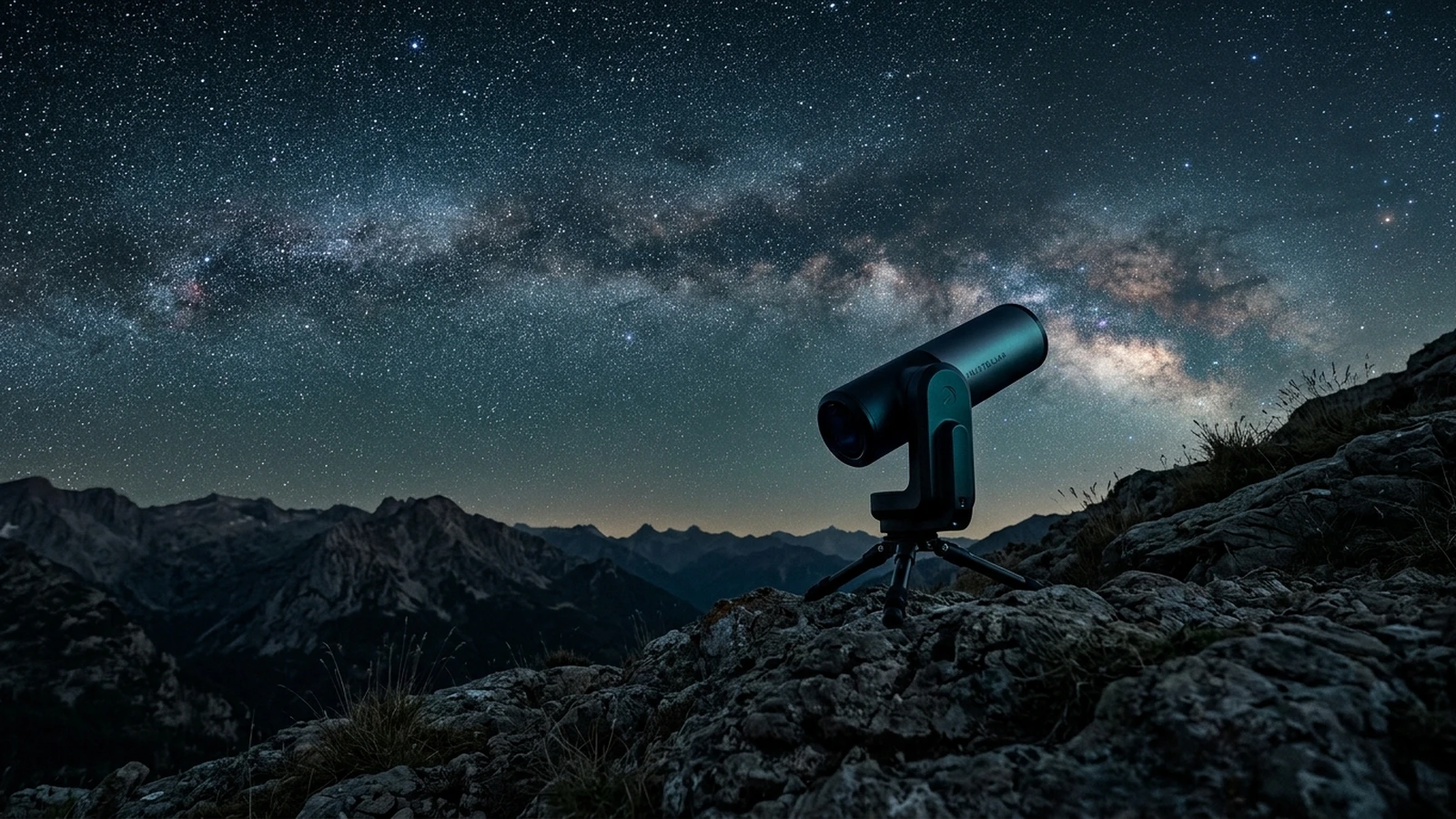
DwarfLab Dwarf 3
Torn between this and the Seestar S50? Read our Seestar S50 vs Dwarf 3 head-to-head: nebulae, galaxies, the Moon, the Sun, app, battery and UK price, with a verdict for each. Tempted by the new 90mm DwarfLab Draco? Our Draco vs Dwarf 3 verdict explains what the extra £840 buys, and our Seestar S50 Pro vs Dwarf Draco vs Vespera II comparison covers the whole step-up class.
| Key Specifications: DwarfLab Dwarf 3 | |
|---|---|
| Telephoto Aperture | 35mm |
| Telephoto Focal Length | 150mm (f/4.3) |
| Main Sensor | Sony IMX678: 8.3MP, 1/1.8" BSI CMOS |
| Wide-Angle Lens | 3.4mm aperture, 6.7mm focal length, f/2 |
| Wide-Angle Sensor | Sony IMX307: 2.1MP, 1/2.8" CMOS |
| Dual Capture | Both lenses shoot simultaneously |
| Mount | Built-in motorised alt-azimuth with tracking |
| Connectivity | Wi-Fi (2.4GHz + 5GHz), DWARF app (iOS & Android) |
| Battery | Built-in, ~6 hours imaging per charge (DwarfLab quotes 5h38 tracking, 6h42 preview) |
| Weight | ~1.35 kg |
| Warranty | 2 years (via First Light Optics) |
| Best For | Deep-sky imaging, nebulae, galaxies, planets, the Moon, all-sky timelapse |
Who Is the Dwarf 3 For?
The Dwarf 3 is for people who want the best results a smart telescope can offer, without the complexity (or cost) of a traditional astrophotography setup. It's the right choice if:
- You want serious image quality from a smart telescope. The Sony IMX678 sensor is a significant step up from budget smart telescope sensors. Images of the Orion Nebula, Andromeda, and large clusters show genuine detail, not just a blurry blob.
- The dual-lens feature appeals to you. Being able to capture a wide-angle all-sky view while simultaneously imaging a deep-sky target is genuinely useful: you can check sky conditions, run a timelapse of the whole night, and do your primary imaging all at once.
- You're an experienced visual stargazer who wants to start imaging. If you've spent years looking through an eyepiece and want to start capturing what you see, the Dwarf 3 bridges that gap without requiring you to learn polar alignment, guiding, or calibration frames.
- You want something that's fast to set up and easy to transport. The Dwarf 3 is the kind of telescope you actually take out. No mount to level, no alignment to complete, no dew shield to attach. Set it down, connect the app, and start imaging.
The Dwarf 3 is not ideal if you want eyepiece views (it has none: everything is on your phone screen), or if maximum astrophotography quality is the goal (a dedicated imaging setup at the same price point will outperform it, but will require far more skill and time to use).
The Dual-Lens System: What It Actually Means
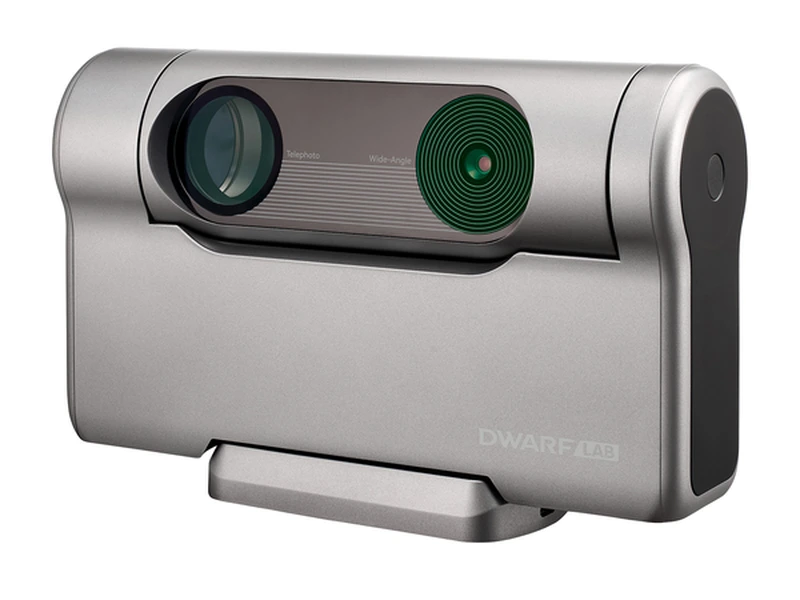
The Dwarf 3's biggest differentiator is its two-lens design. Most smart telescopes, and the Dwarf Mini, have a single optical system. The Dwarf 3 has two: a 150mm telephoto for deep-sky targets and a 6.7mm wide-angle for all-sky capture. Both shoot independently, simultaneously, via the app.
The practical uses are more varied than you might expect. During a session you can: shoot a deep-sky target through the telephoto while recording a whole-night wide-angle timelapse; use the wide-angle to confirm your target is visible before committing to a long telephoto session; capture a broader context frame of a nebula while the telephoto zooms in on the core; or monitor for cloud coverage while imaging.
The wide-angle lens (f/2, 3.4mm aperture) is also genuinely fast for bright targets like star clusters and wide nebula fields: the Milky Way core, the Pleiades, and large emission nebulae respond well to the wider field of view.
What Can You Image?
Smart telescopes shine on objects that benefit from stacked exposures: the category that's hardest to get right with traditional gear. The Dwarf 3 is capable on all of these:
Nebulae
The Orion Nebula (M42), Lagoon Nebula, and Eagle Nebula are accessible even from suburban skies. The Rosette and California Nebulae benefit from the darker skies but reward patience.
Galaxies
Andromeda (M31) is a showpiece target: you can see its core and dust lanes with enough stacking. The Whirlpool Galaxy (M51) shows its spiral structure from dark sites.
Star Clusters
The Pleiades, Double Cluster in Perseus, Beehive Cluster (M44), and Hercules Cluster (M13) all image beautifully. These are the quickest wins on a clear night.
The Moon
The Dwarf 3 captures detailed lunar images showing craters, mountain ranges, and mare boundaries. The large image scale makes lunar photography genuinely satisfying.
Planets
Saturn's rings and Jupiter's cloud bands are clearly visible. Planetary performance is limited by the 35mm aperture rather than the sensor, this isn't a planetary specialist.
Wide-Field & All-Sky
The wide-angle lens opens up Milky Way panoramas, comet hunts, and all-night sky timelapses, targets completely outside the telephoto's reach.
What Buyers Say
23 reviews at First Light Optics with a strong positive trend. Common themes from verified buyers:
First-night results. Multiple buyers report imaging their first nebulae within an hour of unboxing. The auto-alignment and DWARF app are consistently praised for making the experience frictionless.
The dual-lens is a genuine differentiator. Buyers who came from the Dwarf II or Dwarf Mini specifically mention the wide-angle capability as the feature that sealed the upgrade decision.
Battery life is excellent. The ~9 hour battery is called out repeatedly as a real advantage over smart telescopes that require external power.
App improvements are ongoing. DwarfLab push regular firmware and app updates. Some features (including certain capture modes) have been added post-launch, if a specific feature matters to you, check the current app version before buying.
Known Limitations & Tradeoffs
- 35mm aperture is modest. Smart telescopes are limited by their compact size. A 35mm lens gathers significantly less light than a traditional 130mm or 200mm telescope. This matters in practice: some fainter deep-sky objects need dark skies and long stacking sessions to reveal detail.
- No eyepiece viewing. The Dwarf 3 is a camera device, not a visual telescope. Everything you see is on your phone or tablet screen. If you want the experience of looking through an eyepiece, this isn't the right product.
- Wi-Fi dependent. The telescope is controlled via Wi-Fi to your phone. Connectivity issues (weak signal, interference) can interrupt sessions. Most users don't encounter problems, but the dependency is worth knowing about.
- Image quality ceiling. For serious astrophotographers, a dedicated astrocamera on a proper equatorial mount will produce better images at a similar total cost. The Dwarf 3's appeal is convenience, not maximum quality.
- Tripod not included. The Dwarf 3 comes with a basic stand. For field use or anything other than a flat surface, the DwarfLab Mini Tripod (£73) is a useful companion.
Accessories for the Dwarf 3
DwarfLab Mini Tripod with Fluid Head
A compact aluminium tripod built for the Dwarf 3 (and the Dwarf Mini). Adjusts from 25cm to 53cm via 5 twist-lock leg sections. Fluid head gives smooth repositioning. At 790g and 25cm folded, it's genuinely portable. Note: lock each leg section individually, don't just twist the foot and assume the upper sections are secure.
£73 View at FLO →Astro Essentials Magnetic Bahtinov Focusing Mask
A 3D-printed Bahtinov mask that snaps onto the Dwarf 3's lens housing via concealed rotating magnets, even when the telescope is closed. Creates the distinctive spike pattern that makes precise focus visually obvious, useful when you want to manually verify the autofocus result. Dwarf 3 only; not compatible with the Dwarf Mini.
£22 View at FLO →How the Dwarf 3 Compares
The Dwarf 3 and Dwarf Mini share the same 150mm telephoto focal length, but the Dwarf 3 has a larger 35mm lens against the Mini's 30mm. The differences: the Dwarf 3 has a higher-resolution main sensor (8.3MP vs 2.1MP), a second wide-angle lens for all-sky capture, and an £86 higher price tag. If you're unsure whether you'll use a smart telescope enough to justify the cost, start with the Dwarf Mini.
The main alternative from a different brand is the ZWO Seestar S50 (£539). The S50 has a built-in dual-band narrowband filter, a significant advantage for nebula imaging from light-polluted skies, but its sensor is 2.1MP, so the Dwarf 3 has a meaningful resolution edge. If you're primarily imaging nebulae from a city garden, the S50's filter is worth serious consideration. If you want the highest sensor resolution in the class or the dual-lens wide-angle capability, the Dwarf 3 is the one.
Read our full Dwarf Mini guide → Read our full Seestar S50 guide →