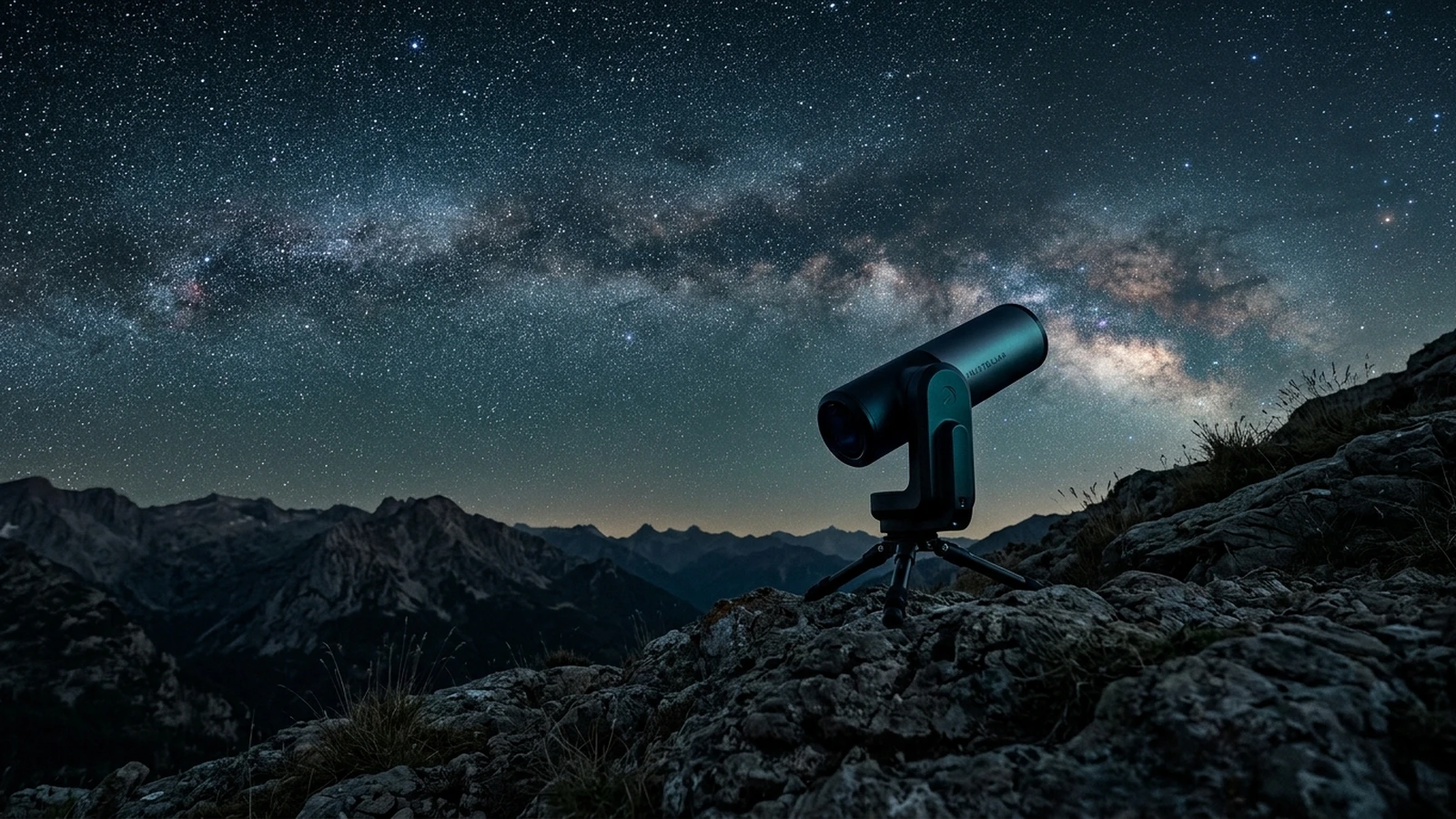
Best Smart Telescopes 2026
Point your phone at the sky, tap an object, and walk away while your telescope stacks images automatically. Smart telescopes remove every barrier between you and astrophotography: no eyepieces, no polar alignment, no processing software. This guide covers the six main smart telescopes available from UK retailers right now: the ZWO Seestar S50 Pro, S30 Pro, S30 and S50, and the DwarfLab Dwarf 3 and Dwarf Mini, plus the 90mm DwarfLab Draco that is on pre-order at First Light Optics.
New for autumn 2026: DwarfLab's 90mm Draco is on pre-order at First Light Optics for £1,349 with deliveries expected from November, and ZWO's Seestar S50 Pro (£999) is in stock. Our Seestar S50 Pro vs Dwarf Draco vs Vespera II comparison covers the step up from the telescopes on this page.
Seestar S50 or Dwarf 3? The two best sellers, compared target by target in our Seestar S50 vs Dwarf 3 head-to-head: nebulae, galaxies, the Moon, the Sun, app, battery and UK price, with a verdict for each.
What Is a Smart Telescope?
A smart telescope is an all-in-one astrophotography device: optics, camera, mount, and processing computer built into a single compact unit, controlled entirely via a smartphone app. There are no eyepieces. You don't look through it. You watch your phone screen as the telescope automatically locates targets, tracks them as the Earth rotates, and stacks multiple exposures in real time to reveal detail that a single shot can't capture.
The appeal is straightforward. A traditional astrophotography setup (telescope, equatorial mount, guide camera, imaging camera, laptop) can cost over £2,000 and takes hours to learn. A smart telescope costs a fraction of that, fits in a backpack, and produces results on your very first night out. The trade-off is that you have less control over the process, and the images have a different character to what an experienced imager produces with dedicated equipment.
Smart telescopes aren't for everyone. If you enjoy the technical challenge of traditional stargazing or astrophotography, or if you want maximum image quality above all else, they're probably not the right tool. But if you want to photograph the Orion Nebula or Andromeda Galaxy with minimal fuss, and you want to do it tonight, nothing else comes close for the money.
| Telescope | Aperture | Light Pollution Filter | Main Sensor | Price | Best For |
|---|---|---|---|---|---|
| ZWO Seestar S50 Pro | 50mm APO quadruplet | Built-in dual-band (Hα + OIII) | 1/1.2" 8.3MP 4K, dual cameras | £999 | Best Overall |
| ZWO Seestar S30 Pro | 30mm APO quadruplet | LP filter (Ha + OIII) | Sony IMX585 (8.3MP 4K) | £649 | Best Sensor |
| ZWO Seestar S30 | 30mm APO | LP filter (Ha + OIII) | Sony IMX662 (1080p) | £419 | Portable Pick |
| ZWO Seestar S50 | 50mm APO | Built-in dual-band | Sony IMX462 (2.1MP) | £539 | Top Pick |
| DwarfLab Dwarf 3 | 35mm | ✓ Built-in dual-band (Hα + OIII) | Sony IMX678 (8.3MP) | £459 | Dual-Lens Pick |
| DwarfLab Draco Pre-order | 90mm folded, f/3.8 | ✓ Built-in dual-band (Hα + OIII, 13nm) | 1/1.3" 50MP (binned to 12MP) | £1,349 | Biggest Aperture |
| Vaonis Vespera II | 50mm, f/5 | Optional clip-on dual-band | Sony IMX585 (8.3MP), mosaics to 24MP | £1,398 | Best Design |
| Unistellar Odyssey | 85mm mirror, f/3.9 | Software (Deep Dark), no filter | 1.45µm colour, 0.93"/px | £2,099 | Most Aperture |
| DwarfLab Dwarf Mini | 30mm | ✓ Built-in dual-band (Hα + OIII) | Sony IMX462 (2.1MP) | £389 | Entry-Level Pick |
ZWO Seestar S50 Pro
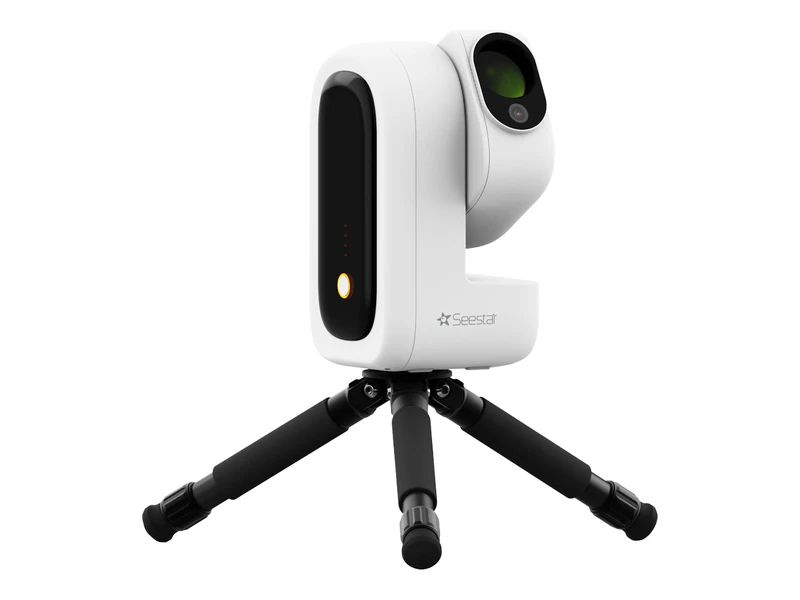
The Seestar S50 Pro is the telescope the original S50 always deserved to be. ZWO kept the 50mm aperture that made the S50 the strongest imager in its price class, upgraded the lens from a triplet to a four-element APO, and replaced the 2.1MP sensor with a 1/1.2-inch 8.3MP chip shooting 4K. That is four times the pixels of the old S50 on a sensor with far more light-gathering area, and it closes the resolution gap that let the Dwarf 3 claim the sharper picture.
It also gains what the S30 Pro introduced: a second 8.3MP wide-angle camera with its own autofocus and live stacking, for the Milky Way, nightscapes and star-trail timelapses while the main camera works on a nebula. Battery goes up to 10,000mAh, which ZWO rate at up to nine hours, storage doubles to 128GB, NFC tap-to-connect arrives, and new app features include photometry for variable stars, background gradient removal, and Telescope Network for sharing a live view with friends. The dual-band H-alpha + OIII filter that makes nebulae possible from a town garden is still inside.
At £999 it costs £460 more than the S50 and £350 more than the S30 Pro (an £899 launch price ended on 15 September), but it arrives as a complete kit: a proper tripod (the S30 Pro's is flimsy), a hard case and a solar filter. It weighs 2.8kg, so it's a rucksack telescope rather than a pocket one. Units started shipping in early September 2026 and First Light Optics have it in stock.
The best smart telescope you can buy under £1,000, and the one to get if you can stretch to it: the S50's aperture and filter with a modern sensor and a second camera. If £999 is too much, the S50 below still does the important things for £460 less. If you want more aperture than 50mm, the only options are the £1,349 DwarfLab Draco, on pre-order at FLO for November or December delivery, or £2,000-plus for a Unistellar. Our Seestar S50 Pro vs Dwarf Draco vs Vespera II comparison goes through that decision.
ZWO Seestar S30 Pro
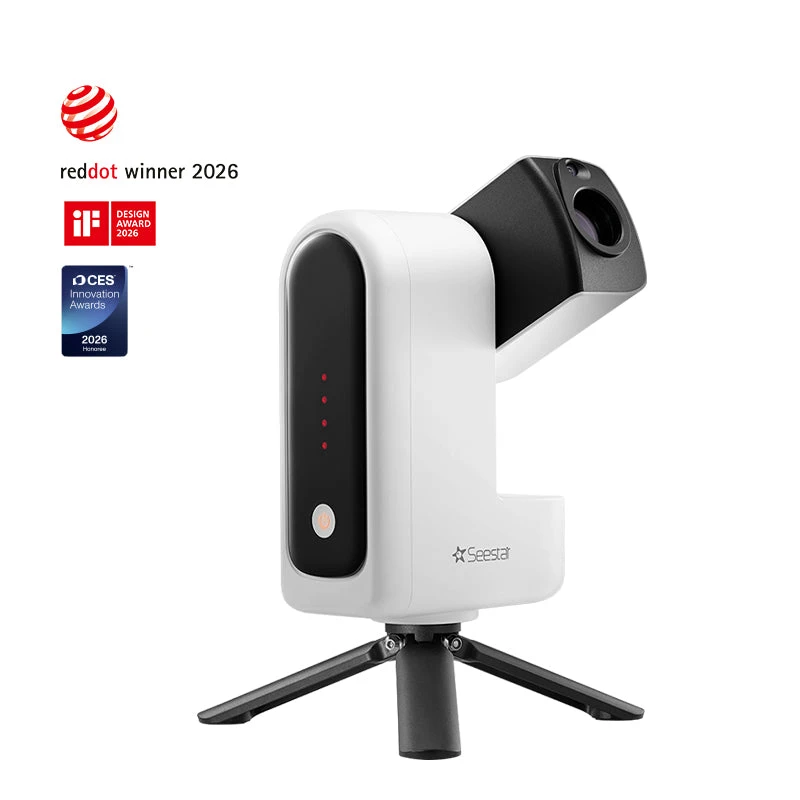
The S30 Pro was ZWO's best smart telescope until the S50 Pro arrived in August 2026, and it is still the best one under 2kg. It takes the compact dual-lens body of the standard S30 and installs a Sony IMX585 telephoto sensor: a 1/1.2-inch format chip with four times the light-sensitive area of the S30's sensor, shooting 8.3MP 4K. The wide-angle camera upgrades to an IMX586 (also 8.3MP 4K). Every camera on this telescope shoots 4K.
The optics step up to a four-element APO quadruplet, designed to keep stars sharp across the larger sensor. A built-in anti-dew heater keeps the lens clear on damp UK autumn and winter nights without any extra cables. Storage doubles to 128GB. Plan mode lets you schedule overnight imaging sessions and go to bed, the telescope handles the rest.
It costs £649: £180 more than the standard S30, £60 more than the S50. At that price, it's the most capable smart telescope you can carry in a coat pocket. Head-to-head image quality comparisons with the S50 show results that are closer than the aperture gap suggests; the IMX585's sensor quality largely offsets the S50's aperture advantage for most targets under typical UK suburban skies.
Best smart telescope for sensor quality, 4K dual-lens capability, and UK-practical features. The S50 still edges it for emission nebula imaging from heavily light-polluted locations, but for everything else, and especially for anyone who travels with their telescope, the S30 Pro is the one to get.
ZWO Seestar S30
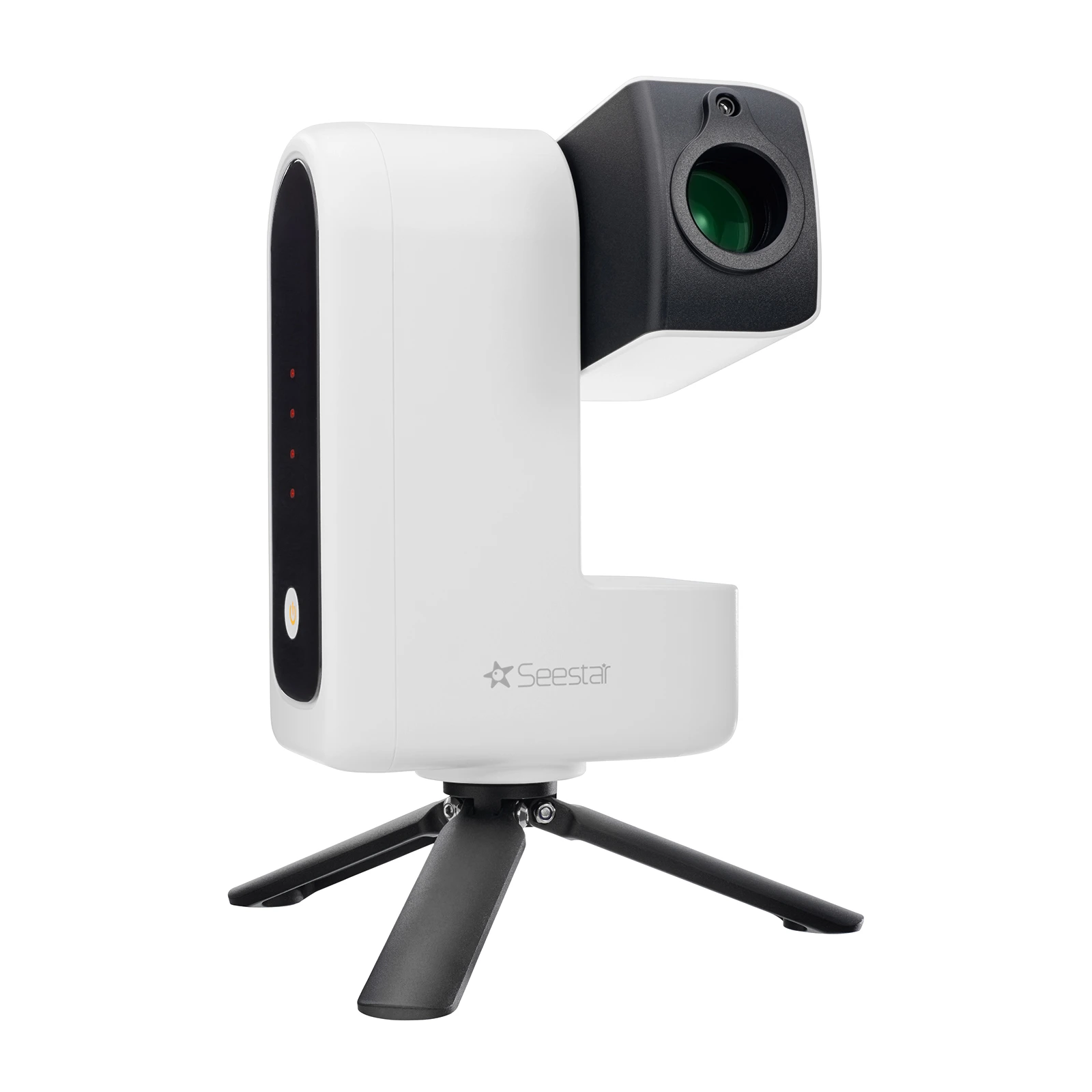
The Seestar S30 is ZWO's most compact and affordable smart telescope. At 1.65kg with the tripod it's genuinely portable: it goes in a backpack alongside everything else without thinking about it. That's a real advantage over every other smart telescope here, which are all noticeably heavier and bulkier.
The S30 has a dual-lens system: a 30mm f/5 APO telephoto for deep-sky imaging, and a wide-angle camera that runs at the same time. This makes finding and framing targets easier than on any single-lens smart telescope. It also opens up Milky Way timelapses and all-sky wide-field shots that the other telescopes here can't do without swapping modes.
The 30mm aperture is the main trade-off: it collects less light than the larger-aperture telescopes below, which means faint nebulae take longer to bring out. But for the Orion Nebula, Andromeda, star clusters, the Moon, and the Sun (magnetic solar filter included), the S30 performs solidly. And at £419 with tripod, solar filter, and carry case all in the box, it's the best value starting point in the class.
Best smart telescope if portability matters, if you're buying your first and want the ZWO ecosystem at the lower price point, or if the dual wide-angle lens specifically appeals. For nebulae from urban skies, the S50's stronger filter is worth the extra £120, but for most other uses the S30 is genuinely capable.
ZWO Seestar S50
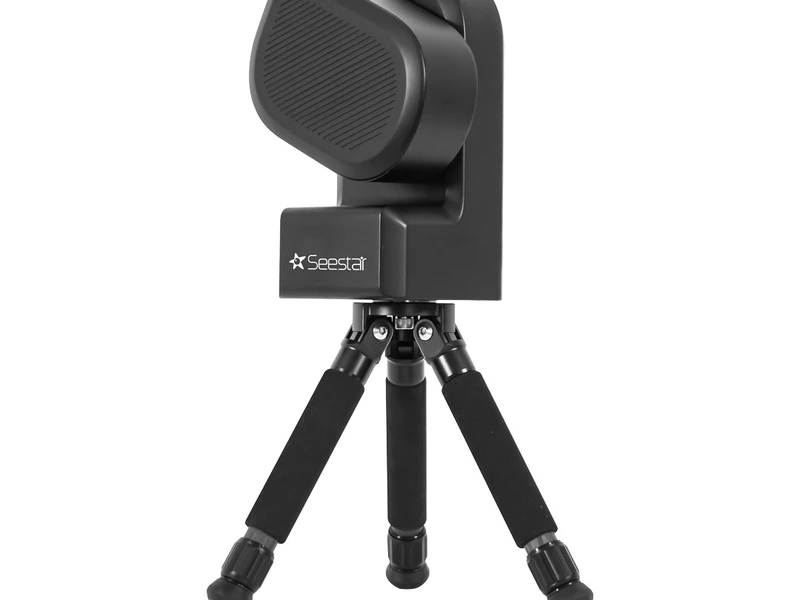
The Seestar S50 is the most widely reviewed smart telescope on the market and the one most UK buyers should consider first. Its standout feature is a built-in dual-band narrowband filter, covering H-alpha and OIII wavelengths, that's permanently inside the optical path and switchable via the app. For anyone imaging from a light-polluted back garden (which describes most of the UK), this filter is transformative. Nebulae that would be washed out under orange skies reveal gas structure, contrast, and colour that a broadband telescope simply can't achieve without a separate filter and adapter.
ZWO are a well-established name in astronomy: they've been making dedicated astrophotography cameras for years, and that heritage shows in the S50's build quality, app, and firmware support. Regular updates have added mosaic mode (for targets wider than the field of view), equatorial mode (to reduce field rotation), and enhanced stacking algorithms since launch. The community around the S50 is large, which means when you have a question, someone has almost certainly already answered it.
The S50 ships as a proper kit: carbon fibre tripod, solar filter, carry case, dew heater, and 64GB of internal storage all included. At £539 you're getting significantly more in the box than either DwarfLab model provides. The solar filter turns it into a capable daytime instrument too, sunspot imaging during the current solar maximum is genuinely rewarding.
The Seestar S50 is our top pick for most UK buyers. The built-in dual-band filter is a genuine competitive advantage for nebula imaging from light-polluted locations, and that's the majority of people reading this. The complete kit (tripod, case, solar filter) also makes it the best value at the point of purchase. If you're starting from scratch and you want one product that covers deep-sky, lunar, and solar observing, this is it.
DwarfLab Dwarf 3
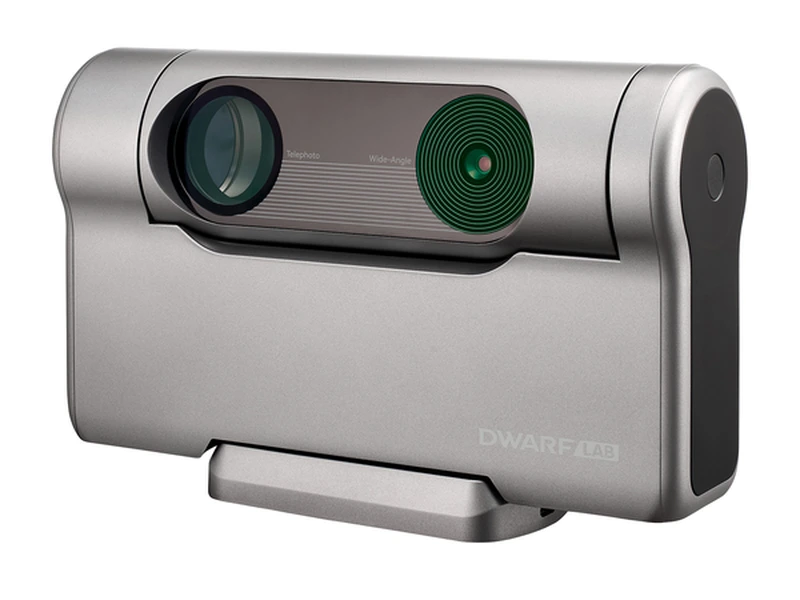
The Dwarf 3 is DwarfLab's flagship smart telescope and the one most serious beginners should consider. Its defining feature, and the reason it costs £86 more than the Dwarf Mini, is a dual-lens system. A 35mm f/4.3 telephoto lens handles deep-sky and planetary targets, while a wide-angle 13.5mm f/1.75 lens captures a broad all-sky view simultaneously. Both shoot at the same time, so you can be imaging a nebula through the telephoto while the wide-angle is recording the sky for sky quality logging or all-sky timelapse.
The main sensor is a Sony IMX678: an 8.3 megapixel backside-illuminated sensor with excellent low-light performance. In practice, this means the Dwarf 3 pulls out faint detail in objects like the Orion Nebula, Andromeda Galaxy, and the Pleiades in ways that the Dwarf Mini's 2.1MP sensor can't quite match. The detail resolution is noticeably better when you push to print size or zoom in.
Like all smart telescopes, the Dwarf 3 is controlled entirely through the DWARF app on your phone. You tap a target on the star map, the telescope slews to it, refines its pointing, and begins stacking exposures. As frames accumulate, you watch detail emerge in real time on your screen. Most popular deep-sky targets are reachable within five minutes of setting up. The built-in 9-hour battery means a full night's observing without a power cable.
The Dwarf 3 is the pick if you specifically want the highest-resolution sensor in the class or the dual-lens wide-angle capability. Its Sony IMX678 (8.3MP) outresolves both the S50 and the Dwarf Mini, and simultaneous wide-angle + telephoto capture is unique to the DwarfLab range. The S50 edges it for light-polluted nebula imaging, but for raw sensor quality and dual-lens flexibility the Dwarf 3 stands alone.
DwarfLab Dwarf Mini
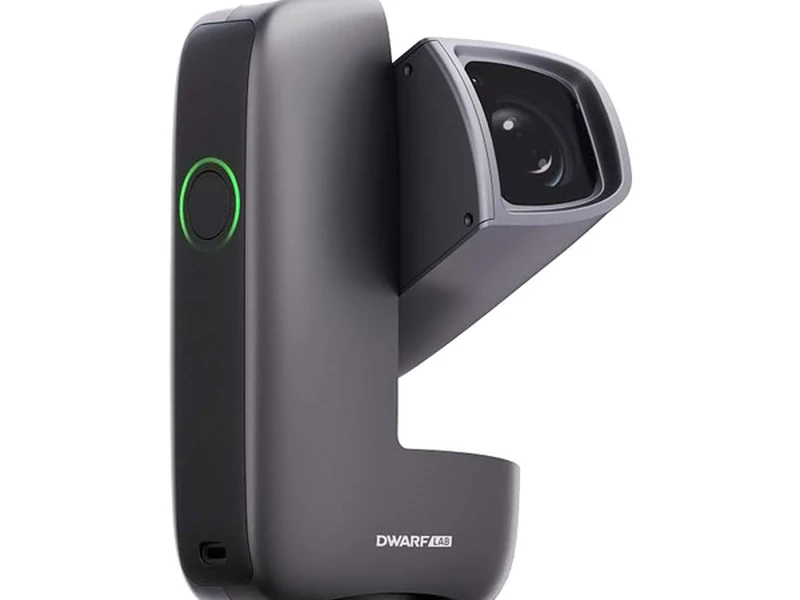
The Dwarf Mini is DwarfLab's entry-level smart telescope: smaller, lighter, and £86 cheaper than the Dwarf 3. It shares the Dwarf 3's 150mm focal length but with a smaller 30mm lens, and has a single Sony IMX462 sensor rather than the Dwarf 3's dual-lens system and higher-resolution IMX678.
The IMX462 is a smaller, lower-resolution sensor (2.1MP vs 8.3MP), which means images have less fine detail and smaller maximum print sizes. For viewing on a phone screen or sharing on social media, the difference is minor. If you're the kind of person who zooms in on every pixel or wants to produce wall-art prints, the Dwarf 3's sensor advantage becomes meaningful.
Where the Dwarf Mini wins is portability and price. It's the more compact of the two, making it the natural choice for dark sky trips where you're packing light, or for a first smart telescope where you want to test the concept without paying full price. The DWARF app experience is identical to the Dwarf 3: same interface, same auto-stacking, same target library.
The right first smart telescope for most people. If you want to see what smart telescopes can do, or if portability matters more than maximum image quality, the Dwarf Mini is the more sensible starting point. You can always upgrade to the Dwarf 3 later, but many Dwarf Mini owners find they never need to.
Vaonis Vespera II
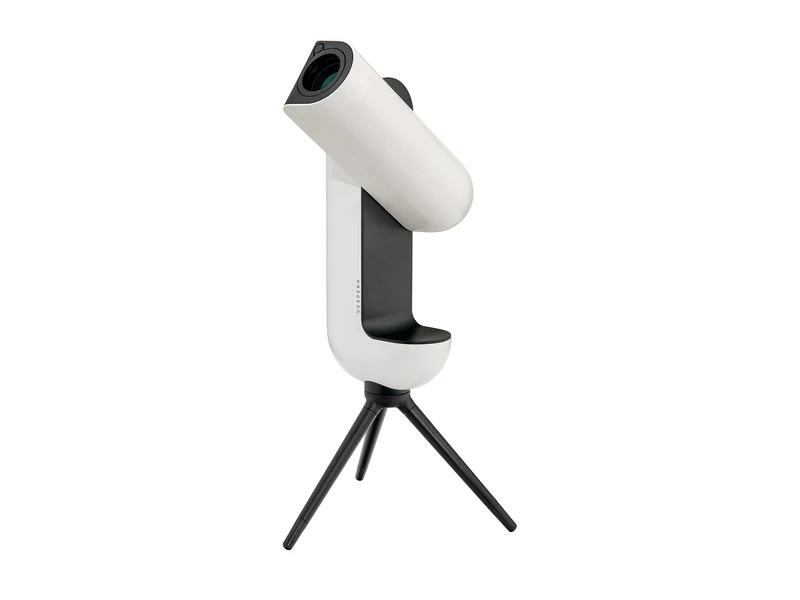
The Vespera II is the smart telescope that looks like a design object, and its Singularity app is the most refined in the business. Its party trick is CovalENS, an automatic mosaic mode that stitches a field up to 4.3 by 2.4 degrees at about 24 megapixels, so Andromeda and the North America Nebula fit in one frame with room to spare. Nothing under £1,000 does that.
The catch is what it shares with the Seestar S50 Pro and what it lacks. Same 50mm aperture, comparable 8.3MP sensor, but no built-in filter, no wide camera, a four-hour battery, 25GB of storage and no tripod in the box, for about £400 more. From a UK garden the two produce images most people could not tell apart.
Buy it for the mosaics, the app and the design, with your eyes open about the price. If image-per-pound is the measure, the S50 Pro wins.
Unistellar Odyssey
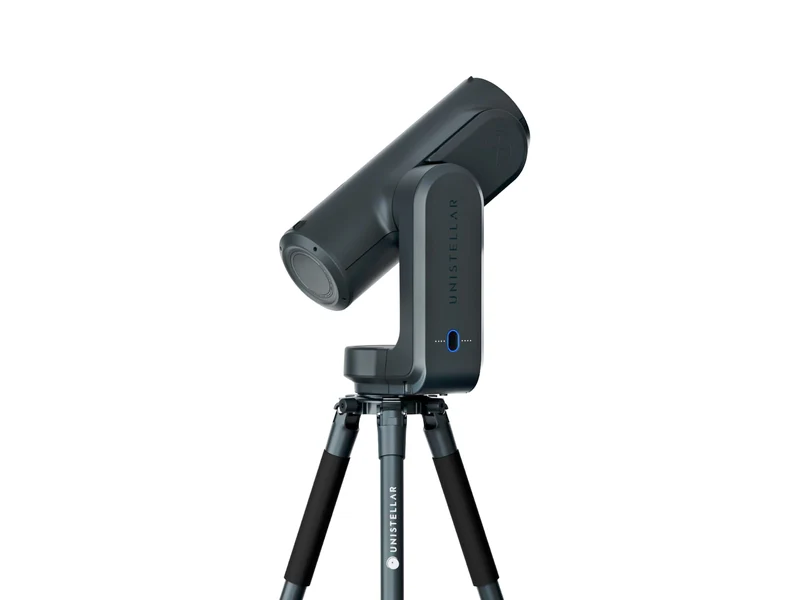
The Odyssey is the only established smart telescope with more than 50mm of aperture, and until the DwarfLab Draco ships it is the one to buy if galaxies and globular clusters are the goal. Its 85mm mirror gathers nearly three times the light of a Seestar or Vespera. Its Nikon-developed optics need no collimation, autofocus runs every session, and Unistellar's citizen-science programme lets owners contribute real asteroid and exoplanet data.
It costs more than two Seestar S50 Pros, its three-quarter-degree field is too tight for the big nebulae, there is no physical light-pollution filter, and planets are its weak spot. The Odyssey Pro adds a Nikon electronic eyepiece for £1,600 more, which reviewers did not think worth it.
The serious choice for small deep-sky targets and the only big-aperture smart telescope you can use this autumn. For wide nebulae or value, look lower down this list.
Which Smart Telescope Should You Choose?
Choose the Seestar S50 Pro if:
You can spend £999 and want the best smart telescope on sale today without going to £1,000-plus. It pairs the S50's 50mm aperture and dual-band filter with an 8.3MP 4K sensor and a second 4K wide-angle camera, and it comes with a tripod, hard case and solar filter. The trade-off is 2.8kg, so it lives in a rucksack rather than a pocket. If you're weighing it against the pre-order DwarfLab Draco, read our Seestar S50 Pro vs Dwarf Draco vs Vespera II comparison.
Choose the Seestar S30 Pro if:
You want the best sensor in the Seestar range and 4K dual-lens capability. At £649 it's the most capable smart telescope under 2kg. The Sony IMX585 telephoto is four times larger than the S30's sensor and shoots 4K. The built-in anti-dew heater is a practical advantage for UK conditions. If you'll use your telescope regularly and want the best image quality in a portable package, this is the one.
Choose the Seestar S30 if:
Portability matters, or you want the ZWO ecosystem at a lower entry price. At 1.65kg with everything included, it's the most packable smart telescope here. The dual-lens system also makes finding and framing targets noticeably easier than on any single-lens model. The 30mm aperture is the limiting factor on the faintest deep-sky targets, but for most beginners it performs well above expectations.
Choose the Seestar S50 if:
You image from a light-polluted location (most UK towns and cities) and nebulae are your primary target. The built-in H-alpha + OIII dual-band filter is what makes that possible (the Dwarf 3 has one too; the Dwarf Mini does not). Torn between the two? Read our Seestar S50 vs Dwarf 3 head-to-head. It also ships with the most complete kit (tripod, carry case, and solar filter in the box) making it the best value at the point of purchase. If you're buying just one smart telescope and you live anywhere with orange skies, this is the one.
Choose the Dwarf 3 if:
You want the highest-resolution sensor in the class (8.3MP Sony IMX678 vs 2.1MP on both the S50 and Dwarf Mini), or if the dual-lens system specifically appeals. Being able to run a wide-angle all-sky timelapse simultaneously while imaging a deep-sky target through the telephoto is something only the Dwarf 3 offers, and it's genuinely useful for comet hunts, sky quality logging, and context shots. Battery life is similar on both, around six hours of imaging.
Choose the Dwarf Mini if:
You're buying your first smart telescope and want to test the concept before committing to a higher price. The Dwarf Mini gives you the full smart telescope experience (app, auto-stacking, real nebula images on your phone) for the lowest outlay. It's also the most portable of the three, making it the natural choice for dark-sky trips where pack weight matters.
Choose the Vespera II or Odyssey if:
You can spend over £1,000 and want something the sub-£1,000 class does not offer: the Vespera II for automatic wide-field mosaics and the best app, or the Odyssey for 85mm of aperture on galaxies and clusters. Both are shipping now with UK dealer support, unlike the pre-order Draco.
Recommended Accessories
Both the Dwarf 3 and Dwarf Mini include everything you need to start imaging out of the box. There are two accessories worth considering as add-ons:
DwarfLab Mini Tripod with Fluid Head
A compact aluminium tripod specifically designed for the Dwarf 3 and Dwarf Mini. 5-section legs adjust from 25cm to 53cm, with a fluid head for smooth positioning. At 790g and 25cm folded, it's small enough to carry alongside either telescope. Folds to a very compact size for travel. Note from early buyers: make sure to lock each leg segment individually, twisting just the foot won't lock the upper sections.
£73 at FLO View at FLO →Astro Essentials Magnetic Bahtinov Mask (Dwarf 3 only)
A 3D-printed Bahtinov focusing mask that attaches to the Dwarf 3's lens housing via concealed rotating magnets. A Bahtinov mask creates a distinctive diffraction pattern that makes precise focus visually obvious, useful when you want to manually verify focus rather than trusting the autofocus. Dwarf 3-specific; not compatible with the Dwarf Mini.
£22 at FLO View at FLO →