China's Moon Program
Chang'e, the ILRS, and a permanent base by 2035
China has already landed on the far side of the Moon, returned samples from both sides, and is now preparing to send astronauts to the lunar south pole by 2030. After that, construction of a permanent International Lunar Research Station begins. This is the most ambitious space programme on Earth, and it's ahead of schedule.
(new date TBC)
lander
(27,000 kg to Moon)
(south pole)
50+ institutions
China's lunar programme is the most methodical and most ambitious space effort currently underway on Earth. Where NASA's Artemis programme is a coalition of commercial partners and allied nations racing to re-establish American presence on the Moon, China's approach is state-led, long-term, and oriented around permanent infrastructure rather than flags-and-footprints milestones.
The Chang'e programme, named after the Chinese moon goddess, has delivered a series of world firsts since 2013: the first far-side lunar landing, the first far-side sample return, and the first rover to operate on the lunar far side. Chang'e 7 was due to launch on 24 August 2026 to attempt the most complex robotic south pole mission ever flown, but the launch was postponed at the last minute because of an approaching typhoon at the Wenchang launch site, and a new date hasn't been set yet. By 2030, China intends to put astronauts on the Moon. By 2035, it plans to have a working base there.
This page is your complete guide to what China is planning, why, and what it means for the future of lunar exploration.
The Chang'e Programme: A Decade of World Firsts
China's lunar exploration programme officially launched in 2007 with Chang'e 1, an orbital mission designed to map the Moon's surface. What followed was a systematic, patient programme of escalating capability: each mission building on the last, each one proving out technology needed for the next step.
The pace and reliability of China's lunar programme has been remarkable. In 15 years, China went from its first lunar orbiter to returning samples from the far side of the Moon, a feat no other space agency had ever achieved. Every mission in the Chang'e series has been successful.
Chang'e 1: First Lunar Orbiter ✅
China's first spacecraft to reach the Moon. Orbited for 16 months producing a complete map of the lunar surface. Deliberately crashed into the Moon to end the mission. China became only the fifth nation to operate a lunar spacecraft.
Chang'e 2: High-Resolution Mapping ✅
Second orbiter, producing significantly higher-resolution imagery than Chang'e 1. After completing its lunar mission, went on to visit asteroid 4179 Toutatis in a deep space extension, demonstrating interplanetary capability.
Chang'e 3: First Chinese Lunar Landing ✅
China's first soft landing on the Moon, in the Bay of Rainbows (Mare Imbrium) on the lunar near side. Deployed the Yutu rover. China became the third country to achieve a controlled lunar landing, after the Soviet Union and the United States.
Chang'e 4 · World First: Far Side Landing ✅
The first spacecraft in history to land on the far side of the Moon, touching down in the Von Kármán crater within the South Pole–Aitken Basin. Required a relay satellite (Queqiao) positioned at the L2 Lagrange point to maintain communications. The Yutu-2 rover has been operating ever since and holds the record as the longest-operating lunar rover.
Chang'e 5: First Chinese Sample Return ✅
Returned 1.73 kg of lunar samples from Mons Rümker, a geologically young volcanic region on the near side. First lunar sample return mission by any country since the Soviet Luna 24 in 1976. Samples have revealed some of the youngest volcanic activity ever found on the Moon.
Chang'e 6 · World First: Far Side Sample Return ✅
Landed in the Apollo crater within the South Pole–Aitken Basin and returned 1.9 kg of far-side lunar samples to Earth, another world first. The South Pole–Aitken Basin is the oldest and largest impact crater in the Solar System; its rocks may contain material from the lunar mantle and early Solar System history.
Chang'e 7: South Pole Scout (LAUNCH POSTPONED)
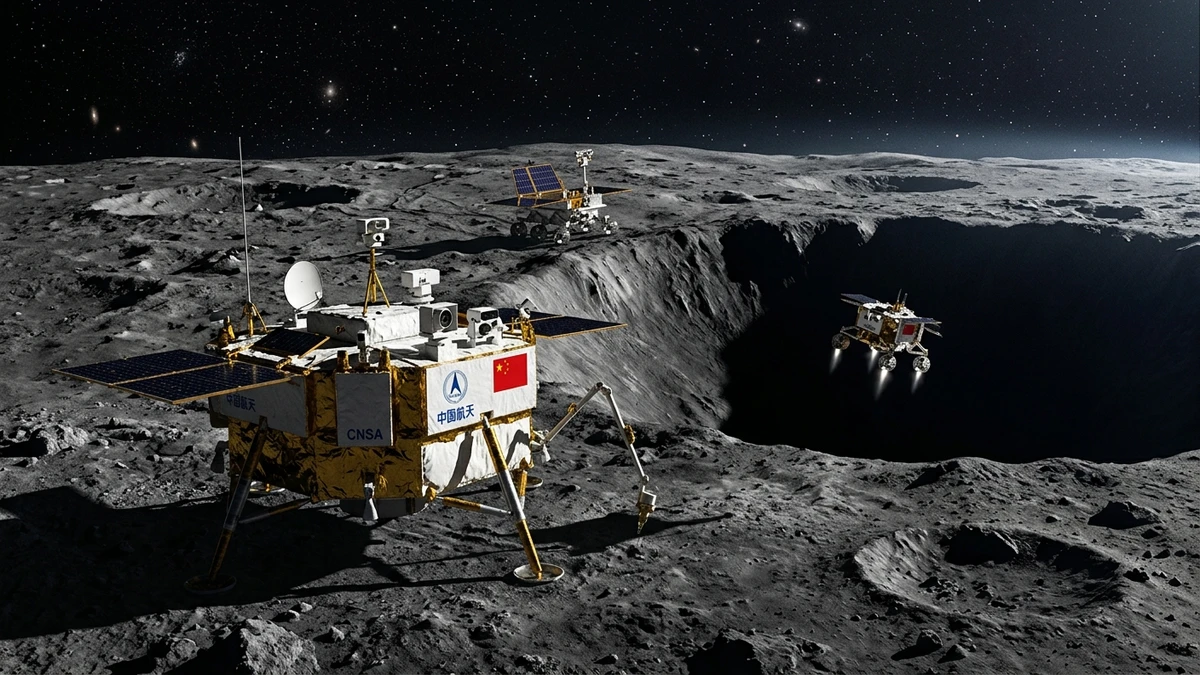
Five-component mission targeting the lunar south pole: orbiter, lander, rover, relay satellite, and a mini hopping probe. The hopper will fly into permanently shadowed polar craters to directly sample for water ice and volatiles, a world first in robotic lunar exploration. The rocket was rolled to the pad on 19 August ahead of a planned 24 August launch on a Long March 5 from Wenchang, but China's space agency postponed it on 23 August as Typhoon Narra closed in. No new launch date has been announced. Chang'e 7 will identify the best sites for future crewed landings and the ILRS base.
Chang'e 8: South Pole ISRU Demonstrator
Follows up Chang'e 7 at the south pole. Will test in-situ resource utilisation (ISRU) technologies: using lunar regolith to 3D-print bricks that could build habitats, and prospecting water ice for potential conversion to rocket propellant and drinking water. If successful, Chang'e 8 validates the technology underpinning the entire ILRS construction programme.
First Crewed Lunar Landing: Mengzhou + Lanyue 🎯
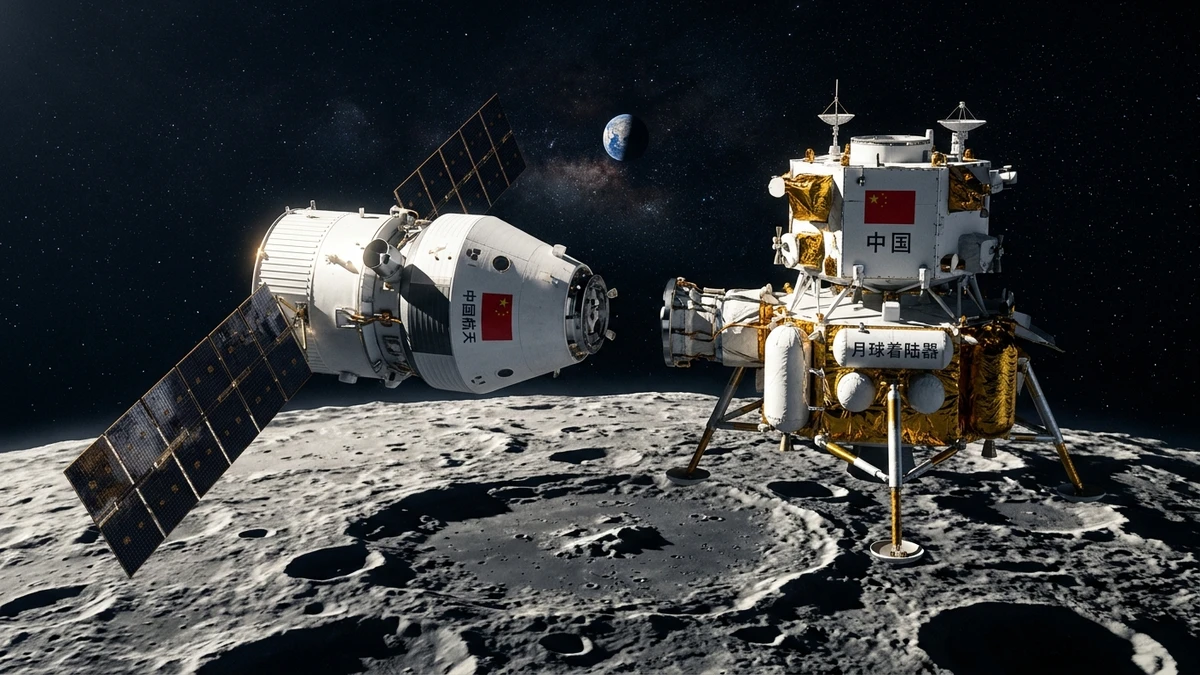
Two Long March 10 rockets launch separately: one carrying the Mengzhou crew vehicle (with astronauts), one carrying the Lanyue lander. After rendezvous in lunar orbit, astronauts transfer to Lanyue and descend to the south pole. China becomes the second country to land humans on the Moon.
ILRS Construction Begins
International Lunar Research Station construction launches using super heavy-lift Long March 9 (Chinese) and Yenisei (Russian) rockets. Modules, power systems, and equipment delivered over multiple missions. Basic facility operational by 2035.
The Rockets: Long March 10 and Long March 9
China's crewed lunar ambitions require a generational leap in launch capability. The Long March 5, China's current most powerful rocket, can lift about 8,000 kg to a trans-lunar trajectory. That's not enough for a crewed moon mission. Two new rockets are being developed to change that.
| Role | Crewed lunar missions (Artemis IV equivalent) |
| Trans-lunar payload | ~27,000 kg (3× Long March 5) |
| Crew capacity | Up to 3 taikonauts |
| Missions needed | 2 launches per crewed landing (crew + lander) |
| First use | First crewed lunar landing, 2029–2030 |
| Status (Aug 2026) | Static fire + low-altitude flight test complete; single-core 10B variant flew and landed July 2026 |
| Role | ILRS module and cargo delivery (Saturn V equivalent) |
| Low Earth orbit payload | ~150,000 kg (exceeds Saturn V) |
| Comparable to | NASA's SLS Block 2 / SpaceX Starship |
| First use | ILRS construction from 2031 |
| Status (2026) | In development; key technology demonstrations ongoing |
The two-rocket architecture for crewed lunar landings mirrors the approach NASA used during Apollo: separate launches for the crew vehicle and the lander, rendezvous in lunar orbit. It's a proven concept, and China's engineers know it works. Long March 10's development is considered one of the most important projects in China's space programme and is described officially as progressing "smoothly." It's no longer all on paper, either: the rocket flew a successful low-altitude demonstration test at Wenchang in February 2026, and its single-core sibling, the Long March 10B, reached orbit and was recovered at sea in July 2026, China's first rocket landing.
Why the South Pole? Water Ice, Sunlight, and Strategic Position
Both China and the United States are targeting the same place: the lunar south pole. This is not a coincidence, and it's not just about scientific interest. The south pole is where the Moon's most valuable resources are concentrated, and where any permanent human presence will need to be.
The south pole has three things no other part of the Moon has in combination:
Water Ice
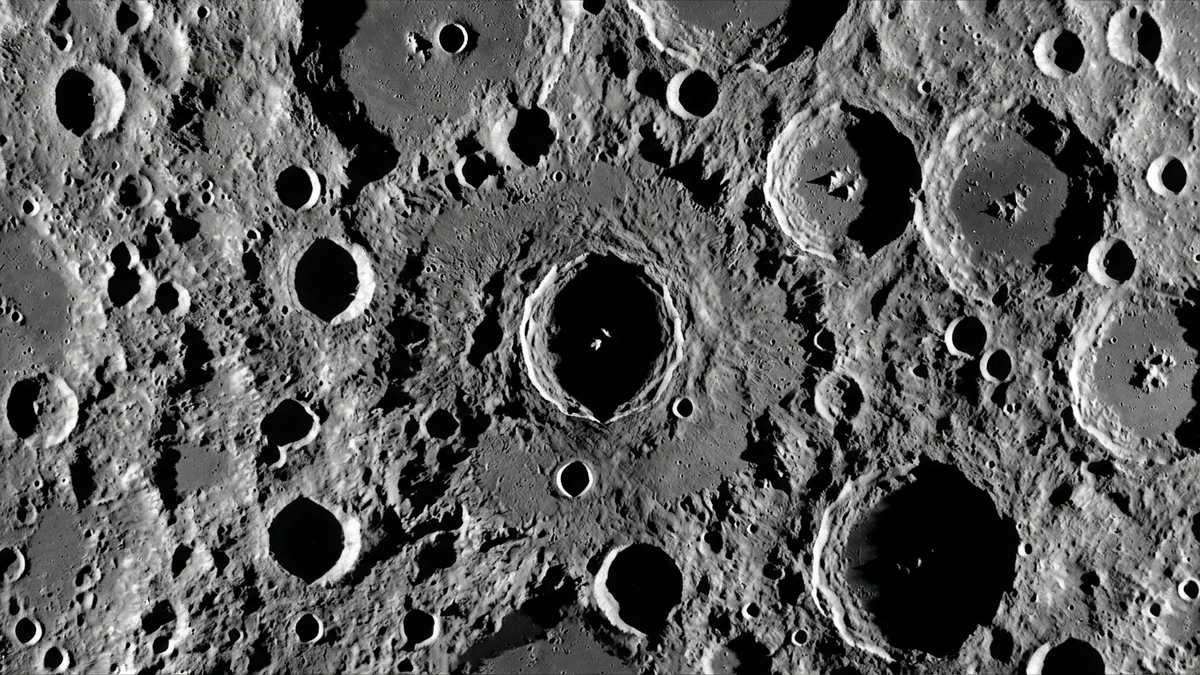
Billions of Tonnes in Shadowed CratersPermanently shadowed craters at the south pole have never seen sunlight in billions of years. They act as cold traps for water ice delivered by comets and asteroids over geological time. NASA's LCROSS mission confirmed significant water ice deposits in 2009. Water ice can be split into hydrogen and oxygen, rocket propellant, and can supply a lunar base with drinking water. Whoever controls the best ice deposits controls the most valuable real estate on the Moon.
Continuous Sunlight
Peaks of Eternal LightCertain elevated peaks near the south pole, the 'Peaks of Eternal Light', receive near-continuous sunlight year-round. A solar-powered base sited on or near these peaks can generate power almost without interruption, unlike equatorial sites which experience two-week lunar nights. China's Chang'e 7 will map these peaks in detail to identify optimal base locations.
Helium-3
Future Fusion FuelChina has explicitly cited helium-3 as a long-term resource target. Helium-3 is an isotope implanted in the lunar regolith by the solar wind over billions of years and is extremely rare on Earth. It is a potential fuel for fusion reactors that would produce far less radioactive waste than conventional nuclear fusion. China's National Space Administration has described helium-3 extraction as a long-term objective of the lunar programme.
Strategic Value
First There, Best PositionedThere are no international agreements governing who can use specific lunar locations. The Outer Space Treaty prohibits national sovereignty claims, but says nothing about where a base can be sited or who can use nearby resources. The Artemis Accords, signed by 70 nations, establish norms around 'safety zones' near lunar operations, but China is not a signatory. The race to the south pole is as much about positioning as science.
The International Lunar Research Station (ILRS)
The ILRS is China's answer to the question of what comes after a crewed landing. Where NASA has spoken in broad terms about "sustainable lunar exploration," China has published a phased construction plan with specific dates, specific technology goals, and a specific site.
"The essential goal is to establish a comprehensive scientific experiment base, with the possibility of long-term unmanned operation and the prospect of human presence."
· CNSA ILRS Guide for PartnershipConstruction is planned in two phases. Phase 1 runs from approximately 2031 to 2035 and will establish a basic operational facility at the south pole: power systems, communications infrastructure, science modules, and the beginnings of ISRU production. Phase 2, extending to 2050, will expand into a network connecting the south pole, the lunar equator, and the far side, each node serving different scientific and operational purposes.
| Location | Lunar south pole |
| Power | Solar + nuclear reactor (China/Russia joint) |
| Operations | Long-term unmanned with periodic crewed visits |
| Key tech | ISRU (regolith bricks, water extraction) |
| Delivery rockets | Long March 9 (China) + Yenisei (Russia) |
| Target complete | 2035 |
| South pole node | Full research base, semi-permanent crew |
| Equatorial node | Communications relay and science platform |
| Far side node | Radio astronomy (shielded from Earth interference) |
| Partners target | 50 countries, 500 institutions, 5,000 researchers |
| Energy research | Helium-3 extraction technology development |
| Target complete | 2050 |
Power is a critical and often overlooked detail. China and Russia have formally agreed to develop a nuclear fission reactor to power the ILRS, something NASA has not yet committed to for its own lunar operations. Nuclear power solves the two-week lunar night problem definitively, making round-the-clock operations possible regardless of the sun.
Who's Joining China?
As of 2026, 17 countries and more than 50 research institutions have signed up to the ILRS. China's partners are a geopolitically significant list: not NATO allies, but a coalition of Global South nations, post-Soviet states, and countries that have either been excluded from or chosen not to join the US-led Artemis Accords framework.
| Founding partner | Russia (Roscosmos, co-architect) |
| Asia | Pakistan, Thailand, Azerbaijan |
| Africa | South Africa, Egypt |
| Latin America | Venezuela, Nicaragua |
| Europe | Belarus, Serbia |
| Central Asia | Kazakhstan |
| Pending | Turkey (expected to apply) |
| Total signatories | 17 countries + 50+ institutions |
The ILRS partnership model differs from the Artemis Accords in important ways. The Accords are a set of principles: essentially a US-led framework for how countries should behave in space. The ILRS is an operational project: partners contribute scientific instruments, expertise, or resources in exchange for access to the station and its data. China has described it as an "open" platform, explicitly inviting countries that have not signed the Artemis Accords to participate.
The Crew Mission: Mengzhou and Lanyue
China's first crewed lunar landing will use two vehicles developed specifically for the mission, neither of which has flown yet, but both of which China says are on track.
| Purpose | Trans-lunar crew transport (equivalent to NASA's Orion) |
| Crew | Up to 3 taikonauts |
| Launch vehicle | Long March 10 |
| Function | Carries crew to and from lunar orbit; does not land |
| Test status | Zero-altitude and in-flight max-Q abort tests passed (2025–26) |
| Name meaning | 'Dream Boat' (梦舟) |
| Purpose | Crew descent to and ascent from lunar surface |
| Launch vehicle | Long March 10 (separate launch from crew) |
| Landing site | Lunar south pole |
| EVAs | At least one confirmed; likely multiple |
| Test status | Landing and take-off trials completed |
| Name meaning | 'Embracing the Moon' (揽月) |
The two-launch architecture means the Lanyue lander will be sent to the Moon first, wait in lunar orbit, and then rendezvous with Mengzhou once the crew arrives. Both vehicles are named with characteristic poetic intent, a tradition in China's space programme that reflects the cultural weight attached to lunar exploration.
What Does China Actually Want From the Moon?
China's lunar programme serves several distinct objectives, and it's worth separating them clearly, because they range from the purely scientific to the highly strategic.
Scientific research is the stated primary purpose of the ILRS. Lunar geology, the history of the early Solar System, radio astronomy from the far side (shielded from Earth's radio frequency interference), and the space environment between the Earth and Moon are all genuine research priorities. The sample returns from Chang'e 5 and 6 have already produced significant scientific findings.
In-situ resource utilisation is the practical foundation for everything else. If you can make propellant from lunar water ice, you can refuel spacecraft on the Moon. If you can print structures from lunar regolith, you don't need to launch building materials from Earth. Chang'e 8 will test both of these capabilities. Without ISRU, a permanent lunar base is impossibly expensive. With it, the Moon becomes a logistics node for the entire inner Solar System.
Helium-3 for fusion energy is the long game. China is one of the most active nations in fusion energy research and has made explicit statements linking the lunar programme to long-term energy security. Helium-3 is extraordinarily rare on Earth but deposited in the lunar regolith by the solar wind over billions of years. Whether commercial helium-3 extraction is economically viable remains scientifically contested, but China is building the infrastructure to find out.
Geopolitical positioning underpins all of the above. China's ILRS, its partner coalition, and its explicit rejection of the Artemis Accords framework are not merely technical choices. They represent a deliberate effort to establish an alternative centre of gravity for international space cooperation, one that China leads and defines. The Moon is where that contest is being played out most visibly.
China vs the US: Where Does the Race Stand?
As of August 2026, NASA has a genuine but narrow lead on crewed capability. Artemis II, a crewed lunar flyby, completed successfully in April 2026. China's equivalent mission (a crewed lunar flyby) has not yet been scheduled. NASA is targeting its first crewed landing (Artemis IV) for early 2028; China is targeting 2029–2030. On that basis, the US is likely to get humans on the Moon first, by roughly one to two years.
But "first crewed landing" is only one metric. On long-term planning, China leads decisively. The ILRS has a specific construction timeline, committed partner nations, a nuclear power plan, and defined milestones through 2050. NASA's equivalent, a permanent presence at the south pole, has no equivalent specificity or commitment beyond the early 2030s. Artemis is a mission programme; the ILRS is an infrastructure programme.
The most consequential uncertainty is the south pole itself. Both programmes are targeting the same small region, and there are no agreed rules governing who can build where, or who can use the water ice in a particular crater. The Artemis Accords attempt to establish norms, including "safety zones" around lunar operations, but China is not party to them and has described the Accords as an instrument of US hegemony.
"We will spare no effort to achieve the goal of landing Chinese astronauts on the Moon before 2030."
· Zhang Hailian, Deputy Chief Designer, China's crewed Moon mission programmeWhat's Next: The Timeline to Watch
The next two years will be defining. Chang'e 7 is still China's most important near-term mission: it will characterise the south pole landing sites, confirm water ice deposits, and directly inform the location of the ILRS base, but its planned 24 August 2026 launch was postponed at the last minute because of a typhoon at Wenchang, and no new date has been set. Its eventual success or failure will be a significant indicator of China's readiness for crewed operations.
Simultaneously, NASA's Artemis III mission in late 2027 will test SpaceX's Starship HLS and Blue Origin's Blue Moon lander in Earth orbit, a key step before Artemis IV. The state of Starship HLS development will determine whether the 2028 landing target is achievable or slips further.
By 2030, we will very likely know which country has landed humans on the Moon first in the 21st century. What happens after that, who builds what, where, and with whom, will define the next century of human activity beyond Earth.
WatchTheStars will be covering every mission, every milestone, and every development as they happen. See the US Artemis Programme deep-dive and the Moon Race hub page for the full picture.
Watch the same patch of sky China's aiming for
Kit we've tested and reviewed in full
Chang'e 7 is aiming to scout the lunar south pole once it launches. Point a small telescope at the Moon on any clear night and you can see the terrain everyone's racing for.

A tabletop reflector with enough aperture to pick out craters, ridgelines and the terminator in real detail.
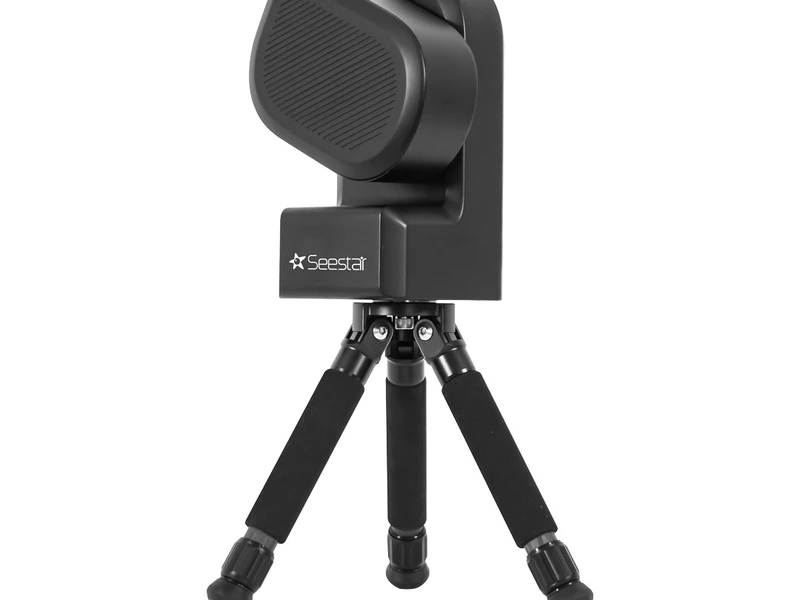
A smart scope that finds and tracks the Moon on its own and streams the view straight to your phone.
Affiliate links: you pay the same price, we earn a small commission that helps keep WatchTheStars free.
Related Posts & Pages
Sources and Further Reading
- Chinese Lunar Exploration Program · Wikipedia
- Chang'e 7 · Wikipedia
- China Confirms Crewed Lunar Landing by 2030 · The Defense News
- China shakes up its space programs to land astronauts on the Moon by 2030 · Space.com
- International Lunar Research Station · Wikipedia
- ILRS Guide for Partnership · CNSA
- US–China space race accelerates · Christian Science Monitor
- China prepares to launch Chang'e-7 lunar probe · Xinhua
- China conducts low-altitude flight test for Long March 10 · CGTN