NASA's Artemis Program
From flyby to footprints: the road back to the Moon
In April 2026, four astronauts flew around the Moon for the first time since 1972. They didn't land. That comes in 2028, and after that, the plan is to stay. NASA's Artemis program is the most ambitious human spaceflight effort since Apollo, backed by commercial partners, 70 allied nations, and a target of permanent human presence at the lunar south pole.
First crewed lunar flyby since 1972
Targeted 2028
(named Integrity)
(SLS Block 1)
Blue Origin Blue Moon
(China not included)
For 54 years, the Moon waited. After Apollo 17 splashed down in December 1972, no human being left Earth orbit again. The Space Shuttle stayed close to home. The International Space Station orbits at just 400 kilometres up, barely past the edge of the atmosphere on cosmic scales. The Moon, 384,000 kilometres away, was left to robots.
That changed on 1 April 2026, when four astronauts climbed aboard a 98-metre rocket, rode 8.8 million pounds of thrust into orbit, and kept going. Ten days later, after flying around the Moon and watching Earth rise over the lunar limb, they splashed down in the Pacific. The era of human deep space exploration had restarted.
Artemis II was a flyby, not a landing. But the landing is coming: in 2028, NASA plans to put boots on the lunar south pole for the first time in history. After that, the goal is not to leave. This is the complete guide to how we get there.
The Artemis Mission Timeline
Artemis is a phased programme, with each mission building on the last. The pace has accelerated significantly since Artemis II: the SLS rocket for Artemis III arrived at Kennedy Space Center in April 2026, less than three weeks after Artemis II landed. For the full mission-by-mission breakdown with dates and objectives, see our complete Artemis timeline.
| Mission | Date | Type | Crew | Key objective |
|---|---|---|---|---|
| Artemis I | Nov 2022 | ✅ Complete | Uncrewed | Prove SLS and Orion can fly |
| Artemis II | Apr 2026 | ✅ Complete | 4 astronauts | First crewed Moon flyby in 54 years |
| Artemis III | Late 2027 | 🔄 Redesigned | Crewed | Test landers in Earth orbit, no landing |
| Artemis IV | Early 2028 | 🌕 First landing | Crewed | First humans on Moon since 1972 |
| Artemis V | 2028–29 | 🌕 Second landing | Crewed | South pole surface ops + LTV deployment |
| Artemis VI+ | 2029 onwards | 🏗️ Planned | Crewed | Annual landings, build permanent base |
Artemis I: Uncrewed Test Flight ✅
Lifted off at 01:47 EST on 16 November 2022 from Launch Complex 39B, the same pad that sent Apollo crews to the Moon. Orion flew a 25.5-day mission, coming within just 130 km of the lunar surface, then re-entered Earth's atmosphere at 39,400 km/h, faster than any crewed spacecraft in history, and splashed down on 11 December 2022. By coincidence, that was exactly 50 years to the day since Apollo 17 astronauts last walked on the Moon. Every primary objective was met or exceeded. NASA declared Orion flight-ready for crew.
Artemis II: First Crewed Lunar Flyby ✅
Four astronauts (Wiseman, Glover, Koch, and Hansen) flew around the Moon aboard Orion (named Integrity). A 10-day mission covering approximately 2.25 million kilometres. First humans beyond low Earth orbit since 1972. First woman and first Canadian on a lunar trajectory. Splashed down in the Pacific on 10 April 2026.
Follow the mission →
🚀 Launch🌑 Halfway to the Moon🌕 Lunar flyby↩ Homeward bound🌊 Splashdown📷 Best photos
Artemis III: Crewed Lander Test in Earth Orbit
Not a lunar landing. Artemis III will launch Orion with crew to Earth orbit, where they will rendezvous and dock with SpaceX's Starship HLS and Blue Origin's Blue Moon lander, both launched separately. The mission tests docking procedures, pressure suit operations (AxEMU suits), and crew transfer between vehicles. Essential rehearsal for Artemis IV. The crew was named on 9 June 2026: commander Randy Bresnik, pilot Luca Parmitano (the first ESA astronaut assigned to an Artemis mission), and mission specialists Frank Rubio and Andre Douglas. Rocket assembly is now well underway: booster stacking began in the Vehicle Assembly Building in July 2026, all four RS-25 engines were delivered on 21 July, and the Orion crew and service modules were joined in early August. Administrator Isaacman says he is 'extremely confident' of a 2027 launch.
Follow the mission →
👨🚀 Crew announced
Artemis IV: First Crewed Lunar Landing Since 1972 🎯
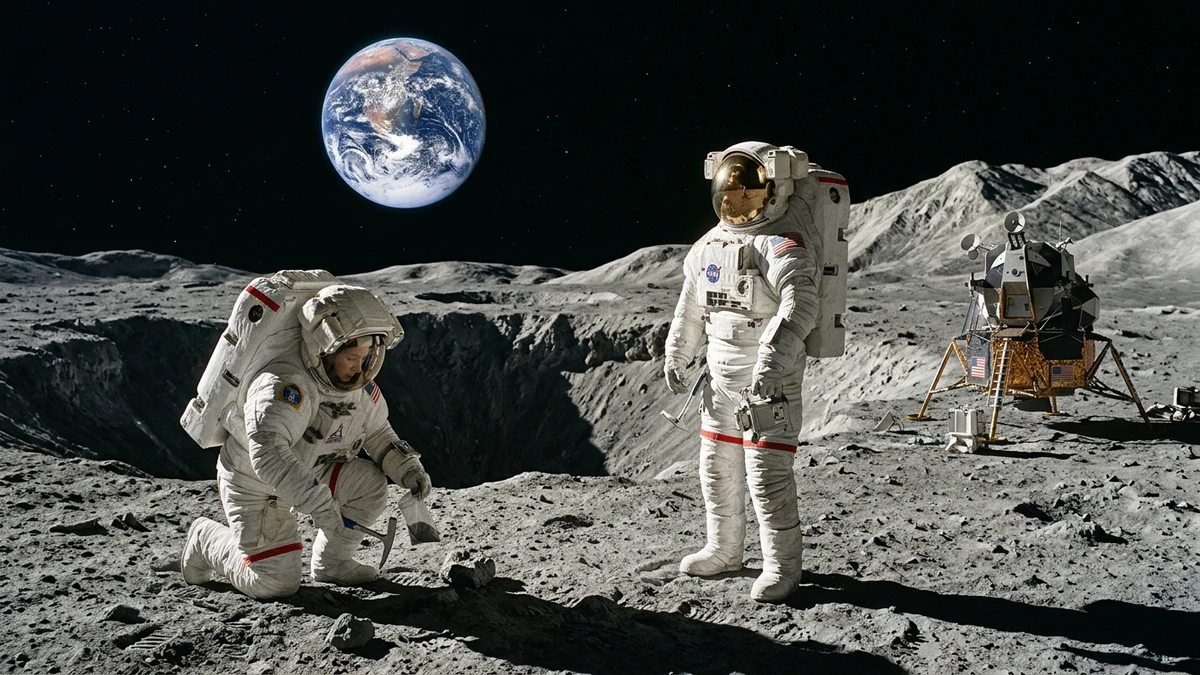
The headline mission. Orion launches with crew, a separately-launched lander (Starship HLS or Blue Moon) is waiting near the Moon, and astronauts descend to the lunar south pole. At least two EVAs planned: the first humans to walk on the Moon since Gene Cernan stepped off the surface in December 1972. Landing site will be the south polar region, where water ice has been confirmed.
Artemis V: Second Crewed Landing
Planned to follow Artemis IV closely, an accelerated tempo reflecting the urgency of China's 2029–2030 crewed landing target. Blue Origin's Blue Moon lander is expected to carry this crew to a site near where NASA will deploy a crewed Lunar Terrain Vehicle (LTV), a pressurised rover allowing astronauts to travel far further from the landing site than was ever possible during Apollo. Astrolab and Lunar Outpost were awarded the first LTV contracts in May 2026. Artemis V and the missions after it will begin building out the Moon Base's permanent south pole infrastructure.
Moon Base: Robotic Landers and Rovers
Running in parallel with the crewed Artemis missions, NASA's Moon Base programme sends a wave of commercial robotic landers to the lunar south pole. The first three (Moon Base I, II and III) fly on Blue Origin's Blue Moon Mark 1, Astrobotic's Griffin and Intuitive Machines' Nova-C Trinity, carrying science instruments and the first rovers. More than a dozen further missions are planned this decade, delivering power, communications and habitat hardware ahead of a permanent crewed outpost around 2030. Blue Origin's New Glenn pad explosion in May 2026 slowed preparations, but all four Phase One landers cleared environmental testing in August 2026 and Moon Base I is now targeted for no earlier than autumn 2026.
Sustained Presence: Regular Crewed Missions
From 2030 onwards, NASA envisions annual or more frequent crewed missions to a growing south pole outpost, using the Moon as a testbed for life support, propulsion, and in-situ resource utilisation ahead of eventual Mars missions.
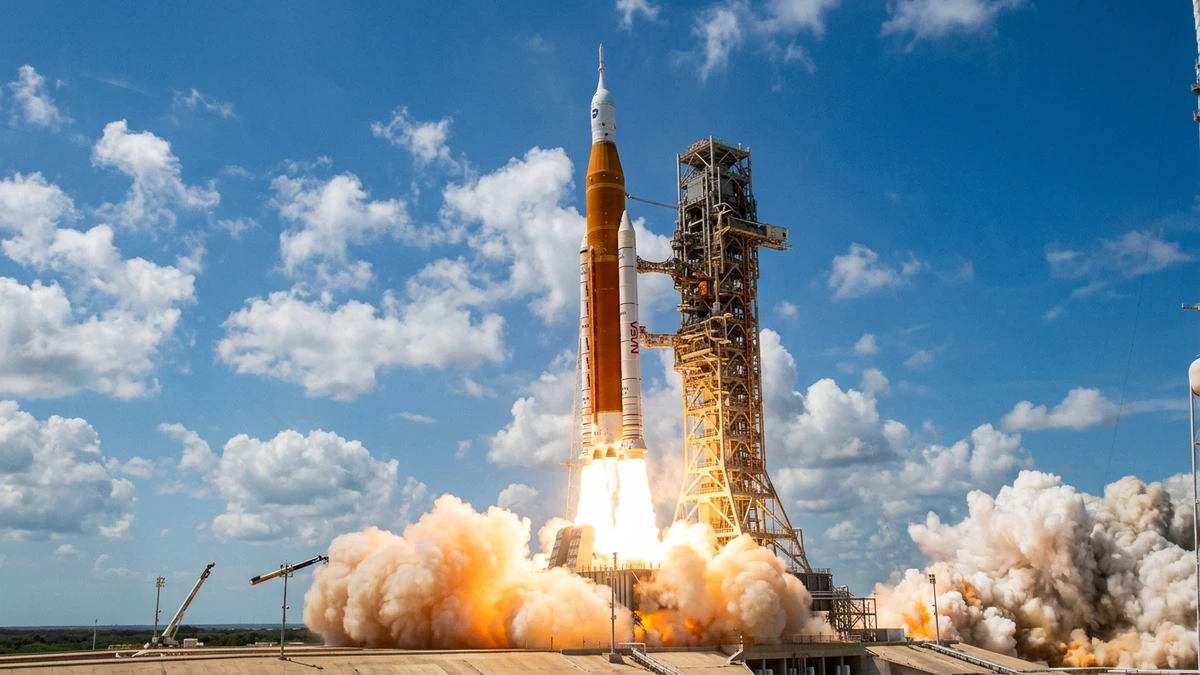
The Hardware: SLS, Orion, and the Landers
Artemis uses a combination of NASA-developed and commercially built vehicles: a deliberate architecture that spreads risk, drives down cost over time, and leverages the capabilities of the private space industry that has grown enormously since Apollo.
| Height | 98 metres (Block 1 configuration) |
| Thrust at liftoff | 8.8 million pounds (39 MN) |
| Trans-lunar payload | 27,000 kg (Block 1) |
| Core stage engines | 4 × RS-25 (shuttle heritage) |
| Boosters | 2 × five-segment solid rocket boosters |
| Flights to date | 2 (Artemis I & II) |
| Crew capacity | 4 astronauts |
| Mission duration | Up to 21 days |
| Heat shield | AVCOAT ablative, rated for 2,760°C re-entry |
| Service module | Built by ESA (European Service Module) |
| Artemis II name | Integrity |
| Status | Flight proven, 2 successful missions |
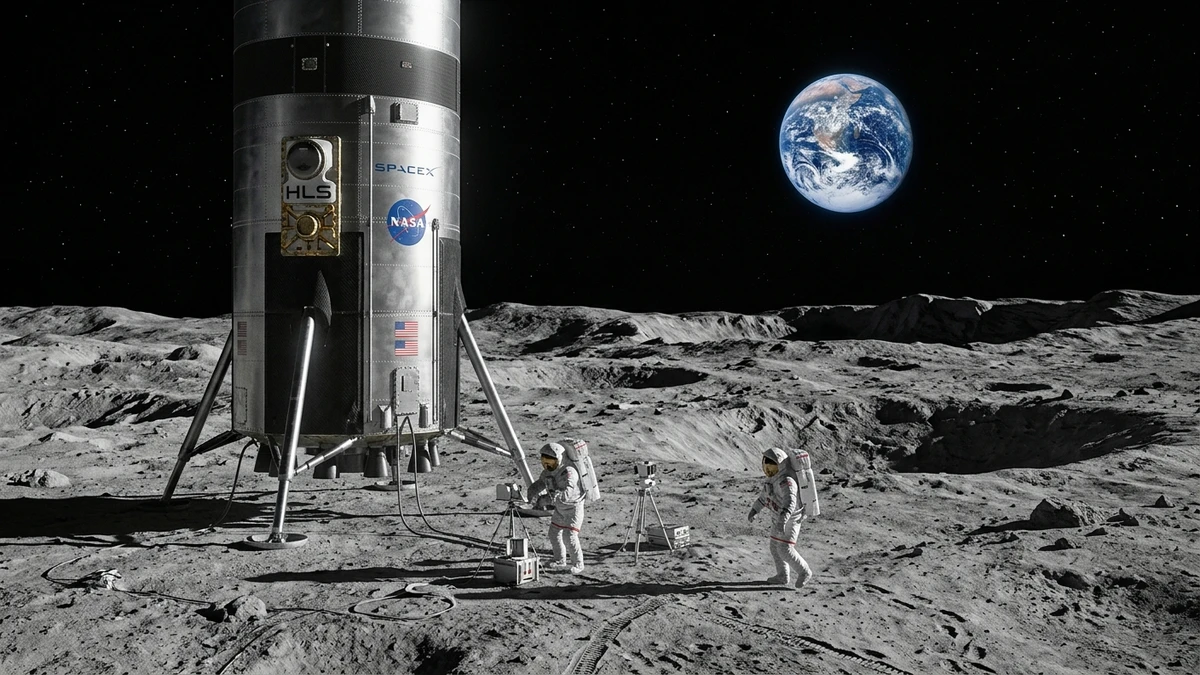
| Role | Crew descent to and ascent from lunar surface |
| Launch vehicle | Starship (launches separately from Orion/SLS) |
| Unique requirement | Propellant transfer in orbit (not yet demonstrated) |
| Selected | April 2021, sole HLS provider initially |
| Competition added | October 2025 (Blue Origin added following delays) |
| Status (Aug 2026) | Propellant transfer demo scheduled late 2026; design cert review outstanding |
| Role | Alternative crewed lunar lander |
| Current variant | Mark 1.5 (in development, based on Blue Moon Mark 1) |
| Why added | Competition introduced after Starship HLS delays |
| Status (Aug 2026) | Mark 1.5 in development; cargo Mark 1 tested and flight-ready for Moon Base I |
The two-lander competition is a significant shift from NASA's original approach. In 2021, NASA controversially selected only SpaceX's Starship as its human landing system, triggering a protest from Blue Origin. In October 2025, facing mounting concerns about Starship HLS timelines, NASA opened the competition again, essentially creating a backup option if Starship is not ready for Artemis IV. Both landers are now expected to be tested in Earth orbit during Artemis III in late 2027.
One of the bigger behind-the-scenes changes to Artemis was the cancellation of the more powerful SLS Block 1B variant. The original plan called for SLS to evolve to use a larger upper stage called the Exploration Upper Stage (EUS), requiring a new launch tower (Mobile Launcher 2). Both were years behind schedule and billions over budget, and were scrapped in early 2026. NASA will instead fly a standardised "near Block 1" configuration across all missions: the same rocket, built repeatedly. As Isaacman put it: "Launching a rocket as important and as complex as SLS every three years is not a path to success." Frequency over capability.
NASA's Moon Base: The Permanent Lunar Outpost Plan
In April 2026, within days of Artemis II splashing down, NASA Administrator Jared Isaacman announced the cancellation of the Lunar Gateway space station and its replacement with something more ambitious: a permanent Moon Base. (NASA first unveiled the pivot under the name "Project Ignition"; it now refers to the programme simply as the Moon Base.)
"We're not going to the Moon to plant a flag and leave. We're going to stay."
· NASA Administrator Jared Isaacman, April 2026Gateway was a planned small space station in lunar orbit that astronauts would dock with before descending to the surface. It had been in development for years, and ESA had already delivered the HALO habitation module, a €1 billion piece of hardware, when the cancellation was announced. Three European astronaut seats that had been tied to Gateway missions are now uncertain.
The Moon Base replaces Gateway with a fundamentally different vision: get to the surface faster, build infrastructure there, and establish a permanent presence before China does. It is structured as a roughly $30 billion plan in three phases. Phase one, through 2028, is a wave of robotic landers and rovers: the first missions, Moon Base I, II and III, fly on Blue Origin's Blue Moon Mark 1, Astrobotic's Griffin and Intuitive Machines' Nova-C Trinity, with crewed rover contracts awarded to Astrolab and Lunar Outpost in May 2026. Phase two (roughly 2029–2032) brings habitats and regular crewed visits. Phase three (2033 onwards) aims for a semi-permanent presence with a small nuclear power source and water-ice mining. The target is an operational surface outpost around 2030.
Why cancelled Gateway?
Speed and CompetitionGateway added complexity and time to every crewed mission: astronauts had to rendezvous with the station before descending, adding days and mission risk. The Moon Base puts infrastructure on the surface directly, cutting the mission profile. The pivot was also explicitly driven by the race against China's 2035 ILRS target.
Robotic missions first
Infrastructure FirstStarting in 2026 with Moon Base I, II and III, a steady stream of commercial robotic landers will deliver rovers, power systems, communications arrays, science packages, and eventually habitat modules to the south pole ahead of crews. This mirrors how the International Space Station was built: robots and cargo first, then long-duration human habitation.
ESA's HALO module
The Cost of CancellationESA had already delivered its HALO habitation module to NASA, built by Thales Alenia Space in Italy, before Gateway was cancelled. Three European astronaut seats that had been allocated to Gateway missions are now unconfirmed. ESA chief Josef Aschbacher said he must 'negotiate' with NASA over their future. This remains an open diplomatic issue within the Artemis partnership.
~$30 billion
Moon Base BudgetThe scale of the Moon Base reflects the political urgency behind Artemis: roughly $30 billion across three phases over the decade, about $10 billion each, the largest NASA budget commitment to lunar exploration since Apollo. Funding beyond 2026 is not yet secured, and the proposed 2027 NASA budget faces opposition in Congress.
The Artemis Accords: 70 Nations, One Framework
Artemis is not just a NASA programme: it is a geopolitical coalition. The Artemis Accords, first established in 2020, are a set of principles governing responsible behaviour in space. By August 2026, 70 countries have signed them (Mauritius became the 70th in July), making the Accords the largest multilateral space agreement ever assembled.
| Transparency | Signatories commit to open publication of their space plans and activities |
| Interoperability | Systems and infrastructure should be designed to work with other nations' equipment |
| Safety zones | Operations should establish zones around active missions to prevent interference |
| Resource rights | Extraction of space resources is permissible under the Outer Space Treaty framework |
| Deconfliction | Nations should notify others if their activities could cause interference |
| China's position | Not a signatory. Has described the Accords as a US tool for space hegemony |
The Accords are significant not as binding law (they are not a treaty) but as a statement of which nations are operating in the American-led framework and which are not. China and Russia are notably absent. The 70 signatories form the diplomatic backing for US lunar activities, and in practice represent the partner pool from which future mission participants will be drawn.
The resource rights section is particularly consequential. By affirming that space resource extraction is permissible, the Accords establish a US-backed legal interpretation that water ice mined from lunar craters can be owned and used by the entity that extracts it. China, which also intends to use lunar water ice, has not accepted this framework.
The Artemis II Crew: Who Flew Around the Moon
How Artemis II unfolded
- February 2026: days after a successful wet dress rehearsal, a helium flow fault in the upper stage sent the rocket back to the Vehicle Assembly Building and ruled out a March launch.
- March 2026: engineers traced the fault to a dislodged seal in a quick-disconnect fitting, repaired it, rolled back out and confirmed 1 April as launch day.
- 1 April 2026, 23:24 BST: lift-off from Kennedy Space Center, the first crewed mission to the Moon in 54 years.
- 6 April 2026: closest approach, 4,070 miles (6,550 km) from the Moon, beating Apollo 13's distance record; the crew watched Earthrise over the far side and a 54-minute solar eclipse from deep space.
- 10 April 2026: Pacific splashdown after ten days, the furthest any humans have travelled from Earth.
Reid Wiseman
Commander: US Navy, NASA AstronautMission commander. A US Navy test pilot and NASA astronaut who previously served as commander of ISS Expedition 41. Selected as Artemis II commander in 2023. Led the crew through the first crewed deep space mission in 54 years.
Victor Glover
Pilot: First African American Beyond LEOPilot of Orion. US Navy aviator and NASA astronaut. The first African American to travel beyond low Earth orbit in history. Previously flew to the ISS on SpaceX Crew Dragon in 2020.
Christina Koch
Mission Specialist: First Woman on Lunar TrajectoryThe first woman to travel on a lunar trajectory. Koch holds the record for the longest single spaceflight by a woman (328 days on the ISS in 2019–2020). Selected as the first woman to fly toward the Moon.
Jeremy Hansen
Mission Specialist: First Non-American on Lunar MissionCanadian Space Agency astronaut. The first non-American to fly on a lunar trajectory, a historic milestone for international space collaboration. Selected as Canada's contribution to the Artemis partnership.
What the US Wants From the Moon
Artemis has layered objectives: some scientific, some economic, some strategically geopolitical. Understanding all of them is essential to understanding why the programme exists and why it is accelerating.
Return to scientific leadership in space exploration. NASA has not landed humans on the Moon since 1972. The scientific questions that remain (the history of the inner Solar System, the origin of Earth's water, the geology of the south polar region) require human explorers, not just robots. Artemis will allow astronauts to conduct field geology, collect diverse samples, and deploy long-duration surface instruments.
Develop and prove deep space technology for Mars. The Moon is 3 days away; Mars is up to 9 months away. Artemis is explicitly framed by NASA as the proving ground for life support, propulsion, in-situ resource utilisation, and crew health technologies that will eventually be needed for a Mars mission. Every lunar surface operation is a Mars analogue test.
Secure water ice access at the south pole. Water ice can be electrolysed into hydrogen and oxygen: rocket propellant. A Moon base that can produce its own propellant becomes a refuelling depot for missions to Mars and beyond, transforming the economics of deep space exploration. The south pole deposits are the key enabler for everything that follows.
Maintain strategic leadership in space against China. This is the least-discussed but most politically powerful driver. NASA's accelerated timeline (a rapid run of crewed landings from 2028, the roughly $30 billion Moon Base programme, the cancellation of Gateway to save time) all reflect a direct response to China's stated 2029–2030 crewed landing target. Administrator Isaacman has explicitly referenced the China factor when explaining the Moon Base's scope and urgency.
How Does Artemis Compare to China's Programme?
As of August 2026, the US has a meaningful but not decisive lead. Artemis II has flown; China's equivalent crewed mission (a lunar flyby) has not yet been scheduled. NASA is targeting its first crewed landing approximately one to two years ahead of China. But the gap is not as wide as the historical Apollo era, and on long-term infrastructure, China has more specific commitments.
| Crewed Moon flyby | US ✅ Complete (Artemis II, April 2026) · China: not yet flown |
| First crewed landing | US targets 2028 (Artemis IV) · China targets 2029–2030 |
| Permanent base target | US: ~2030 (Moon Base) · China: 2035 (ILRS Phase 1) |
| Landing site | Both targeting lunar south pole |
| Power plans | US: solar primary · China/Russia: nuclear reactor |
| International backing | US: 70 Artemis Accords signatories · China: 17 ILRS countries |
| Key risk | US: Starship HLS certification · China: Long March 10 development |
The most important uncertainty for the US timeline is Starship HLS. As of August 2026, SpaceX has not yet completed an orbital propellant transfer demonstration, a technically demanding process of moving liquid oxygen and methane between spacecraft in orbit, which is required before Starship can be certified to carry crew to the Moon. The demonstration is now scheduled for late 2026: two Starships will launch separately, dock in orbit, and transfer several tonnes of propellant between them. The design certification review has also not been completed. If Starship HLS slips further, Blue Moon's readiness becomes critical to keeping Artemis IV in 2028.
What to Watch For
The next 18 months are critical. The Starship HLS propellant transfer demonstration, now scheduled for late 2026, will tell us whether the primary lunar lander is on track for Artemis III in late 2027. Blue Origin's progress on Blue Moon Mark 1.5 will tell us how robust the backup option is. And the Moon Base programme's first robotic landers (Moon Base I, II and III) will show whether the surface infrastructure push is real or aspirational. The signs there are good: all four Phase One landers cleared environmental testing in August 2026, and Moon Base I is targeted for no earlier than autumn 2026 despite Blue Origin's New Glenn pad explosion in May.
For China's side of the race, Chang'e 7 is still the most important near-term event: it will characterise the lunar south pole in detail and directly identify the site where China plans to build its base. Its planned 24 August 2026 launch was postponed at the last minute as a typhoon approached the Wenchang launch site, and no new date has been announced. The two programmes are converging on the same patch of lunar real estate, and neither has clear right of way.
WatchTheStars will be covering every mission and milestone as they happen. See the China Moon Program deep-dive and the Moon Race hub page for the full picture of both sides of the race.
Watch the Moon while you wait for Artemis
Kit we've tested and reviewed in full
Every Artemis milestone points at the same patch of sky. A small telescope brings the lunar south pole close enough to see the craters these missions are actually aiming for.

A tabletop reflector with enough aperture to resolve craters, mountain ranges and the terminator line in real detail on any clear night.

A smart scope that finds and tracks the Moon automatically and streams the view to your phone, no setup faff, just point and watch.
Affiliate links: you pay the same price, we earn a small commission that helps keep WatchTheStars free.
Related Posts
Sources and Further Reading
- Artemis II · Wikipedia
- Artemis III · Wikipedia
- Artemis program · Wikipedia
- Artemis II mission page · NASA
- NASA welcomes Artemis II moonfarers back to Earth · NASA
- Starship HLS · Wikipedia
- Human Landing Systems · NASA
- NASA OIG: Management of the Human Landing System Contracts · NASA
- Artemis 3 and beyond: What's next after Artemis II · Space.com
- US–China space race accelerates · Christian Science Monitor
- NASA joins Artemis III Orion modules; rocket hardware update · NASA
- NASA provides update on Moon Base rovers, landers, missions · NASA