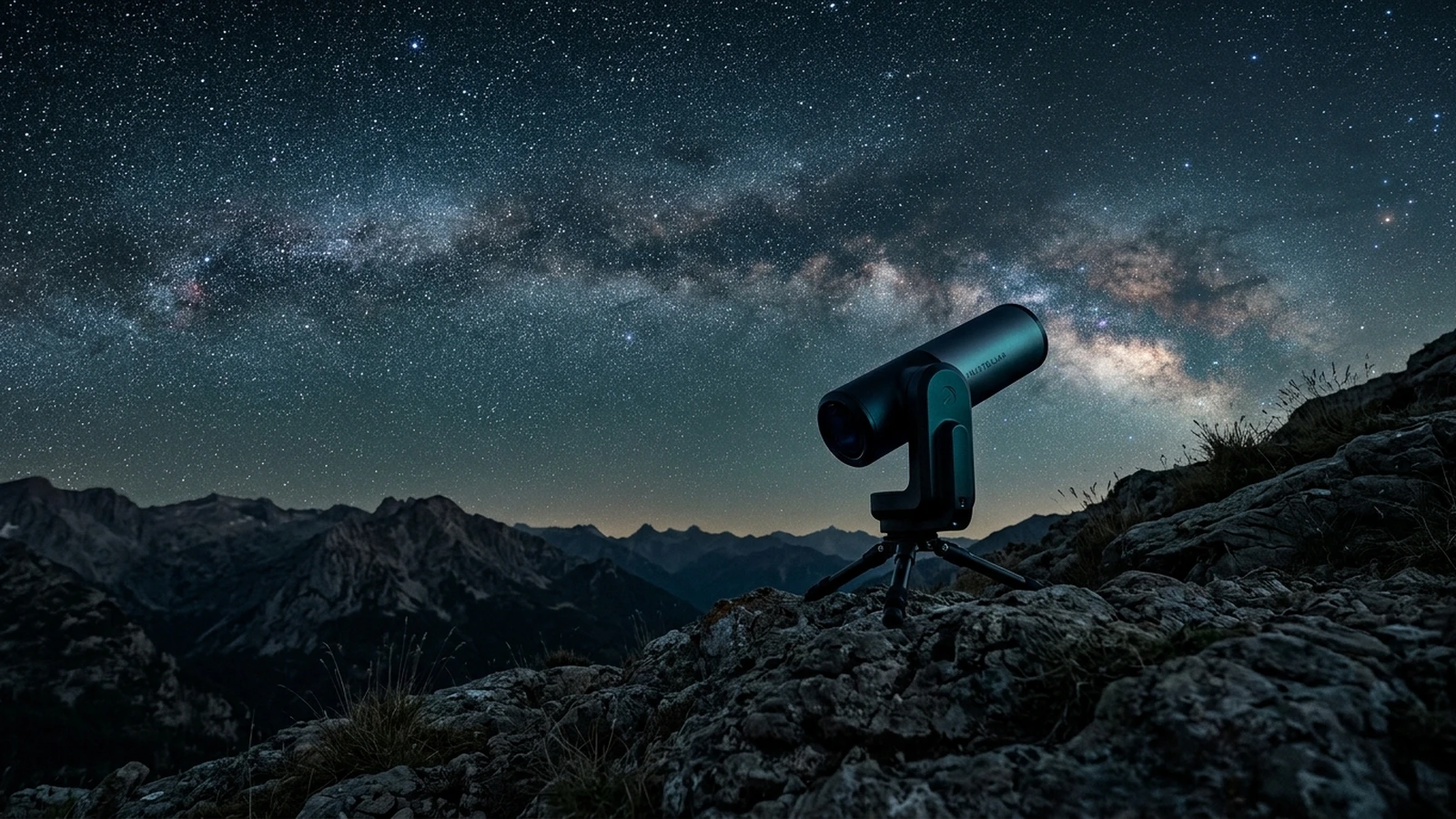
DwarfLab Dwarf Mini
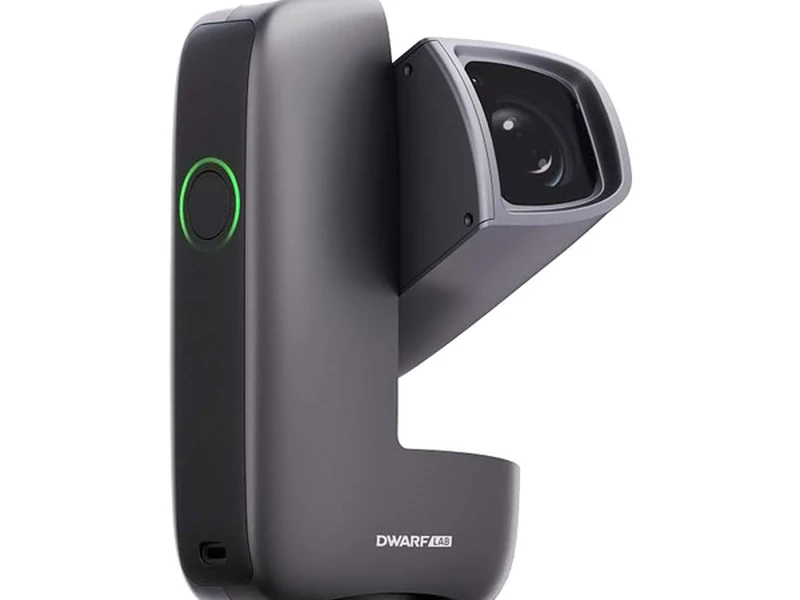
| Key Specifications: DwarfLab Dwarf Mini | |
|---|---|
| Aperture | 30mm |
| Focal Length | 150mm (f/5) |
| Sensor | Sony IMX462: 2.1MP, 1/2.8" CMOS |
| Filters | Built-in Astro, dual-band Hα + OIII and dark-frame filters, switched in the app |
| Lens Configuration | Single lens (telephoto only) |
| Mount | Built-in motorised alt-azimuth with tracking |
| Connectivity | Wi-Fi (2.4GHz + 5GHz), DWARF app (iOS & Android) |
| Battery | Built-in, ~9 hours per charge |
| Weight | ~840 g |
| Warranty | 2 years (via First Light Optics) |
| Best For | Beginner astrophotography, the Moon, star clusters, nebulae, travel stargazing |
Who Is the Dwarf Mini For?
The Dwarf Mini is the right starting point if you want to try astrophotography without spending more than £400, and without committing to a complex traditional setup. It makes sense if:
- You're brand new to astrophotography. The Dwarf Mini removes every barrier to entry: no polar alignment, no calibration frames, no astrophotography software to learn. Set it down, open the DWARF app, point at something bright, and start imaging. Your first recognisable nebula photo could be in your hands within 20 minutes.
- You travel or stargaze away from home. At around 840g and compact enough to pack in a small bag, the Dwarf Mini is genuinely portable in a way that most optical telescopes are not. It's the kind of kit you actually bring on a camping trip or dark-sky getaway.
- You're not sure yet how committed you are. Spending £459 on a Dwarf 3 before you know whether you'll use it regularly is a real risk. The Dwarf Mini at £389 is a lower-stakes way to find out whether smart telescope astrophotography is for you. If it captures you (it likely will), upgrading later is a reasonable path.
- You want to share the night sky with family or kids. A smart telescope connected to a phone or tablet screen is far more engaging for a group than queuing to look through an eyepiece. The Dwarf Mini's accessible price makes it a compelling family stargazing tool.
The Dwarf Mini is not the right choice if you want the highest resolution images in the DwarfLab range, or if the wide-angle all-sky capability of the Dwarf 3 appeals to you. For those priorities, the Dwarf 3 is the better option.
The Single-Lens Design: What You Get (and Don't Get)
The Dwarf Mini uses a single 30mm f/5 telephoto lens: the same 150mm focal length as the Dwarf 3's main lens, but a smaller aperture. This means the core imaging capability is close, but not identical: the same focal length and a similar field of view on the primary target, with a slightly narrower light-gathering aperture than the Dwarf 3's 35mm. What changes most is the sensor and the absence of a second lens.
The Sony IMX462 sensor in the Dwarf Mini is a well-regarded 2.1MP CMOS chip, used in astronomy cameras at higher price points. It performs well in low light, which matters for deep-sky imaging. The trade-off compared to the Dwarf 3's IMX678 is lower resolution and less fine detail in the final stacked image, you'll see the Orion Nebula clearly, but with less fine structure than the higher-res sensor can reveal.
There's no wide-angle lens. You can't simultaneously capture an all-sky view or run an Milky Way timelapse alongside your main target. If those use cases matter to you, the Dwarf 3 is the model to buy. If you simply want a straightforward single-target smart telescope experience, the Dwarf Mini does the job cleanly.
What Can You Image?
The Dwarf Mini's 30mm aperture and auto-stacking firmware handles the same range of targets as any compact smart telescope. These are the highlights:
Nebulae
The Orion Nebula (M42), Lagoon Nebula (M8), and Omega Nebula (M17) are accessible from suburban skies. The structure is visible; finer detail benefits from darker conditions and longer stacking runs.
Galaxies
Andromeda (M31) is the showpiece target: the elongated core and dust lanes are identifiable with a good stack. Smaller galaxies like M81 and M82 in Ursa Major show up from darker sites.
Star Clusters
Open clusters like the Pleiades, Beehive (M44), and Double Cluster in Perseus are quick wins on any clear night. Globular clusters like M13 in Hercules resolve into a dense ball of stars.
The Moon
Lunar imaging is one of the Dwarf Mini's strongest suits. Craters, mountain ranges, and the curved limb all photograph well. A full-Moon session is a satisfying first test for new owners.
Planets
Saturn's rings and Jupiter's main cloud belts are visible. A 30mm aperture isn't a planetary specialist, but the results are more than just a dot, especially at opposition.
Comets & Bright Transients
When a bright comet comes through, and they do, the Dwarf Mini's tracking and stacking makes comet imaging straightforward. One of the more satisfying things a compact smart telescope does well.
What Buyers Say
7 reviews at First Light Optics, a smaller sample than the Dwarf 3, but the sentiment is consistently positive. Key themes from verified buyers:
Genuinely easy to use from the start. First-session success is a recurring theme. The DWARF app guides you through alignment and target selection in a way that doesn't require any prior astronomy knowledge.
Portability is the standout feature. Buyers specifically mention taking it out on garden chairs, balconies, camping trips, and holidays. The lightweight build and long battery life make it a take-anywhere option in a way that most telescopes are not.
Good enough for social sharing and prints. Results from the IMX462 sensor are sharp enough to share, multiple buyers mention posting their first nebula or galaxy image online to positive reactions.
DWARF app is polished and regularly updated. DwarfLab continue to push firmware and app improvements post-launch. Some early software limitations reported in older Dwarf II reviews have been addressed in the current generation.
Known Limitations & Tradeoffs
- 2.1MP sensor has a resolution ceiling. The IMX462 is a good sensor, but 2.1MP means you won't extract the same level of fine detail as the Dwarf 3's 8.3MP IMX678, especially on galaxies and tight nebula cores. For casual sharing and prints up to A4, it's perfectly adequate.
- No wide-angle lens. Unlike the Dwarf 3, the Mini is single-target. You can't simultaneously run an all-sky timelapse or use a second lens for context. If you think you'll want that capability, budget for the Dwarf 3 from the start.
- No eyepiece viewing. Like all smart telescopes, the Dwarf Mini is a camera device. There's no eyepiece: everything is on your phone screen. If the experience of looking through an eyepiece matters to you, consider a traditional telescope instead.
- Wi-Fi dependent. The telescope is controlled entirely through the DWARF app over Wi-Fi. Interference or connection issues can interrupt sessions. Most users don't experience problems, but the dependency is worth noting.
- 30mm aperture limits light-gathering. This applies to any compact smart telescope, including the Dwarf 3. Fainter targets require good skies and patient stacking. The Dwarf Mini handles everything listed in the imaging section above; it just takes longer in worse conditions.
Accessories for the Dwarf Mini
DwarfLab Mini Tripod with Fluid Head
A compact aluminium tripod designed for both the Dwarf Mini and the Dwarf 3. Adjusts from 25cm to 53cm via 5 twist-lock leg sections, with a fluid head for smooth repositioning. At 790g folded to 25cm, it travels well. The Dwarf Mini's own stand works on flat surfaces; this tripod gives you flexibility in the field. A sensible addition if you plan to use it away from a garden table.
£73 View at FLO →Note: the Astro Essentials Magnetic Bahtinov Focusing Mask (£22) is designed specifically for the Dwarf 3 and is not compatible with the Dwarf Mini.
How the Dwarf Mini Compares
The Dwarf Mini is the entry point in a three-way comparison. The DwarfLab Dwarf 3 (£459) adds a higher-resolution 8.3MP sensor and a second wide-angle lens for all-sky capture, if those features matter to you, the £86 step up is worthwhile. The ZWO Seestar S50 (£539) takes a different approach: same 2.1MP sensor as the Dwarf Mini, but with a built-in dual-band narrowband filter that transforms nebula imaging from light-polluted locations.
For a first smart telescope, the Dwarf Mini gets you the full experience at the lowest cost. If nebulae are your main target, the Mini's built-in dual-band filter will get you started, but the S50's larger aperture makes a strong case for spending more from the start. For a full head-to-head between those two flagship models, see our Seestar S50 vs Dwarf 3 comparison.
Read our full Dwarf 3 guide → Read our full Seestar S50 guide →