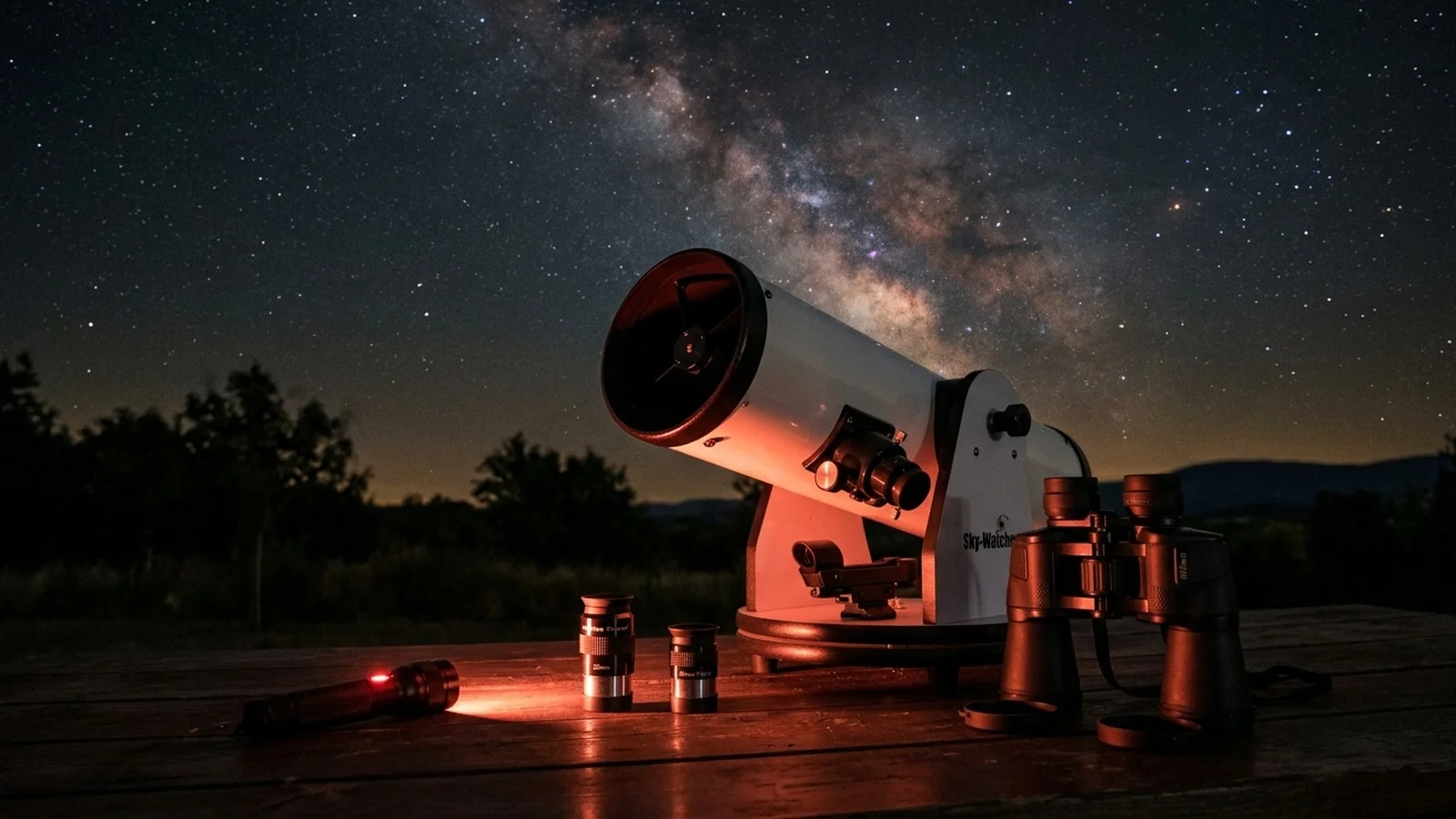
Sky-Watcher Skyliner 250PX FlexTube
| Sky-Watcher Skyliner 250PX FlexTube Specifications | |
|---|---|
| Aperture | 254mm (10") |
| Focal Length | 1200mm (f/4.7) |
| Mount Type | Manual Dobsonian alt-azimuth (FlexTube collapsible) |
| Tube Design | FlexTube: collapses to ~65% of full length for storage and transport |
| Weight | ~32kg total (tube ~12kg, base ~20kg) |
| Included Eyepieces | 10mm and 25mm (1.25") |
| Focuser | 2" dual-speed Crayford + 1.25" adapter |
| Finder | 9×50 right-angle finder scope |
| Light Gathering vs 8" | 60% more light than the Skyliner 200P |
| Price | ~£619 |
Skyliner 250PX vs Skyliner 200P: What's the Difference?
The jump from the Skyliner 200P (8") to the 250PX (10") is the same kind of step as going from a 130mm to a 200mm. The numbers don't look dramatic, two extra inches, but the physics is meaningful. A 10-inch mirror collects 60% more light than an 8-inch. That's the difference between hinting at detail and clearly seeing it.
On planets, 10 inches means you can push magnification higher without the image falling apart. Saturn's Cassini Division is obvious rather than tentative. Jupiter's belt structure becomes complex (multiple bands, festoons, white ovals) rather than just two dark stripes. On Mars at opposition, surface markings and polar cap detail become genuinely rewarding rather than a challenge requiring perfect seeing.
On deep-sky objects, faint galaxies cross the threshold from "a smudge" to "a structured object with a brighter core and detectable spiral arms on good nights." Globular clusters fully resolve to the centre. Planetary nebulae show real internal structure.
Why Buy the FlexTube Version?
The FlexTube design is the key practical advantage over the standard solid-tube Skyliner 250P. Three metal struts connect the upper mirror cell to the lower tube section, and the tube compresses down to roughly 65% of its full deployed length for storage and transport.
In practice, this matters a lot at 10 inches. The full tube of a standard 250P stands over 130cm tall: too long to fit in most car boots without folding down seats or using a van. The FlexTube collapses to around 85cm, which fits more easily in a typical hatchback or estate boot alongside the Dobsonian base.
The FlexTube design also means faster cooling: the open truss structure allows airflow around the primary mirror, reducing the thermal equilibration time compared to an enclosed tube. With a 254mm mirror, waiting 45–60 minutes for a solid-tube scope to cool is normal; the FlexTube typically cuts that by 15–20 minutes.
One trade-off: the open truss is slightly more susceptible to stray light and dew on the secondary mirror on humid nights. A dew shield or cover for the upper section is worth having.
Who Is the Skyliner 250PX For?
- Existing 8" Dobsonian owners ready for more: this is the natural next aperture step that justifies the upgrade
- Serious deep-sky observers who want to push beyond Messier objects into NGCs, faint galaxy groups, and small planetary nebulae
- Advanced planetary observers who want to see genuine planetary detail rather than hints of it: particularly valuable on Saturn and Jupiter
- Observers wanting to resolve Uranus and Neptune's moons: at 10 inches, Triton (Neptune's largest moon) becomes a challenging but achievable target on excellent nights
- People with car transport: the FlexTube helps, but you still need a car. This is not public-transport equipment.
This is not a beginner scope. If you don't yet own a telescope, start with the Heritage 130P or Heritage 150P first. The 250PX rewards observers who know what they're looking for and how to find it.
What Can You See with the Skyliner 250PX?
At 10 inches, the sky genuinely opens up. Here's what changes compared to the 8-inch:
Saturn
Cassini Division obviously visible across the full ring ansae. Cloud banding across the globe is complex rather than simple. Multiple moons resolved including Titan, Rhea, Dione, and Tethys simultaneously.
Jupiter
Multiple belt pairs with festoons and white ovals visible on good seeing nights. The Great Red Spot shows internal structure. Moon shadow transits are dramatic high-contrast events.
Faint Galaxies
NGC objects that were invisible or barely detectable at 8 inches become genuine targets. Galaxy pairs, compact groups, and the fainter members of clusters become observable.
Globular Clusters
M13, M5, M22 resolve completely to the core. Smaller, fainter globulars show star resolution rather than just a glow. Omega Centauri (from southern UK) becomes spectacular.
Neptune & Triton
Neptune shows a definite blue-grey disc at high magnification. Triton is a challenging but achievable target at 14th magnitude on excellent nights with steady seeing.
Uranus & Moons
Uranus's disc is clearly resolved with subtle greenish colour. The five major moons (Ariel, Umbriel, Titania, Oberon, Miranda) are within range under dark skies.
What Buyers Say About the Skyliner 250PX
"The jump from 8 to 10 inches is larger than the numbers suggest." Observers moving from a 200P to a 250P consistently report being surprised by how much more they can see: not just marginally more, but a meaningful qualitative step in what's accessible.
FlexTube is the right choice at 10 inches. Forum consensus is that the standard solid-tube 250P is cumbersome to transport and store. The FlexTube version's portability advantage at this aperture is significant enough to justify the price premium over a solid tube.
Dual-speed focuser is a genuine upgrade. The 250PX includes a dual-speed Crayford focuser: the fine adjustment makes achieving precise focus at high magnification considerably easier than the single-speed focusers on smaller scopes.
Long-term ownership is common. Many observers who buy a 250P stop upgrading. The aperture is sufficient for virtually any visual observing goal, and the FlexTube design manages the practicality issues that cause people to leave larger Dobsonians sitting unused.
Limitations to Know
- Still heavy. 32kg total is not trivial. Two trips (tube and base separately) is standard practice. The base alone is around 20kg.
- No motorised tracking. Like all manual Dobsonians, you nudge by hand to keep objects centred at high magnification. This becomes second nature but requires engagement throughout each session.
- Collimation is mandatory. Moving a 10-inch reflector will knock it slightly out of alignment. Plan 5–10 minutes of collimation before each session. A laser collimator makes this quick.
- Cooling time. The 254mm primary mirror takes 45–60 minutes to reach thermal equilibrium. The FlexTube design helps, but you still need to allow time for the mirror to settle on cold nights.
- Significant storage footprint. Even collapsed, the FlexTube and Dobsonian base take up a substantial garage or shed corner.
- Upper section dew susceptibility. The open truss exposes the secondary mirror to dew. A simple cover for the top section and periodic checks during sessions are recommended on humid nights.
Recommended Eyepieces and Accessories
BST StarGuider 8mm
The planetary eyepiece for this scope. At f/4.7, the 8mm delivers 150×: the sweet spot for Saturn and Jupiter on most nights. Excellent sharpness and eye relief.
See FLO for price Read our guide →Explore Scientific 68° 20mm
Takes advantage of the 2" focuser for wide-field deep-sky work. At 60×, this gives a true field of over 1°: ideal for sweeping globular clusters, open clusters, and nebulae.
See FLO for price Read our guide →Telrad Finder
The 9×50 finder supplied is good, but a Telrad as a primary finder makes target acquisition much faster. Use the Telrad to get close, then use the 9×50 to centre.
See FLO for price Read our guide →Sky-Watcher Skyliner 250PX: Is It Worth It?
The Skyliner 250PX sits above the Skyliner 200P in the Sky-Watcher Dobsonian range. If you're deciding between them, the question is whether 60% more light-gathering power justifies the jump from ~£340 to ~£619. For casual visual observing, the 8-inch is often enough. For observers who want to push into fainter objects, hunt planetary moons, or get the most out of exceptional seeing nights, the 250PX is the right call.
Beyond the 250PX, the next step would be a 12-inch or 14-inch Dobsonian: at which point portability and practicality become significantly more challenging. Many observers find the 10-inch to be the largest scope they can realistically use regularly, which makes the 250PX a long-term home for dedicated amateurs.