Key takeaways
- Six NASA photographs from Apollo 12 and 17 show luminous anomalies above the lunar horizon
- The images were specifically included in the Pentagon's PURSUE declassification package in May 2026
- Apollo 12 photographs show at least five separate anomalous light sources in the same frame
- Apollo 17 photographs show a blue-white cluster above the Taurus-Littrow valley
- No official NASA explanation for what appears in these images has been published
Jump to section 6 sections
The Photographs
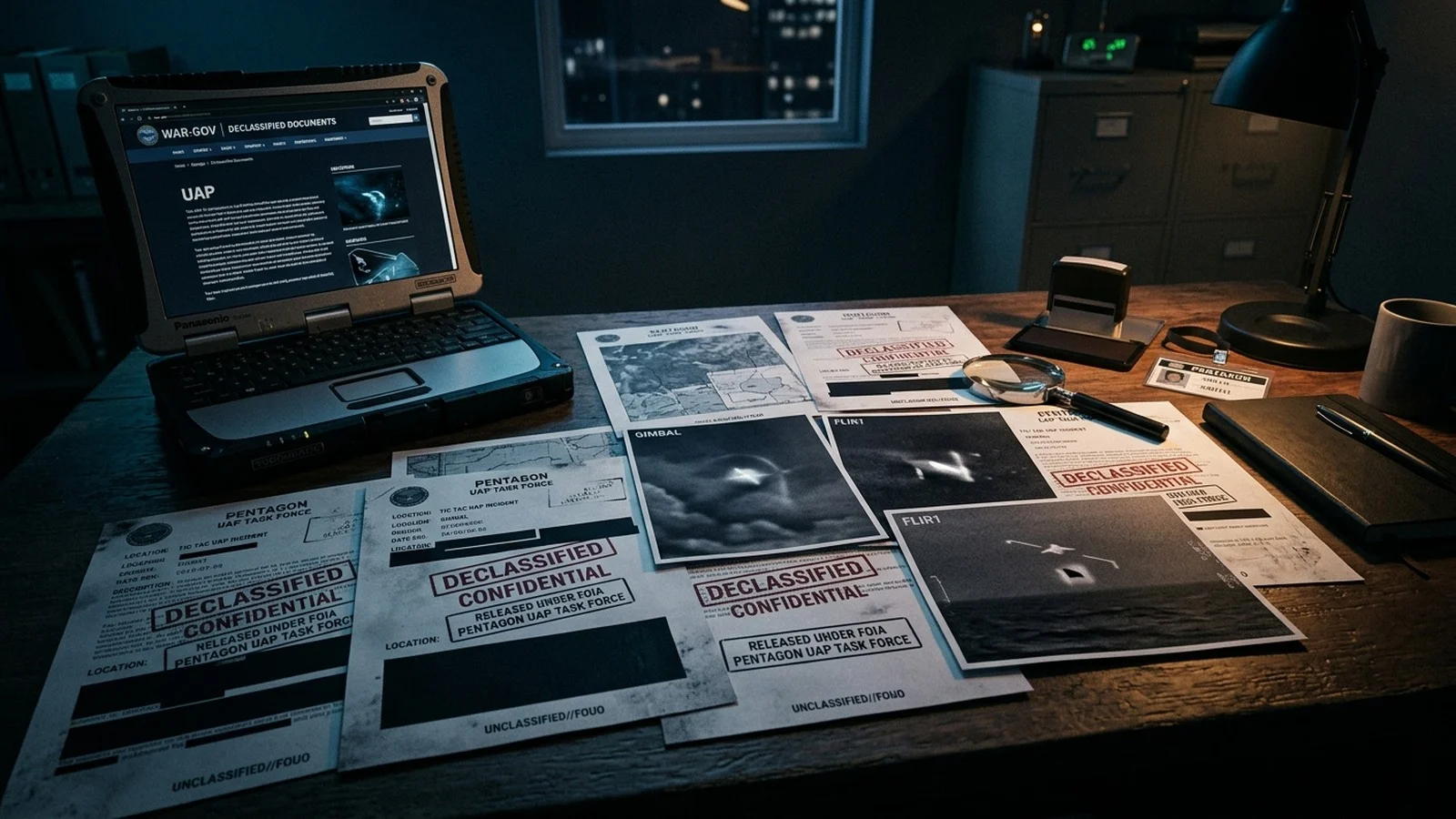
In May 2026, the Pentagon released a package of 162 declassified UAP documents under what has been internally designated the PURSUE programme. Most of the coverage focused on military intercept cases: the Hellfire missile, the Red Sea orbs, the Tehran F-4 incident. But buried inside the same package were six annotated NASA photographs from the Apollo programme.
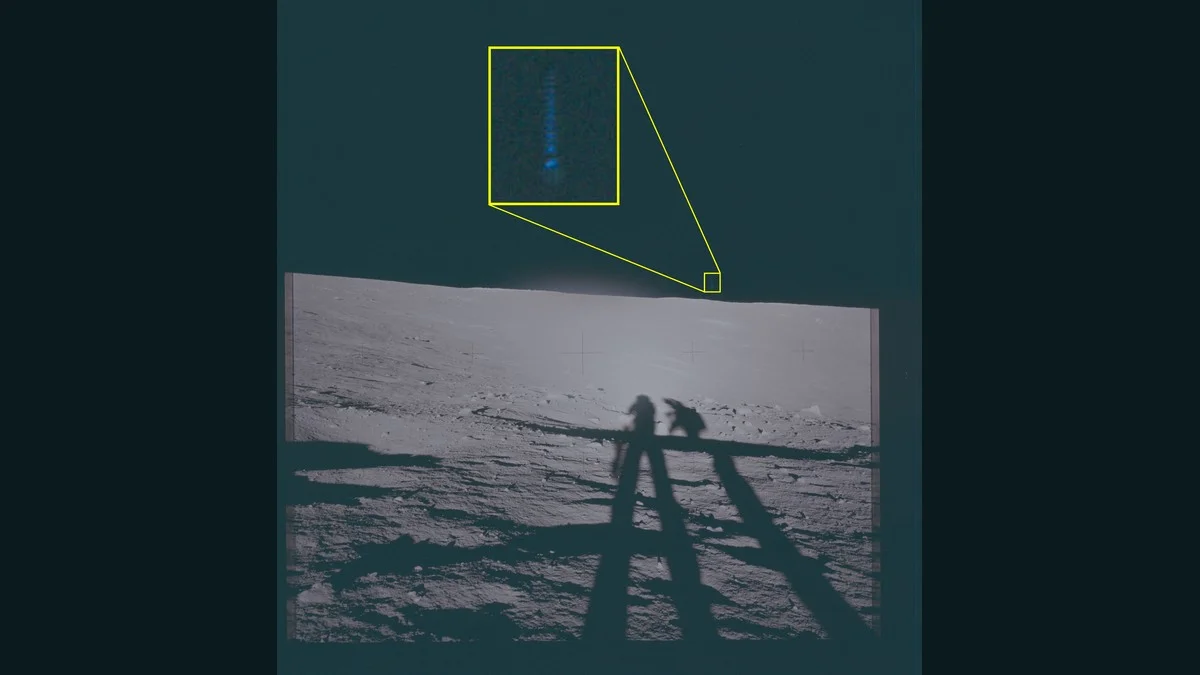
They came labelled NASA-UAP-VM1 through VM6. VM stands for Visual Material. Someone, at some point, went through the Apollo photographic archive and selected these six images specifically for inclusion in a UAP document release. Each one has been annotated with yellow bounding boxes and zoom insets, pointing to objects above the lunar horizon that appear in the original frames.
The photographs are real NASA originals. They weren't made for social media or a documentary. They were taken on the lunar surface during moonwalks, in 1969 and 1972, on film cameras with no digital post-processing. Whatever appears in them was there when the shutter opened.
What the Images Actually Show
The six photographs divide across two missions: five from Apollo 12 (November 1969) and one from Apollo 17 (December 1972). In every case, the main photograph shows a standard Apollo surface shot: the familiar grey regolith, long shadows from a low sun, the black sky of the airless Moon above the horizon. And in that black sky, annotated with yellow boxes and zoom insets, are light sources.
They are not spacecraft. They are not the Sun. They are not lens flares: the Hasselblad cameras used during Apollo EVAs are well-characterised and their optical artefacts are well-understood. They appear as distinct point sources or small clusters of light, some with visible colour (blue, red, white, orange), above the horizon in the lunar sky.
Some are single points. One frame from Apollo 12 has five separate annotated areas in the same image, each pointing to a different anomalous object. The PURSUE compilers evidently considered this significant enough to annotate all five separately, then provide individual zoom insets for each one.
Apollo 12: Multiple Objects in a Single Frame
Apollo 12 landed in Oceanus Procellarum in November 1969. Pete Conrad and Alan Bean spent nearly eight hours on the surface across two EVAs while Dick Gordon orbited above in Yankee Clipper. The photographs in the PURSUE package appear to have been taken during those EVAs.
The most striking image, VM5, shows a wide panoramic shot of the surface with five annotated areas in the same frame. Area 5, the largest zoom, shows a multi-coloured elongated object above the horizon: white at its core, with coloured elements around it. The other four areas show separate point-source lights, each in a different part of the sky.
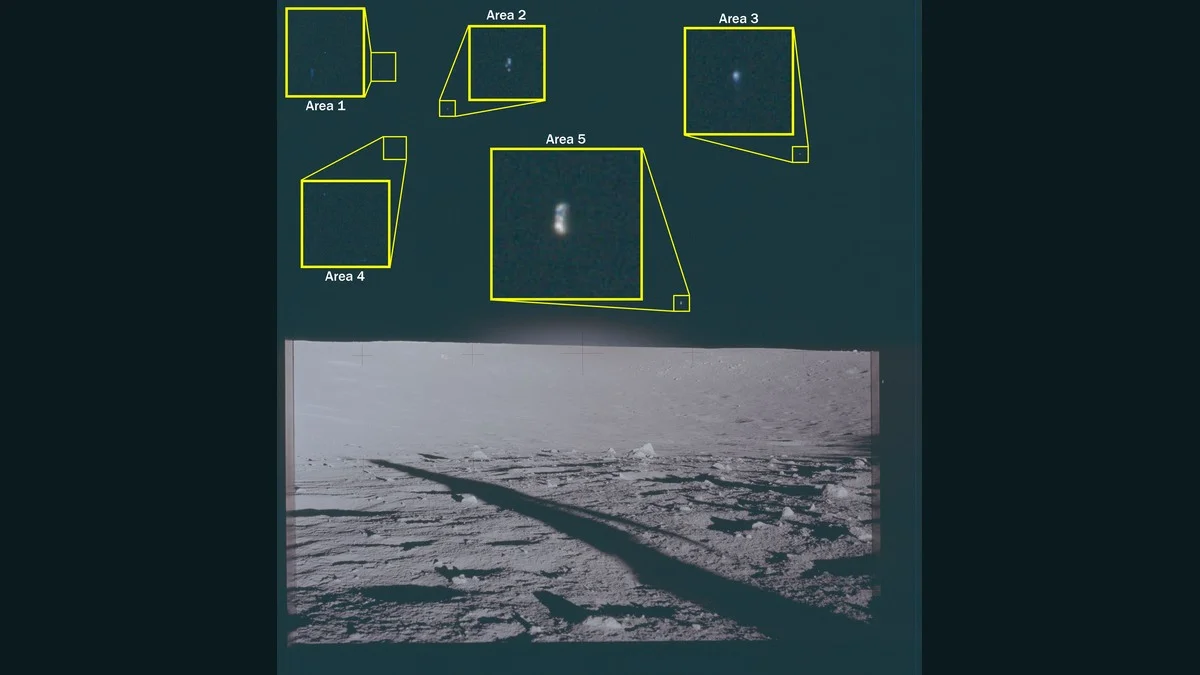
Other Apollo 12 images in the set (VM1, VM3, VM4) show individual objects: a blue elongated form above the horizon in one, a red-white point source in another, a warm orange point in a third. Each has been annotated and zoomed by whoever compiled the PURSUE materials.
Interestingly, the Apollo 12 flight transcript, also included in the PURSUE package, contains a passage from Alan Bean looking through the AOT (Alignment Optical Telescope) in the darkness: "You can see these lights, particles of light, flashes of light just seem to come from, which is the left one... some of those things are escaping the Moon. They really haul out of here and just press off at the stars." Bean was describing particles from the spacecraft's water boiler, but he wasn't certain, and the description matches nothing routine.
See the Moon These Photos Were Taken On
Kit we've tested and reviewed in full
You won't spot lunar anomalies from your back garden, but a decent pair of binoculars puts you in touch with the same landscape the Apollo crews photographed: craters, mountains and all.
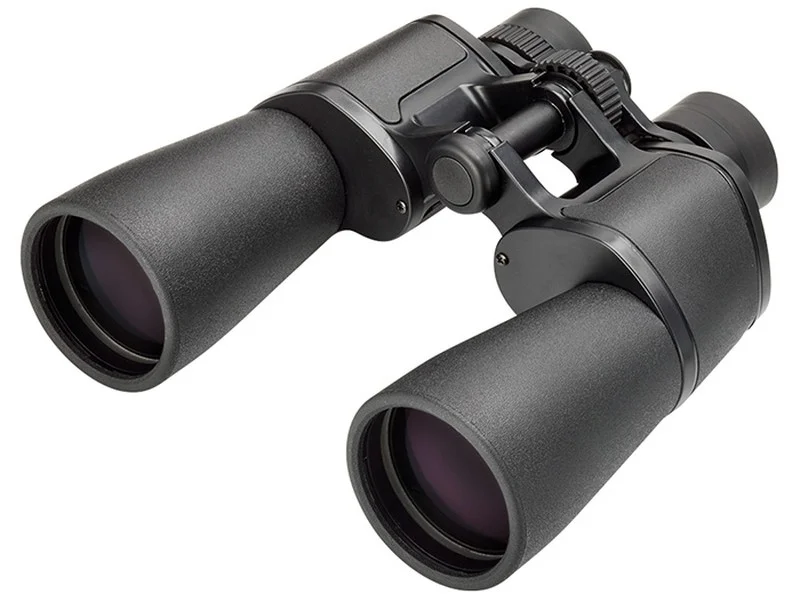
Sharp enough to trace the lunar terminator and pick out major features without any fuss.
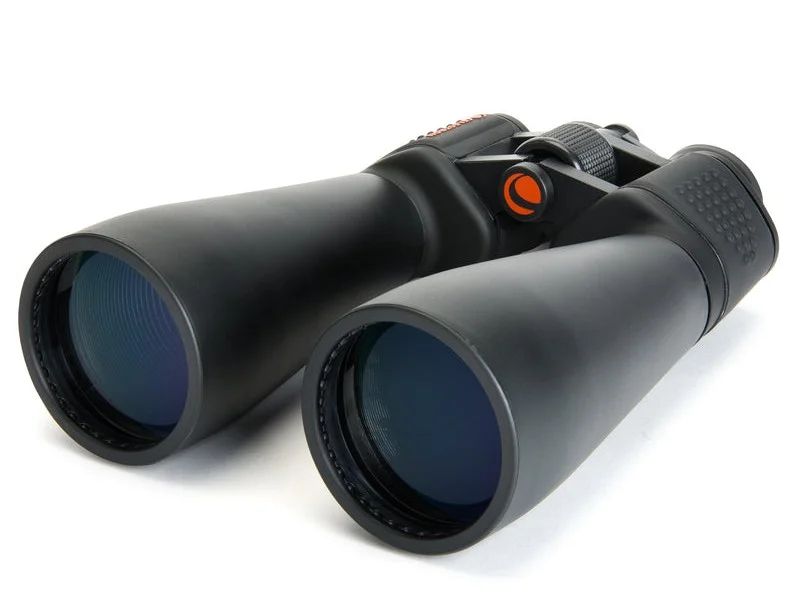
Bigger lenses reveal the kind of highland terrain seen around Taurus-Littrow, in far more detail than a standard pair.
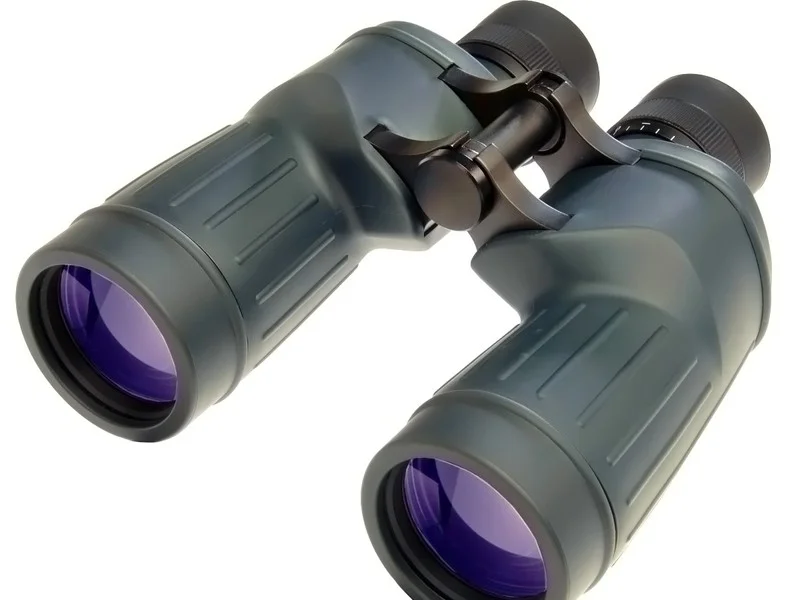
Crisper glass for anyone who wants their own long-term look at the Moon, mysteries and all.
Affiliate links: you pay the same price, we earn a small commission that helps keep WatchTheStars free.
Apollo 17: Above the Taurus-Littrow Valley
The Apollo 17 photograph (VM6) is different in character from the Apollo 12 images. The terrain is different: the highlands of the Taurus-Littrow valley, with actual mountains rising above the horizon rather than the flat Procellarum plains. And the object annotated in the image is not a single point source: it's a blue-white cluster of lights, grouped together, hanging above the mountains.
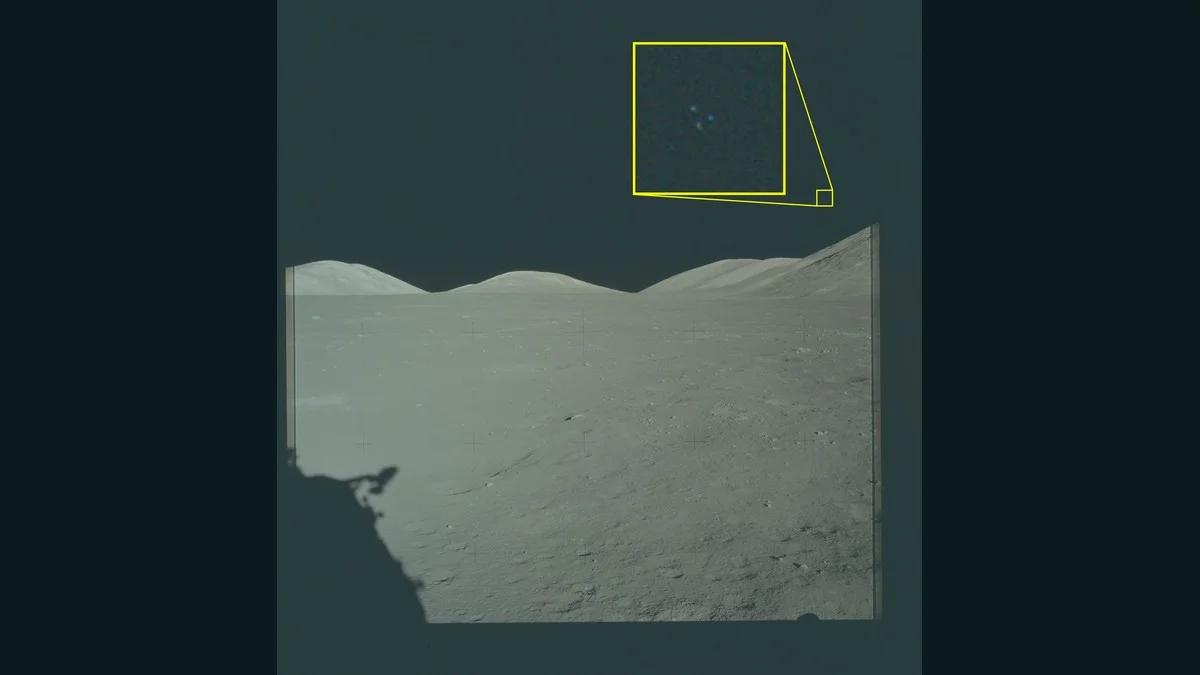
Apollo 17 is also the mission that produced the most extensive crew reports of anomalous objects during the mission itself: most notably the flashing rotating object tracked by Cernan and Schmitt for 24 hours during the translunar coast, a separate incident from the surface photograph.
The Crew Reports That Go with the Images
The PURSUE package includes the Apollo 17 flight transcript alongside the VM6 photograph. That transcript contains Gene Cernan telling Houston about the rotating object: "It is a bright object, and it's obviously rotating because it's flashing... there is something out there." It contains Jack Schmitt reporting a flash on the lunar surface north of Grimaldi crater. It contains Ron Evans describing two simultaneous flashing objects from the Command Module.
The Apollo 12 transcript similarly contains Alan Bean's report of particles of light "escaping the Moon," sailing off toward the stars. Whether any of these verbal reports connect directly to the photographs in the package is not established, but the PURSUE compilers clearly found them relevant enough to include both.
What Are They?
The honest answer is: we don't know. The PURSUE document package doesn't offer an explanation: it presents the images as UAP visual material without annotation beyond the yellow bounding boxes. No NASA statement accompanies them. No analysis has been published explaining what appears in the frames or ruling out conventional explanations.
There are several things the objects in the Apollo photographs could plausibly be. Solar corona light scattered by the camera's optics or the visor of the suit is one possibility, though the Hasselblad cameras carried by Apollo crews were well-understood optically and the images show point sources rather than diffuse scatter. Debris or ice particles from the spacecraft, as documented in other Apollo missions, is another, though those tend to be near-field and don't account for the coloured clustering. Cosmic ray hits on the film emulsion are known to produce spots, but usually as single-pixel marks, not the multi-element clusters visible in some of these frames.
What makes these particular images notable is not that they can't be explained: it's that they were specifically selected, annotated, and included in a formal government UAP document release. Someone with access to the full Apollo photographic archive decided these six frames were worth flagging. That decision is itself part of the story.
The photographs are from 1969 and 1972. They sat in the NASA archive for more than 50 years. In May 2026, they appeared, annotated, zoomed, flagged, inside a Pentagon UAP disclosure package. Whatever they show, they're now part of the official record.
Frequently Asked Questions
Equipment guides
Related topics
Ian ClaytonAmateur astronomer and founder of WatchTheStars.co.uk, dedicated to helping others explore the wonders of our universe. Full profile →