Key takeaways
- JWST has captured M77 (NGC 1068) in unprecedented infrared detail using NIRCam and MIRI instruments
- M77 is a Seyfert galaxy 47 million light-years away in the constellation Cetus, with a black hole 8 million times the Sun's mass
- A starburst ring more than 6,000 light-years across rings the galaxy's violently active core
- Scientists use M77 as a proxy for understanding the dormant black hole at the centre of our own Milky Way
- M77 is one of the brightest and closest active galaxies, visible through a modest backyard telescope
Jump to section 6 sections
What Webb Just Revealed
There are galaxies that look beautiful from a distance. Then there are galaxies that, when you look closer, reveal something genuinely unnerving about the universe, and about ourselves.
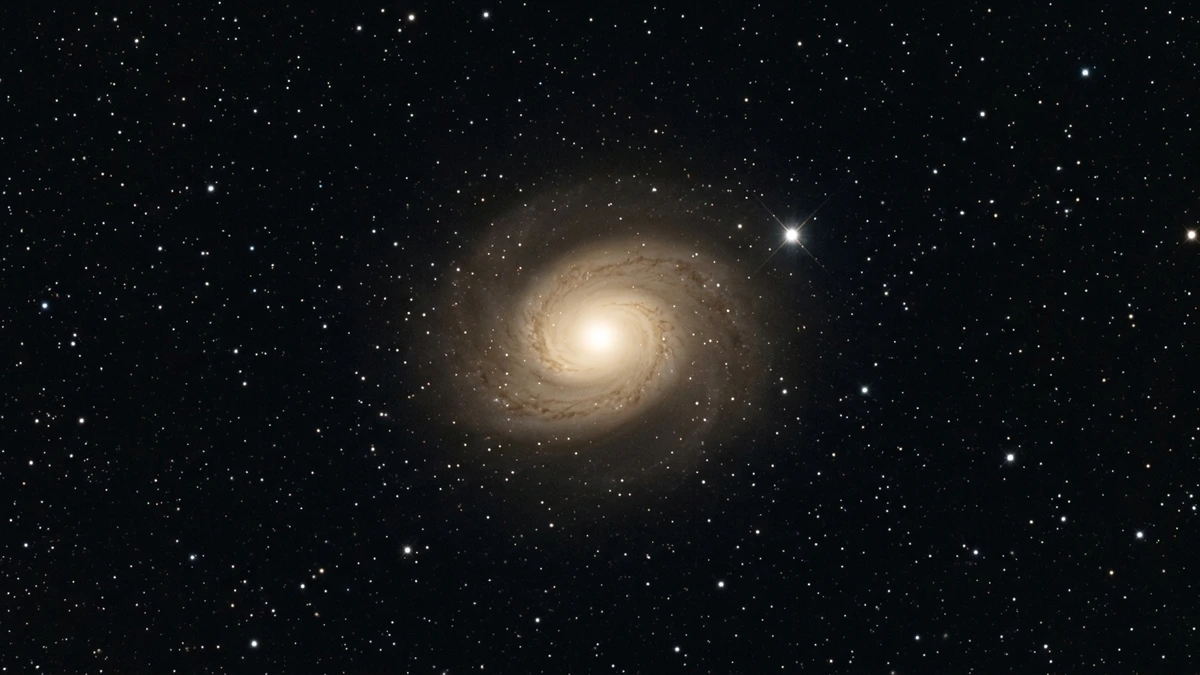
Messier 77 (NGC 1068, also catalogued as the radio source Cetus A) is one of the latter kind. It is a barred spiral galaxy 47 million light-years away in the constellation Cetus: the nearest and brightest example of a Seyfert Type 2 galaxy in the sky, and the archetypal active galactic nucleus (AGN) used by astronomers to define this entire class of objects. First catalogued by Pierre Méchain in 1780 as a nebula, it is now one of the most intensively studied galaxies in the universe.
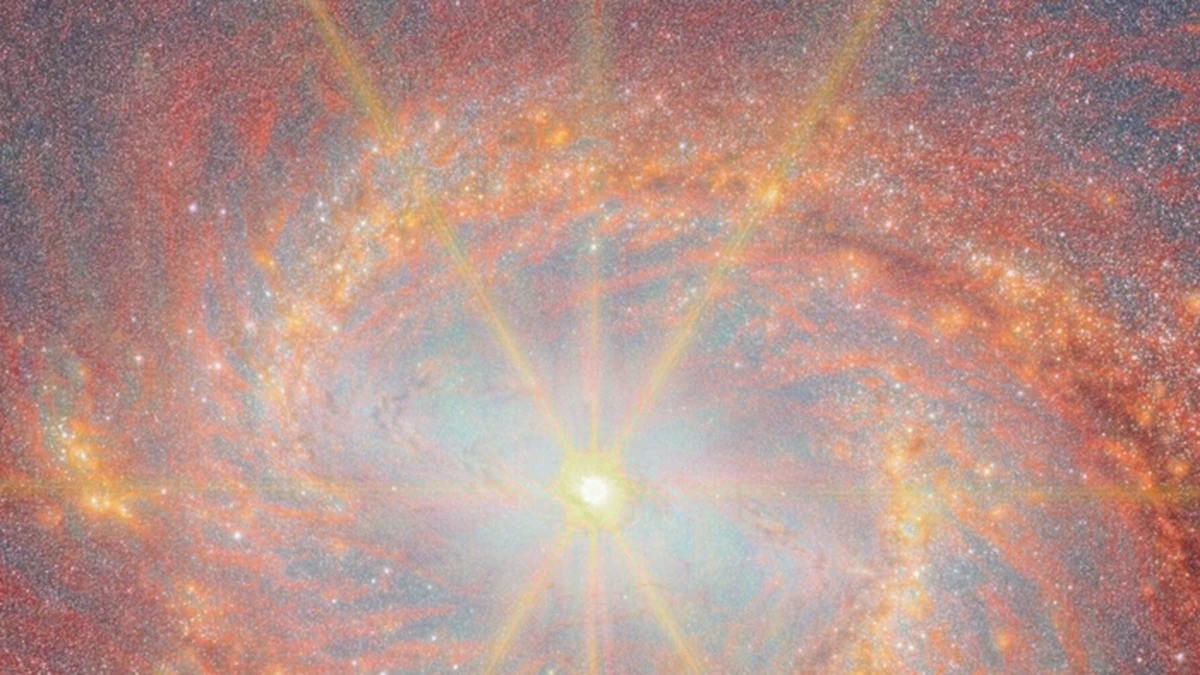
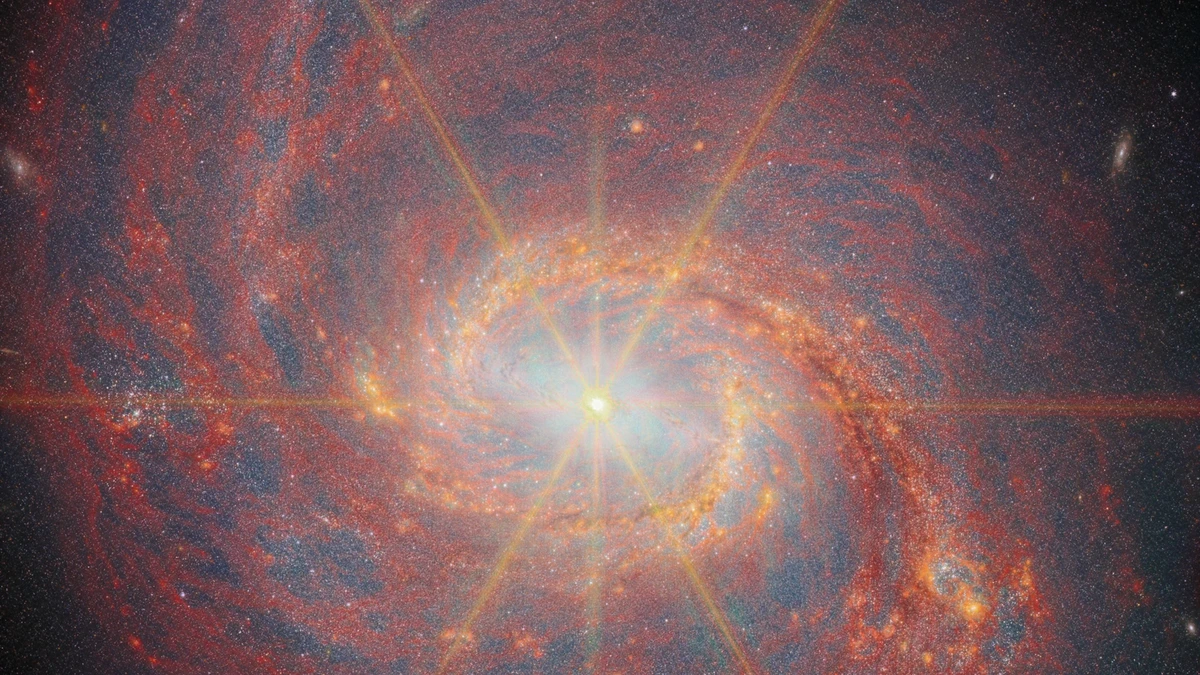
NASA's James Webb Space Telescope has just released a stunning new image of this barred spiral galaxy sitting 47 million light-years away in the constellation Cetus. Captured using Webb's Near-Infrared Camera (NIRCam) and its Mid-Infrared Instrument (MIRI), the image reveals structure that was previously hidden behind dense clouds of gas and dust: a blazing starburst ring, a turbulent central core, and a supermassive black hole pulling material into itself at a furious rate.
It is one of the most detailed views ever obtained of an active galaxy at these wavelengths, and it is already prompting scientists to revise their models of how galaxies evolve.
What Is a Seyfert Galaxy?
Most galaxies, including our own Milky Way, have a supermassive black hole sitting at their centre. In the vast majority of galaxies, that black hole is essentially dormant, occasionally nibbling on the odd cloud of gas but not producing much energy. Our own central black hole, Sagittarius A*, is so quiet that we barely knew it was there until 2022.
A Seyfert galaxy is different. In a Seyfert, the central black hole is actively feeding, pulling in material from a surrounding disc, heating it to millions of degrees, and blasting out enormous amounts of radiation across the electromagnetic spectrum. The result is a core that can outshine the entire rest of the galaxy combined.
M77 is a Type 2 Seyfert, which means its ferociously active nucleus is partially shrouded by a thick doughnut-shaped ring of gas and dust called a torus. From our angle, we can't see directly into the heart of the beast, but infrared light can penetrate that dusty veil in ways that visible light cannot. That is precisely what Webb has been doing.
"M77 has long been one of the most studied active galaxies precisely because it is so close and so bright," notes one of the researchers involved in the observations. "Webb lets us see the connection between what's happening at the very centre and what's happening thousands of light-years away in the spiral arms, in real time."
The Starburst Ring and the Hidden Core
The most visually dramatic feature in Webb's new image is the starburst ring: a ring of intensely active star formation that encircles the galaxy's core. This ring is more than 6,000 light-years across (for comparison, the distance from our Sun to its nearest stellar neighbour is just 4 light-years). It is formed by the inner ends of M77's two great spiral arms, which funnel gas inward toward the nucleus.
Within that ring, conditions are extraordinary. Gas densities are so high, and the shockwaves from the central black hole's energy output so violent, that stars are being born at a rate many times higher than in the typical galaxy disc. Webb's infrared instruments can trace individual star-forming clumps within the ring that were invisible to previous telescopes: knots of warm gas and dust glowing with the heat of embedded newborn stellar clusters.
One of the more unexpected findings emerging from the new data concerns the possibility of two separate supermassive black holes at the galaxy's centre: one actively feeding, one apparently lurking nearby in a more dormant state. While not yet confirmed, the evidence comes from subtle asymmetries in the infrared emission that do not fit a single-nucleus model. If this holds up under further analysis, it would suggest M77 is the product of a past galaxy merger, with two nuclear black holes yet to fully combine.
The observations also confirm that M77's AGN (active galactic nucleus) is driving powerful outflows of material, jets and winds moving at thousands of kilometres per second, that are punching holes through the surrounding dust torus and sculpting the structure of the surrounding interstellar medium. In short: the black hole is not just feeding, it is reshaping the galaxy around it.
M77's Starburst Ring Needs Webb, But You Can Still See the Galaxy
Kit we've tested and reviewed in full
No backyard telescope will show the AGN detail JWST captured, but M77 itself is bright enough for a modest scope. Here's what would get you there and beyond.
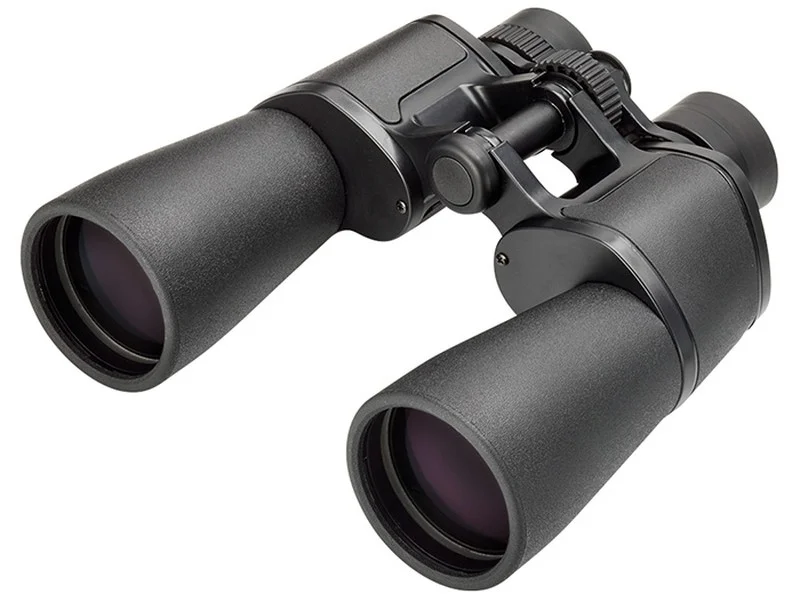
Good for star-hopping to Cetus and getting your bearings before you point a telescope at M77's faint glow.
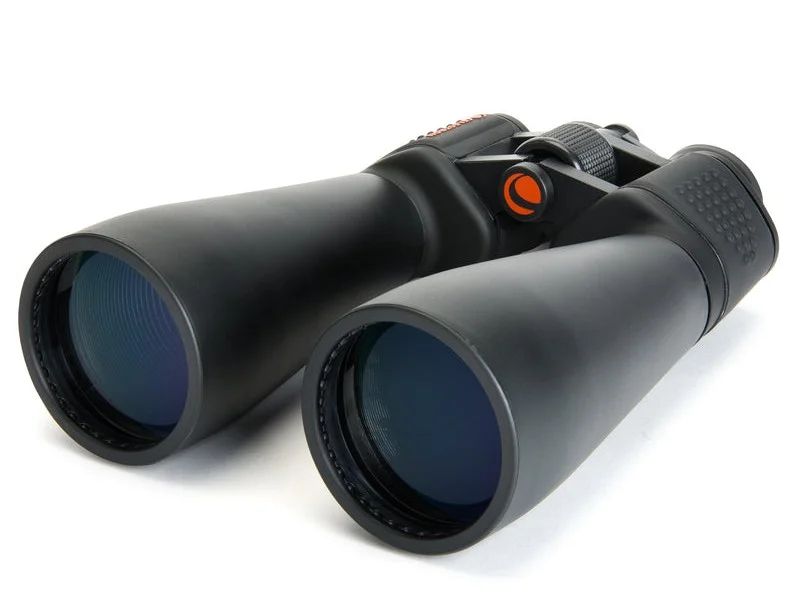
At magnitude 9.6, M77 needs decent aperture, these help pull the galaxy's glow out of a dark autumn sky.
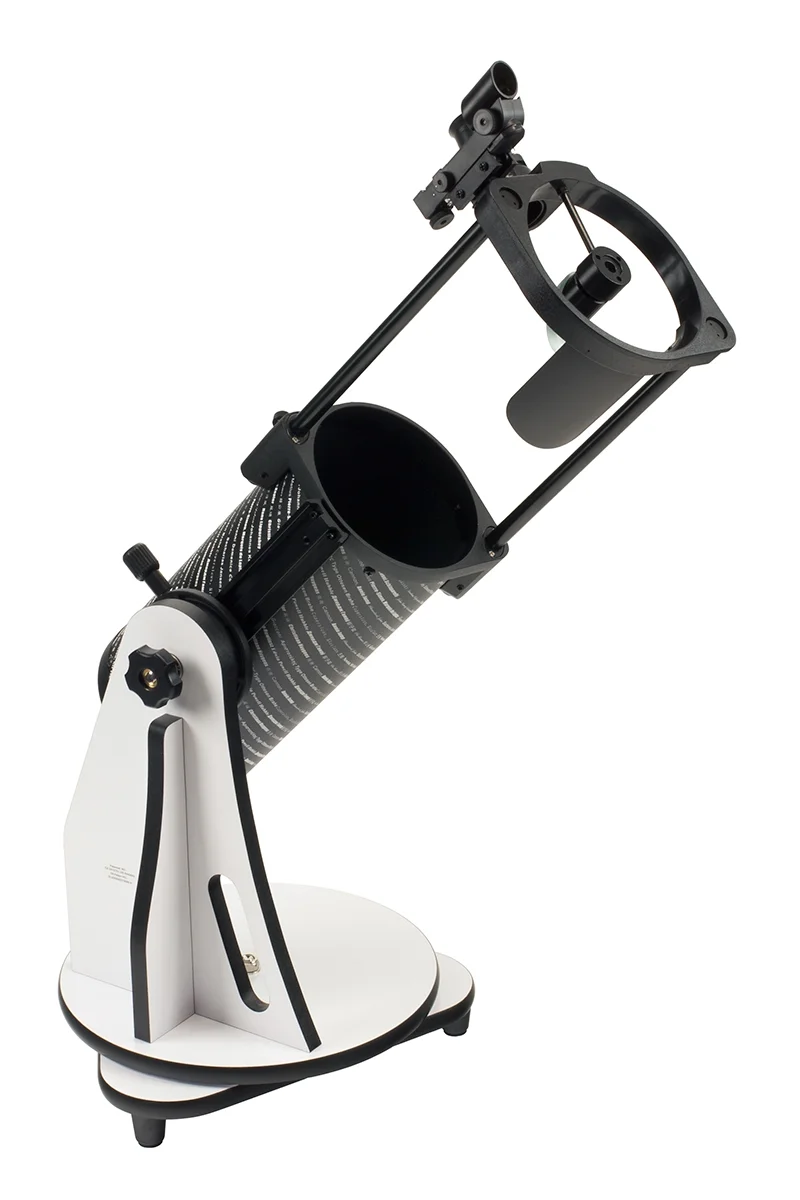
This is the telescope that actually shows M77's bright nucleus and faint oval halo, exactly as described in this piece.
Affiliate links: you pay the same price, we earn a small commission that helps keep WatchTheStars free.
A Mirror of Our Own Milky Way
So why does M77 matter beyond being beautiful?
Because it may show us what our own galaxy could look like if Sagittarius A* woke up.
Scientists have long suspected that most galactic black holes go through cycles of activity: periods of relative quiet punctuated by episodes of intense feeding when a large supply of gas falls into the nucleus. Our Milky Way shows signs of having undergone at least one such active period in the relatively recent past (the so-called Fermi Bubbles, enormous lobes of high-energy gas extending above and below the galactic plane, are thought to be the remnants of a major outburst some few million years ago).
M77 is currently in the middle of exactly such an active phase. By studying it with Webb's full suite of instruments, astronomers can observe in detail the processes that transform a sleeping black hole into an active one, trace how that activity feeds back into the galaxy's star formation, and ultimately build a picture of the full life cycle that most spiral galaxies, ours included, go through.
"NASA has used M77 as a proxy for understanding the physics at the centre of the Milky Way," one team member explained. "The processes Webb is revealing here are almost certainly the same processes that have shaped our galaxy's history. We're reading our own future, and our past, in M77's light."
Seeing M77 Yourself
One of the genuinely satisfying things about M77 is that it is not just a target for space telescopes. It is one of the brightest active galaxies in the sky, and it is observable from British back gardens with a modest telescope.
At magnitude 9.6, M77 requires at least a 10cm (4-inch) aperture telescope to see as more than a star-like point. In a 15–20cm scope under dark skies, you can make out the bright, almost stellar nucleus surrounded by a faint oval halo of the surrounding disc. The starburst ring and the spectacular AGN detail are beyond what any ground-based amateur equipment can reveal, that requires Webb, but knowing what lies behind that small, deceptively quiet glow makes the view through the eyepiece rather more haunting.
To find M77: it sits just over 1 degree south-southeast of the 4th magnitude star Delta Ceti. If you can identify the constellation Cetus in the autumn sky, Delta Ceti will guide you directly to it. The galaxy is best placed for UK observers from October through to January, reaching a reasonable height in the south on November evenings.
Where to Find It: Cetus, the Sea Monster
Messier 77 lives in Cetus, one of the largest and most ancient constellations in the sky, representing the sea monster sent by Poseidon to devour the princess Andromeda before Perseus arrived to save the day. It is a vast, sprawling constellation that occupies more than 1,200 square degrees of sky, yet is often overlooked by beginners because its brightest stars are only moderately bright and it lacks an obvious distinctive shape.
Cetus contains several other remarkable objects beyond M77. Its most famous star is Mira, Omicron Ceti, a long-period variable that swings from naked-eye visibility (magnitude 2.0 at maximum) to complete invisibility (magnitude 10.1 at minimum) over a 332-day cycle. When Mira is near maximum, it transforms Cetus into one of the more striking autumn constellations. At minimum, the constellation's only really prominent star is Diphda (Beta Ceti), shining at magnitude 2.02.
The constellation also contains Tau Ceti, at just 11.9 light-years away, one of the closest Sun-like stars to our solar system and a long-standing target for SETI researchers. You can read more about Tau Ceti here.
If you want a full observing guide to the constellation, including how to find it from the UK, its key stars, and all its deep-sky targets, we've put together a complete Cetus constellation guide: Finding & Observing Cetus: The Sea Monster.
Sources:
- Webb Peers into Brilliant Heart of Messier 77 · Sci.News
- ESA/Webb: A beacon of light in swirls of dust
- ESA/Webb Image: Messier 77 (NIRCam)
- Webb telescope captures blazing core of spiral galaxy M77 · Prism News
- Webb's New Image of Messier 77 Rewrites Galactic Evolution · Cosmo Science
Frequently Asked Questions
Equipment guides
Related topics
Ian ClaytonAmateur astronomer and founder of WatchTheStars.co.uk, dedicated to helping others explore the wonders of our universe. Full profile →