Key takeaways
- Hubble launched on 24 April 1990 and has now made over 1.7 million observations across 36 years
- The anniversary image shows the Trifid Nebula, a stellar nursery 5,000 light-years away where new stars are being born right now
- By comparing the 2026 image with one from 1997, astronomers can see a protostellar jet (HH 399) that has visibly expanded in just 29 years
- The Trifid is one of only a handful of nebulae where we can watch star formation happening on human timescales
Jump to section 6 sections
Happy Birthday, Hubble
On 24 April 1990, the Space Shuttle Discovery lifted the Hubble Space Telescope out of its cargo bay and released it into orbit 547 kilometres above the Earth. Thirty-six years later, after five servicing missions, a famously blurry mirror that was fixed in spectacular fashion, and a career that has reshaped almost every branch of astronomy, Hubble is still working. Still discovering. And still taking photographs that stop you in your tracks.
Every year NASA releases an anniversary image, and the 36th is one of the best yet. For this birthday Hubble turned its gaze back to a place it first photographed in 1997: a turbulent patch of gas and dust inside the Trifid Nebula, roughly 5,000 light-years from Earth in the constellation Sagittarius. By comparing the two images, one from each end of Hubble's career, astronomers can now see changes that have occurred in a stellar nursery across a single human generation.
That might not sound remarkable until you consider the timescales involved. Stars take millions of years to form. Nebulae persist for hundreds of thousands of years. The fact that anything at all has changed in just 29 years is extraordinary, and it tells us something important about the violent, energetic processes that create new solar systems.
The Cosmic Sea Lemon
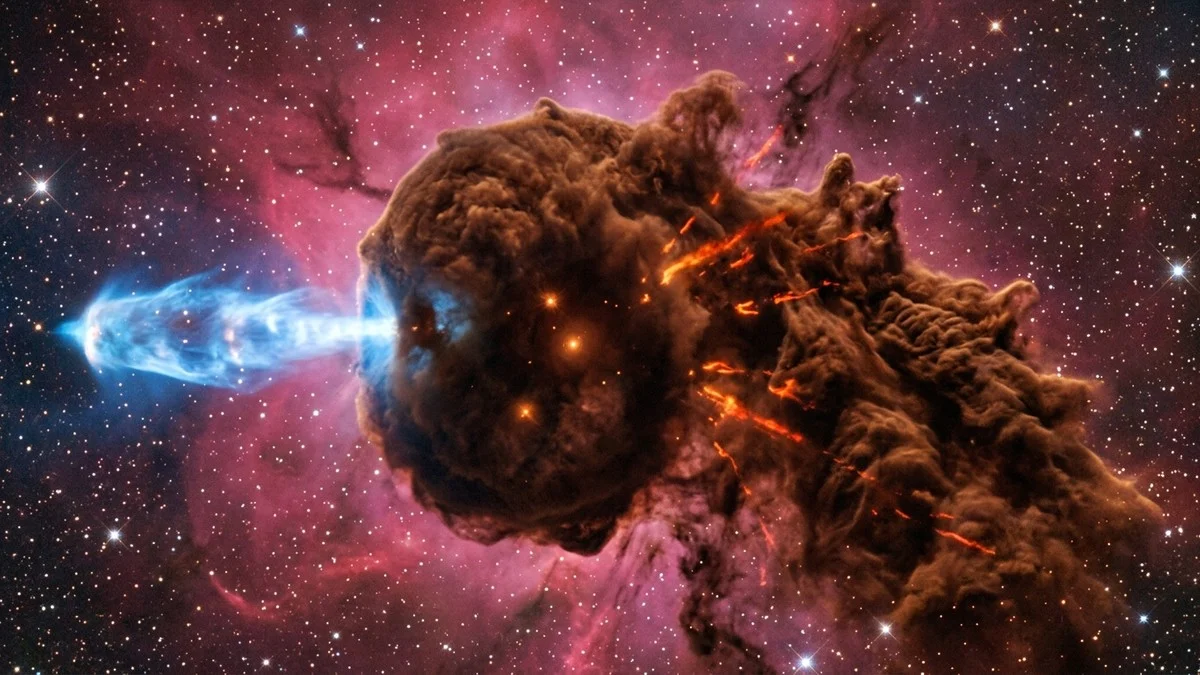
The centrepiece of Hubble's new image is a formation NASA has nicknamed the "Cosmic Sea Lemon", a rusty-coloured cloud of gas and dust whose shape, with its rounded head and undulating body, resembles a marine sea slug gliding through the cosmos.
But this is no gentle creature. The Sea Lemon's left "horn" is part of something called Herbig-Haro 399 (HH 399), a jet of superheated plasma being periodically blasted out by a young protostar buried deep inside the cloud's head. The protostar is still in the process of forming, pulling material inward from a surrounding disc while simultaneously firing jets outward at hundreds of kilometres per second along its rotational axis.
On the opposite side of the cloud, a counter-jet punches into the dense brown dust, showing up as jagged orange and red lines where a natural V-shape appears in the dust. These jets are one of the hallmarks of star formation. When a collapsing cloud of gas starts spinning fast enough, material that cannot fall directly onto the growing star is funnelled along magnetic field lines and ejected in narrow beams from the poles. It is violent, beautiful, and, as Hubble has now shown, measurably fast.
Elsewhere in the image, another protostar reveals itself as a faint red dot surrounded by a green arc. That arc may be evidence of a circumstellar disc, the raw material of a future planetary system, being eroded by intense ultraviolet radiation from nearby massive stars. The cleared area around this protostar suggests it is almost finished forming. In a few million years, it will switch on as a fully fledged star.
Twenty-Nine Years of Change
The real headline from this anniversary image is the comparison. In 1997 Hubble photographed the same patch of the Trifid with its then-current Wide Field and Planetary Camera 2 (WFPC2). In 2026 it returned with the far more capable Wide Field Camera 3 (WFC3), installed during the final servicing mission in 2009. By overlaying the two images, astronomers can pick out features that have moved, expanded, or brightened.
The most obvious change is in HH 399 itself. The jet's horn is noticeably longer than it was 29 years ago. The counter-jet, visible as that slash of orange and red along the Sea Lemon's body, has expanded measurably to the right. Even some of the pinker stars scattered across the scene appear to have shifted position or changed brightness, a testament to the dynamic, restless nature of a region where stars are being born.
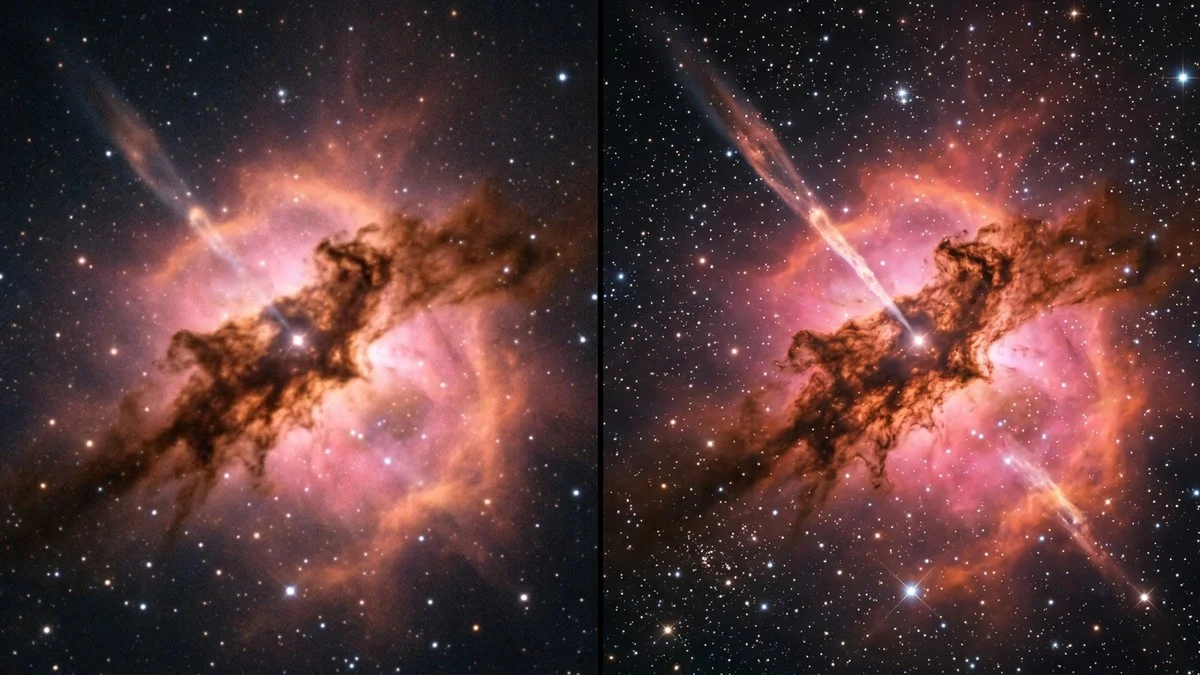
These changes are not just visually striking. They are scientifically useful. By measuring how far the jet material has moved in 29 years, researchers can calculate the speed of the outflows and work out how much energy the protostar is injecting into its surroundings. That data feeds directly into models of how newly formed stars interact with the clouds that created them, and how those interactions trigger, or suppress, the next wave of star formation.
The Trifid is one of only a small number of nebulae where changes can be tracked on human timescales. Most of the cosmos moves too slowly for us to notice within a single lifetime. But here, thanks to Hubble's longevity and improving instruments, we are watching the birth of stars in something close to real time.
You won't get Hubble's view, but you can still see the Trifid
Kit we've tested and reviewed in full
No back garden telescope will show you protostellar jets, but the Trifid Nebula itself is a real target for UK observers once summer comes round. Here's what would get you there.
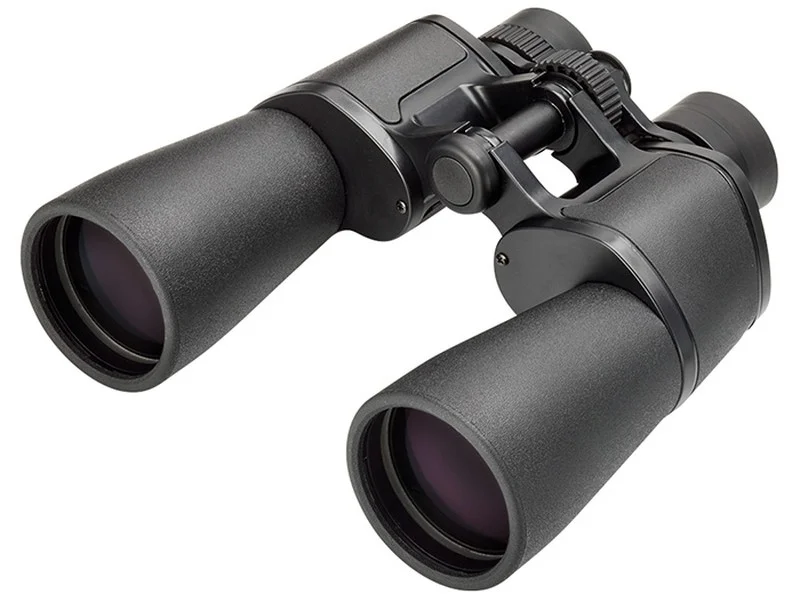
A good general pair for scanning Sagittarius low on the southern horizon and finding your bearings before you hunt for the Trifid.
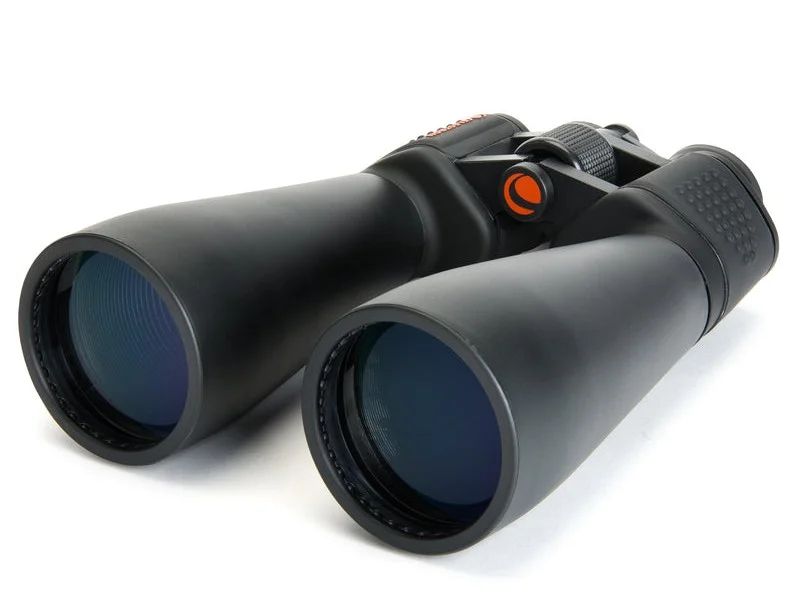
Useful for picking out the nearby Lagoon Nebula as a signpost, though you'll still need a telescope to properly separate the Trifid's three lobes.
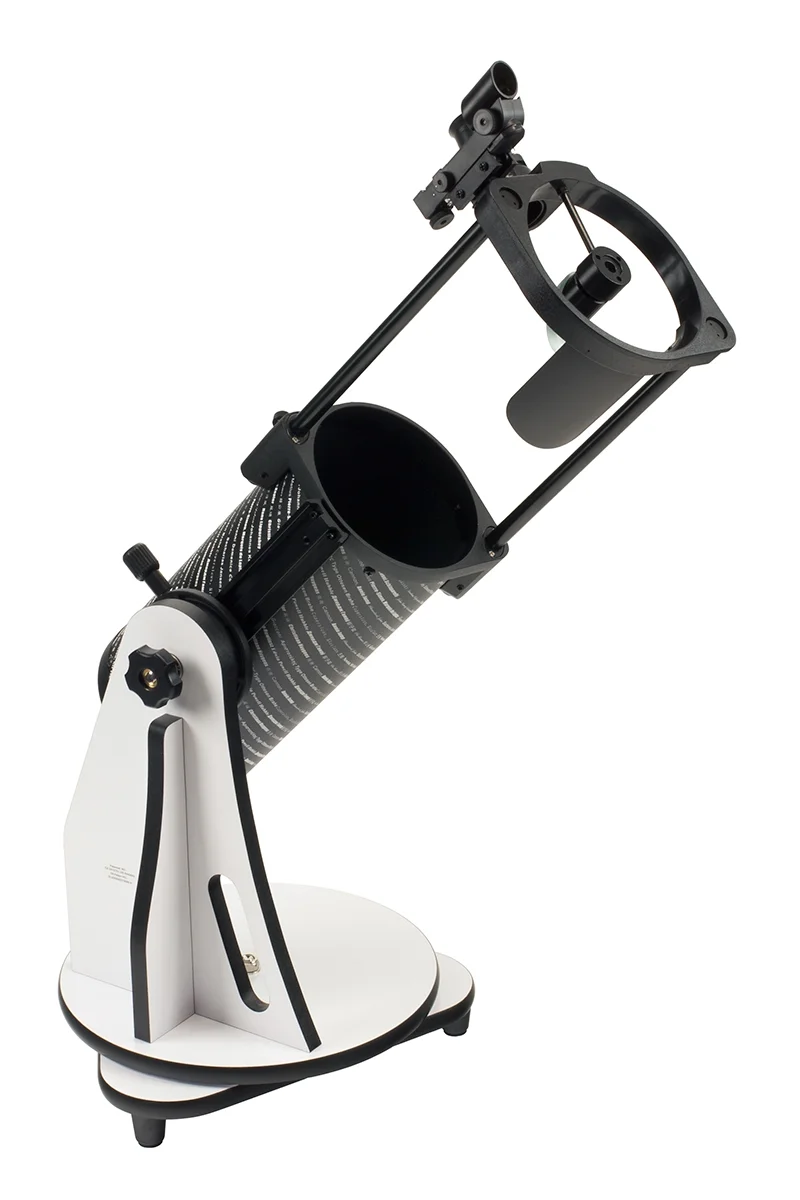
A genuinely capable beginner scope that will show the Trifid as a soft round glow, with the dark dust lanes starting to appear under a clear, dark sky.
Affiliate links: you pay the same price, we earn a small commission that helps keep WatchTheStars free.
What Is the Trifid Nebula?
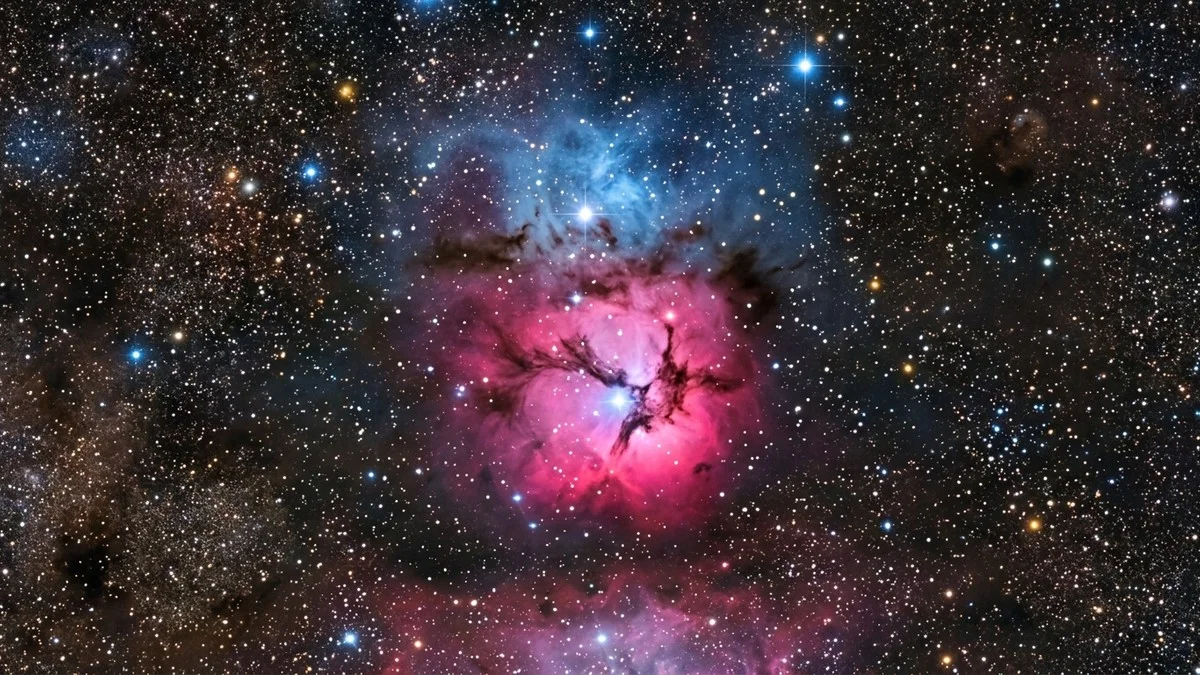
The Trifid Nebula, catalogued as Messier 20 (M20), sits in the constellation Sagittarius, toward the heart of the Milky Way. Charles Messier first logged it on 5 June 1764, though it may have been spotted as early as 1747 by the French astronomer Guillaume Le Gentil. The name "Trifid" was coined later by John Herschel, who noticed that dark dust lanes appear to split the nebula into three distinct lobes. "Trifid" simply means "divided into three."
What makes M20 unusual is that it is not one type of nebula. It is three at once. The central pinkish-red region is an emission nebula: hydrogen gas heated by young, massive stars until it glows. The blue region to the north is a reflection nebula: dust particles scattering the light of nearby stars like fog around a streetlamp. And the dark lanes themselves are a dark nebula: dense curtains of dust that block the light behind them. This combination of emission, reflection, and absorption nebula in a single object is rare, and it is part of what makes the Trifid such a popular target for both professional astronomers and amateur astrophotographers.
The entire structure is only about 300,000 years old, young by cosmic standards. Several massive stars at its centre have been sculpting the surrounding gas with their fierce ultraviolet radiation and stellar winds, blowing an enormous bubble that compresses the cloud's edges, triggering new waves of star formation as it goes. The nebula spans over 40 light-years across.
Hubble by the Numbers
Thirty-six years is a staggering operational lifetime for any space mission, and Hubble's statistics reflect a telescope that has fundamentally changed our understanding of the universe. As of April 2026, Hubble has completed over 1.7 million individual observations. Nearly 29,000 astronomers have used its data, producing more than 23,000 peer-reviewed scientific papers, with almost 1,100 published in 2025 alone.
Among its recent discoveries, Hubble has uncovered "Cloud-9", the first confirmed detection of a starless, gas-rich, dark-matter-dominated cloud. It witnessed catastrophic collisions in the Fomalhaut planetary system in real time. It identified a galaxy that appears to be almost entirely dark matter, shining with the light of only about one million suns. And it captured Comet C/2025 K1 (ATLAS) fragmenting into at least four pieces.
Hubble was designed to last 15 years. It has now more than doubled that, and NASA estimates it could continue operating into the early 2030s. Its orbit is slowly decaying, but missions to reboost it, potentially using commercial spacecraft, are under active discussion. For now, Hubble remains the most productive scientific instrument ever built, and its partnership with the James Webb Space Telescope means the two observatories cover complementary wavelengths: Hubble sees in ultraviolet and visible light while JWST specialises in infrared. Together, they give astronomers the most complete view of the cosmos ever achieved.
Seeing the Trifid Yourself
The Trifid Nebula is a summer target for UK observers. From late June through August, Sagittarius hangs low along the southern horizon. It never climbs very high from British latitudes, but on a clear, dark night the Trifid is within reach of a small telescope.
To find it, locate the "Teapot" asterism of Sagittarius low in the south after midnight during summer. M20 sits about 2° northwest of the brighter Lagoon Nebula (M8), which is itself visible to the naked eye from dark sites. Through a 6-inch (150mm) telescope at low power, the Trifid appears as a soft, round glow. With an 8-inch or larger scope and good seeing, you can start to pick out the dark dust lanes that give the nebula its three-lobed shape. A narrowband filter (UHC or O-III) helps separate the nebula from the background sky glow.
If you have a camera and a tracking mount, the Trifid is a wonderful astrophotography target. Even short exposures (30–60 seconds) with a DSLR at ISO 1600 on a basic star tracker will pick up the pink emission glow. Longer integrations reveal the blue reflection component and the intricate dark lanes. It is a demanding subject from the UK because of its low altitude, but the results are worth the effort.
Hubble's 36th birthday reminds us that the universe does not stand still: even the places we think of as timeless are constantly, restlessly changing. And sometimes, if you watch for long enough, you can see it happen.
Frequently Asked Questions
Equipment guides
Related topics
Ian ClaytonAmateur astronomer and founder of WatchTheStars.co.uk, dedicated to helping others explore the wonders of our universe. Full profile →