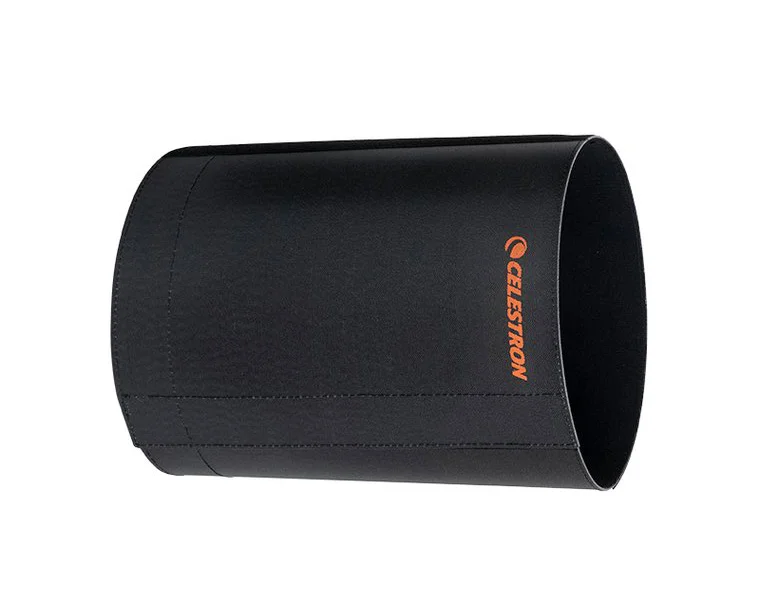
Celestron Dew Shield for C6 and C8 OTAs
| Key Specifications | |
|---|---|
| Type | Flexible plastic dew shield (corrector plate baffle) |
| Fit | C6 (150mm) and C8 (200mm) Schmidt-Cassegrain tubes |
| Compatibility | NexStar 6SE, C6/C8 OTA tubes, and similar SCTs |
| Material | Flexible plastic/rubber composite |
| Extension Length | Extends beyond corrector plate |
| Weight | ~200g |
| Storage | Rolls up compactly |
| Installation | Slides over scope front, held by friction |
| Climate | Essential for UK (maritime climate) |
Who Is This For?
Every UK owner of a Celestron C6, C8, or similar Schmidt-Cassegrain telescope. If you own an NexStar 6SE or any 150mm or 200mm SCT, this is day-one equipment. Do not start observing without it.
- C6 and C8 owners first and foremost: the shield is purpose-built for these scopes
- Anyone observing with an SCT in the UK: dew forms on corrector plates within 30–60 minutes on most clear nights
- NexStar 6SE owners especially: the most popular entry-level SCT, and the shield is OEM-designed for it
- Observers who want to avoid the "fogged optics" frustration: this is the shield to buy if you have one of these scopes
- Anyone planning sessions longer than 90 minutes: dew prevention is non-negotiable for extended observing
Unlike generic dew shields that may or may not fit snugly, this is the Celestron-branded accessory. It fits perfectly, stays secure, and won't slip off mid-session.
What Does It Do?
Schmidt-Cassegrain telescopes have a large glass corrector plate at the front. The UK's maritime climate means moisture is always present in the air. When your cold scope sits outside on a clear night, that moisture condenses on the corrector plate within 30–60 minutes. The glass fogs over, and unless you have a dew heater or hairdryer with you, your observing session ends.
The Celestron dew shield is a plastic tube that extends out from the corrector plate, creating a protective zone. The shield doesn't prevent dew entirely. Nothing can in the UK's humidity. Instead, it acts as a baffle that keeps direct atmospheric moisture off the corrector plate glass. Result: dew forms on the shield and the corrector plate stays clear for much longer.
Second benefit: light shield. The extended tube also blocks stray light: streetlamps, neighbor's security lights, and other unwanted illumination that can wash out your view. This improves contrast on deep-sky targets and planets.
Important: For the most effective dew prevention, combine the shield with a dew heater strip (separate accessory, £40–£60). Shield + heater = problem solved for all-night observing. Shield alone = significantly extended session length.
How to Use It
Installation: Slide the shield over the front of your C6 or C8. It's held by friction: no tools, no fasteners, no permanence. Fits snugly and won't slip.
During observing: Leave it on throughout the session. It doesn't interfere with your view, focuser, or diagonal access.
Storage: The flexible plastic allows you to roll the shield up compactly. Fits easily in your scope case or transport bag.
Maintenance: Wipe with a soft cloth if dust accumulates. That's all.
Compatibility: Made specifically for Celestron C6 (150mm) and C8 (200mm) tubes. Perfect fit for NexStar 6SE and equivalent OTAs. Not compatible with other apertures. Celestron makes separate shields for other sizes.
What the Community Says
Essential for SCT owners. On astronomy forums, SCT owners universally recommend dew shields and heaters as day-one accessories. Without them, sessions are routinely cut short by fogged optics.
The OEM part is worth the premium. Generic dew shields fit loosely and shift on the tube. The Celestron part fits perfectly, stays put, and looks intentional.
Combined with a dew heater = night-and-day improvement. Observers who use both report being able to observe all night without worrying about optics fogging. This is the standard setup for serious SCT users.
Shield alone = 2–3× longer sessions. Even without a heater, the shield buys significant extra observing time. A session that would have been ruined by dew at 90 minutes can extend to 180–240 minutes.
Better than generic alternatives. The Celestron shield is more robust, fits better, and includes the bonus light-blocking benefit that generic shields don't deliver.
Known Limitations & Tradeoffs
- Not a complete solution on its own. The shield delays dew formation but doesn't eliminate it. For a complete, foolproof solution, add a dew heater.
- Very humid nights can still defeat it. On the most humid UK nights (coastal areas after rain, autumn/spring fog), even with the shield, dew might form in 60–90 minutes. Still much better than 30 minutes without.
- Requires a dew heater for all-night observing. If you plan sessions longer than two hours without the shield fogging, you'll need to add a heater. This is standard practice.
- SCT-specific, not universal. This shield is made specifically for C6/C8 tubes. Refractors, Newtonians, and other SCT apertures need different shields.
- Doesn't block dew on the secondary mirror or eyepieces. The shield protects the corrector plate (the main optic), but eyepieces and the secondary can still dew up. A dew heater wrap solves this.
Alternatives & Related Solutions
Dew Heater Strip
A heated wire that wraps around the corrector plate, keeping it slightly warm to prevent dew entirely. Combined with the shield = complete dew prevention for all-night observing. Requires 12V power (battery or mains).
~£40–£60 View at FLO →Generic Dew Shield
Cheaper universal dew shields (£15–£30) exist, but don't fit C6/C8 tubes as well. They slip, don't extend as far, and lack the light-blocking benefit. Worth the extra £20 for the proper Celestron part.
~£15–£30 (poor fit)Fan Dew Prevention
A small 12V fan blows warm air across the corrector plate. Less effective than a heater but cheaper and simpler. Works on calm nights; useless if you want to observe steady targets with a slow fan.
~£25–£40Where It Sits on the Accessory Path
For C6/C8 owners, this is accessory #1. Buy it before you buy eyepieces, before you buy a diagonal, before you buy anything else. Dew is the #1 frustration for UK SCT observers. This shield is the first step to solving it.
Then add a dew heater (£40–£60) as accessory #2. Shield + heater is the complete dew solution. Without the heater, expect to observe for 90–180 minutes before the optics fog. With the heater, observe all night.
For NexStar 6SE owners especially: You've spent £750 on a capable scope. The £49 dew shield is the most cost-effective accessory you can add: it ensures that your expensive scope actually gets used rather than ending up frustrating you.