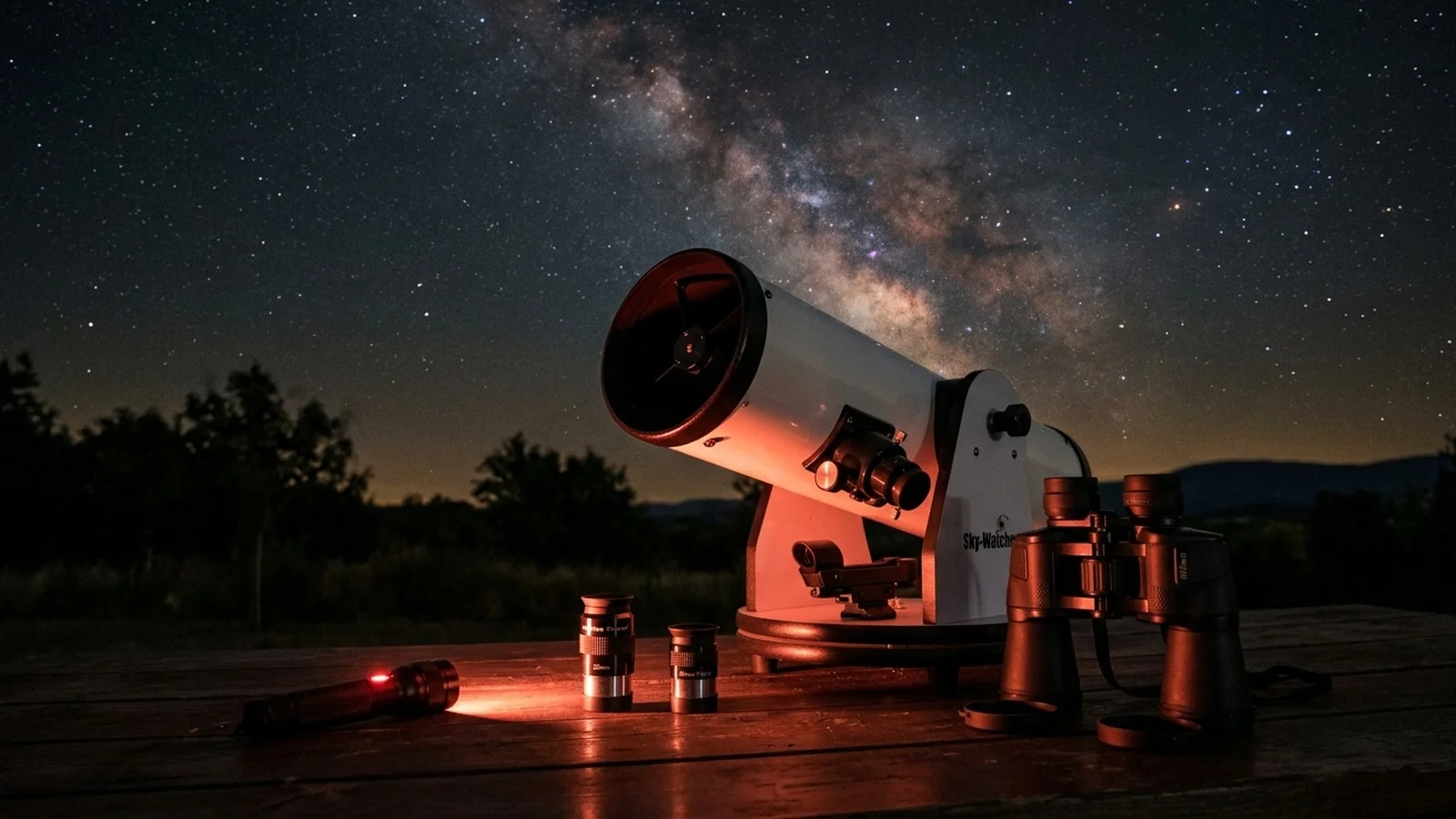
Sky-Watcher Explorer 200P
The Explorer 200P is Sky-Watcher's 8-inch f/5 Newtonian. It comes in four configurations: OTA only (£309), with a manual EQ5 mount (£599), with a motorised EQ5 Pro GOTO mount (£1,040), or as the Quattro f4 imaging variant (£499). The right version depends entirely on what you already own and what you want to do with it.
What Is the Sky-Watcher Explorer 200P?
The Explorer 200P is an 8-inch (200mm) parabolic Newtonian reflector, Sky-Watcher's mid-range visual scope. At f/5 with a 1000mm focal length, it sits in a useful middle ground: more magnification potential than the shorter-tube Heritage Dobsonians, wide enough to frame nebulae and large galaxies properly, and compatible with a broad range of eyepieces and accessories.
200mm of aperture is meaningfully more than the 130mm and 150mm beginner scopes most people start on. At this size you're resolving globular clusters to individual stars, splitting close double stars, seeing Saturn's Cassini Division clearly, and reaching galaxies that a 5-inch can only hint at. The Milky Way's structure starts to become genuinely interesting at 200mm.
It's an OTA (optical tube assembly), the optics in a tube, with focuser and finder included. What you mount it on determines a lot of the experience. Sky-Watcher sell it standalone or bundled with two different equatorial mounts, and there's also a separate imaging-optimised variant called the Quattro that uses the same aperture but different optics and focal ratio.
Sky-Watcher Explorer 200P: Which Version Should You Buy?
Explorer 200P OTA
The optical tube with focuser and finder, no mount. Right choice if you already own a compatible equatorial mount (EQ5 or equivalent, with at least 8–10kg payload capacity). Also the choice if you want to put it on a different brand of mount.
Buy at First Light Optics →Explorer 200P + EQ5
OTA plus Sky-Watcher's EQ5 manual equatorial mount. No motors. You move the telescope by hand and nudge it to track objects. Good for visual observing sessions. Not well-suited to astrophotography without adding motor drives (sold separately).
Buy at First Light Optics →Explorer 200P EQ5 Pro GOTO
OTA plus the EQ5 Pro with SynScan GOTO hand controller. The mount finds objects automatically and tracks them as the Earth rotates. Best all-round version if budget allows, genuinely useful for both visual observing and imaging. The EQ5 Pro handles up to 10kg comfortably.
Buy at First Light Optics →Quattro 200 f4 Imaging Newtonian
Different OTA: same 200mm aperture but f/4 (800mm FL) with a parabolic primary on low-expansion glass, knife-edge baffles, ultra-thin secondary supports, and a 2-inch dual-speed linear power focuser. Built for astrophotography. Needs a coma corrector and precise collimation. Not recommended for beginners.
Buy at First Light Optics →Sky-Watcher Explorer 200P Specifications
| Explorer 200P OTA: Core Specifications | |
|---|---|
| Aperture | 200mm (8") |
| Optical Design | Parabolic Newtonian reflector |
| Focal Length | 1000mm (f/5) |
| Focuser | 2" Crayford dual-speed 10:1 ratio |
| Finder | 9×50 right-angle correct-image |
| Tube Length | ~900mm (open tube) |
| OTA Weight | ~7.5kg |
| Recommended Mount Payload | 8kg+ (EQ5 minimum) |
| Price (OTA only) | £309 |
| Price (with EQ5) | £599 |
| Price (with EQ5 Pro GOTO) | £1,040 |
Sky-Watcher Quattro 200 f4 Specifications
| Quattro 200 f4 Imaging Newtonian: Specifications | |
|---|---|
| Aperture | 205mm primary (8") |
| Optical Design | Parabolic Newtonian, low expansion glass |
| Focal Length | 800mm (f/4) |
| Focuser | 2" dual-speed 10:1 linear power focuser |
| Baffles | 9× internal knife-edge baffles |
| Secondary Supports | 0.5mm ultra-thin spider vanes |
| Finder | 9×50 |
| Tube Material | Steel |
| OTA Weight | 9kg |
| Coma Corrector | Required for optimal imaging results |
| Price (OTA only) | £499 |
What Can You See with the Explorer 200P?
200mm is a significant step up from the 130mm and 150mm scopes most people start on. It gathers 2.4× more light than a 130mm. Here's what becomes reachable:
The Planets
Saturn's rings are crisp, and on good seeing nights the Cassini Division is clearly split. Jupiter shows multiple cloud belts and the Great Red Spot when it transits. Mars shows polar ice caps and dark albedo features when near opposition. Uranus and Neptune are resolvable discs. Venus shows phases clearly.
Globular Clusters
One of the 200P's showpieces. The Hercules Globular (M13) resolves all the way to its core, a ball of thousands of individual stars rather than a fuzzy patch. Omega Centauri (from southern latitudes), M5, M15, and M22 are all spectacular. At this aperture they stop looking like objects and start looking like places.
Galaxies
Andromeda (M31) is huge in the field. You can see the dust lane with averted vision. The Whirlpool (M51) and its companion show structural detail. M81 and M82 as a pair are rewarding. From a reasonably dark site (Bortle 4–5), fainter Virgo Cluster galaxies become accessible. From city gardens, stick to the brighter targets.
Nebulae
The Orion Nebula fills the field at low power. The Trapezium cluster at its core splits into 4–6 individual stars. The Ring Nebula (M57) is a clear smoke-ring shape. The Dumbbell (M27) is one of the finest objects in the sky at this aperture. A narrowband filter (UHC or OIII) improves contrast on planetary nebulae from suburban locations.
Double Stars
The 200P splits close pairs that defeat smaller scopes. Epsilon Lyrae (the Double-Double) separates cleanly into four stars. Albireo shows vivid gold and blue contrast. Porrima in Virgo and Zeta Boötis are satisfying challenges on nights with good seeing.
The Moon
At medium magnification (100–150×) the lunar surface is overwhelming: craterlets, rilles, mountain ranges, and ray systems crowd every field. A neutral density or variable polarising filter helps manage the brightness.
Explorer 200P EQ5 Pro GOTO: Is It Worth the Extra?
The jump from £309 (OTA) to £1,040 (with EQ5 Pro GOTO) is large. Here's what you're paying for:
The EQ5 Pro is a solid, well-regarded equatorial mount. It handles up to 10kg, polar aligns reliably, and the SynScan GOTO system finds objects accurately. You enter the object name or catalogue number, press go, and the mount slews to it and holds it in the field as the Earth rotates. After an evening with GOTO you find it very hard to go back to star-hopping.
For astrophotography the EQ5 Pro is the minimum viable mount for the 200P OTA. Without tracking, exposures are limited to a few seconds. With tracking you can push to several minutes, enough to capture galaxies and nebulae properly with a DSLR. For serious imaging, adding an autoguider extends that further.
If your budget is tight, the EQ5 manual (£599) is decent for visual use but you'll feel the limitation quickly. The GOTO version is worth stretching to if you plan to image.
Sky-Watcher Quattro 200 f4: Who Is It For?
The Quattro is a different product category from the standard Explorer. The faster f/4 ratio means a shorter tube and a wider field of view at a given magnification, better for imaging extended targets like large nebulae. The parabolic primary on low-expansion glass cools down faster than standard mirrors and produces sharper stars at the edges of the field.
The nine internal knife-edge baffles and ultra-thin 0.5mm secondary supports reduce diffraction spikes and stray light significantly compared to the standard Explorer. This shows up in imaging as better contrast and cleaner star shapes in the corners.
The trade-off is that f/4 is less forgiving. At this focal ratio, coma (the comet-shaped aberration in corner stars) is noticeable without a coma corrector. Sky-Watcher's own f4 Aplanatic Coma Corrector (around £130) is the recommended pairing and essentially makes the combination into a proper imaging instrument. Budget for this when pricing the Quattro.
Collimation also needs to be more precise at f/4. A Cheshire eyepiece is the minimum. FLO's StellaLyra Premium Cheshire (£37) is the go-to recommendation. A laser collimator alone is not sufficient for the secondary at this focal ratio.
The Quattro is best for: intermediate astronomers moving into dedicated astrophotography who want a wide-field imaging platform. It's not the right first telescope, but on an EQ5 Pro or HEQ5, properly collimated with a coma corrector, it produces excellent images of large nebulae.
Sky-Watcher Explorer 200P Collimation: What You Need to Know
All Newtonian reflectors need collimation: the alignment of secondary and primary mirrors. For the standard Explorer 200P at f/5, this is not difficult. The scope typically arrives well-collimated; if it's been moved around or hasn't been used in a while, a quick check takes 5 minutes.
A Cheshire eyepiece (£15–37) is the most reliable collimation tool for beginners. A laser collimator is quicker but requires a properly centred laser to be useful. Used incorrectly it can give a false sense of good collimation. For the Quattro at f/4, use a Cheshire and take your time.
The Explorer 200P uses spring-loaded collimation screws on the primary cell. You can adjust by hand without tools in most conditions. The secondary is adjusted with an Allen key. Once you've done it a couple of times it takes a few minutes and becomes routine.
Sky-Watcher Explorer 200P: What Buyers Say
The standard Explorer 200P is consistently well reviewed for visual use. Buyers coming from 5- and 6-inch scopes consistently note the jump in what's visible: resolved globulars, visible galaxy structure, and meaningful planetary detail. At £309 for the OTA it's considered excellent value.
The EQ5 is seen as adequate but limiting. Most buyers who start with the manual EQ5 version end up adding motor drives or wishing they'd bought the GOTO version. If there's any chance you'll want to image, go straight to the EQ5 Pro GOTO.
The Quattro has a strong reputation among imagers. BBC Sky at Night gave it a strong review ("superb for imaging") and FLO buyers consistently praise the focuser and baffle system. The coma corrector requirement is flagged in almost every review. Budget for it from the start.
Collimation is mentioned regularly, but not as a problem. Buyers note it was out of collimation on arrival more often than they expected, but found the process easier than anticipated once they understood what to do. The Cheshire eyepiece recommendation comes up repeatedly.
Known Limitations
- The OTA is long. At ~900mm tube length the Explorer 200P doesn't fit in a rucksack. It needs a decent-sized car boot and a proper case for transport. This is just the physics of f/5 with a 200mm mirror.
- The manual EQ5 has no tracking. Objects drift out of the field every few minutes and you have to nudge the mount to re-centre them. Fine for quick views; frustrating for long observing sessions. Add motor drives if you buy this version.
- The Quattro needs a coma corrector. Without one, corner stars are comet-shaped on cameras. The Sky-Watcher f4 Aplanatic Coma Corrector (~£130) is the standard recommendation. Factor this into the total cost.
- Both mirrors need occasional recoating. After 10–20 years of use, the mirror coatings can deteriorate. Not a short-term concern but worth knowing for a long-term ownership picture.
- Secondary obstruction. The secondary mirror blocks a small portion of the aperture (~23%). This reduces contrast slightly compared to a refractor of equivalent aperture. In practice it's not noticeable to most observers.
Sky-Watcher Explorer 200P: Frequently Asked Questions
How we reviewed this
This is a research-based review rather than a laboratory test. The facts on this page come from the manufacturer's specifications, the First Light Optics listing and its customer reviews, and the long-running owner threads on Stargazers Lounge and Cloudy Nights, checked against what the same kit shows from a typical UK garden. We have not necessarily used every item ourselves; where we have, the page says so. We receive no free equipment, and the retailer links pay a small commission that never changes the price you pay or the verdict we give.
Prices are read from our product data, last checked against First Light Optics on 23 October 2026. Own this kit and see it differently? Email [email protected] and we will update the page.