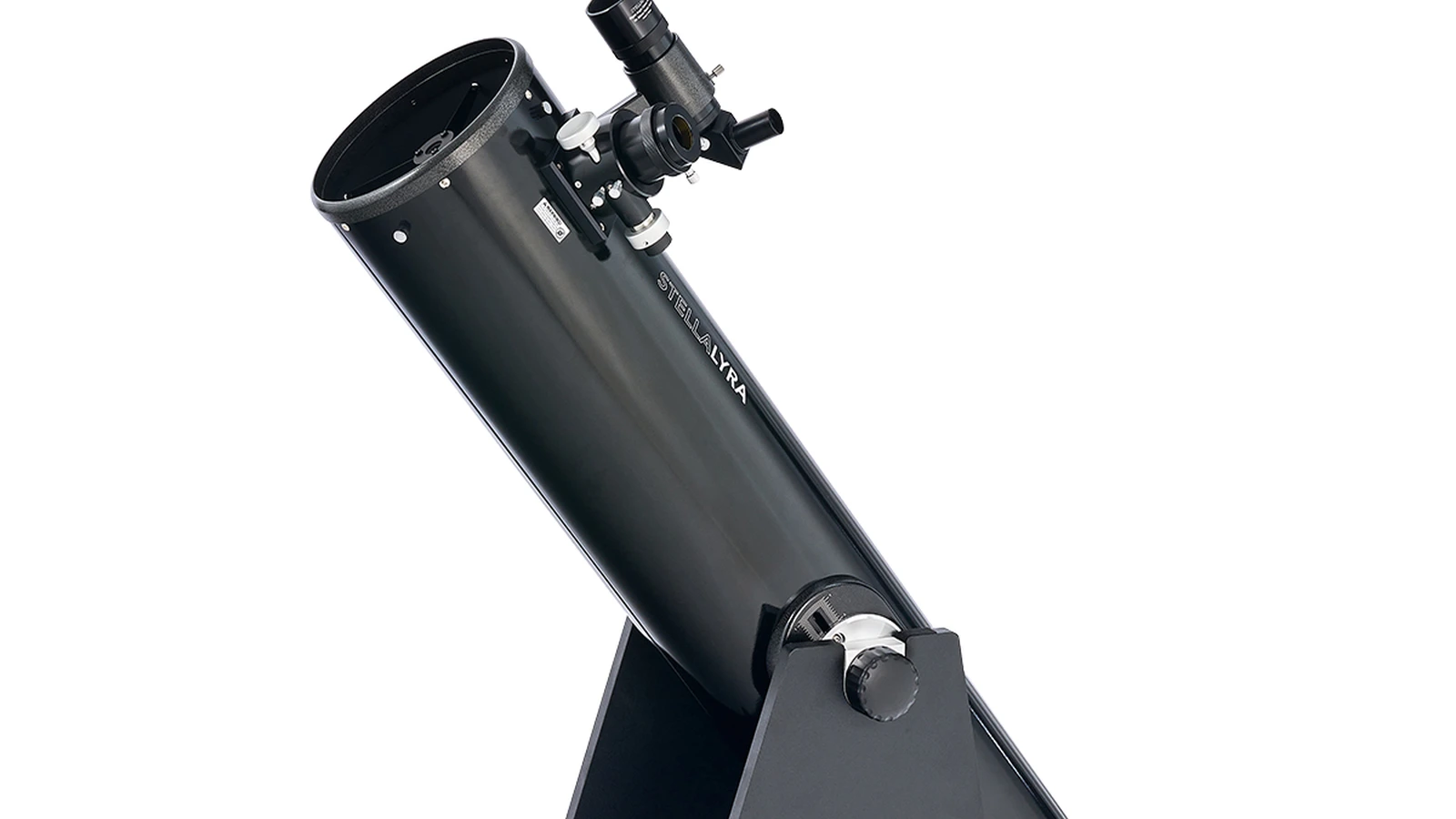
StellaLyra 8" f/6 Dobsonian
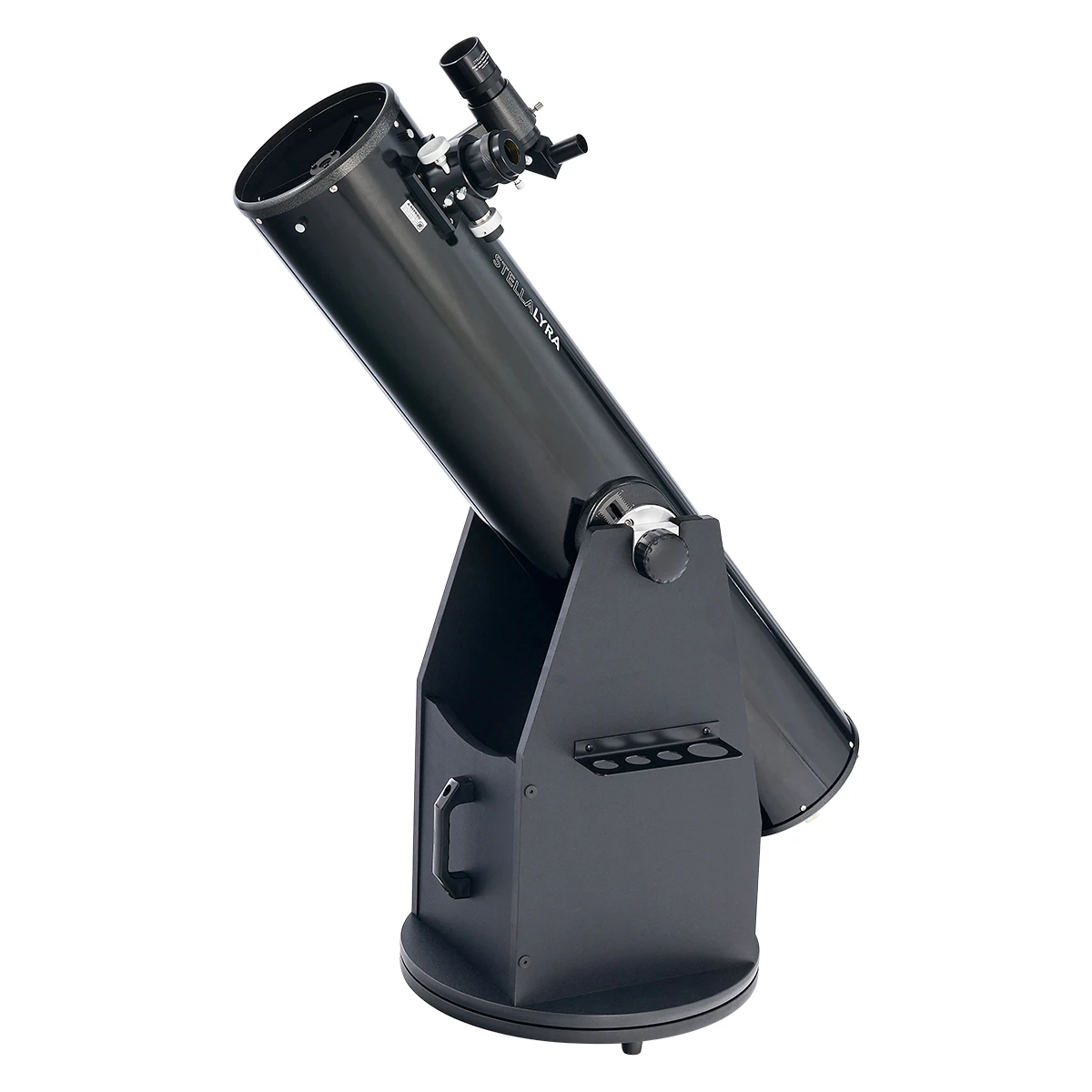
The StellaLyra 8" is rated #1 of 34 telescopes in its price bracket by TelescopicWatch. It costs around £110 more than the Sky-Watcher Skyliner 200P, and it earns every penny of that in the box: a proper 2" eyepiece, cooling fan, and dual-speed focuser are all included where the Skyliner requires you to buy them separately. If you want an 8-inch Dobsonian and don't want to immediately start spending on accessories, this is the one.
StellaLyra 8" f/6 Dobsonian Specifications
| Key Specifications: StellaLyra 8" f/6 Dobsonian | |
|---|---|
| Price (UK) | £449 at First Light Optics |
| Aperture | 203mm (8") |
| Optical Design | Newtonian reflector on Dobsonian alt-azimuth mount |
| Focal Length | 1200mm (f/5.9) |
| Primary Mirror | GSO parabolic, 93%+ reflectivity, silicon dioxide overcoat, BK7 glass |
| Focuser | 2" dual-speed Crayford, 10:1 ratio, brass compression ring |
| Cooling Fan | Battery-powered, built-in: included |
| Included Eyepieces | 30mm 2" SuperView (40×) · 9mm 1.25" Plössl (133×) |
| Finderscope | 9×50 right-angle correct-image |
| Mount Type | Dobsonian alt-azimuth: roller bearing azimuth, ball bearing altitude |
| Base Material | MFC/MDF: flat-packed, self-assembly |
| Total Weight | ~20.9kg (tube ~9.5kg · base ~11.4kg) |
| Equivalent US models | Apertura AD8, Zhumell Z8 (same GSO optics) |
| Warranty | 2 years via First Light Optics |
What Is the StellaLyra 8" f/6 Dobsonian?
StellaLyra is First Light Optics's own telescope brand, made by GSO (Guan Sheng Optical) in Taiwan. The 8" f/6 Dobsonian is their entry-level 8-inch, and it's the UK equivalent of the Apertura AD8 and Zhumell Z8 that are popular in the US: same optics, same mount design, same accessory package. The difference is you can buy it from a UK retailer with UK warranty support rather than importing.
It's a 203mm Newtonian reflector on a simple alt-azimuth Dobsonian base. No motors, no computers, no alignment. You carry it outside in two pieces (tube and base), put the tube on the base, and observe. Setup is around 5 minutes once you know it. If this is your first Dobsonian, our how to use a telescope guide covers finding your first target and the basics of collimation checks.
What makes it stand out at the price is what comes in the box. Most 8-inch Dobsonians at this price level ship with two 1.25-inch Plössl eyepieces. The StellaLyra includes a 30mm 2-inch SuperView: a proper wide-field eyepiece that gives you a 40× immersive view ideal for star fields, the Pleiades, and finding objects. It also includes a cooling fan, which matters more than it sounds, and a dual-speed focuser, which most scopes only add as an aftermarket upgrade. At £449 with all of that included, the value is genuinely hard to argue with.
What's Included with the StellaLyra 8" Dobsonian?
This is where the StellaLyra earns its reputation. The accessory package is better than anything else in the price bracket:
30mm 2" SuperView eyepiece (40×). A 5-element Erfle design with a ~68° apparent field. This is what you'll use most: low power for scanning the Milky Way, finding objects, and wide-field clusters. The Pleiades fit beautifully. Stars at the extreme edge of the field show slight distortion (the "seagull" pattern common to Erfle types at fast focal ratios), but the centre is sharp and the view is genuinely wide and immersive. This eyepiece alone is worth £40–60 bought separately.
9mm 1.25" Plössl (133×). Your high-magnification eyepiece for planets, the Moon, globular clusters, and planetary nebulae. Narrow 45° apparent field and limited eye relief at 9mm, but sharp and reliable. At 133× the detail on Jupiter's cloud belts and Saturn's ring structure is clear on decent seeing nights.
9×50 right-angle correct-image finderscope. A genuine 9×50 with a correct-image right-angle prism: this shows the sky the same way up as the naked eye, which makes it much easier to star-hop from a chart. Significantly better than the small red dot or 6×30 straight-through finders that ship with most budget Dobsonians.
Battery-powered cooling fan. Fitted to the back of the primary mirror cell. When you first bring a reflector outside on a cold night, the mirror takes time to reach ambient temperature: until it does, images are blurry. The fan cuts this warm-up time significantly. Most 8" Dobsonians don't include one.
Dual-speed Crayford focuser. A 2" focuser with a 10:1 fine-focus knob. This makes achieving sharp focus at high magnification much easier than a single-speed focuser. Again, usually an aftermarket add-on.
What Can You See with the StellaLyra 8" Dobsonian?
203mm of aperture is enough to make stargazing feel genuinely different from smaller scopes. The jump from 130mm to 200mm is more noticeable than most aperture upgrades: objects that were smudges become structures.
The Planets
Saturn's Cassini Division splits cleanly on any decent night. Jupiter's cloud belts show multiple bands and the Great Red Spot when it transits. Mars shows polar ice caps and dark surface features near opposition. Uranus resolves as a turquoise disc; Neptune as a tiny blue dot. The Moon at high magnification is overwhelming: craters, rilles, mountains, and ray systems filling the field.
Globular Clusters
The Hercules Globular (M13) resolves all the way to its core: a genuinely three-dimensional ball of stars rather than a fuzzy patch. M5, M15, M22, and M2 are all spectacular. This is one of the strongest arguments for 8 inches over 6: globulars stop looking like objects and start looking like places.
Galaxies
Under reasonably dark skies (Bortle 4–5, find your nearest one on our UK dark sky sites map) the full Messier galaxy catalogue is accessible. M51 (Whirlpool) shows a hint of spiral structure. M82 (Cigar Galaxy) shows the dust lane clearly. Andromeda (M31) fills the wide field view and the dust lane in the disc is visible with averted vision. From suburban gardens, stick to the brighter Messier galaxies.
Nebulae
The Orion Nebula (M42) at 40× is dramatic: the Trapezium cluster splits into 4–6 stars at the core. The Ring Nebula (M57) shows the hole clearly. The Dumbbell (M27) is one of the finest objects in the sky at this aperture. Under dark skies with a UHC filter, the Veil Nebula and North America Nebula become accessible.
Double Stars
Epsilon Lyrae (the Double-Double) separates cleanly into all four components. Albireo's gold and blue contrast is vivid. On good seeing nights the StellaLyra will split Porrima, Zeta Boötis, and other challenging close pairs. Double stars are among the best targets for suburban observers: light pollution barely affects them.
Open Clusters
Quick, satisfying targets. The Pleiades at 40× in the wide 30mm eyepiece is stunning: all the main stars in a single field with background detail. M11 (Wild Duck Cluster), M35, the Beehive (M44), and the Double Cluster in Perseus are all showpieces. Open clusters are ideal for light-polluted skies because they're bright and unaffected by sky glow.
StellaLyra 8" Dobsonian vs Sky-Watcher Skyliner 200P: Which Should You Buy?
This is the obvious comparison. Both are 8-inch f/6 Dobsonians with 1200mm focal lengths. The StellaLyra is £449; the Skyliner 200P is around £340. Here's what the extra £110 buys you:
| StellaLyra 8" | Skyliner 200P | |
|---|---|---|
| Price | £449 | ~£340 |
| Aperture | 203mm | 200mm |
| Focuser | Dual-speed Crayford ✓ | Single-speed |
| Included eyepieces | 30mm 2" SuperView + 9mm ✓ | 25mm + 10mm 1.25" |
| Cooling fan | Included ✓ | Not included |
| Finderscope | 9×50 right-angle ✓ | 8×50 |
| Azimuth bearing | Roller (can be loose) | Teflon on laminate ✓ |
| Total weight | ~20.9kg | ~23kg |
The simple way to think about it: if you bought the Skyliner 200P and then upgraded to a dual-speed focuser (~£60), bought a 30mm 2" eyepiece (~£50), and added a cooling fan (~£30), you'd spend more than the StellaLyra's £449 and still end up with the Skyliner's single-speed focuser on the side rather than a proper dual-speed unit.
The one area the Skyliner genuinely wins is the azimuth bearing. Teflon on laminate is a more consistent, reliable movement than the StellaLyra's roller system: the rollers can feel loose on windy nights and the friction adjustment is finicky. This is a real limitation, and the easiest fix is to replace the rollers with PTFE furniture glides, which costs a few pounds and sorts it permanently.
For most buyers the StellaLyra is the better purchase. The Skyliner at £340 is the right call if budget is genuinely the deciding factor.
Read our full Skyliner 200P guide →StellaLyra 8" Dobsonian: What Buyers Say
Rated #1 of 34 telescopes in the £500 range by TelescopicWatch. BBC Sky at Night reviewed the StellaLyra 8" shortly after launch and gave it a strong write-up, praising the optics and accessory package. The consensus across the UK astronomy community is consistent: it's the 8-inch Dobsonian to buy if you can stretch to £449.
The 30mm SuperView eyepiece gets singled out repeatedly. Buyers who've used standard Plössl-equipped scopes before comment on how different the wide field feels, particularly for open clusters, the Pleiades, and scanning the Milky Way. Several reviews specifically mention the Pleiades fitting beautifully in a single low-power view.
The cooling fan is more useful than people expect. UK autumn and winter nights can drop temperature quickly. The standard advice is "let the telescope cool down for 30 minutes before observing": the fan cuts this to 10–15 minutes. On evenings when there's only an hour of clear sky, this makes a real difference to what you can actually observe.
The roller bearing azimuth gets mentioned as the main gripe. On calm nights it's fine. On breezy nights the scope can drift more than expected. The PTFE furniture glide fix is well-documented in the community and costs about £3, most experienced owners do it shortly after buying.
Multiple buyers mention the mirror lock bolt issue. The four bolts on the primary cell marked as "lock" screws should be removed before use: they interfere with collimation and can touch the mirror if the scope is bumped hard. FLO's team confirms this in their product notes. Remove them on your first assembly and set them aside.
StellaLyra 8" Dobsonian: Known Limitations
- Roller bearing azimuth can be loose. The standard fit can feel wobbly on a breezy night and the friction adjustment is hard to dial in precisely. The fix, replacing the rollers with PTFE furniture glides, is cheap and quick, but it's an out-of-box issue that the Skyliner's Teflon bearing doesn't have.
- MFC/MDF base. Not actual wood: a denser, heavier material that adds to the base weight (~12kg) and can swell or deteriorate in persistent damp conditions. Fine for most UK users who store the scope indoors. If you're leaving it in a garage or shed long-term, check it regularly.
- Long tube. At 1200mm focal length the tube is around a metre long. It fits most car back seats laid flat but won't fit in a typical hatchback boot upright. This is the physics of f/6: the Skyliner 200P has the same issue.
- Mirror lock bolts need removing. Remove the four lock bolts from the primary cell before first use. They can confuse collimation and potentially damage the mirror. Store them in the box but don't use them during normal operation.
- BK7 mirror glass needs cool-down time. Not as thermally stable as borosilicate glass: without the fan, allow at least 30 minutes before expecting sharp images on cold nights. With the fan, 10–15 minutes is usually enough.
- No tracking. Like all Dobsonians, objects drift out of the field as the Earth rotates and you have to nudge the scope to follow them. At 133× (9mm eyepiece), objects cross the field in about 30 seconds. This is a feature of the mount type, not a flaw in the product, but worth knowing before you buy.
Should You Buy the StellaLyra 8" or 10"?
The StellaLyra 10" f/5 costs around £150 more and gives you 56% more light-collecting area. It uses the same focuser, same finder, and same accessory package. The 10" tube is the same length as the 8" (f/5 vs f/6 keeps the tube similar in practice), and the total weight is only a few kilograms more.
If your budget can stretch to the 10", it's usually worth it: the increase in aperture is genuinely noticeable on faint galaxies, dim nebulae, and the outer planets. The 8" is the right choice if the price difference matters, if you're not sure how much you'll use it, or if you specifically want the more manageable weight for car transport or setting up alone. And if even 8 inches feels like a big first step, the much smaller Sky-Watcher Heritage 130P is a genuinely good, far cheaper way to try Dobsonian observing first: see our guide to stargazing for beginners for how the two compare for a first telescope.
StellaLyra 8" f/6 Dobsonian: Frequently Asked Questions
How we reviewed this
This is a research-based review rather than a laboratory test. The facts on this page come from the manufacturer's specifications, the First Light Optics listing and its customer reviews, and the long-running owner threads on Stargazers Lounge and Cloudy Nights, checked against what the same kit shows from a typical UK garden. We have not necessarily used every item ourselves; where we have, the page says so. We receive no free equipment, and the retailer links pay a small commission that never changes the price you pay or the verdict we give.
Prices are read from our product data, last checked against First Light Optics on 23 October 2026. Own this kit and see it differently? Email [email protected] and we will update the page.