Key takeaways
- Venus and Jupiter are converging in the western evening sky, visible tonight and every clear evening through June
- On June 9 they'll be just 1.6° apart, close enough to cover both with your little finger at arm's length
- No equipment needed: these are the two brightest planets in the sky and impossible to miss
- On May 18, a slim crescent Moon joins Venus for a stunning three-object photo opportunity
Jump to section 8 sections
What's Happening Right Now
Step outside after sunset tonight and look west. You'll see two brilliant points of light that outshine everything else in the sky, and through May and into early June, building to their closest approach on 9 June, they're heading straight for each other.
The brighter of the two, low in the west, is Venus at magnitude −3.9: so bright it can cast faint shadows on a dark night. Higher and to its upper left is Jupiter at magnitude −2.1: the second-brightest planet in the sky.
Right now they're separated by roughly 32°, which is a generous gap: about the span of your outstretched hand at arm's length, thumb to little finger. But Venus is moving eastward at 1.2° per day, while Jupiter drifts at just 0.15° per day. Venus is gaining on Jupiter at roughly a degree per night, and by June 9 the two planets will be just 1.6° apart, close enough to cover both with your little finger held at arm's length.
This is one of the most visually spectacular events in astronomy, and you don't need a single piece of equipment to enjoy it.
Why This Conjunction Is Special
A conjunction happens when two objects share the same right ascension, essentially the same east-west line, in the sky. Planetary conjunctions are fairly common, but Venus-Jupiter conjunctions are in a class of their own because these are the two brightest planets visible from Earth.
Venus is so bright because it's relatively close to us (currently about 1.3 AU away) and its thick cloud layers reflect roughly 70% of the sunlight that hits them. Jupiter is bright despite being much farther away (about 6 AU) because it's enormous: 11 times Earth's diameter, with a vast reflective cloud deck.
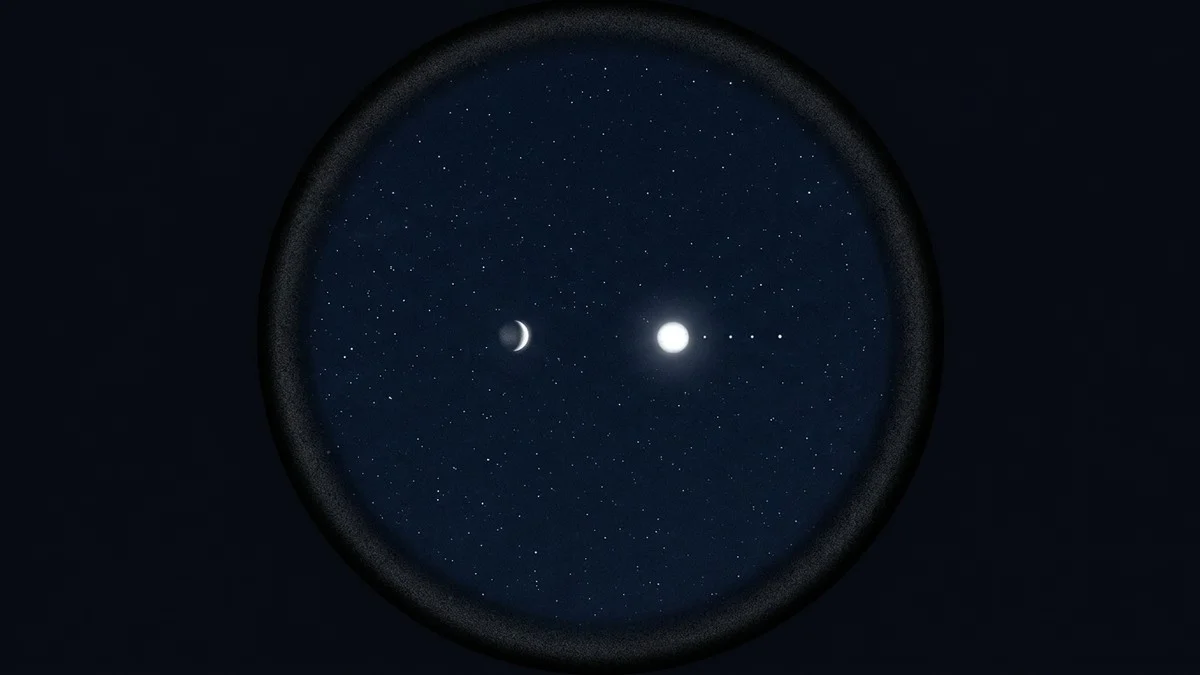
When the two come together, the effect is striking. Two dazzling lights, separated by less than the width of a finger, hanging in the twilight like a pair of cosmic headlamps. At their closest on June 9, they'll easily fit in the same binocular field of view, and through a telescope at low power you'll be able to see Venus's crescent phase and Jupiter's cloud belts in the same eyepiece. Conjunctions like this are exactly what binoculars are made for, and our guide to binocular astronomy covers how to get the steadiest view of an event like this.
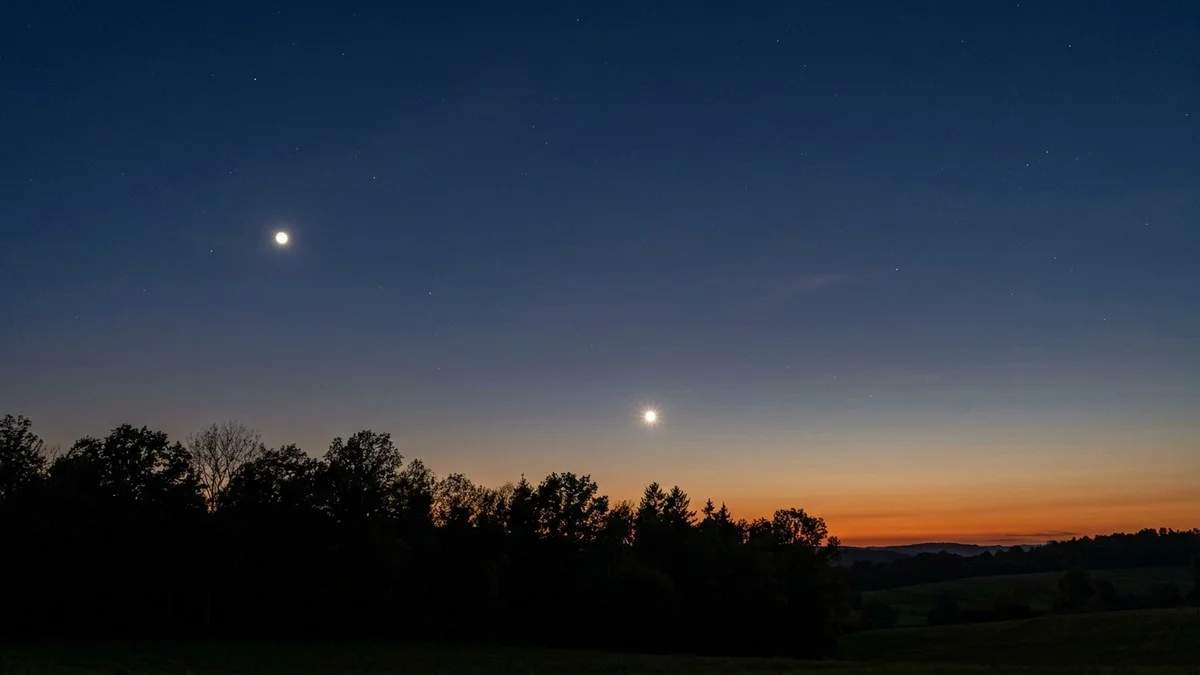
Venus-Jupiter conjunctions happen roughly once every 13 months on average, but the geometry varies enormously. Sometimes one or both planets are too close to the Sun to see. Sometimes the conjunction happens in the predawn sky when most people are asleep. This one plays out in the evening sky after sunset, in late spring when the weather is mild and the twilight is long, about as convenient as it gets for UK observers.
The Night-by-Night Timeline
Here's how the approach unfolds over the next month. All observations are in the western sky after sunset from the UK.
How to Watch From the UK
This is about as easy as astronomy gets.
When: Any clear evening from now through mid-June. Start looking from about 30 minutes after sunset (roughly 21:15–21:30 BST in mid-May, later as we approach the summer solstice).
Where: Face west to northwest. You need a reasonably clear view of the western horizon: a hill, open field, coastline, or even a west-facing window will work.
What you'll see: Venus is unmistakable: it's the brightest thing in the sky after the Sun and Moon, blazing white-yellow low in the west. Jupiter is the second-brightest point of light, higher up and to the left. Over the weeks, watch Venus climb toward Jupiter and the gap shrink.
How long is the window? Both planets set in the west during the late evening. In early May, Jupiter sets around midnight BST. By early June, it sets earlier (around 23:00 BST) as the twilight lingers longer. You have a good 90-minute to two-hour window after sunset each evening.
Best viewing nights: Any clear evening works, but the May 18 crescent Moon evening and the June 9 conjunction itself are the highlights worth planning around.
The Right Binoculars for a Month of Planet-Watching
Kit we've tested and reviewed in full
You don't need anything to enjoy this conjunction with the naked eye, but a decent pair of binoculars turns it into a proper show: Venus's crescent phase, Jupiter's moons, and both planets side by side by June 9.
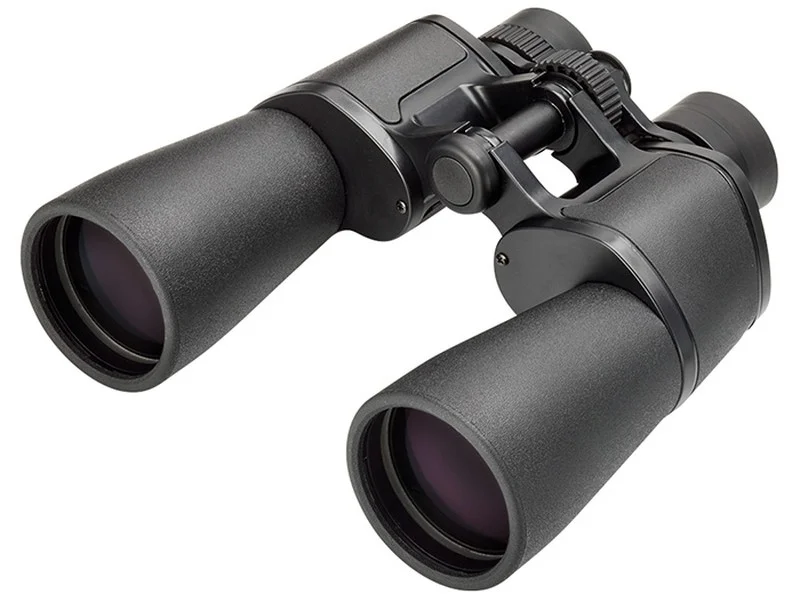
Light and easy to hold steady in twilight, ideal for following the two planets closing in night after night.
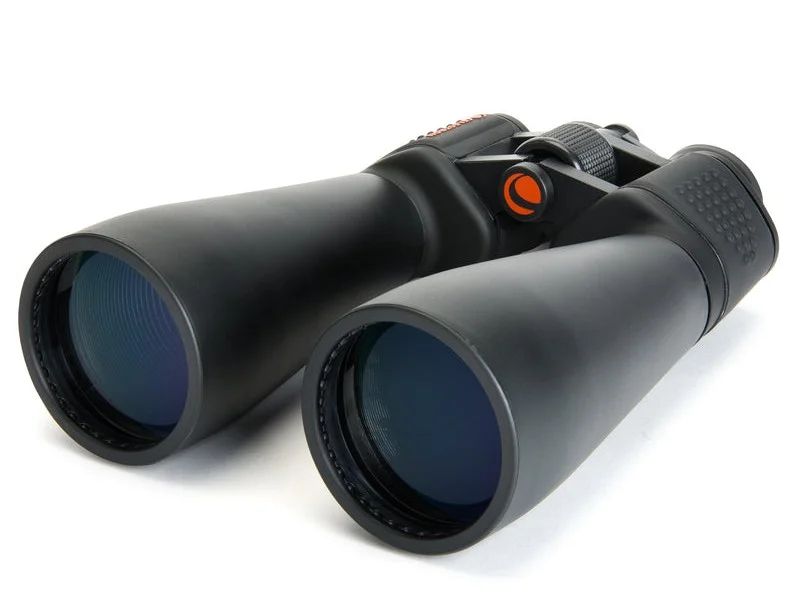
More magnification pulls out the Galilean moons strung out beside Jupiter, a real treat once both planets share the same field of view.
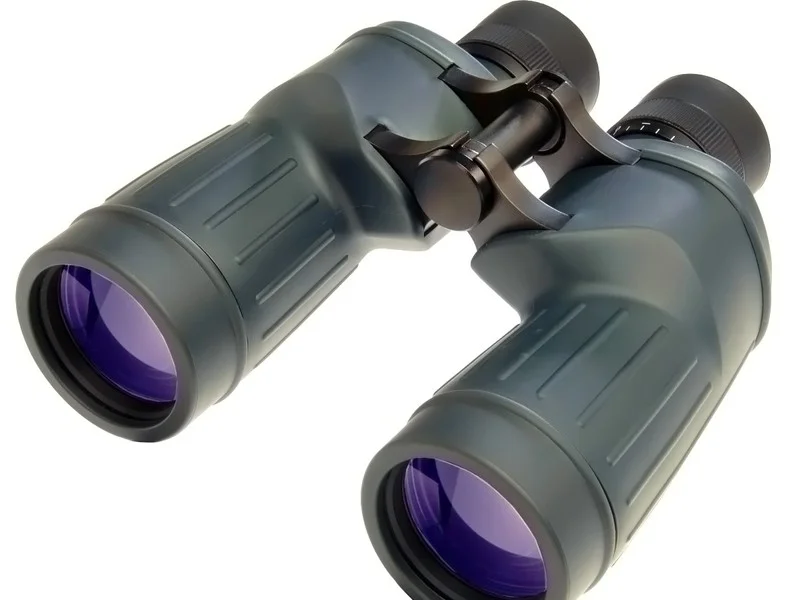
Crisper contrast for picking Venus and Jupiter cleanly out of a bright twilight sky.
Affiliate links: you pay the same price, we earn a small commission that helps keep WatchTheStars free.
The Crescent Moon Bonus: May 18
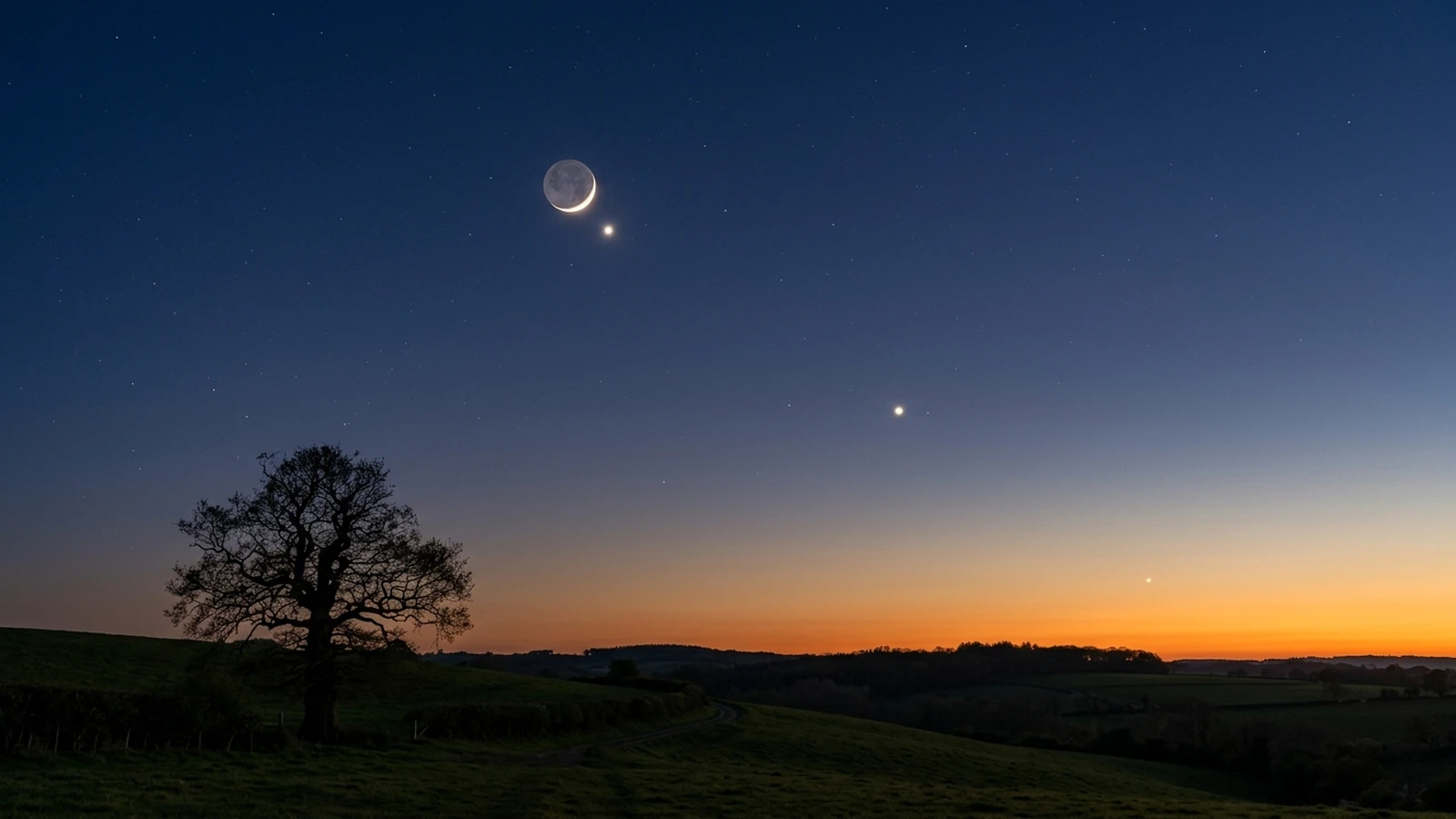
On the evening of Sunday 18 May, a slim waxing crescent Moon, about 10% illuminated, will pass within roughly 3° of Venus. This creates a beautiful three-object scene in the western twilight: the Moon (with earthshine lighting its dark portion), blazing Venus just below it, and Jupiter higher up.
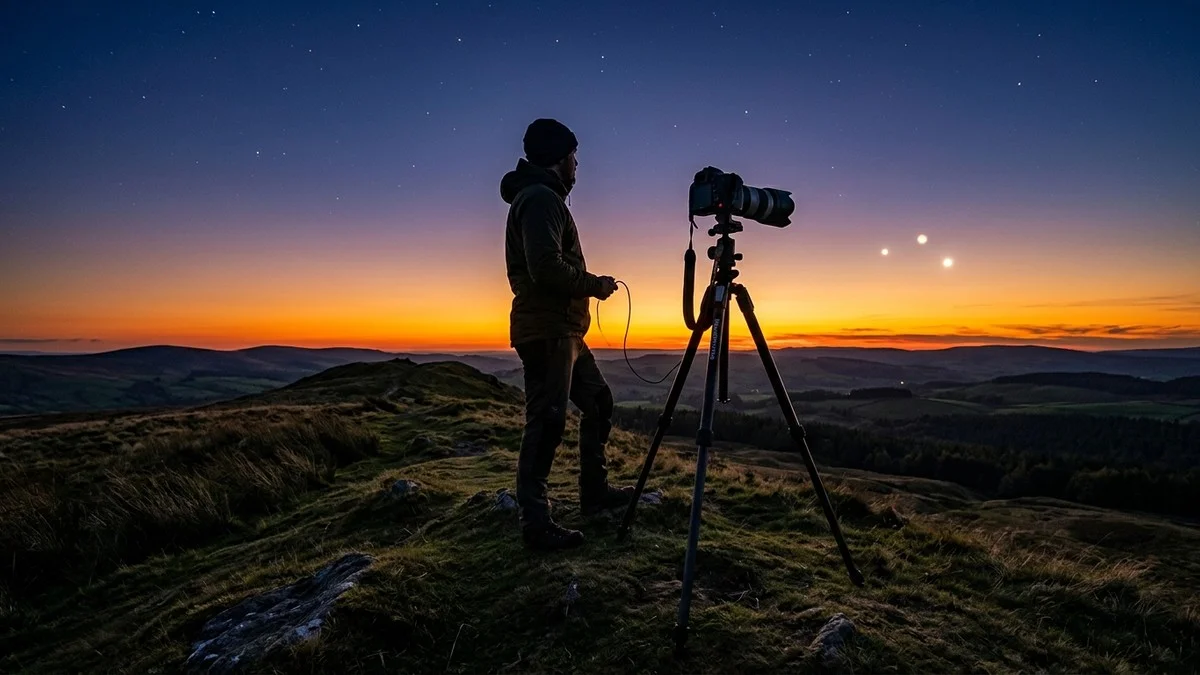
This is a superb photography opportunity. The crescent Moon, Venus, and Jupiter will all fit in a single wide-angle smartphone frame, set against the orange-to-blue gradient of the twilight sky. It's the kind of image that works on a phone without any special settings.
If you only go outside once this month, make it May 18.
Photographing the Conjunction
The good news is that Venus-Jupiter conjunctions are among the easiest astronomical events to photograph.
Smartphone: Point and shoot. Your phone's camera will pick up both planets easily in the twilight. For the best result, tap to focus on Venus and hold still (or lean against something). The twilight background provides natural colour contrast. Night mode can work but often overexposes the planets into blobs, try standard photo mode first.
DSLR or mirrorless: Use a wide-angle or standard lens (24–85mm). Settings to start with: f/4, ISO 400, 2–4 second exposure on a tripod. Include foreground interest, a church spire, tree line, or coastline, to give the image context. As Venus and Jupiter get closer, switch to a longer lens (135–200mm) to fill the frame. If you're thinking about getting into dedicated astronomy cameras, our camera guides cover the options, or see our astrophotography complete setup for a ready-to-go kit.
The panorama trick: Throughout May, take a photo of Venus and Jupiter from the same spot at the same time each clear evening. By late May you'll have a sequence showing Venus racing toward Jupiter, a stunning visual record of their convergence.
Through Binoculars and Telescopes
Binoculars transform this event. Standard 10×50s give you a roughly 5–6° field of view. Once Venus and Jupiter are within about 5° of each other (from early June), both fit in the same binocular view. On June 9, you'll see Venus as a tiny crescent and Jupiter as a small disc with its four Galilean moons strung out in a line, two utterly different worlds sharing the same circle of sky. If you don't yet own a pair, our binocular starter setup guide covers the best options for under £120.
Through a telescope at low power (20–40×), the conjunction is remarkable. Venus appears as a brilliant crescent: it's showing us its "half-lit" phase, like a tiny quarter Moon. Jupiter, by contrast, shows its familiar ochre-and-cream cloud belts, perhaps a hint of the Great Red Spot if the timing is right, and up to four moons scattered nearby. Seeing both in the same eyepiece field on June 9 is a treat: two giant planets, 500 million miles apart in reality, momentarily aligned from our vantage point on Earth. Any telescope will show this well, see our telescope roundup if you're looking for a first scope.
A note on altitude: Both planets will be relatively low in the west during the conjunction, which means you're looking through more atmosphere than usual. Atmospheric turbulence (what astronomers call "seeing") will make the view shimmer. Don't crank up the magnification, stick with low to medium power for the sharpest view.
What Happens After June 9
Venus doesn't stop moving after the conjunction. It will overtake Jupiter and continue eastward, rapidly increasing the separation again. By mid-June the pair will already be noticeably farther apart, and by July they'll be in completely different parts of the sky.
Jupiter, meanwhile, is slowly sinking toward the Sun from our perspective. By late June it'll be lost in the solar glare, not to reappear until August when it emerges as a morning object.
So enjoy the convergence while it lasts. Every clear evening from now through June 9 is an opportunity to step outside for two minutes and watch the solar system's two brightest planets draw together. No alarm clock, no special equipment, no clear horizons needed, just the western sky after dinner.
The next Venus-Jupiter evening conjunction won't be until 2028.
Frequently Asked Questions
Equipment guides
Related topics
Ian ClaytonAmateur astronomer and founder of WatchTheStars.co.uk, dedicated to helping others explore the wonders of our universe. Full profile →