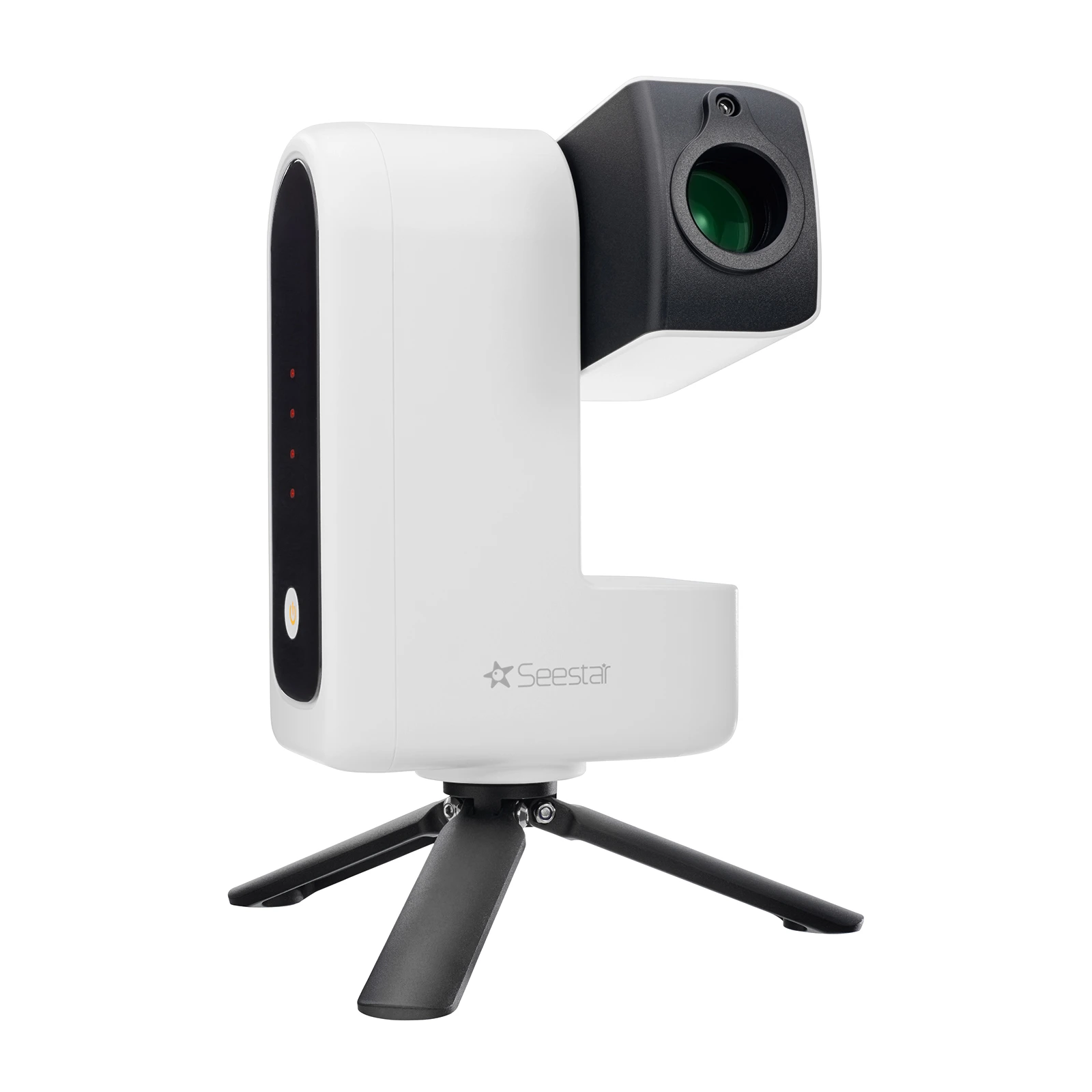
ZWO Seestar S30
The Seestar S30 is the most portable smart telescope ZWO makes. At 1.65kg and £419 it undercuts the S50 on both weight and price, and its second wide-angle lens makes finding targets noticeably easier. The trade-off is a smaller 30mm aperture: it needs longer exposures to capture fainter nebulae than the S50 would. For beginners, travellers, and anyone who genuinely wants something they'll actually take outside, it's a strong choice.
ZWO Seestar S30 Specifications
| Key Specifications: ZWO Seestar S30 | |
|---|---|
| Price (UK) | £419 at First Light Optics |
| Aperture | 30mm (telephoto lens) |
| Optical Design | Triplet apochromatic (APO) refractor with ED glass |
| Focal Length | 150mm (f/5) |
| Telephoto Sensor | Sony IMX662 Starvis 2: Full HD 1080p |
| Wide-Angle Lens | Second lens (23.2° FOV) with separate 1080p sensor |
| Built-in Filters | Dark Field, UV/IR Cut, Light Pollution (H-alpha + OIII) |
| Internal Storage | 64GB eMMC |
| Mount | Built-in motorised alt-azimuth with automatic tracking |
| Connectivity | Dual-band Wi-Fi (2.4GHz + 5GHz) · 20m range · Seestar app (iOS & Android) |
| Battery | ~6 hours (4 hours in video mode) |
| Weight | 1.65kg including tripod |
| Celestial Objects | 4,000+ objects in app database |
| In the Box | Telescope, tripod, magnetic solar filter, carry case, USB-C cable, manual |
| Solar Filter | Included (magnetic snap-on) |
| Warranty | 2 years |
What Makes the Seestar S30 Different
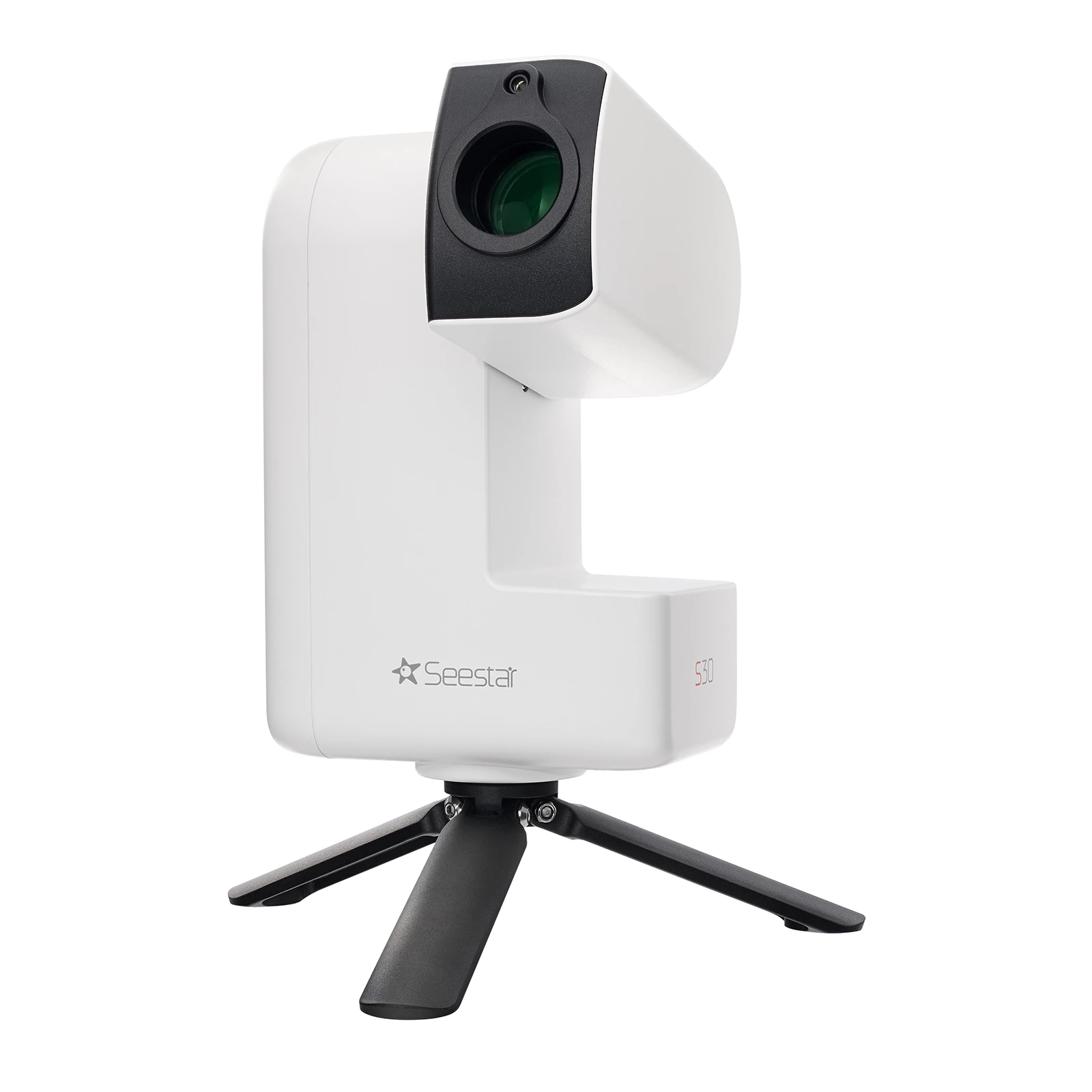
The obvious thing about the S30 is its size. It's genuinely compact: at 1.65kg with the tripod folded, it fits in a backpack and you can carry it one-handed. That's not something you'd say about most smart telescopes, and it matters if the reason your old telescope gathered dust was that setting it up felt like an event.
The less obvious thing, and the reason the S30 isn't just a shrunken S50, is the dual-lens system. There are two cameras on the front of this telescope. The main one is the 30mm APO telephoto, which does the astrophotography. The second is a wider-angle lens that shows you a broader patch of sky. In practice, this means you can centre a target using the wide view and then switch to the telephoto to start stacking, it's a bit like having a proper finder scope built in, but on your phone screen. First-time users consistently comment on how much easier this makes getting started.
The built-in triple filter system also works harder than a quick read of the specs might suggest. The light pollution filter (optimised for H-alpha and OIII wavelengths) cuts through the orange glow of UK suburban skies. Buyers regularly post M42 and M45 images taken from back gardens in towns, not dramatic conditions for deep sky work. Under Bortle 5–6 skies, which covers most of England and Wales, the filter makes a real difference on emission nebulae.
Who Is the Seestar S30 For?
The S30 suits you well if:
- You want something you'll actually use. Setup is under five minutes. Power on, level the tripod, do a quick alignment check in the app, pick a target. Real buyers comment repeatedly on how this gets them outside on cloudy-with-gaps nights that they'd have ignored if they owned a traditional setup.
- Portability matters. If you want to take a telescope to a dark site, on a camping trip, or anywhere that involves putting it in a bag, the S30 is far easier to travel with than the S50 or any of the DwarfLab models. 1.65kg is genuinely light.
- You're starting out in astrophotography. The app handles everything: finding targets, focusing, stacking frames, basic processing. You don't need to know what focal ratio means or how to polar align. Several FLO buyers mention going from unboxing to first image in under an hour.
- You live under typical UK skies. The built-in light pollution filter means urban and suburban observers aren't left out. The Orion Nebula from a street-lit garden in a British town is absolutely doable.
The S30 suits you less well if you want the absolute best performance on faint, diffuse targets like the Horsehead Nebula or the Veil Nebula complex. The S50's larger aperture gathers significantly more light per unit of exposure time, on the most demanding targets that gap shows. The S30 can reach them, but it takes longer.
What Can You See and Image with the Seestar S30?
The S30's 150mm focal length and light pollution filter give it a wide target list for a 30mm aperture. Here's what works well and what needs managing:
Emission Nebulae
The Orion Nebula (M42) and the Lagoon Nebula are strong S30 showpieces: the light pollution filter pulls them out clearly even from urban sites. The Rosette, Omega, and Eagle Nebulae are all achievable. Fainter targets like the Horsehead and the Veil complex need longer total exposure times than on the S50, but they're not off the table.
Galaxies
Andromeda (M31) is well-framed at 150mm: you can fit the whole galaxy with some sky around it, which is actually a nice field of view for it. M81, M82, and the Whirlpool (M51) are achievable on darker nights. Galaxy season from February to May is the best time to try these.
Star Clusters
The Pleiades (M45), Beehive (M44), Double Cluster in Perseus, and the Hercules Globular (M13) all work well. These are quick, satisfying targets for short sessions, 10–15 minutes is enough to get a good result.
The Moon
Excellent. The Moon is one of the S30's best subjects: the detail in craters and mountain ranges at 150mm is striking. The app saves lunar video footage which you can also stack externally with AutoStakkert! for even sharper results than the in-app processing.
The Sun
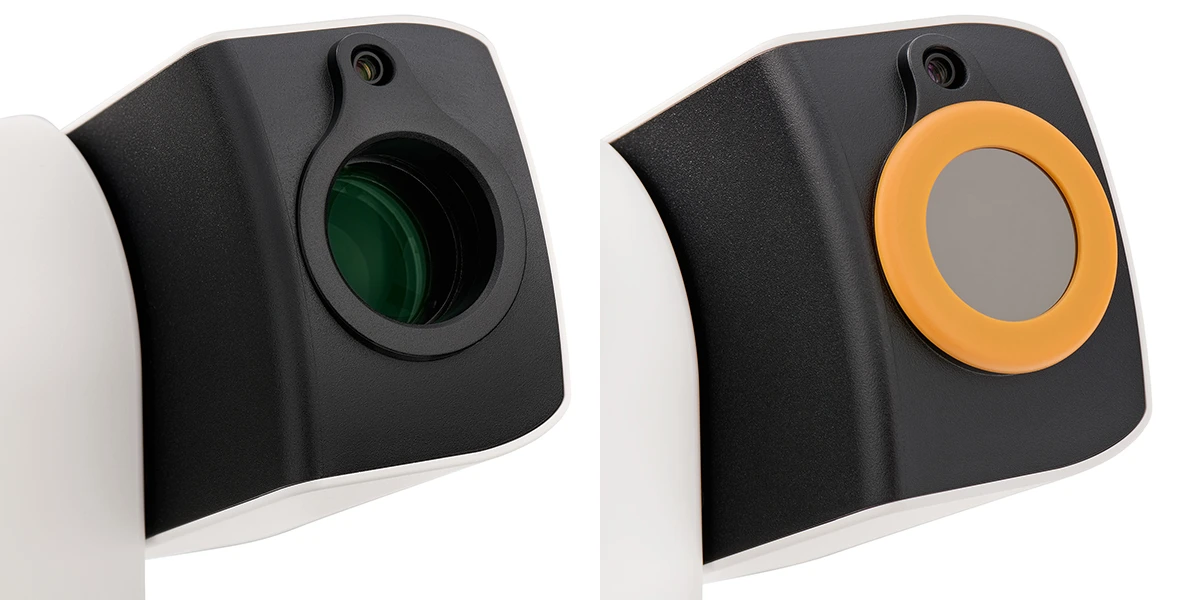
The magnetic solar filter included in the box snaps on and off cleanly. Sunspot groups are clearly visible, and it's a straightforward switch between deep-sky and solar modes in the app. During the current solar maximum, there's regularly something worth imaging.
Planets
Don't expect too much here. At 30mm aperture you'll see Saturn's rings and Jupiter's equatorial belts, but fine planetary detail needs more aperture. The S30 is primarily a deep-sky and nebula tool: planets are a bonus, not a selling point.
Seestar S30 vs S50: Which Should You Buy?
These are the two questions that settle it:
Do you prioritise portability or raw performance? The S30 is meaningfully lighter and smaller, and it costs £120 less. If you'll actually carry it places because it fits in a bag, that's worth something. The S50 is a better telescope technically, more aperture, more light, a solar filter in the box, but if it ends up staying indoors because you can't be bothered with the extra bulk, the S30 wins by default. If you're also weighing up DwarfLab's flagship, our Seestar S50 vs Dwarf 3 comparison covers how the S50 stacks up against its closest rival.
Do you want the dual-lens finder system? The S30's wide-angle second camera is genuinely useful for pointing the telescope at the right part of the sky, especially when starting out. The S50 doesn't have this: it has a wider, more capable single lens. Which matters more depends on how much you struggle to locate targets initially.
| Seestar S30 | Seestar S50 | |
|---|---|---|
| Price | £419 | £539 |
| Aperture | 30mm | 50mm |
| Weight (with tripod) | 1.65kg ✓ | 2.5kg |
| Dual lens system | Yes ✓ | No |
| Light pollution filter | Yes | Yes (dual-band H-α + OIII) |
| Solar filter included | Yes ✓ (magnetic) | Yes ✓ |
| Battery life | ~6 hours | ~6 hours |
| Best for | Portability, beginners | Faint nebulae, city skies |
What Buyers Say
Rated 4.7/5 from 162 verified reviews on the ZWO store. The S30 launched in late 2024 and built a strong review record quickly. Common threads across the buyer feedback:
"From unboxing to final image in hours." Multiple buyers comment on how quickly they were up and running, imaging M42 within the first evening, having been sceptical about what a 30mm aperture could do. First-session results consistently exceed expectations.
The simplicity is the point. One buyer who'd stepped away from astrophotography after years of frustration with traditional gear described it as "no more sitting in a freezing garden making sure no wires get tangled." The S30 does away with that entirely. You set it up, go inside, and watch it work from your phone.
It handles cold UK conditions well. One buyer tested it at -24°C. The built-in dew heater and the heat generated by the sensor kept the lens clear without any issues. That's useful context for UK winters, where damp nights are far more likely than genuinely cold ones.
Once you have it, you want the Pro too. Several existing S50 owners bought the S30 as a second instrument specifically for its portability. A few comment that having tested the S30, they now also want the S30 Pro. This says something about how well it works, people don't start planning upgrades from things they're disappointed in.
What the S30 Can't Do
- 30mm aperture limits faint-target performance. This is the main trade-off. The S50's larger mirror collects more than 2.7× the light of the S30. For the faintest targets (Horsehead Nebula, Veil Complex, the Flame Nebula) the S50 pulls out detail in a session that the S30 needs considerably longer to match. The S30 can get there, but it requires patience and clear, stable nights.
- No dew heater. The S50 includes a dew heater in the box. The S30 doesn't. On damp UK autumn and winter nights this is a practical difference: the S50 will keep the lens clear longer without intervention. It's not a deal-breaker, but it's worth knowing.
- 1080p sensor, not higher resolution. The Sony IMX662 records in Full HD. Images look great on a phone screen and hold up well when shared on social media, but if you want to crop tightly and print large, the resolution ceiling is lower than newer sensors in more expensive telescopes like the S30 Pro.
- Field rotation on long exposures. The alt-az mount produces field rotation over extended stacking sessions, stars in the frame corners gradually trace arcs. This doesn't matter for shorter sessions or targets you're sharing on Instagram, but it's worth knowing if you're planning serious processing work.
- App dependency. Everything runs through the Seestar app. If ZWO ever discontinued the app or experienced server issues, functionality would be affected. This is a shared limitation of all smart telescopes, not unique to the S30, but it's worth factoring into a long-term ownership picture.
Frequently Asked Questions
How we reviewed this
This is a research-based review rather than a laboratory test. The facts on this page come from the manufacturer's specifications, the First Light Optics listing and its customer reviews, and the long-running owner threads on Stargazers Lounge and Cloudy Nights, checked against what the same kit shows from a typical UK garden. We have not necessarily used every item ourselves; where we have, the page says so. We receive no free equipment, and the retailer links pay a small commission that never changes the price you pay or the verdict we give.
Prices are read from our product data, last checked against First Light Optics on 23 October 2026. Own this kit and see it differently? Email [email protected] and we will update the page.