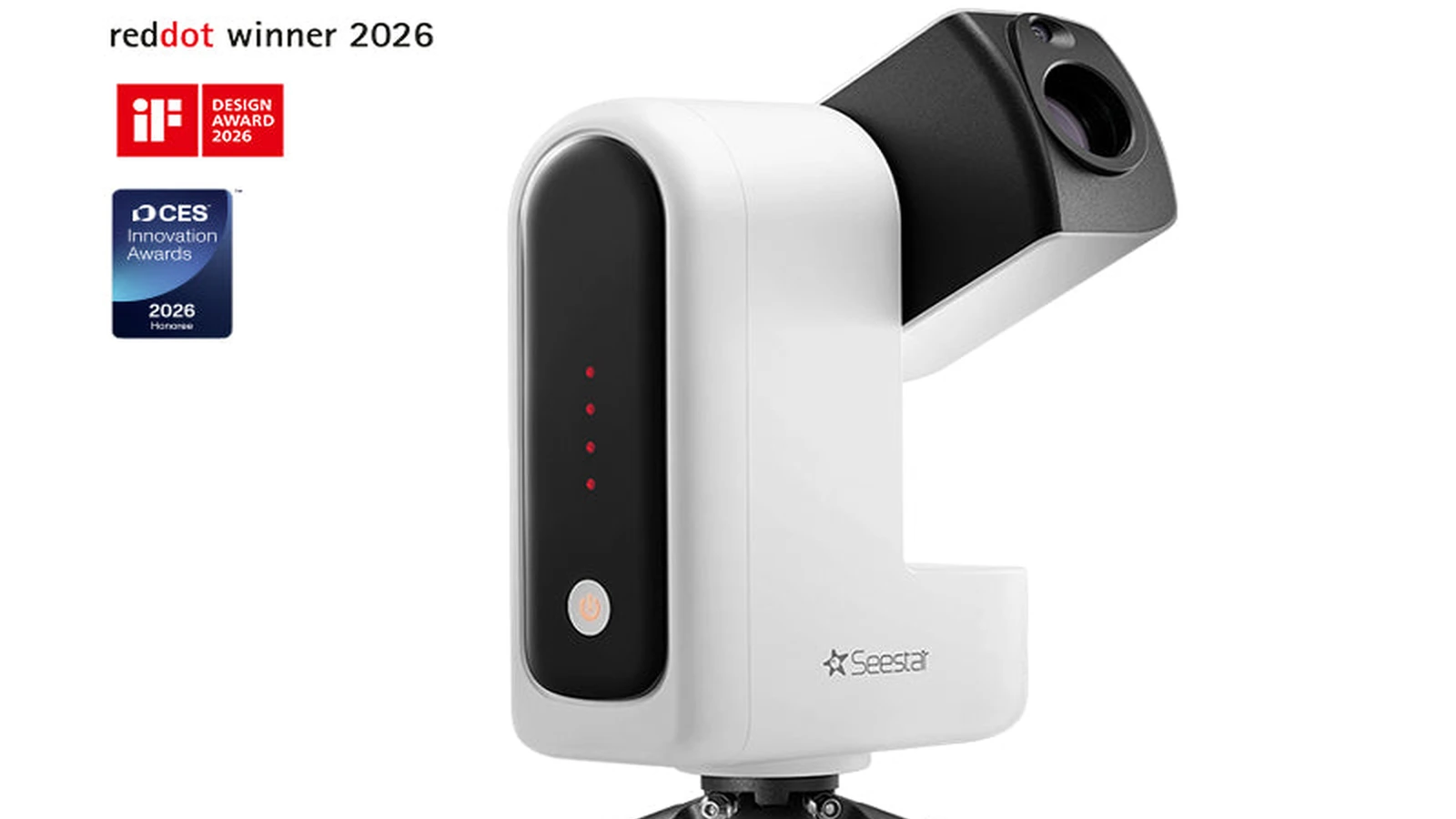
ZWO Seestar S30 Pro
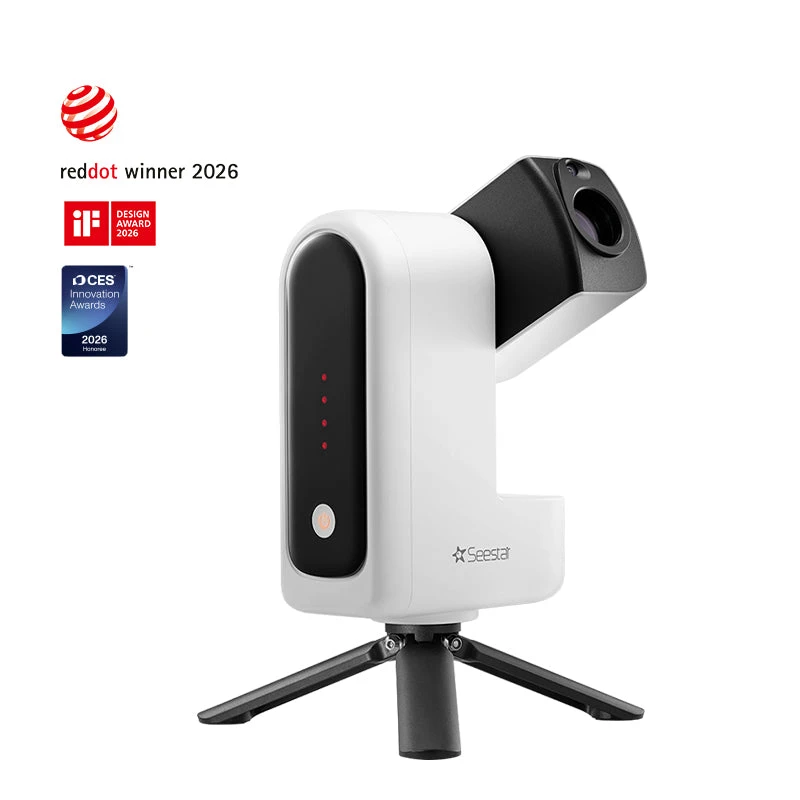
The S30 Pro is the best sensor in the Seestar range. Its Sony IMX585 has a light-sensitive area four times larger than the standard S30, and both cameras shoot 4K, something no other smart telescope at this price matches. The 30mm aperture is still the limiting factor on the very faintest targets, and the S50's dedicated narrowband filter is stronger for heavy urban light pollution. But for most uses, and especially for anyone who wants to travel with it, the S30 Pro is the pick.
ZWO Seestar S30 Pro Specifications
| Key Specifications: ZWO Seestar S30 Pro | |
|---|---|
| Price (UK) | £599 at First Light Optics |
| Telephoto Aperture | 30mm |
| Optical Design | 4-element apochromatic quadruplet with ED glass |
| Telephoto Focal Length | 160mm (f/5.3) · 4.6° field of view |
| Telephoto Sensor | Sony IMX585: 8.3MP, 4K (3840×2160), 1/1.2" CMOS |
| Wide-Angle Lens | 3.4mm f/1.75 · 63° field of view |
| Wide-Angle Sensor | Sony IMX586: 8.3MP, 4K (3840×2160) |
| Built-in Filters | LP filter (Ha 20nm + OIII 30nm), UV/IR cut, dark field |
| Solar Filter | Magnetic snap-on: included |
| Anti-Dew | Built-in active anti-dew heater |
| Internal Storage | 128GB eMMC |
| Mount | Built-in motorised alt-azimuth with tracking · EQ mode supported |
| Connectivity | Wi-Fi 2.4G/5G · Bluetooth · USB-C · ASCOM Alpaca |
| Battery | 6,000mAh · ~6 hours |
| Weight | 1.65kg |
| Deep-Sky Database | 80,000+ objects |
| In the Box | Telescope, tripod, magnetic solar filter, carry case, USB-C cable |
What Is the ZWO Seestar S30 Pro?
The Seestar S30 Pro is ZWO's current flagship smart telescope. It takes the compact dual-lens body of the standard S30 and puts substantially better cameras inside: a Sony IMX585 in the telephoto and a Sony IMX586 in the wide-angle, both shooting 4K at 8.3MP. The telephoto sensor's light-sensitive area is four times larger than the one in the S30. That's not a marginal spec bump.
The optics get an upgrade too. Where the standard S30 uses a triplet APO, the S30 Pro has a four-element APO quadruplet. The extra element is there to keep stars sharp across the edges of the larger sensor, bigger sensors show off optical flaws more readily, and ZWO have addressed this properly rather than cutting corners.
Everything else you'd expect is here: the same Seestar app, the same alt-az mount with auto-tracking, 128GB of storage (double the S30), and a built-in anti-dew heater that the standard S30 doesn't have. That last one matters more in the UK than it might seem, autumn and winter nights in England are damp, and a heater that keeps the lens clear without you having to think about it is a genuine practical advantage.
At £599 it costs £180 more than the S30 and £60 more than the S50. Whether that's worth it depends on what you're imaging and from where, more on that below.
The Sony IMX585 Sensor: Why It Matters
The IMX585 is a backside-illuminated CMOS sensor with a 1/1.2-inch format. To put that in context: the standard S30's IMX662 is a 1/2.8-inch sensor. The S30 Pro's sensor has four times the light-gathering area. More area means more photons per exposure, which means less noise in the same amount of time, which means cleaner images of faint targets.
In practice this shows up most clearly on dim extended objects: the outer arms of a galaxy, the faint wisps at the edge of a nebula. Where the S30 needs a longer stacking session to pull detail out of a noisy background, the S30 Pro reaches the same point faster. That matters on UK nights when clear skies don't last long.
The 4K resolution (3840×2160) is also a genuine step up. 1080p looks fine on a phone screen but starts to look soft if you want to crop tightly or share full-resolution versions. 4K images hold up considerably better. If you use the mosaic mode, which stitches multiple 4K frames together, the results can reach an effective 8K resolution on wide targets like the Orion Nebula region.
Both the telephoto and wide-angle cameras now shoot 4K. The wide-angle in the standard S30 was HD. The S30 Pro's wide IMX586 at 8.3MP produces noticeably sharper Milky Way and timelapse footage than anything the standard model can achieve.
The Seestar S30 Pro Dual-Lens System Explained
Like the standard S30, the Pro has two cameras: a 30mm telephoto for deep-sky imaging and a wide-angle (63° field of view) that runs simultaneously. The wide-angle can capture the whole constellation while the telephoto is locked onto a nebula inside it. You can run Milky Way timelapses while imaging a galaxy. You can watch what's above you on the wide view while the telephoto stacks deep-sky frames.
What's changed over the S30 is the quality of both feeds. The 4K wide-angle is a proper landscape and sky camera: the IMX586 has enough resolution to produce wide-field images worth printing, not just sharing on social media. Combined with the Plan mode (which lets you schedule imaging sessions in advance and wake the telescope while you sleep), the S30 Pro opens up overnight wide-field sky projects that no previous Seestar could match.
The wide-angle autofocuses down to 0.1m, so it can also be used as a close-focus camera during the day, useful for travel photography beyond just astronomy.
What Can You Photograph with the Seestar S30 Pro?
Emission Nebulae
The built-in LP filter (Ha 20nm + OIII 30nm) cuts urban sky glow on emission targets. The Orion Nebula, Rosette, Eagle, Lagoon, and Omega all photograph well. The IMX585's larger sensor gathers more light per exposure than the S30, so faint structures come out faster. The Horsehead Nebula is achievable in a reasonable session from Bortle 5–6 skies.
Galaxies
Andromeda fits comfortably in the telephoto's 4.6° field of view with room to show surrounding sky. M81, M82, M51 (the Whirlpool), and the Leo Triplet are all reachable. The IMX585's low read noise helps on galaxies, which need dark backgrounds to show arm structure. Galaxy season, roughly February to May, is the best window.
Star Clusters
Open clusters are quick wins on any session. The Pleiades (M45), Beehive (M44), Double Cluster in Perseus, and Hercules Globular (M13) all stack up nicely in 10–15 minutes. The 4.6° field of view frames loose clusters like the Pleiades better than the S50's 2.6°.
The Milky Way
This is where the 4K wide-angle earns its place. The 63° field covers a large arc of the Milky Way in a single frame. Plan mode lets you schedule an overnight wide-field session and come back to finished 4K timelapse footage in the morning. The ground-freeze feature separates the landscape from the sky so both are sharp simultaneously.
The Moon & Sun
The Moon resolves well at 160mm: craters, rilles, and mountain ranges show clearly. The included magnetic solar filter makes switching to solar imaging quick. Sunspot groups are clearly visible during the current solar maximum. The EQ mode (via the optional TH10 mount) allows longer lunar exposures without field rotation.
Planets & Day Use
Saturn's rings and Jupiter's main belts are visible through the telephoto, but a 30mm aperture limits planetary detail. The S30 Pro is primarily a deep-sky instrument. The wide-angle camera doubles as an ultra-telephoto for daytime birdwatching, distant landscapes, and rocket launches, genuinely useful for travel.
Who Is the Seestar S30 Pro For?
You want the best sensor in the Seestar range. The IMX585 is a meaningful step up from both the S30's IMX662 and the S50's IMX462. If image quality matters more than aperture, the S30 Pro has the best camera of any Seestar.
You want 4K dual-lens capability. Both cameras on the S30 Pro shoot 4K. No other smart telescope at this price does this. If Milky Way timelapses, wide-field constellation shots, and simultaneous deep-sky and wide-angle capture are things you'd actually use, there's no competition.
You image in the UK and want the anti-dew heater. The built-in heater keeps the lens clear on damp autumn and winter nights. The standard S30 doesn't have one. The S50 ships with an external dew heater. On the S30 Pro it's integrated: cleaner, simpler, no extra cable to manage.
You travel with it or want a portable grab-and-go setup. At 1.65kg the S30 Pro is the same weight as the standard S30, far lighter than any 50mm smart telescope. It goes in a bag. You'll actually take it places.
The S30 Pro suits you less well if nebulae from a heavily light-polluted city garden are the main priority. The S50's dedicated dual-band narrowband filter and 50mm aperture still produce better emission nebula results from Bortle 7–8 skies. For most suburban UK locations, Bortle 5–6, the S30 Pro's LP filter is competitive.
Seestar S30 Pro vs S30: Is the Upgrade Worth It?
The honest answer: yes, for most buyers who'll use it regularly.
The sensor is four times larger. The wide-angle jumps from HD to 4K. Storage doubles from 64GB to 128GB. The anti-dew heater is added. The optics upgrade from a triplet to a quadruplet APO. That's a lot of changes for £180.
The case for the standard S30 is if you're buying your first smart telescope and you're not sure yet how much you'll use it. The £419 entry point is lower risk. If you use it and get hooked, the Pro will tempt you. But real-world image quality comparisons consistently show the difference is smaller than the spec gap suggests: both share the same 30mm aperture, and the LP filter is similar. For occasional or casual use, the standard S30 is perfectly capable.
| Seestar S30 | Seestar S30 Pro | |
|---|---|---|
| Price | £419 | £599 |
| Telephoto sensor | IMX662 · 1080p | IMX585 · 4K ✓ |
| Sensor area | 1/2.8" | 1/1.2" (4× larger) ✓ |
| Wide-angle camera | HD | 4K IMX586 ✓ |
| Optics | APO triplet | APO quadruplet ✓ |
| Storage | 64GB | 128GB ✓ |
| Anti-dew heater | No | Built-in ✓ |
| Weight | 1.65kg | 1.65kg |
Seestar S30 Pro vs Seestar S50: Which Should You Buy?
This is the comparison most people are actually making at the £599 price point, since they're close in price.
The S30 Pro has the better sensor: the IMX585 at 8.3MP 4K vs the S50's IMX462 at 2.1MP 1080p. It has the dual-lens system: the S50 has a single telephoto. It's lighter and more portable. The built-in anti-dew heater is integrated rather than a separate cable. ASCOM Alpaca support opens it up to advanced software like N.I.N.A for automated sessions.
The S50 has a 50mm aperture. Physics matters here: 50mm gathers roughly 2.8× more light than 30mm per unit of time. On genuinely faint targets, that gap shows. The S50 also has a dedicated switchable dual-band narrowband filter (H-alpha + OIII) that is more aggressive at cutting urban light pollution than the S30 Pro's LP filter. If your sky is Bortle 7 or worse and your main targets are emission nebulae, the S50 still has an edge.
For most UK buyers under typical suburban Bortle 5–6 skies, the S30 Pro's sensor advantage largely offsets the aperture gap on common targets. Head-to-head comparisons show the results are closer than the aperture numbers suggest. The S30 Pro pulls ahead on sensor quality; the S50 pulls ahead under the worst light pollution on the best nebula targets.
| Seestar S30 Pro | Seestar S50 | |
|---|---|---|
| Price | £599 | £539 |
| Aperture | 30mm | 50mm ✓ |
| Main sensor | IMX585 · 8.3MP 4K ✓ | IMX462 · 2.1MP |
| Dual-lens | Yes ✓ | No |
| Light pollution filter | LP (Ha + OIII) | Dual-band switchable ✓ |
| Anti-dew | Built-in ✓ | External heater |
| Storage | 128GB ✓ | 64GB |
| Best for | Sensor quality, portability, versatility | Nebulae from heavy LP |
ZWO Seestar S30 Pro Reviews: What Buyers Say
Rated 4.8/5 from 220 verified reviews on the ZWO store. The S30 Pro launched in early 2025 and has been reviewed widely by publications including Digital Camera World, Live Science, T3, Fstoppers, and AstroBackyard. The consensus is strong.
The sensor impresses most reviewers who come from earlier Seestar models. Buyers upgrading from an S30 or S50 consistently comment on the improvement in background smoothness and the detail held in dim targets. The 4K resolution makes a visible difference when cropping or processing in Pixinsight.
The 4K wide-angle gets used more than expected. Several reviewers note they bought the S30 Pro for the telephoto and ended up using the wide-angle camera more than they expected, particularly for overnight Milky Way sessions and star trail videos. The 63° field is genuinely wide and the IMX586 handles it well.
The built-in anti-dew heater draws specific praise from UK buyers. Multiple reviews from UK users flag this as a more practical setup than the S50's external heater, especially during early-morning autumn sessions where dew is a consistent issue.
ASCOM Alpaca support opens up N.I.N.A integration. More advanced users report running the S30 Pro through N.I.N.A for automated multi-night sessions with plate solving and meridian flip management. This is well beyond what the average buyer needs, but it shows the ceiling of what the telescope can do.
Plan mode is used heavily. The ability to schedule a session, put the telescope outside, and go to bed while it images overnight is mentioned by multiple buyers as the feature that changed how they use it. Results are downloaded in the morning.
Seestar S30 Pro: Known Limitations
- 30mm aperture is still 30mm. The IMX585 is a big sensor improvement, but four times the sensor area doesn't mean four times the light collected, that depends on aperture. On the very faintest targets (dim galaxy arms, faint diffuse nebulae), the S50's 50mm still has a meaningful edge. For most targets under typical UK skies, you won't notice the difference in a session.
- LP filter is not as strong as the S50's dual-band. The S30 Pro's light pollution filter (Ha 20nm, OIII 30nm) works well from Bortle 5–6. Under Bortle 7–8 urban skies, the S50's switchable narrowband dual-band filter extracts better contrast from emission nebulae. If you're in central London, the S50 has an edge. In a typical English town or suburb, the difference is smaller.
- Battery life is 6 hours, same as S30. Not a problem for most sessions, but for overnight Plan mode runs you'll want a USB-C power bank. Any modern 20,000mAh bank will extend the session indefinitely.
- EQ mode needs the optional TH10 mount (£179). Equatorial mode, which reduces field rotation in long sessions, requires the Seestar TH10 fluid tripod head. It's not included. If you're planning long exposures or automated overnight sessions, this is worth budgeting for.
- App dependency. Everything runs through the Seestar app. This is shared with all smart telescopes and isn't unique to the S30 Pro, but it's worth knowing, advanced imaging features like ASCOM Alpaca integration require a bit of setup beyond the app.
ZWO Seestar S30 Pro: Frequently Asked Questions
How we reviewed this
This is a research-based review rather than a laboratory test. The facts on this page come from the manufacturer's specifications, the First Light Optics listing and its customer reviews, and the long-running owner threads on Stargazers Lounge and Cloudy Nights, checked against what the same kit shows from a typical UK garden. We have not necessarily used every item ourselves; where we have, the page says so. We receive no free equipment, and the retailer links pay a small commission that never changes the price you pay or the verdict we give.
Prices are read from our product data, last checked against First Light Optics on 23 October 2026. Own this kit and see it differently? Email [email protected] and we will update the page.