Grey Aliens
Small grey body, oversized hairless head, huge black almond eyes. It's the face the whole world pictures when you say 'alien', and its trail leads back to one extraordinary night in 1961, a course of hypnosis, and a question researchers still argue over today: a real encounter, or a story the culture taught us to tell?
the 'classic' alien
case, 1961
cover, 1987
much under hypnosis
shared media image
and undisproven
Ask anyone to draw an alien and you'll get the same thing: a small grey body, a big bald head, and two enormous black eyes. The Grey is the default: the face on the t-shirts, the keyrings and the X-Files posters. What very few people realise is how recent and how specific that image is.
This is the most reported type of alien in the world, and also one of the most traceable. The modern Grey didn't drift in from ancient legend. It has a date of birth, a place, and a couple of witnesses. Follow it back and you arrive at a quiet road in New Hampshire in 1961, and a series of hypnosis sessions three years later.
That doesn't mean the people involved were lying: the Hills were, by every account, sincere and badly shaken by what happened to them. It means the evidence is testimony rather than proof, and where you land on it depends on how you weigh that. Some look at the trail and see an image we all learned; others see a real experience the culture later borrowed and made its own. This page lays out both, and leaves the verdict to you.
What is a grey alien?
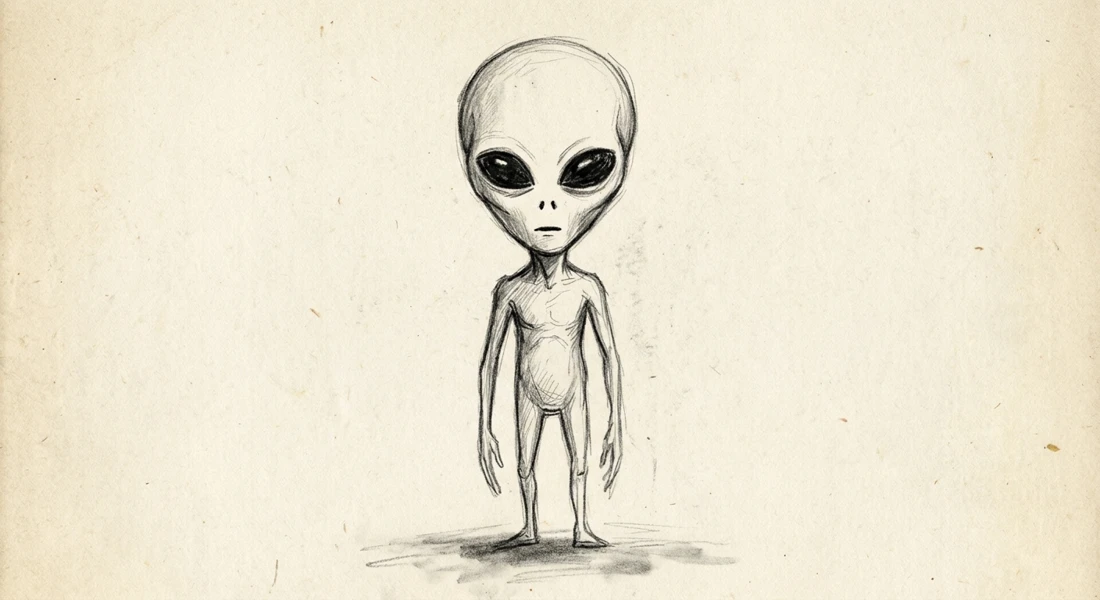
The Grey is described with unusual consistency: roughly 1 to 1.4 metres tall, smooth grey skin, a large hairless head, huge solid-black almond-shaped eyes, tiny nostrils, a thin slit of a mouth and no real ears. It doesn't speak, communication is said to be telepathic, and it's usually cast as a cold, clinical "worker" carrying out medical examinations rather than a monster.
Researchers often split the type into short "worker" Greys and taller "overseer" Greys, but that hierarchy is an internal idea within abduction circles, not anything anyone has confirmed. The single most important fact about the Grey is the one most often skipped: its description barely existed before the 1960s.
Where grey aliens came from: the Hill case (1961)
On the night of 19 September 1961, Betty and Barney Hill were driving home to Portsmouth, New Hampshire when they saw a light that seemed to follow the car, and later realised they couldn't account for about two hours of the journey. That much they reported early. The detailed description of small grey beings with large dark eyes did not come until later: it emerged under hypnosis with the psychiatrist Dr Benjamin Simon, in weekly sessions that began on 4 January 1964.
This is the detail the sceptical case turns on. Simon, who actually conducted the sessions, did not conclude that he had recovered a real memory. His view was that the abduction account grew out of Betty's vivid nightmares in the weeks after the sighting, which Barney then absorbed: many of the details matched her written dream journal. Hypnosis, he warned, is not a magic route to the truth; it can produce confident, detailed memories of things that never happened.
"The hypnosis confirmed the dreams. It did not prove the reality of the abduction."
· the position of Dr Benjamin Simon, who hypnotised the HillsHow the grey alien image went global
From that one case, the Grey spread outward through popular culture in a clear chain. John G. Fuller's 1966 book The Interrupted Journey told the Hills' story to a mass audience. In 1975, NBC dramatised it as The UFO Incident, starring James Earl Jones, which aired on 20 October that year. And in 1987 the Grey was locked in for good by the cover of Whitley Strieber's Communion, a painting Strieber worked on with the artist Ted Seth Jacobs until the face matched what he said he'd seen. It is arguably the most reproduced image of an alien ever made.
One detail captures the pattern neatly. Travis Walton's famous Arizona abduction, in which he described small beings with large heads and big eyes, happened on 5 November 1975, just sixteen days after The UFO Incident had aired on national television. Sceptics have never been able to prove the film influenced him, but the timing is the kind of thing an honest page has to put on the table.
The Zeta Reticuli star map
Under hypnosis, Betty Hill also drew a "star map" she said she had seen aboard the craft. In the late 1960s an amateur astronomer and schoolteacher, Marjorie Fish, built a three-dimensional model of nearby stars and announced that the map matched the Zeta Reticuli system, a claim that became one of the most cited pieces of "evidence" in UFO history.
It doesn't hold up. As more precise measurements of stellar distances came in, the stars Fish had used no longer lined up, and the pattern dissolved. Crucially, Fish herself later acknowledged that the correlation had broken down. A map drawn from memory, under hypnosis, that matches nothing once the data improves, is not evidence of anything.
The sleep-paralysis explanation
There's a well-documented experience that reproduces the core of the abduction story almost exactly: sleep paralysis. Roughly 40 to 50 per cent of people have it at least once. You surface from sleep but can't move; very often there's a sensed presence in the room, pressure on the chest, strange sounds and vivid hallucinations right at the edge of waking. Earlier cultures called it the Old Hag, or a demon, or an incubus. Today, primed by decades of films and book covers, people are far more likely to recognise the figure by the bed as a Grey.
The psychologist Susan Blackmore found that self-described abductees report sleep paralysis far more often than other people. Add hypnosis, which is very good at building detailed memories, true or not, and you have a natural pathway from a frightening night to a confident, specific encounter, no spacecraft required.
It's worth being honest about the limits of this, though. Sleep paralysis is a powerful explanation for the classic bedroom abduction: the figure at the end of the bed, the pinned, helpless feeling. It's a much weaker fit for a case like the Hills', who were awake and driving when the sighting began, with a stretch of genuinely lost time neither could account for. That gap is part of why the debate has never quite closed, and why thoughtful people still land on opposite sides of it.
So are grey aliens real?
On the physical side there's nothing in hand, no artefact, no body, no verified photograph, and sceptics make a genuinely strong case that the Grey rests on a culturally shared image and an ordinary experience, sleep paralysis, that needs no spacecraft to explain it. (You'll sometimes read that Greys make up around 73 per cent of US abduction reports; that figure comes from the journalist C.D.B. Bryan, who covered a 1992 conference at MIT, not from a peer-reviewed study, so treat it as a rough impression rather than a hard statistic.)
Set against that is the part no explanation fully dissolves. Two credible people reported a real sighting and a stretch of lost time before anyone mentioned hypnosis, and millions since have described the same being, including dozens of children at once in the Ariel School incident in Zimbabwe in 1994. None of that proves we're being visited, but none of it closes the door, either. In March 2024 the Pentagon's AARO office reported it had found no evidence the US government has ever held non-human craft or biological remains, while making clear that many sightings remain genuinely unexplained and the investigation continues.
So, are grey aliens real? On the evidence we have, nobody can honestly claim to know for certain. The Grey may turn out to be a very human story, built from one frightening night and the films and book covers that followed it. Or it may be the first rough sketch of something we haven't yet understood. Where you land is, in the end, yours to weigh, and the wider question of what's really in our skies is more open today than at any time since Betty and Barney Hill first looked up.
Do your own looking before you draw conclusions
Kit we've tested and reviewed in full
Most "grey alien" encounters start with something seen at a distance in poor light. A decent pair of binoculars is the simplest tool for turning a fuzzy impression into an actual description.
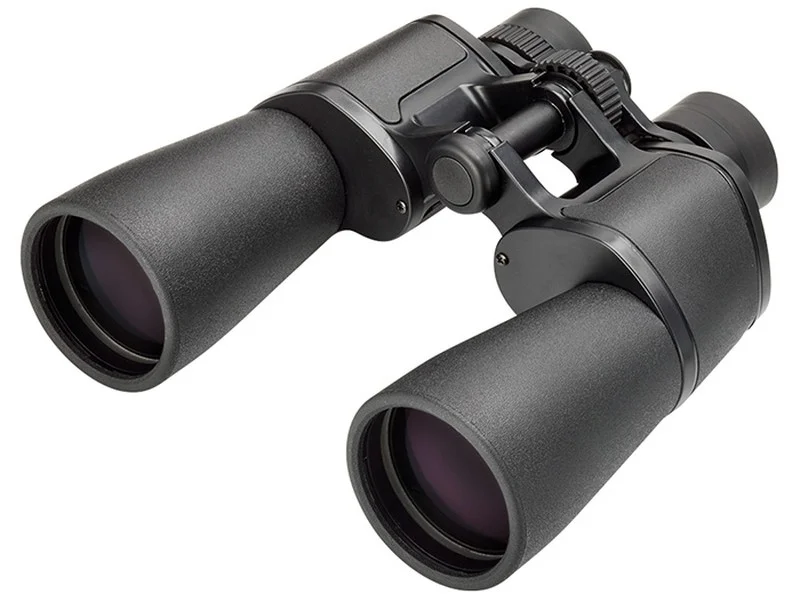
Bright and quick to aim after dark: enough to rule the ordinary in or out before your mind fills in the rest.
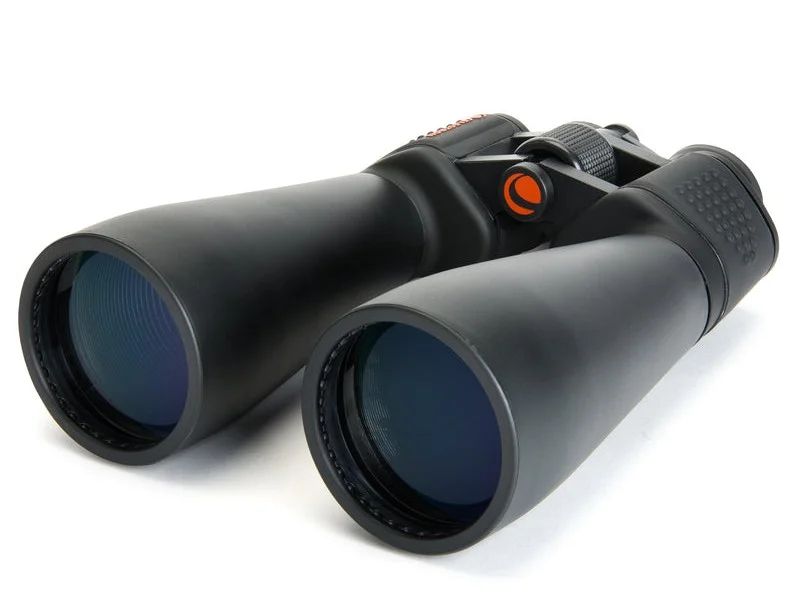
Big 70mm objectives at 15×: enough to pick out real detail in a distant light, which is exactly what separates a report from a mystery.
Affiliate links: you pay the same price, we earn a small commission that helps keep WatchTheStars free.
Frequently asked questions
More UAP cases
- Browse Every Pentagon UFO FileRELEASES 01–06 · 8 MAY TO 18 SEPTEMBER 2026 · MIRRORED ON OUR OWN SERVERS
- Project SIGN: The 1947–48 FileSEPTEMBER 1947 – NOVEMBER 1948 · 245 PAGES · RELEASED 7 AUGUST 2026
- AAWSAP: What the DIA Actually Paid ForCONTRACT 2008–2010 · $21,948,810 OBLIGATED · RELEASED 18 SEPTEMBER 2026
- Reptilian AliensSerpent men · Officer Schirmer · David Icke
- The Hellfire Missile & The OrbINCIDENT DATE: 2024-10-30 | LOCATION: GULF OF ADEN / RED SEA COAST | STATUS: UNDER INVESTIGATION
- The 2025 Military UFO EncounterLATE 2025 · CLASSIFIED US MILITARY TEST RANGE · AMERICAN SOUTHWEST