The Pantex Plant UFO Incident
A Diamond-Shaped UFO Over America's Only Nuclear Weapons Assembly Facility
America's only nuclear warhead assembly facility sits on 16,000 acres of flat Texas panhandle, 15 miles northeast of Amarillo. One September morning in 2015, ground surveillance radar there picked up something nobody could identify. Security officers chased it. The site locked down. Sandia National Laboratories enhanced the images, and the evidence went to the FBI. The full incident report was released on 10 July 2026, and it answers some questions while leaving the biggest one open.
| Facility | Pantex Plant, America's only nuclear warhead assembly and disassembly facility |
| Location | Carson County, Texas, 15 miles northeast of Amarillo |
| Date of incident | 1 September 2015, from approximately 07:08 (report cover dated 2 September) |
| Object description | Diamond type-shape, more round at the top, roughly 4 ft tall, 2 ft wide, silent, no visible propulsion |
| Speed and altitude | 10–15 mph on a steady northerly track, 100–200 ft above the ground |
| Security response | All security-area gates locked down; officers chased the object for several miles; Carson County Sheriff called in |
| Scientific analysis | Radar tower video sent to Sandia National Laboratories for enhancement and analysis |
| Sandia conclusions | Still not released |
| FBI involvement | All evidence turned over to an FBI agent (name redacted) |
| Document released | Full report: 10 July 2026 (DOE-UAP-D005). Pages 5–6 first released 22 May 2026 (DOE-UAP-D001) |
| Classification | UCNI at time of incident: released under Trump's UAP executive order |
The Pantex Plant UFO incident refers to a September 2015 encounter at the Pantex nuclear weapons facility near Amarillo, Texas, in which security personnel tracked a diamond-shaped unidentified object by ground surveillance radar, locked down the site, and chased the object for several miles as it drifted silently north. Video was sent to Sandia National Laboratories for analysis, and all evidence was handed to the FBI. The full six-page incident report was released on 10 July 2026, but Sandia's conclusions about what the object was are still not public.
The Pantex Plant doesn't appear in many news stories. That's largely by design. It sits on the flat plains of the Texas panhandle, visible from miles away but reachable only through multiple security checkpoints. Officially, it assembles and disassembles U.S. nuclear warheads. Unofficially, it is the most nuclear-sensitive piece of real estate in America: every warhead that enters or leaves the U.S. nuclear arsenal passes through there.
On the morning of 22 May 2026, the Department of War published its second batch of declassified UAP documents. Buried among diplomatic cables and Cold War intelligence reports was a two-page partial release from the Department of Energy: DOE-UAP-D001, labelled "ENHANCED PANTEX IMAGERY." It showed a ground surveillance radar image with an object circled, and two Sandia National Laboratories enhanced photographs of something dark, solid, and unidentified in the sky above the facility. Almost everything that might explain what the object was, or wasn't, had been blacked out.
Then, on 10 July 2026, the fourth release changed the picture. The Department of Energy published the complete incident report (DOE-UAP-D005): the covering letter, the full written narrative, the radar track map, and less-redacted versions of the imagery pages. For the first time, we can read exactly what happened at Pantex that morning: minute by minute, from the first radar hit to the moment the object drifted out of reach.
What Is the Pantex Plant?
Pantex was built in 1942 as a conventional bomb plant to support the Second World War. After the war it was mothballed, then reactivated in 1951 at the start of the nuclear arms race. Since then it has been the single point through which all U.S. nuclear warheads pass: whether being assembled for deployment, maintained, or dismantled under arms reduction treaties.
The plant covers roughly 16,000 acres in Carson County, about 15 miles northeast of Amarillo. It is managed by Consolidated Nuclear Security, LLC, a subsidiary of BWX Technologies, under contract to the U.S. Department of Energy. At any given time, Pantex holds a significant portion of the American nuclear arsenal, making it one of the most comprehensively monitored and defended sites in the country. It has its own security force, its own radar systems, and strict protocols for anything that enters its restricted airspace.
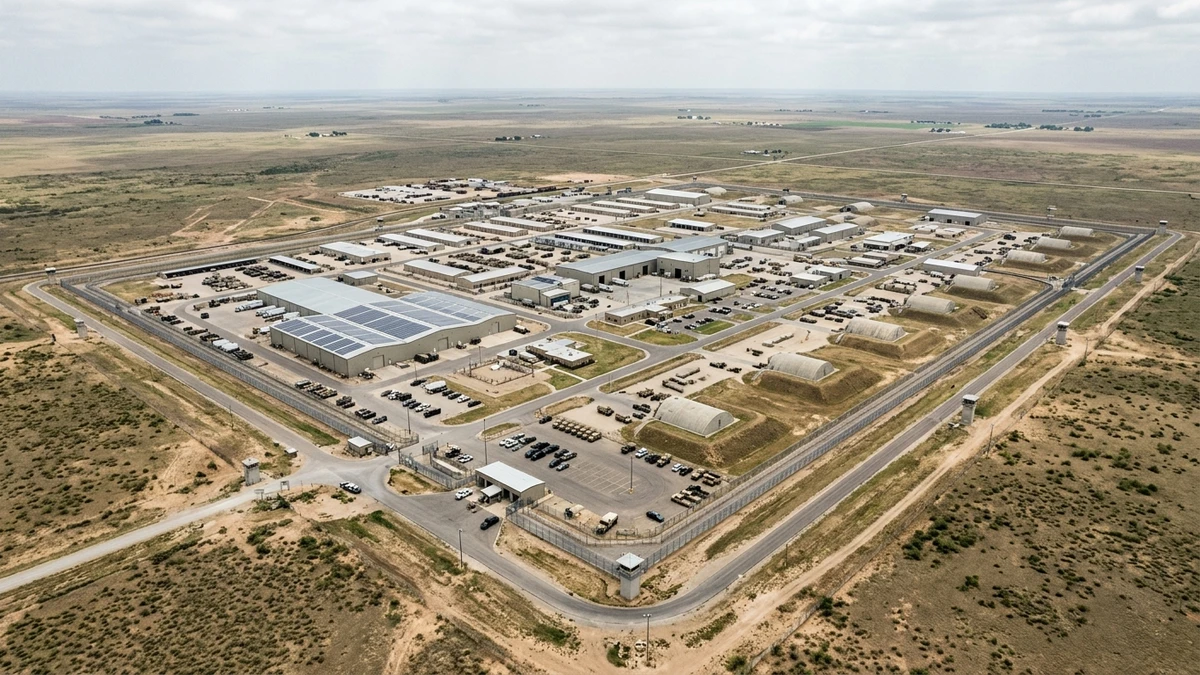
The fact that a UFO was tracked over this facility (and that the government chose to release images of it, however redacted) matters. This isn't a sighting near a generic military base. It's a sighting at the place where America assembles and stores its nuclear weapons.
The September 2015 Incident: What the Report Says
The incident report itself was first obtained by journalist Dustin Slaughter of the UAP Register through a Freedom of Information Act request, published in June 2024. The May 2026 declassification released an enhanced version of the imagery.
According to the document, Pantex security personnel were alerted to an unidentified object on 2 September 2015. The object was described as having a "diamond type-shape with it being more round at the top." Personnel were then directed to follow the object and gather as much information as they could.
"Personnel were directed to follow it and obtain as much information about it as possible."· Pantex Unidentified Object Incident Report, 2 September 2015
The object continued travelling north of the facility. Security tracked it for several miles before it was, in the report's words, "no longer visible." It didn't land. It didn't turn around. It simply disappeared from view.
Crucially, the sighting wasn't only visual. The object was picked up by ground surveillance radar: the same systems that monitor the facility's restricted airspace around the clock. Video was captured from the surveillance radar tower closest to the object, and that footage was sent to Sandia National Laboratories for enhancement and analysis.
| Visual observation | Pantex security personnel, trained observers, familiar with aircraft and drones in the area |
| Radar confirmation | Ground surveillance radar tracked the object from 1.75 miles out |
| Weapon-system camera | Tracked for 3–5 minutes through a CROWS camera on an armoured Bearcat |
| Video evidence | Captured from the nearest ground surveillance radar tower |
| Laboratory analysis | Footage enhanced and analysed by Sandia National Laboratories |
| Sandia findings | Still not released |
What Does the Full Pantex UFO Report Say? The July 2026 Release
The full incident report, released on 10 July 2026 as DOE-UAP-D005, finally fills in the narrative that the May release left blank. It reads like a security log, and that's what makes it convincing. There's no speculation in it: just what the radar recorded, what the officers did, and what they saw.
One small surprise first: the report's own narrative dates the sighting to the morning of 1 September 2015, a day earlier than the date on the report's cover. At approximately 07:08, the plant's Ground Surveillance Radar picked up an unknown object about 1.75 miles southwest of the facility. It was flying at 10 to 15 mph, walking-to-cycling pace, on a steady northerly track, just north of Highway 60.
"All plant pedestrian and vehicle gates leading into and out of security areas were immediately secured upon identification of an unknown object by the GSR. Furthermore, PF patrols moved to a position to ensure the protection of assets."· Pantex Unidentified Object Incident Report (DOE-UAP-D005), released 10 July 2026
That's a lockdown. America's nuclear warhead assembly plant sealed its gates because of a slow-moving object nobody could identify. The Protective Force responded under the site's approved plan for unmanned aerial systems, the drone playbook, while a lieutenant and a security police officer went after the object by vehicle.
They couldn't catch it, so they stopped, got out, and watched it pass overhead. What they reported is the heart of the document: the object made no sound, and through binoculars they could find no visible means of propulsion. Officers in an armoured Bearcat also picked it up through the camera on a CROWS remote weapon system, tracking it for three to five minutes at a range of 75–100 metres. They put it at 100–200 feet above the ground.
The descriptions mostly agree: about 4 feet tall, 2 feet wide at the base, thinner at the top, the "diamond" shape, rounder at the top. The colour is where witnesses split. Some said black. Others said silver, red and blue. That disagreement, from trained observers watching the same object in daylight, is one of the report's stranger details.
The object crossed the plant, stayed over open ground, and carried on north. The officers followed it for several miles until the roads ran out, losing it near County Road G and F.M. 1342. A Carson County Sheriff's deputy met them at the spot; he never saw it. The report closes with a line that raises more questions than it answers:
"All evidence of the incident (i.e. statements, video, etc.) were turned over to FBI agent [name redacted]."· Pantex Unidentified Object Incident Report (DOE-UAP-D005), released 10 July 2026
The FBI took the file. Nothing about what the Bureau did with it has been released. And the one thing the full report still doesn't contain is the answer that matters most: what Sandia National Laboratories concluded after enhancing the footage. Their images are in the report. Their analysis isn't.
What the Declassified Images Actually Show
The May 2026 document (DOE-UAP-D001) contained only pages 5 and 6 of the 6-page report: the narrative pages arrived two months later, in the full July release described above. But the images remain the most striking part of the file, so they're worth examining on their own.
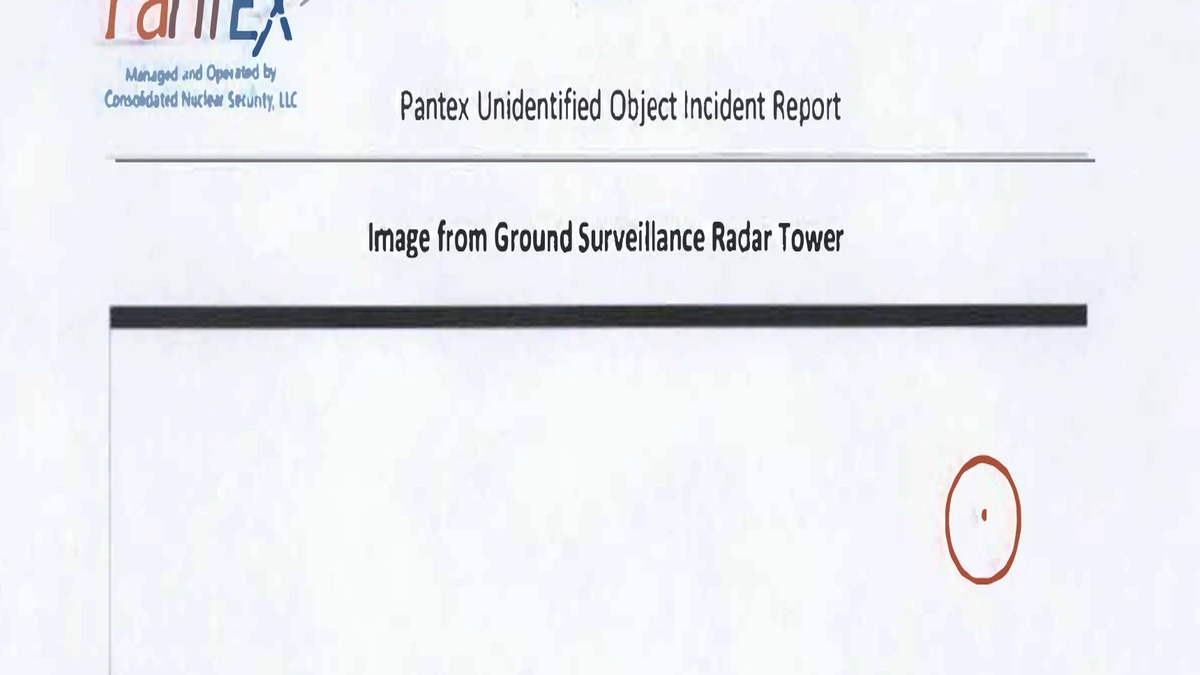
Page 5 shows the ground surveillance radar image. It's a wide view of the area around the facility, with a small object circled in the upper-right quadrant. The descriptive text explaining what the radar return signified is fully redacted under UCNI provisions.
Page 6 shows the Sandia National Laboratories enhanced imagery: two separate captures of the object. These are more striking. The enhanced images show what appears to be a dark, solid, three-dimensional shape against the sky. It is wider at the top and narrows toward the base, consistent with the "diamond type-shape, more round at the top" described by witnesses. There is a faint haze or corona visible around its outline, possibly an artifact of the enhancement process, possibly something else. Whatever Sandia's analysts made of it, their conclusions are on pages that haven't been released.
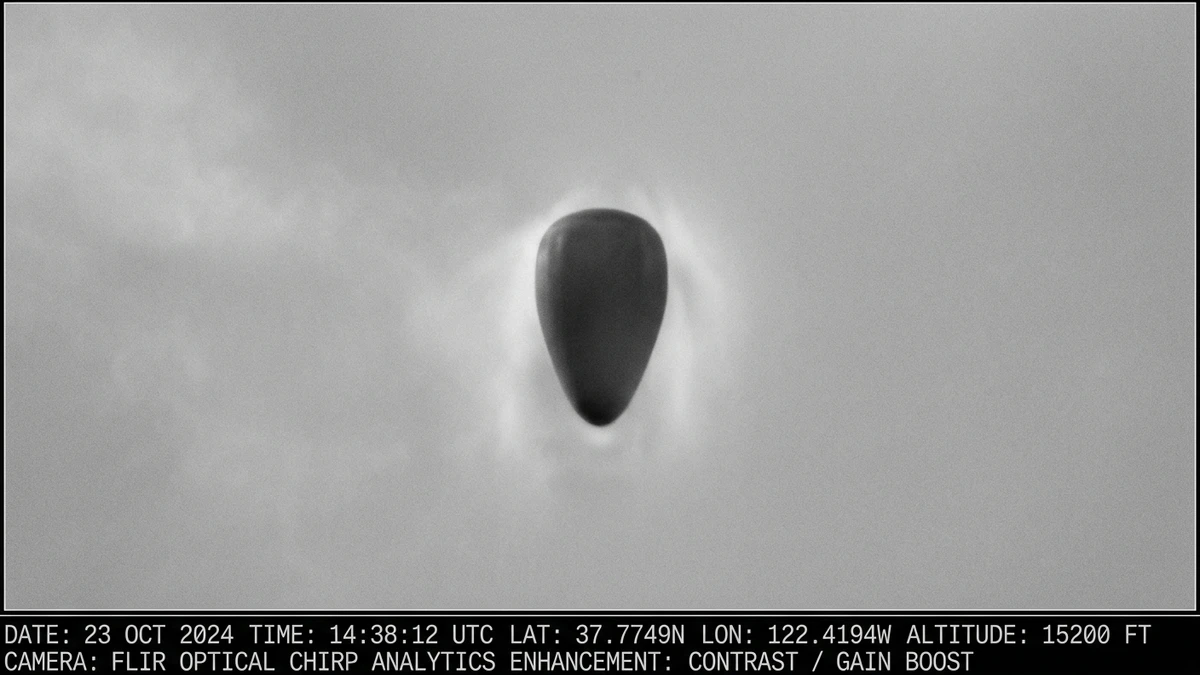
The classification status of the released pages (UCNI, or Unclassified Controlled Nuclear Information) is itself notable. UCNI is a specific category that protects information about nuclear facility security: surveillance capabilities, response protocols, vulnerabilities. By citing UCNI as the reason for redaction, the government is signalling that the withheld information says something meaningful about Pantex's security infrastructure. Which means whatever happened there was taken seriously enough to protect.
Pantex UFO Sightings: A History Going Back to 1957
The 2015 incident isn't unusual in the context of Pantex's history. It's just the first to be formally documented in a government report that has since been released.
On the evening of 7 November 1957, plant guards at Pantex reported three disc-shaped craft with bright coloured lights hovering approximately 50 feet above the facility. The Amarillo Globe-Times covered it the next day:
"Bright, flashing objects hovered for half an hour over the Pantex Atomic Energy Commission ordnance plant, 15 miles east of Amarillo, Thursday night, according to plant guards. The patrolman said guards were 'all shook up.' Guards said three objects had been floating over the plant 50 feet above the ground 'for some time.'"· Amarillo Globe-Times, 8 November 1957
The patrolman who responded said guards told him one of the objects had landed on Farin Road, three miles north of the facility. When they drove to the location, nothing was there, but the officer said he was "convinced that the guards saw something land." Guards had tried turning off their headlights to approach undetected. The report noted the objects "would just slip away from them when they got near."
Multiple former Pantex employees and local residents submitted accounts to the National UFO Reporting Center describing a pattern that continued through the late 1950s and early 1960s. The sightings were frequent enough that fighter jets from Amarillo Air Base were scrambled on multiple occasions. Two witnesses who lived within a few miles of the plant described the same behaviour repeatedly:
"They were over Pantex Ordnance plant. At the time we still had an active air base and fighters were scrambled a number of times. The craft were diamond shaped and changed color. When the fighters got near it would go straight up at high speed, we knew when the planes landed because the craft reappeared. They would sometimes play tag for hours."· Witness account submitted to the National UFO Reporting Center
Another witness described approximately 100 sightings over the same period: "Always the same type of object, that changed colors." When jets closed to within two miles, the object would climb vertically and wait until the aircraft returned to base. Then it came back.
November 1957: Guards Report Three Objects Hovering 50 Feet Above Pantex
Plant guards reported three disc-shaped craft with bright coloured lights hovering at low altitude. A Texas Highway Patrol officer responded and confirmed seeing 'a strange light.' One object reportedly landed on a road three miles north of the facility.
Late 1950s–Early 1960s: Repeated Encounters, Jets Scrambled
Witnesses near Pantex describe approximately 100 sightings over several years. Fighter jets from Amarillo Air Force Base scrambled multiple times. Objects described as diamond-shaped and colour-changing. Pattern: objects vanish when jets approach within two miles, then return after aircraft land.
2 September 2015: Formal Incident Report Filed
Security personnel spot a diamond-shaped object over the facility. Ground surveillance radar tracks it. Object photographed from radar tower. Images sent to Sandia National Laboratories for analysis. A formal 6-page incident report is filed, classified as UCNI.
June 2024: FOIA Release of Incident Report
Journalist Dustin Slaughter of the UAP Register obtains the 2015 incident report through a Freedom of Information Act request. The report confirms radar tracking and Sandia analysis. Key sections remain redacted.
22 May 2026: Partial Declassification Under PURSUE Programme
The Department of War releases DOE-UAP-D001 as part of President Trump's UAP declassification executive order. Pages 5–6 of the 6-page report are released, including the radar image and Sandia enhanced photographs. Narrative pages not yet published.
10 July 2026: Full Incident Report Released
The fourth PURSUE release publishes the complete report (DOE-UAP-D005): the full narrative, the radar track map, and less-redacted imagery. It confirms the site lockdown, the silent flight with no visible propulsion, the CROWS camera tracking, and that all evidence was handed to an FBI agent whose name is redacted. Sandia's analytical conclusions remain unreleased.
Why Do UFOs Keep Appearing Over Nuclear Weapons Facilities?
Pantex sits within a well-documented pattern. For more than 70 years, declassified records have consistently shown unusual aerial activity around nuclear weapons facilities: not isolated incidents, but repeated, documented encounters across multiple sites, multiple decades, and two superpowers.
The pattern begins as early as January 1945, when declassified FBI and Air Force records confirm reports of unusual objects over the Hanford plutonium processing plant in Washington State, before Hiroshima, before the world knew what was being built there. From December 1948, brilliant green fireballs appeared repeatedly over Los Alamos, Sandia, and Kirtland Air Force Base. In 1967, ten Minuteman nuclear missiles at Malmstrom Air Force Base went offline simultaneously while guards reported a glowing object overhead. In 1982, personnel at a Soviet missile base in Ukraine watched their launch codes briefly activate without authorisation while a sphere hovered above the facility.
AARO, the Pentagon's All-domain Anomaly Resolution Office, has formally logged at least 18 UAP reports near U.S. nuclear weapons sites. Lue Elizondo, former director of the AATIP programme, stated plainly to Congress: "There is a relationship between UAP and our nuclear equities. This has been going on for decades."
Pantex is not an anomaly in that pattern. It is the latest confirmed entry in it.
For a full examination of the nuclear pattern across all documented incidents, see our deep-dive page: UAP and Nuclear Weapons: A 70-Year Pattern →
What the Declassified Pantex UFO Documents Don't Tell Us
CONFIRMED
Object detected by multiple systemsGround surveillance radar and photographic evidence confirm the object's presence. This is not a single-witness sighting.
CONFIRMED
Sandia analysis conductedSandia National Laboratories received and enhanced the imagery. A formal analysis was carried out by a government nuclear weapons laboratory.
CONFIRMED
Formal incident report filedA 6-page formal incident report was created, classified, and released in full in July 2026. The government took this seriously enough to document properly, and to hand the evidence to the FBI.
CONFIRMED
Site lockdown and silent flightThe full report (released July 2026) confirms every security-area gate was secured, officers stood directly beneath the object, and it made no sound with no visible propulsion.
REDACTED
What Sandia concludedThe analytical findings from Sandia National Laboratories are still not in the released report. What the enhancement revealed about the object's nature and composition is unknown.
UNKNOWN
What the FBI did with the evidenceThe report states all statements and video were turned over to an FBI agent whose name is redacted. No FBI analysis or follow-up has ever been released.
UNKNOWN
Date of earliest recorded sightingThe 1957 newspaper account and NUFORC witness submissions suggest a much longer history of sightings at Pantex. Whether earlier formal reports exist, and whether they will be released, is not known.
The UAP Register has filed additional FOIA requests for Sandia's full analysis and is considering litigation to compel further disclosure. The Department of Energy has not responded to requests for comment, including whether the investigation into the Pantex incident remains open.
More releases from the PURSUE programme are expected on a rolling basis. The full incident report is now out. The next question is whether Sandia's analysis, and whatever the FBI did with the evidence, will follow.
The gear that beats standing under it
Kit we've reviewed in full
Pantex guards watched their object hover 50 feet up with nothing but the naked eye. Binoculars would have told them a lot more about what they were looking at, and they'll do the same for you.

Bright and quick to aim, enough to pick out shape, lights and silent movement on something hovering low.
Extra aperture for anything further off, real detail rather than just a coloured light against the dark.
Affiliate links: you pay the same price, we earn a small commission that helps keep WatchTheStars free.
Related Cases
More UAP cases
- The Gulf of Oman Gunship Encounter8 SEPTEMBER 2021 · GULF OF OMAN · REPORT RELEASED 7 AUGUST 2026 · UNRESOLVED
- The Pentagon UFO Files: A Complete Guide to the PURSUE ReleasesRELEASES 01–06 · 8 MAY TO 18 SEPTEMBER 2026 · 447 RECORDS
- The DIA's UFO Injury Study, Read Properly38-PAGE PDF · AUTHOR REDACTED · RELEASED 18 SEPTEMBER 2026
- The Puerto Rico Encounters, November 196418–24 NOVEMBER 1964 · ATLANTIC FLEET WEAPONS RANGE, PUERTO RICO · RELEASED 7 AUGUST 2026
- The Colorado UFO Orbs, October 2023OCTOBER 2023 · COLORADO, USA · STATUS: UNRESOLVED
- The Tremonton and Great Falls Film AnalysisREPORT DATED 4 MAY 1953 · FILMS FROM 1950 AND 1952 · RELEASED 7 AUGUST 2026