Telescope Magnification Explained: Which Eyepiece to Use
Work out exactly what magnification you're getting, and which eyepiece actually delivers it.
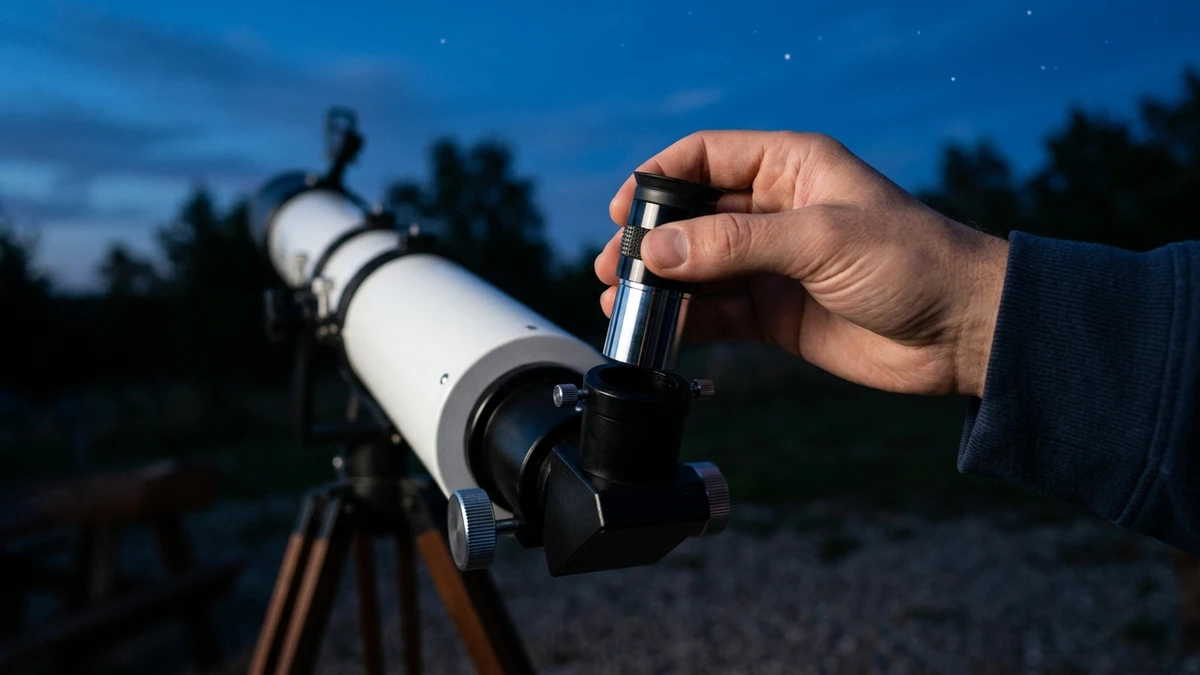
Telescope magnification is your telescope's focal length divided by your eyepiece's focal length. Fit a 25mm eyepiece to a 650mm telescope and you get 650 ÷ 25 = 26× magnification. Swap in a 10mm eyepiece on the same telescope and the number jumps to 65×. That catches almost everyone out the first time: the eyepiece with the smaller number printed on it gives you the higher magnification, not the lower one.
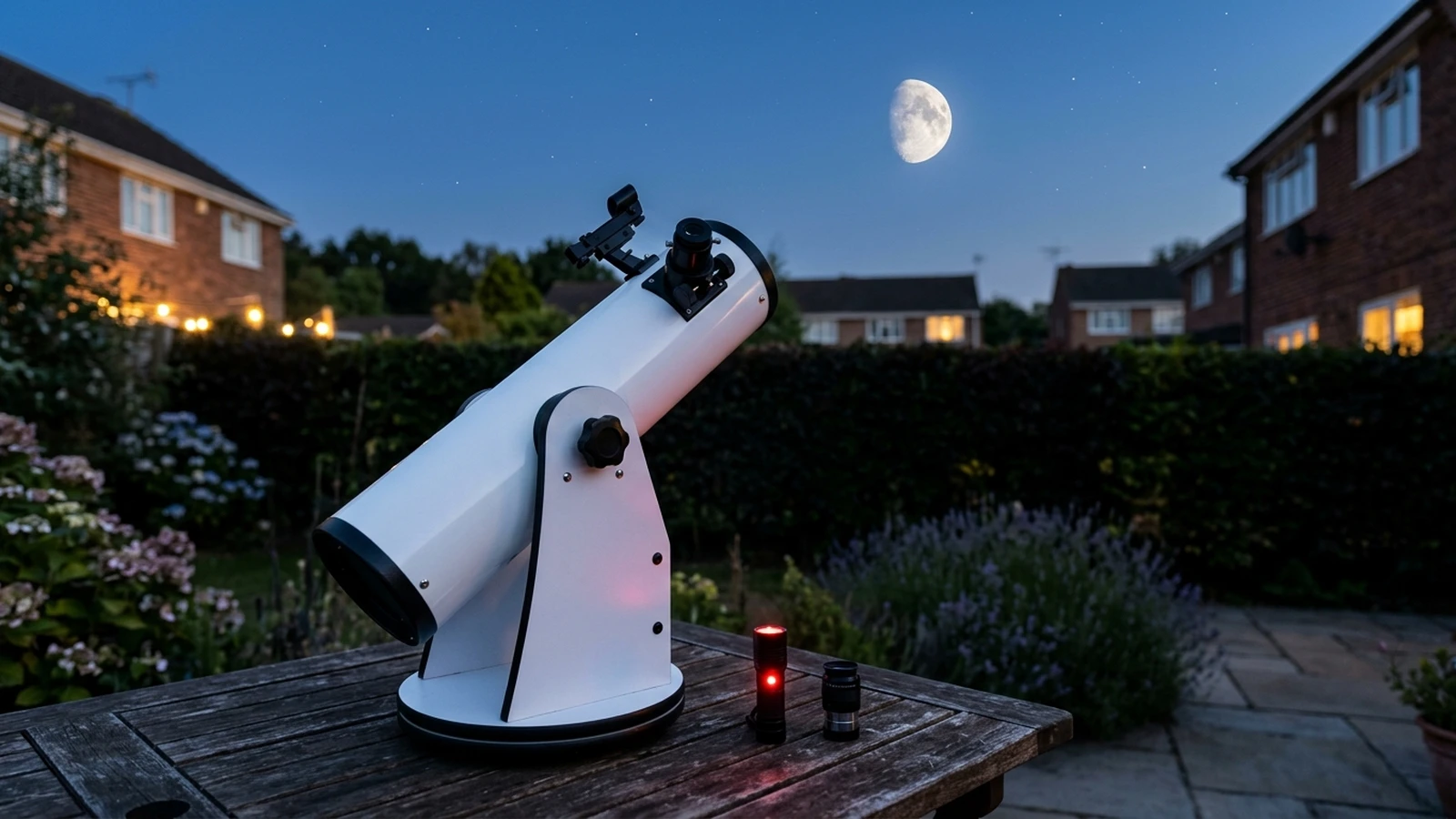
This guide works through telescope magnification properly using one example scope throughout (a 130mm f/5 Newtonian with a 650mm focal length, the spec we recommend most often for a first telescope), so every number connects to the last. You'll find the maximum useful magnification for any aperture, which eyepiece to use for what kind of target, why exit pupil matters more than the figure on the box, and which focal lengths are actually worth owning.
How Do You Calculate Telescope Magnification?
Telescope magnification equals the telescope's focal length divided by the eyepiece's focal length, with both figures in millimetres. Both numbers are printed on the equipment, so you never have to guess.
It's printed on the tube near the focuser, or listed in the manual and spec sheet. Our example scope, a 130mm f/5, has a focal length of 650mm.
It's printed directly on the eyepiece barrel, usually as a number in millimetres: "25mm" or "10mm" are typical starter values.
650mm ÷ 25mm = 26. That's the whole calculation. No other variables involved.
Write it as "26×" or "26x". Swap the 25mm eyepiece for a 10mm one on the same telescope and you get 650 ÷ 10 = 65×.
It's worth saying twice, because it's the single most counter-intuitive part of the whole topic: the smaller the number printed on the eyepiece, the higher the magnification it gives you. A 10mm eyepiece always out-magnifies a 25mm eyepiece on the same telescope. Nothing about the eyepiece itself changes: only the maths on the other side of the division sign.
What Is the Maximum Useful Magnification for a Telescope?
The maximum useful magnification for any telescope is roughly 2× its aperture in millimetres: the diameter of the main mirror or lens. Our 130mm example scope has a genuine optical ceiling of around 260×. Push past that and you're not resolving more detail, you're just magnifying the blur along with everything else.
In practice, that 260× figure rarely gets used from a UK back garden. Atmospheric seeing, meaning how steady the air above you is, usually caps useful magnification at 150–200× regardless of how large your telescope's aperture is. Turbulent air smears out fine detail long before your telescope's optics run out of resolving power, so going past 150–200× on an ordinary UK night just makes a soft image bigger rather than sharper. On a rare, truly still night, when stars overhead barely twinkle, you can push closer to your scope's true ceiling. Check tonight's conditions before deciding whether it's worth fitting your shortest eyepiece.
What Magnification Should You Use, and When?
There's no single "best" magnification: it depends entirely on what's in the eyepiece. The rule that serves almost everyone: use the lowest magnification that comfortably shows your target, and only increase it if there's real extra detail to see.
| Magnification | Best for | Example on a 650mm scope |
|---|---|---|
| Low (25–50×) | Finding anything, large star clusters, wide Milky Way fields | 32mm (≈20×) or 25mm (26×) |
| Medium (50–100×) | Most deep-sky targets: galaxies, nebulae, looser clusters | 18mm (≈36×) or 12mm (≈54×) |
| High (100–200×) | Moon detail, planets, splitting double stars | 8mm (≈81×) or 8mm + 2× Barlow (≈163×) |
| 200×+ | Fine planetary detail, but only on nights of excellent seeing | 6mm + 2× Barlow (≈217×) |
Is tonight steady enough for high power?
Our Tonight tool gives you a live stargazing score, cloud cover, and seeing conditions for your location.
Check Tonight's Conditions →What Is Exit Pupil and Why Does It Matter?
Exit pupil is your telescope's aperture divided by the magnification you're using, and it tells you how bright the view will actually look. It matters more than most beginners realise, because two setups giving the same magnification can look very different depending on aperture.
On our 130mm example scope at 26× (the 25mm eyepiece), exit pupil is 130 ÷ 26 ≈ 5mm, close to a dark-adapted eye's own pupil, so the view looks bright and comfortable. Push to 163× (the 8mm plus a 2× Barlow) and exit pupil drops to roughly 0.8mm. Go further still, to around 217× (a 6mm eyepiece with the same Barlow), and it falls to about 0.6mm: below the ~0.7mm point where the image visibly dims and floaters (the small bits of debris drifting in your own eye's fluid) start to intrude against a small, dim target.
At the other end of the scale, an exit pupil above roughly 7mm is wasted: your pupil physically can't open wide enough to use all the light your telescope is delivering, even fully dark-adapted. In practice this rarely comes up on a telescope: it's more relevant to very low-power, large-aperture binoculars.
Which Eyepiece Focal Lengths Should You Own?
Three eyepieces cover almost everything: a low-power one around 25–32mm, a medium one around 12–18mm, and a high-power one around 6–10mm. On our 650mm example scope, that's roughly 20–26×, 36–54×, and 65–108×.
A 2× Barlow lens doubles whichever of those you have fitted, for the price of one extra piece of glass: the 8mm becomes a 4mm-equivalent view at around 163×. Three eyepieces and a Barlow effectively give you six usable magnification steps, which is why it's usually recommended before buying a fourth or fifth eyepiece outright.
Apparent field of view (AFOV) is worth knowing too: it's how wide the view feels inside the eyepiece itself, separate from magnification. A budget eyepiece with a narrow ~50° AFOV feels like looking through a keyhole; a wide-angle design at 60°+ feels more like a porthole, with room to spare around your target.
Why Do Bundled Telescope Eyepieces Disappoint?
Starter telescopes, including the Sky-Watcher Heritage 130P we recommend most, usually ship with two basic eyepieces, typically a 25mm and a 10mm. They work fine for learning your way around the sky, but they're the cheapest part of the whole package, with narrower fields of view and softer edges than a mid-range eyepiece. The optics are usually the first sensible upgrade once you know what you actually enjoy looking at, and a sharper 8mm or a Barlow lens costs less than a meal out for two.
The classic first eyepiece upgrade
Kit we've reviewed in full
Most starter telescopes ship with two basic eyepieces and nothing else. This trio covers medium and high power properly, plus a Barlow to double both.
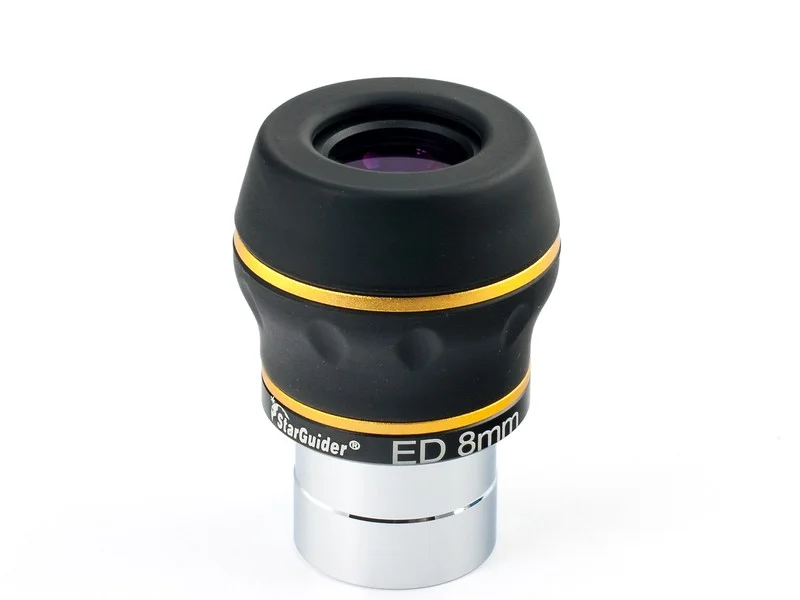
BST StarGuider 60° 8mm ED
Around 81× on a 650mm telescope: enough for Saturn's rings, Jupiter's bands and sharp lunar detail on a steady night. Sharper and wider than the 10mm most scopes ship with.
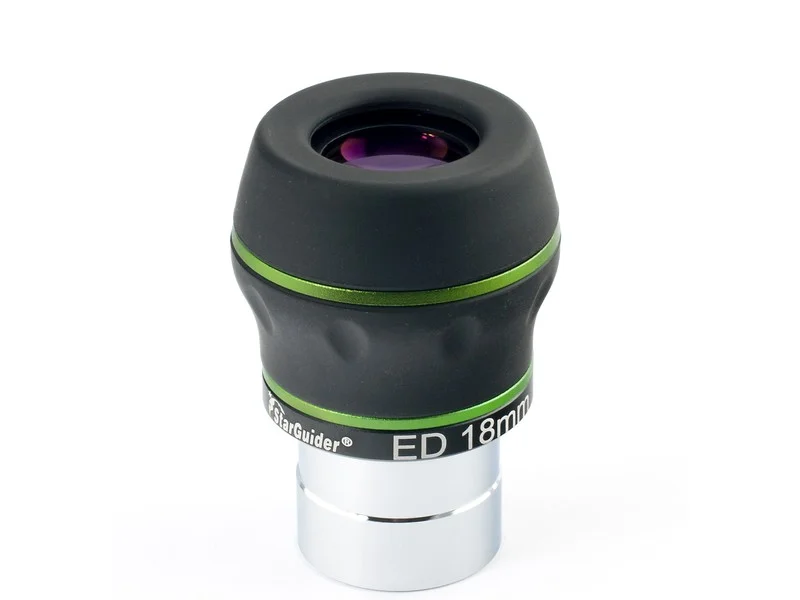
BST StarGuider 60° 18mm ED
Roughly 36× on a 650mm telescope: the magnification you'll actually use most, for galaxies, nebulae and star clusters that need a wider field of view.
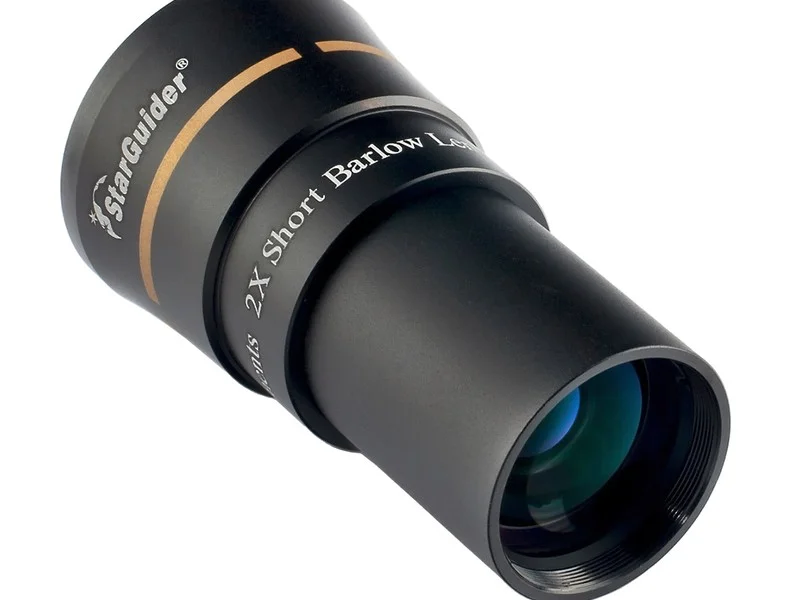
Astro Essentials 2x Barlow Lens
Doubles whatever eyepiece is already in the focuser, so the 8mm becomes a ~163× view on nights of good seeing. Cheapest way to add a magnification step you don't already own.
Browse all eyepieces and Barlow lenses
Honest, research-based recommendations for every budget.
Browse all →Affiliate links: you pay the same price, we earn a small commission that helps keep WatchTheStars free.
Frequently Asked Questions
How do you calculate telescope magnification?
Divide your telescope's focal length by your eyepiece's focal length, both in millimetres. A 650mm telescope with a 25mm eyepiece gives 650 ÷ 25 = 26× magnification; the same telescope with a 10mm eyepiece gives 65×. The smaller the number on the eyepiece, the higher the magnification.
What magnification do you need to see Saturn's rings and Jupiter's cloud bands?
Saturn's rings become clearly separated from the disc from around 50×, and Jupiter's main cloud bands are visible from a similar power. Both improve noticeably up to around 100–150× on a night of good seeing, but beyond that you're fighting the atmosphere more than your telescope.
What is the maximum useful magnification for a telescope?
Roughly 2× the telescope's aperture in millimetres: a 130mm telescope tops out around 260×. In practice, UK atmospheric seeing usually limits useful magnification to 150–200× on an average clear night, whatever the telescope's true optical ceiling is.
Why is my telescope image dimmer at high magnification?
The same amount of light your telescope collects gets spread over a larger image as magnification increases, so every part of that image looks fainter. This is measured as exit pupil, aperture divided by magnification, and it shrinks as magnification climbs, which is why very high power views often look dim as well as soft.
Do I need a filter for high magnification viewing?
Not to gain magnification, but a Moon filter is worth adding: the Moon is dazzling at high power without one, and a filter cuts the glare considerably. Filters don't help with imaging in the same way; for that see our guide to photographing the Moon.
Why does a planet look so small even at 150x magnification?
Planets genuinely are tiny targets: even Jupiter, the largest planet, spans less than an arcminute in our sky. More magnification enlarges that small disc but also enlarges any atmospheric blur, so beyond a certain point a steady night does more for detail than a bigger number on the eyepiece.
Is a smaller eyepiece number really more magnification?
Yes, and it's the detail that trips up almost everyone starting out. Magnification is telescope focal length divided by eyepiece focal length, so a smaller eyepiece focal length gives a bigger result: a 10mm eyepiece gives more magnification than a 25mm eyepiece on the same telescope.
What does a 2x Barlow lens actually do?
A Barlow lens sits between the eyepiece and the focuser and doubles whatever magnification that eyepiece would normally give. It effectively turns a three-eyepiece set into six magnifications for the price of one extra piece of glass: an 8mm eyepiece giving 81× on a 650mm telescope becomes roughly 163× with a 2× Barlow fitted.