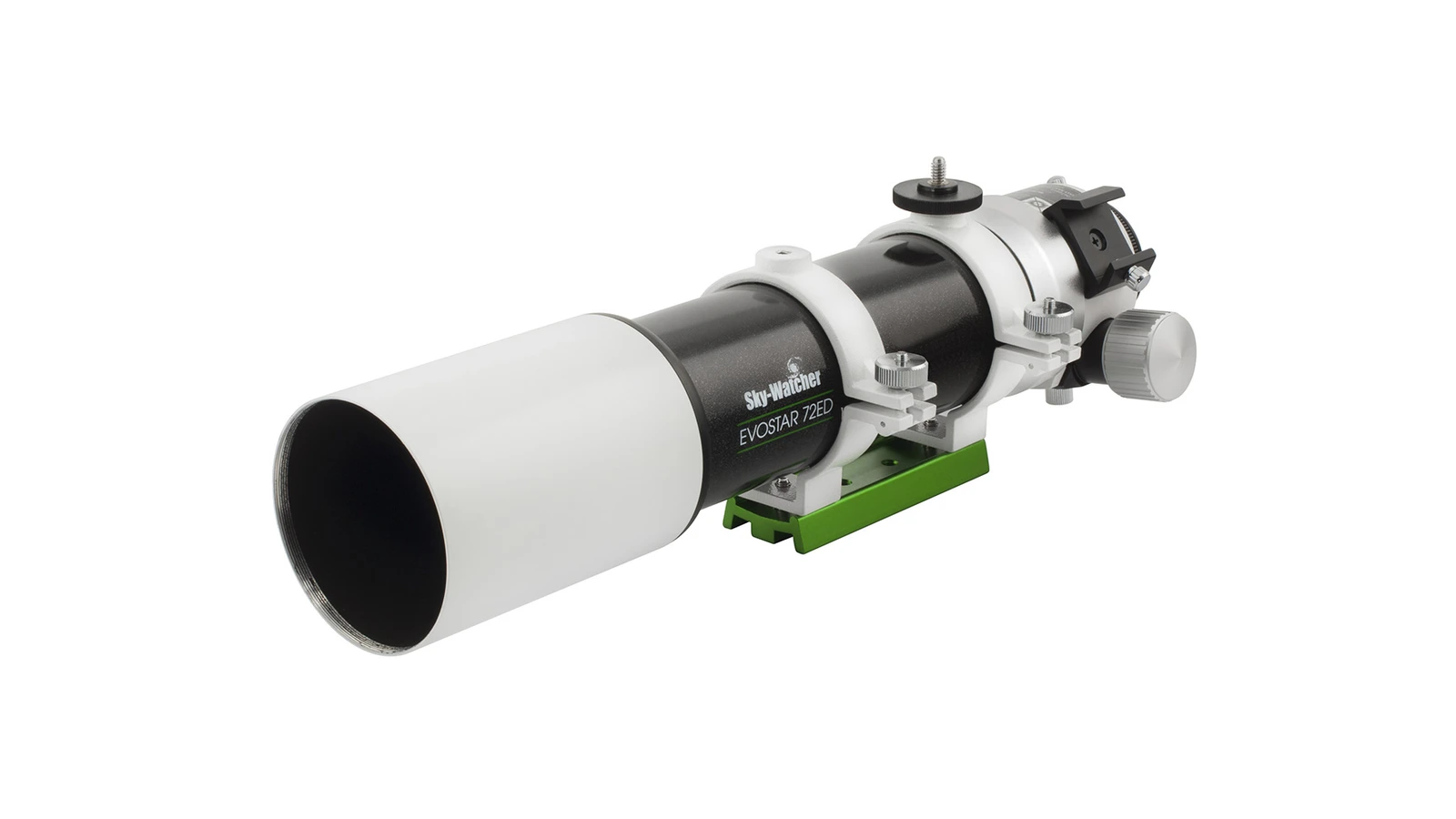
Sky-Watcher Evostar 72ED
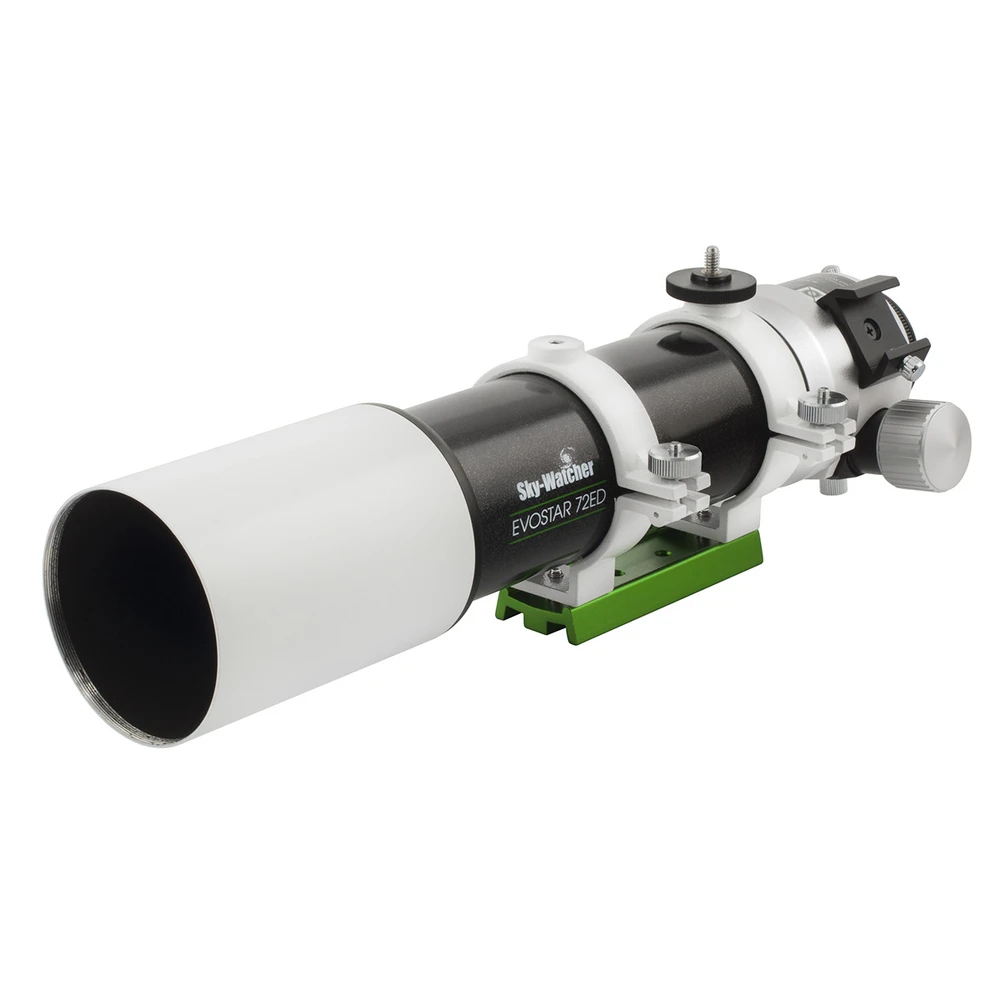
Ask how to start deep-sky astrophotography on a sensible budget and the answer has been the same for years: a small ED refractor on a tracking mount, and the small ED refractor is this one. Sharp, light, forgiving, and currently £50 off at £279, the Evostar 72ED is the rare piece of kit that's both the cheap option and the right one. Budget for the matching reducer/flattener eventually and it'll carry you years into the hobby.
Sky-Watcher Evostar 72ED Specifications
| Key Specifications: Sky-Watcher Evostar 72ED DS-Pro | |
|---|---|
| Price (UK) | £279 at First Light Optics (usually £329) |
| Aperture | 72mm |
| Optical Design | ED doublet refractor (apochromatic-class) |
| Focal Length | 420mm (f/5.8) · 357mm (f/4.9) with 0.85× reducer |
| Focuser | 2" dual-speed Crayford, 10:1 fine focus |
| Dew Shield | Retractable, built in |
| Tube Weight | ~2kg |
| Tube Length | ~42cm with dew shield retracted |
| Fittings | Tube ring with Vixen-style dovetail and carry handle; aluminium case included |
| Matching Reducer | Sky-Watcher 0.85× reducer/flattener: ~£209 |
| Eyepieces/Diagonal | Not included: this is an imaging-first OTA |
| Warranty | 2 years via First Light Optics |
What Is the Sky-Watcher Evostar 72ED?
A small apochromatic-class refractor built for one job above all: putting a camera behind sharp, colour-clean optics without breaking the budget or the mount. The doublet lens uses extra-low dispersion (ED) glass to tame the colour fringing that plagues ordinary achromatic refractors, and at 420mm focal length it frames the sky wide, about 3° across a typical APS-C sensor, enough to swallow the whole North America Nebula.
Why do small refractors dominate astrophotography advice? Because everything about them is forgiving. No collimation to drift, no mirrors to flex, a short focal length that makes tracking errors invisible, and a weight small mounts carry with ease. The frustrations that drive beginners out of imaging (guiding battles, tilted optics, endless faffing) mostly belong to bigger, longer scopes. A 72ED on a small equatorial mount just works, night after night.
Sky-Watcher backs the optics with hardware that matters: a dual-speed Crayford focuser with 10:1 fine control (essential for nailing focus with a camera), a retractable dew shield, a tube ring with dovetail, and an aluminium case. At £279 on the current offer, nothing else gets you into real deep-sky imaging this well for this little.
Astrophotography with the Evostar 72ED: What to Expect
The short version: this scope photographs the big, beautiful objects brilliantly and the small ones poorly. Know that going in and you'll be delighted.
At 420mm native, with a DSLR or dedicated astronomy camera, your targets are the showpieces: the Orion Nebula with its surrounding dust, Andromeda spilling across the frame, the Pleiades and their blue reflection wisps, the double cluster, the Rosette. Stars are tight across most of the frame; the corners of larger sensors show some elongation without a flattener, the one optical compromise of a doublet at f/5.8.
With the 0.85× reducer/flattener (~£209), the scope becomes what most owners actually run: 357mm at f/4.9, flat to the corners, with usefully faster exposures. This is the configuration behind most of the 72ED images you'll see on AstroBin: the Heart and Soul Nebulae, the Veil complex, the California Nebula, big emission regions framed whole.
What it won't do: small galaxies and planetary nebulae arrive as smudges a few dozen pixels across, and planets are not this telescope's business at all. When the urge for galaxy close-ups arrives, that's a longer scope on a bigger mount, a later chapter, and the 72ED stays useful alongside it as the wide-field instrument.
Mount-wise, it's the standard payload for the Star Adventurer GTi, see our guide for the full rig maths, and it gives an HEQ5 Pro the easiest job of its life. We build a complete imaging setup around this exact scope in our astrophotography setup guide.
Is the Evostar 72ED Any Good for Visual Observing?
As a second job, yes. Drop in a diagonal and a wide eyepiece (neither is included, budget ~£80 for both) and you have a lovely grab-and-go scope: razor-sharp star fields, the Moon in crisp detail, big open clusters framed whole, and bright comets when they visit. On a photo tripod it's a two-minute setup.
Just be realistic about 72mm of aperture. Faint fuzzies stay faint, globular clusters don't resolve, and planets, while sharp, are small at the 80–100× this focal length reaches comfortably. If visual observing is the main event, the same money buys a Heritage 150P with four times the light grasp. The 72ED's value is that it does imaging properly and visual pleasantly, not the reverse.
Evostar 72ED vs the Alternatives
| Evostar 72ED | Redcat 51 | Evostar 80ED | |
|---|---|---|---|
| Price | £279 | ~£800+ | ~£589 |
| Aperture / FL | 72mm / 420mm | 51mm / 250mm | 80mm / 600mm |
| Flat field out of the box | No: reducer recommended | Yes ✓ | No: reducer recommended |
| Visual use too | Yes ✓ | Imaging only | Yes ✓ |
| Weight | ~2kg | ~1.5kg | ~2.5kg+ |
The Redcat 51 is gorgeous engineering with a built-in flat field, but at nearly three times the price of the Evostar it's hard to call better value, and it can't double as a visual scope. The Evostar 80ED gathers more light and reaches 600mm, better for smaller targets, but it's heavier, pricier, and starts asking more of small mounts. The 72ED sits in the value sweet spot, which is exactly why it became the default recommendation.
One more alternative deserves mention: the newer Evostar 72EDX (~£319) refines the same formula. The standard DS-Pro at £279 on offer remains the value pick while stocks run.
Evostar 72ED: What Buyers Say
It's the consensus first imaging scope, and has been for years. BBC Sky at Night reviewed it warmly, and UK forums recommend it so consistently that "72ED on a tracking mount" is practically a stock phrase. Search AstroBin for it and you'll find thousands of images, the most reassuring review a telescope can have.
Sharpness gets praised constantly. Owners coming from camera lenses are routinely surprised that a sub-£300 telescope out-resolves their £1,000 telephoto across the frame. Tight, round stars in the centre of the field are a given; the corners are what the reducer is for.
A whisker of colour fringing on the brightest stars. It's a doublet, not a triplet, and on Vega or Sirius a faint blue halo can appear. Most owners either never notice or fix it in processing; the step to a fringe-free triplet costs three times as much.
The focuser holds fine, up to a point. With a DSLR or small cooled camera, no complaints. Owners hanging heavy full-frame rigs plus filter wheels off the back sometimes report the Crayford slipping under load, cured by adjusting the focuser tension screw. At this price the dual-speed focuser is a feature most rivals skip entirely.
"Buy the reducer" is the universal owner advice. Almost every long-term owner ends up with the 0.85× reducer/flattener and wishes they'd bought it sooner. Factor it into the real cost if imaging is the plan.
Evostar 72ED: Known Limitations
- Needs the reducer/flattener for its best imaging. Corner stars elongate on larger sensors without it. The ~£205 accessory is effectively part of the system price for serious imaging, still cheaper than any flat-field alternative.
- Nothing included for visual use. No diagonal, no eyepieces: it ships as an imaging tube. Add ~£80 if you want to look through it as well.
- Mild chromatic aberration on the brightest stars. The doublet compromise. Subtle, and processing removes it, but pixel-peepers comparing against triplets will find it.
- Small targets stay small. 420mm is a wide-field instrument. Galaxies (beyond the giants) and planetary nebulae need double the focal length or more to satisfy.
- Focuser can slip under heavy loads. Tension is adjustable and light rigs are unaffected, but big camera trains test it. Lock the tension screw once focus is set.
- 72mm is modest visual aperture. Lovely sharp views, limited reach. Match expectations, or pick a Dobsonian if visual is the priority.