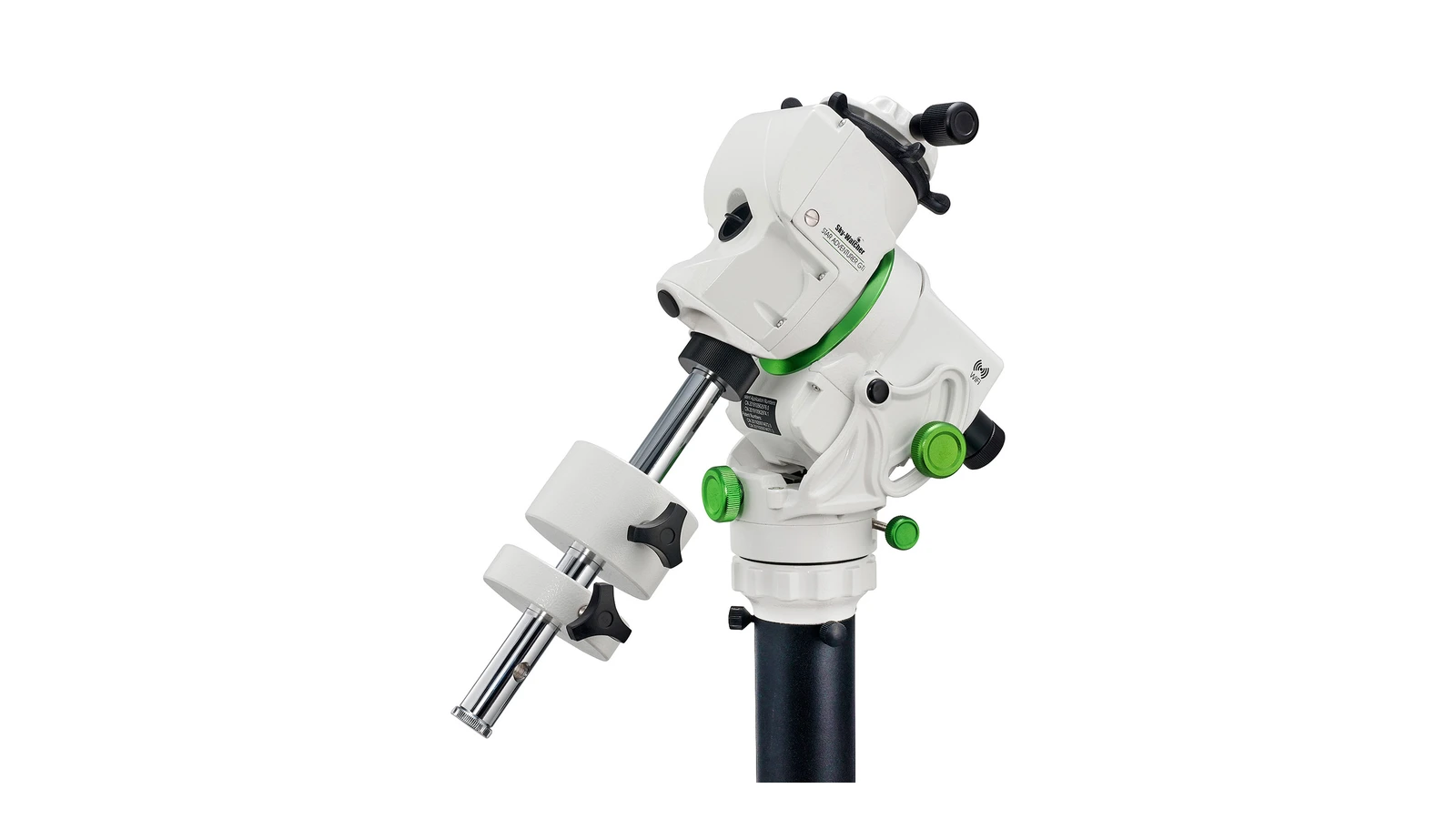
Sky-Watcher Star Adventurer GTi
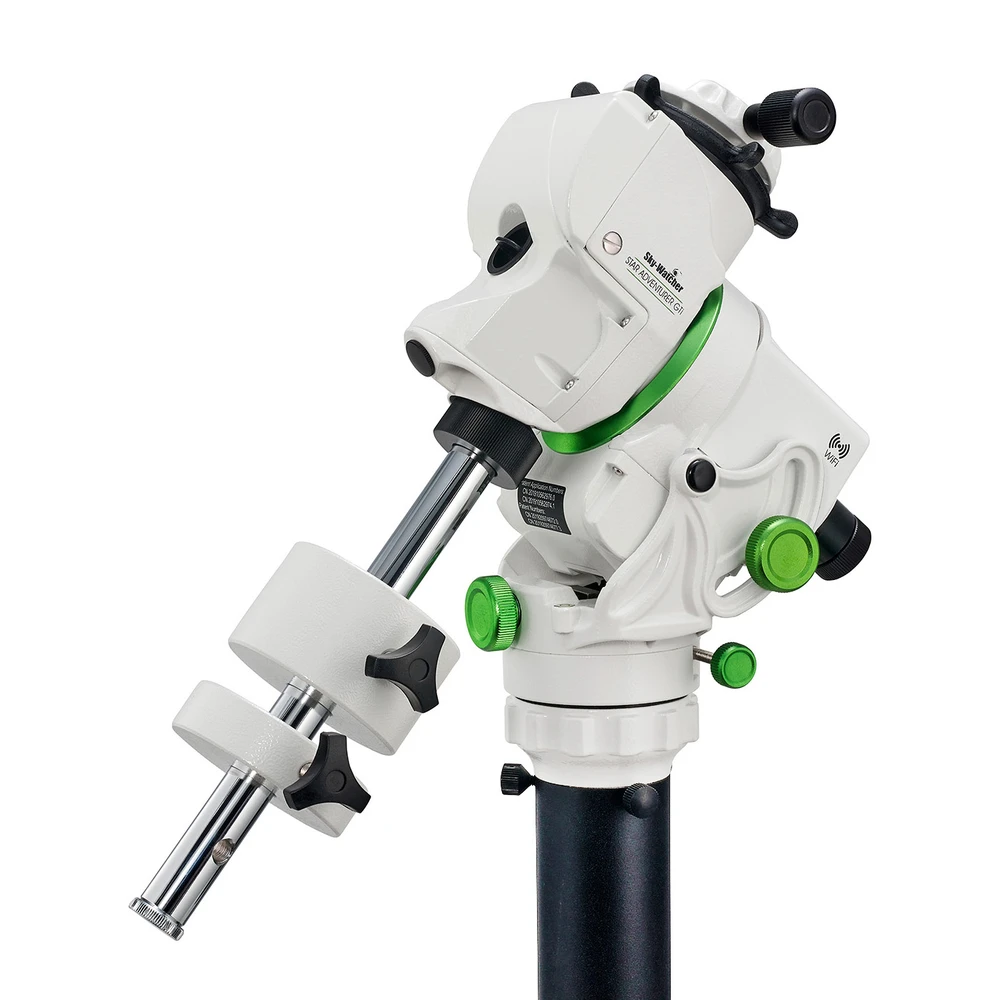
This is the mount that made proper deep-sky astrophotography portable and (relatively) affordable. Full GoTo, dual-axis tracking, guiding support, app control: the feature list of a big equatorial mount, in something that fits in a rucksack. Pair it with a small refractor and stay inside its real-world payload, and the Star Adventurer GTi is the best-value imaging mount in the UK. Try to hang a big telescope off it and you'll fall out with it fast.
Star Adventurer GTi Specifications
| Key Specifications: Sky-Watcher Star Adventurer GTi | |
|---|---|
| Price (UK) | £435 mount only · £525 with tripod & pier extension, at First Light Optics |
| Type | Computerised equatorial GoTo, dual-axis motors |
| Payload Capacity | 5kg rated (excluding counterweight): ~3.5kg realistic for imaging |
| Control | SynScan app over built-in Wi-Fi · optional SynScan hand controller · USB |
| Guiding | ST-4 autoguider port, dual-axis guiding |
| Polar Alignment | Built-in illuminated polar scope |
| Saddle | Vixen-style dovetail clamp |
| Counterweight | 2.3kg counterweight and bar included |
| Power | 8× AA batteries or external DC supply: most imagers use a power bank |
| Mount Head Weight | ~2.6kg (head only, without counterweight) |
| Tripod (kit version) | Steel tripod with pier extension, 3/8" thread |
| Warranty | 2 years via First Light Optics |
What Is the Sky-Watcher Star Adventurer GTi?
For years, beginner astrophotographers faced a gap. Star trackers like the Star Adventurer 2i were portable and affordable but only tracked in one axis: no GoTo, no guiding in declination, and you found targets yourself by trial and error. Proper equatorial mounts like the HEQ5 Pro did everything but weighed the best part of 15kg with their tripods and cost over a grand. The Star Adventurer GTi is Sky-Watcher closing that gap.
It's a genuine equatorial GoTo mount: motors on both axes, a 42,000+ object database via the SynScan app on your phone, an ST-4 port for an autoguider, and a proper counterweight system, scaled down to a 2.6kg head with a 5kg payload. Polar-align through the built-in illuminated polar scope, and the mount then finds your target and tracks it accurately enough for multi-minute exposures when guided.
The intended customer is specific: someone who wants real deep-sky astrophotography (nebulae, galaxies, the lot) with a small telescope or camera lens, without the bulk and cost of a full-size mount. For that person, almost nothing else at this price does the whole job.
What Telescope Works with the Star Adventurer GTi?
The payload arithmetic decides everything with this mount, so here it is in practice.
The classic pairing: a 72mm ED refractor. The Evostar 72ED (~2kg) plus a DSLR like a Canon 2000D (~0.5kg) plus a small guide scope and camera (~0.7kg) totals around 3.2kg, comfortably inside the sweet spot. This combination on a GTi is probably the most common first deep-sky rig in the UK right now, and the images it produces are the proof it works.
Camera and lens setups barely tax it. A DSLR with a 135mm–300mm lens leaves huge headroom and tracks beautifully. If that's all you'll ever mount, though, the cheaper Star Adventurer 2i would also do.
What doesn't work: anything much over 3.5kg for imaging. A 130PDS Newtonian (4kg before camera), 102mm+ refractors with flatteners and cameras, or any SCT bigger than 5 inches push past what the small motors and bearings hold steady. The 5kg rating is honest for visual use, but imaging punishes every gram: stars go eggy long before the mount actually complains.
Star Adventurer GTi vs 2i vs HEQ5 Pro: Which Mount Should You Buy?
These are the three Sky-Watcher mounts beginners actually choose between, and they form a neat ladder.
| Star Adventurer 2i | Star Adventurer GTi | HEQ5 Pro | |
|---|---|---|---|
| Price | ~£249 | £435–525 | ~£1,039 |
| GoTo | No | Yes ✓ | Yes ✓ |
| Tracking axes | One | Two ✓ | Two ✓ |
| Imaging payload (realistic) | ~2kg | ~3.5kg | ~10kg |
| Weight (head) | ~1.2kg | ~2.6kg | ~10kg |
| Best for | Camera + lens | Small scope imaging | Serious, growing setups |
The way to choose: the 2i if you're imaging with camera lenses and want minimum weight and cost. The HEQ5 Pro if you know astrophotography is going to be your hobby and a bigger telescope is in your future: it's the standard advice for a reason. The GTi if you want a real telescope on a real GoTo equatorial now, portability matters, and you're happy committing to small, fast optics. None of the three is a wrong answer; they're different ambition levels.
Star Adventurer GTi: What Buyers Say
The consistent verdict: best portable GoTo for the money. Since launch it's been the default recommendation on UK forums for "first proper imaging mount under £600", and owner galleries on AstroBin back it up: multi-hour integrations of nebulae shot from gardens and dark-site trips on this little mount.
Guiding results surprise people. With a small guide scope and PHD2, owners commonly report sufficient accuracy for 2–5 minute subs with small refractors. Unguided, expect to keep exposures shorter, 30–60 seconds with careful polar alignment, which is still plenty to start stacking.
The payload limit is where the grumbles live. Owners who load it past 4kg report eggy stars and lost subs, exactly as the experienced hands predict. The mount didn't change. The expectations did. Treat 3.5kg as the imaging ceiling and reviews turn glowing.
SynScan app opinions are mixed-to-fine. Most owners find the Wi-Fi connection reliable once they learn its quirks (connect to the mount's network before opening the app; disable mobile data hopping). Plenty bypass it entirely and run the mount from an ASIAIR or laptop, which it supports happily.
The tripod is adequate; the pier extension matters. The kit tripod does the job for small payloads. The pier extension stops scopes hitting the legs when pointing near the pole: owners who skipped the kit version often end up buying one separately.
Star Adventurer GTi: Known Limitations
- Imaging payload is ~3.5kg in practice, not 5kg. The single most important thing to know before buying. Plan your rig's total weight (scope, rings, camera, guide gear, dew strap) before you order anything.
- Locked into small optics. There's no upgrade path on this mount: if you later want a 6-inch Newtonian or a 100mm+ refractor, you're buying a new mount, not a new saddle. Buyers who suspect they'll upgrade should price the HEQ5 honestly first.
- AA batteries won't last an imaging session. Like every Sky-Watcher of its generation: use a 12V power bank or mains supply and never think about it again.
- Some backlash in declination. Visible in guiding graphs; mostly tamed by balancing slightly camera-heavy and letting PHD2's algorithms handle it. Not a dealbreaker, just a known character trait.
- Plastic in places metal would be nicer. The clutches and some housings are polymer. Treated gently they last; this is a 2.6kg precision instrument, not a workhorse to crank down hard.
- Wi-Fi-first control has a learning curve. No hand controller in the box (it's an optional extra). If app-based setup frustrates you, budget for the SynScan handset or run it from a laptop/ASIAIR.
A Realistic First Imaging Rig Around the Star Adventurer GTi
Here's the budget version of the setup half the UK astrophotography community started on. Star Adventurer GTi kit with tripod (£525). Evostar 72ED (£279 on current offer). A second-hand or entry DSLR you may already own. Add the 0.85× reducer/flattener (~£205) when you're hooked, and a guide scope and camera (~£150–200) when you want longer subs. Total: under £1,200 for a rig that photographs nebulae and galaxies properly, and every part of it except the mount carries forward if you upgrade later.
That build is essentially Tier 4 of our complete astrophotography setup guide, where we walk through the whole shopping list and the order to buy it in.