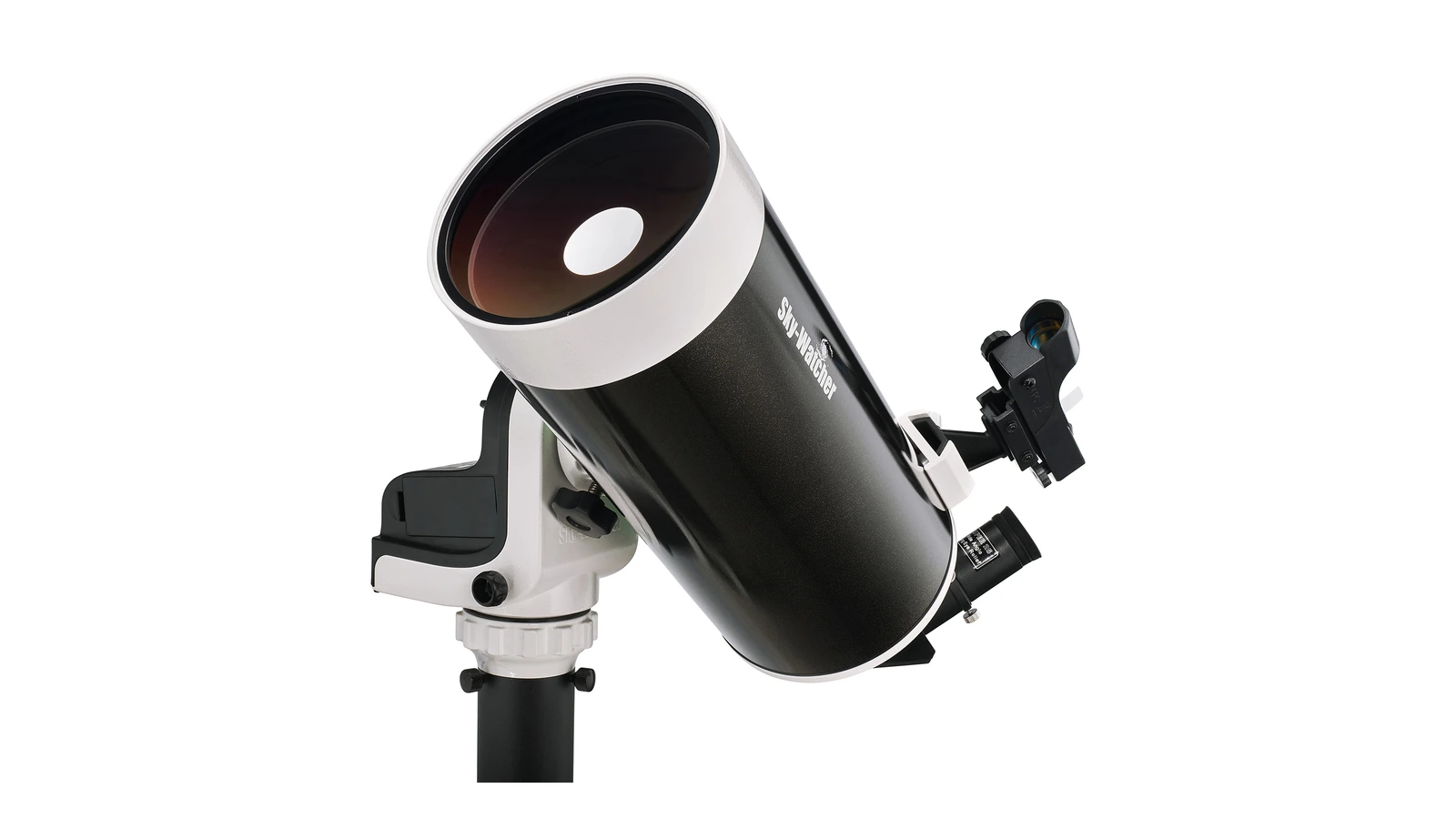
Sky-Watcher Skymax 127
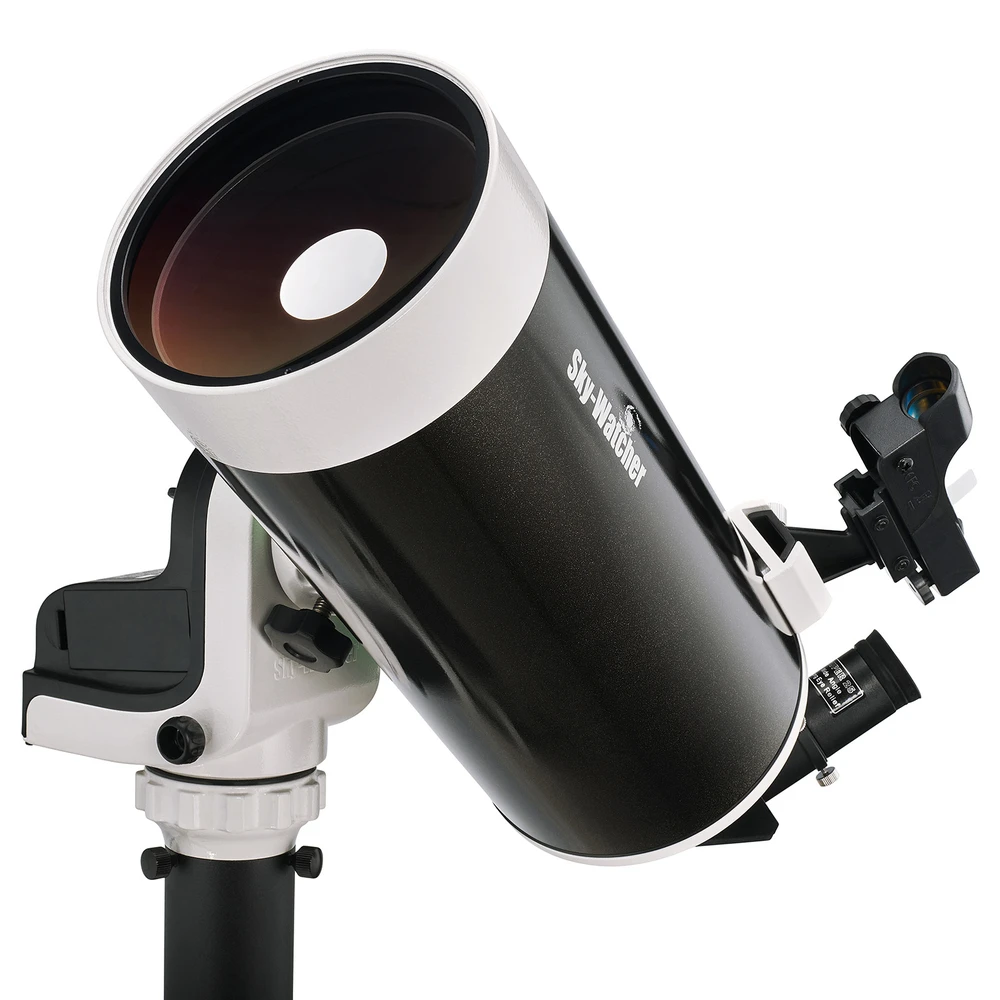
Ask a UK astronomy forum "what's the best scope for planets from my back garden?" and the Skymax 127 is the answer you'll get, over and over. The sealed tube handles damp nights, the 3.4kg weight makes it the easiest serious telescope to actually use, and on the Moon, planets, and double stars it punches at or above its aperture. It is a specialist, though: if you want sweeping star fields and faint nebulae, buy a Dobsonian instead.
Sky-Watcher Skymax 127 Specifications
| Key Specifications: Sky-Watcher Skymax 127 | |
|---|---|
| Price (UK) | £318 OTA only · £547 with AZ-GTi GoTo mount, at First Light Optics |
| Aperture | 127mm (5") |
| Optical Design | Maksutov-Cassegrain, sealed tube |
| Focal Length | 1500mm (f/11.8) |
| Tube Length | ~37cm: a 1.5m focal length folded into a lunchbox |
| Tube Weight | ~3.4kg |
| Included Accessories | 28mm LET eyepiece (54×), red dot finder, 1.25" star diagonal |
| Focuser | Internal: moving primary mirror, focus knob at rear |
| Dovetail | Vixen-style: fits AZ-GTi, EQ3-2, EQ5, AZ5 and most mounts |
| Collimation | Factory-set; effectively never needs adjusting |
| Best For | Moon, planets, double stars, compact deep-sky objects |
| Warranty | 2 years via First Light Optics |
What Is the Sky-Watcher Skymax 127?
The Skymax 127 is a Maksutov-Cassegrain: a design that bounces light between mirrors inside a short, sealed tube, folding a 1500mm focal length into 37 centimetres. The front is closed by a thick curved lens (the corrector), which is why a Mak looks like a stubby camera lens rather than a traditional telescope.
That design choice drives everything this telescope is good at. The long focal length means high magnification comes easily and cheaply: the included 28mm eyepiece already gives 54×, and a modest 10mm gives 150×. The sealed tube means no dust on the mirrors, no collimation, and far less trouble with the damp that defines UK observing. The folded light path means the whole thing weighs 3.4kg and fits in a rucksack.
The cost of those choices is field of view. At f/11.8 you're looking at the sky through a drinking straw compared with a fast Newtonian, wonderful for concentrating on a planet, wrong for drinking in the Milky Way. That's the whole decision with this scope, and it's why the forums call it a planet killer rather than an all-rounder.
Why the Skymax 127 Suits UK Town Gardens
There's a reason this specific telescope keeps getting recommended to UK observers, and it comes down to matching the tool to the conditions most of us actually have.
Light pollution hurts planets least. The Moon, planets, and double stars are bright. A sodium-lit suburban sky that washes out galaxies entirely barely touches Jupiter. If you observe from a town garden, planetary observing is where a telescope keeps delivering, and that's exactly where the Skymax is strongest.
The sealed tube handles damp. British nights are humid. Open-tube reflectors collect dew on exposed mirrors; the Mak's optics sit behind a corrector lens that's easy to protect with a dew shield. No collimation also means it tolerates being carried in and out nightly without ever needing adjustment.
It's light enough to use on a whim. A 3.4kg tube on an AZ-GTi is a one-trip carry into the garden. When a clear gap opens at 10pm on a work night, the telescope that's observing five minutes later is the one that gets used, and over a year, the scope you use beats the bigger one you don't.
What Can You See with the Skymax 127?
On its specialist subjects, this 127mm Mak competes with telescopes well above its price. Here's the full picture, strengths and weaknesses both.
The Moon
The single best reason to own this telescope. At 150–200× the view is like flying over the surface: craterlets on crater floors, rilles, mountain shadows changing by the hour along the terminator. The contrast of a Mak on the Moon is something owners never stop mentioning.
The Planets
Saturn's Cassini Division on steady nights, ring shadows, and several moons. Jupiter shows belt structure, festoons on good nights, the Great Red Spot, and crisp shadow transits. Mars near opposition gives polar cap and surface markings. Venus and Mercury show clean phases. This is the scope's home turf and it delivers session after session.
Double Stars
A quiet speciality. The long focal length and textbook star images let the 127 split pairs right down to its theoretical limit: around one arcsecond. The Double-Double, Porrima, and dozens of coloured pairs are all rewarding, and light pollution doesn't touch them.
Globular Clusters
Better than you'd expect: globulars are compact and bright, which suits the narrow field. M13 starts resolving around its edges at 150×. M15, M5, and M92 are all worthwhile targets every summer.
Compact Nebulae
The Ring Nebula, the Dumbbell, and the brighter planetary nebulae work well at this focal length. The Orion Nebula's core and Trapezium are lovely, even if you can't fit the full sweep of nebulosity in view.
Where It Struggles
The Pleiades won't fit in the field of view. The Andromeda Galaxy spills out of it. Large, faint nebulae like the Veil need both a wider field and a faster focal ratio. If those are your dream targets, this is the wrong telescope: that's not a flaw, it's the trade you made for the planetary performance.
Skymax 127 OTA vs AZ-GTi Bundle: Which Version to Buy?
First Light Optics sells the Skymax 127 two main ways, and the right one depends on what you already own.
| OTA only: £318 | AZ-GTi bundle: £547 | |
|---|---|---|
| You get | Tube, eyepiece, diagonal, finder | All that + Wi-Fi GoTo mount & tripod |
| Finds objects for you | No | Yes: phone app ✓ |
| Tracks at high power | Depends on your mount | Yes ✓ |
| Best for | Owners of an existing mount | First telescope buyers |
The bundle is the better first telescope. At 150×+ a planet drifts out of an undriven eyepiece in under a minute, and the AZ-GTi's tracking turns planetary observing from a chore into a pleasure. The mount alone sells for around £249, so the bundle pricing is fair, and the AZ-GTi is a good mount in its own right, which we've covered separately.
Buy the OTA alone if you already have an AZ-GTi, an EQ5, or anything else that carries 4kg happily. The Vixen dovetail drops onto most mounts, and plenty of owners pair the OTA with a manual AZ5 or a photo tripod head for ultra-simple lunar sessions.
Sky-Watcher Skymax 127: What Buyers Say
The "planet killer" reputation is consistent across a decade of forum threads. Stargazers Lounge and Cloudy Nights are full of owners reporting that the 127 outperforms larger but cheaper-optics scopes on Jupiter and Saturn. BBC Sky at Night's review of the AZ-GTi package praised the optics and the convenience of the Wi-Fi mount together.
Cool-down is the most repeated practical note. The thick corrector lens holds heat, and owners consistently advise putting the scope outside 30–60 minutes before serious high-power observing. Several mention the simple routine: scope goes out when the kettle goes on.
Dew on the corrector catches new owners. The exposed front lens fogs on damp nights without protection. A flexible dew shield is the universal first purchase, about £25–40, and with it fitted, owners report observing through nights that kill unprotected scopes.
The 28mm LET eyepiece is decent; the red dot finder less so. The supplied eyepiece earns reasonable reviews as a low-power starter. The red dot finder does the job, but at 1500mm focal length the view through the eyepiece is so narrow that several owners upgrade to a right-angle 6×30 or 9×50 finder for easier aiming.
Mirror shift gets mentioned, and mostly forgiven. Focusing moves the primary mirror, so the image can wobble a touch as you change direction on the focus knob. It's noticeable at very high magnification and bothers almost nobody in practice: the standard advice is to finish focusing anticlockwise for consistency.
Sky-Watcher Skymax 127: Known Limitations
- Narrow field of view. The defining trade-off. Maximum true field is around 1.1° with a 32mm eyepiece: the Pleiades, Andromeda, and large nebulae simply don't fit. Wide-field deep sky needs a different telescope.
- Cool-down time. 30–60 minutes for peak high-power performance on cold nights. Plan around it rather than fighting it.
- Dew-prone corrector. The front lens points at the open sky. A dew shield is essential UK equipment; a heater band is the belt-and-braces upgrade for long winter sessions.
- Slow focal ratio rules out deep-sky imaging. f/11.8 is built for visual planetary work and planetary video. Long-exposure nebula photography on this scope is a frustration nobody should sign up for.
- Slight mirror shift when focusing. Inherent to moving-mirror Maks. Minor in practice; finish focus turning the same direction each time.
- The supplied red dot finder feels undersized for the focal length. Aiming at 54× through a 0.9° field takes some care. A magnifying finder makes target acquisition noticeably easier if you're using it on a manual mount.
Planetary Imaging with the Skymax 127
If you fancy capturing Jupiter rather than just looking at it, the Skymax 127 is one of the cheapest capable routes in. The recipe is well established: a small planetary camera like the ZWO ASI662MC replaces the diagonal and eyepiece, you record a couple of minutes of video, and free stacking software keeps only the sharpest frames. The 1500mm native focal length is already in the right zone, and a 2× Barlow takes you to 3000mm for larger image scale on steady nights.
Owners produce images of Jupiter's belts and Saturn's rings this way that look implausible from a 3.4kg tube in a UK garden. Pair it with the AZ-GTi's tracking and the whole rig stays under £700. Deep-sky imaging is a different story: see the Evostar 72ED for the scope that job actually wants.