How to See the Milky Way in the UK
No telescope needed, just the right night, in the right place
Yes, you can see the Milky Way from the UK with your own eyes: no telescope, no camera, no special skill. You need three things to line up: a dark site rated roughly Bortle 4 or darker, a night with little or no Moon, and about 20–30 minutes standing in the dark to let your eyes adapt. Get those three right and the band of our galaxy appears overhead as a pale, textured river of light running from horizon to horizon.
Most people in the UK have never seen it, simply because they've never been far enough from streetlights on a clear night at the right time of year. This guide covers exactly when to go, where to head, what it actually looks like once you're there, and how to find it once you look up.
When Can You See the Milky Way in the UK?
The sweet spot is August to October, on evenings around new Moon. That's when true astronomical darkness returns to UK skies and the brightest, most photogenic part of the Milky Way is well placed overhead.
Counter-intuitively, UK summer is a poor time to look. Between roughly mid-May and late July the sky never gets properly dark at British latitudes. It stays in some form of twilight all night, a quirk of how far north we sit. This is worst in Scotland, where the sky can stay bright enough at midnight in June to read a newspaper by. Even a perfectly clear night in this window won't show you a proper Milky Way.
By August, true night returns, and the galactic core (the bright, dense bulge in Sagittarius that produces the famous photos) sits low on the southern horizon. From southern England on an August or September evening it's modestly visible, low down and needing a flat southern horizon; from further north it barely clears the haze at all. What you'll see clearly from anywhere with dark skies, though, is the fainter, wider band running up through Cygnus and overhead, which is arguably the more reliable summer target.
Winter has its own version. From October through to March you're looking at the opposite side of the galaxy: the fainter outer arm running through Orion and Perseus. It's subtler than the summer core, without the same bright bulge, but still a lovely soft band on a clear, dark winter night, and the long nights give you more chances to catch one.
| Month | Milky Way Visibility |
|---|---|
| January | Faint outer arm through Orion and Perseus on clear, dark nights |
| February | Same faint winter arm, still worth a look on a clear night |
| March | Band sits low in the evening sky, not a priority month |
| April | Mostly below the horizon in the evening, skip |
| May | Twilight sets in: the sky no longer gets properly dark |
| June | Worst month: no true darkness, especially in Scotland |
| July | Still marginal, improving in the final week or two |
| August | Best month: true darkness back, core low in the south, Cygnus overhead |
| September | Excellent: dark skies, core still catchable early evening |
| October | Core sinks away, but Cygnus and Cassiopeia's stretch of the band remain striking |
| November | Nights lengthen; the faint winter arm through Perseus returns |
| December | Longest, darkest nights: good for the winter arm if skies stay clear |
Where to See the Milky Way in the UK
The darker the site, the better. As a rule of thumb you want somewhere rated Bortle 4 or darker: the Bortle scale runs from 1 (a remote, pitch-black site) to 9 (a floodlit city centre), and it measures how much artificial light pollution is drowning out the night sky. Most UK towns sit at Bortle 6–8; you need to get well clear of that glow.
You don't need to know your local Bortle rating from memory: lightpollutionmap.info shows it for any spot in the country, so you can check a potential site before you drive out to it. As a general pattern, 20–30 minutes' drive away from a town usually drops you two or three Bortle classes, which makes a genuinely dramatic difference.
For the darkest, most reliable skies in the UK, head for one of the designated dark sky sites: Galloway Forest Park in Scotland, Northumberland and Kielder in the north-east, Eryri (Snowdonia) and Bannau Brycheiniog (the Brecon Beacons) in Wales, Exmoor in the south-west, or the South Downs if you're near London and don't want to travel far. We cover every one of them, with Bortle ratings and what to expect, in our full guide:
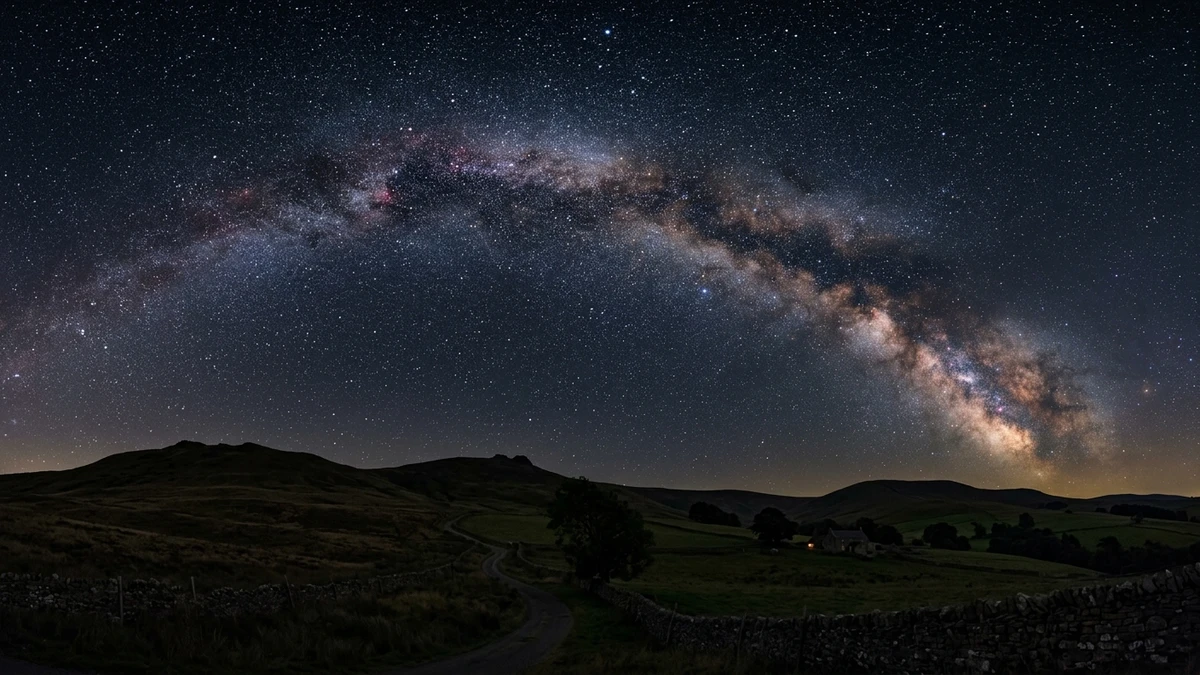
What Does the Milky Way Actually Look Like to the Naked Eye?
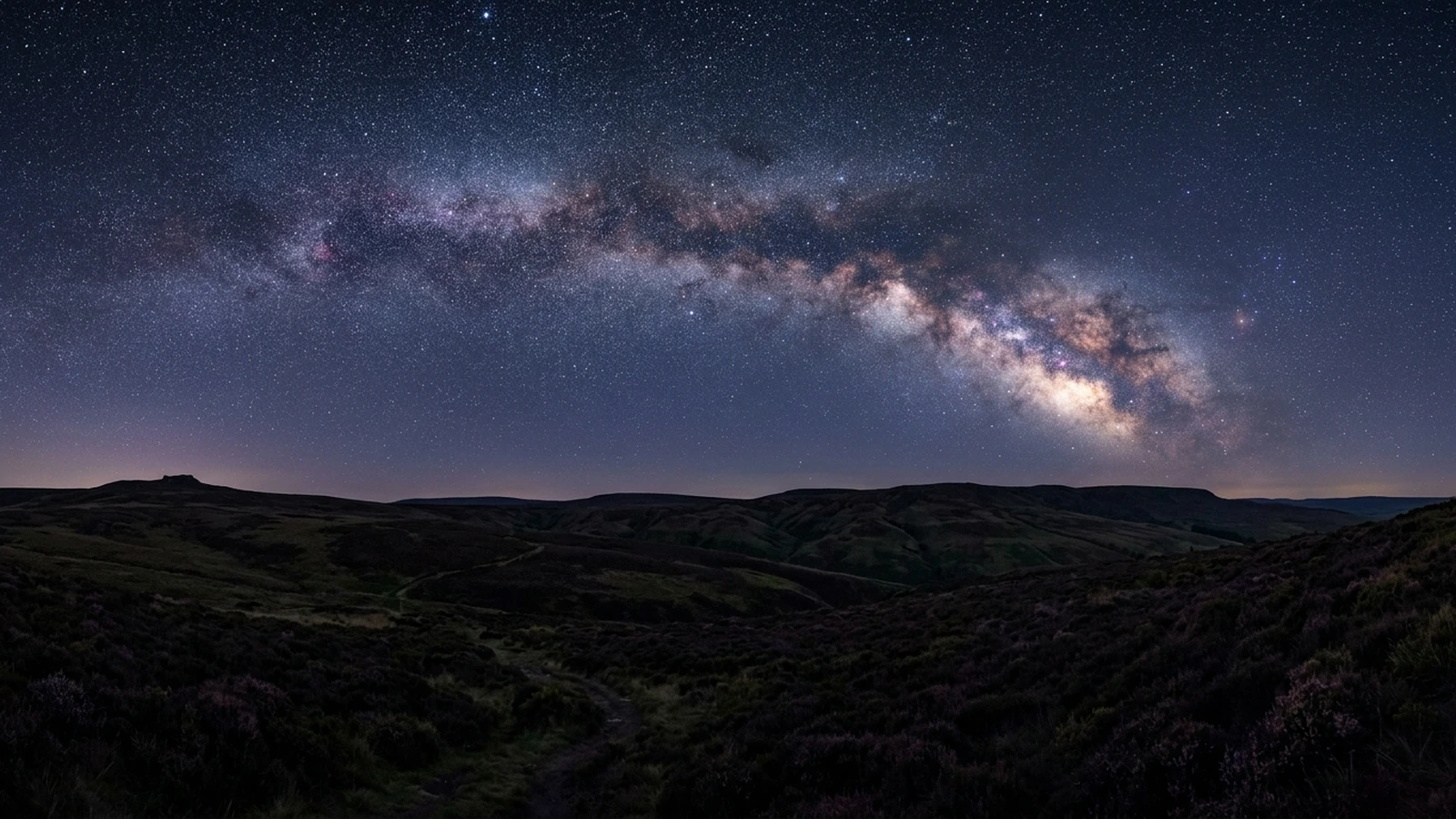
To the naked eye the Milky Way is a soft grey band with texture: patches of hazy glow, faint mottling, and darker lanes running through it where dust blocks the starlight behind. It is not the vivid purple-and-orange arch you see in photographs, and it's worth knowing that before you go out, so you don't spend your first attempt looking for something that isn't there.
Those colourful photos come from long camera exposures, which gather far more light over several seconds or minutes than your eye can gather in an instant. Your eyes simply don't work that way: real-time colour vision needs bright light, and the Milky Way is faint. What you get instead is a genuinely atmospheric sight in its own right: a river of soft light overhead, more obvious the longer you look at it.
If you want to capture the colour and detail your eyes can't quite pick up, a phone on a tripod with a long exposure will get remarkably close these days. Our phone astrophotography guide covers the settings that work, and our DSLR astrophotography for beginners guide is the next step up once you're ready for a dedicated camera.
How Do You Find the Milky Way in the Sky?
The easiest anchor is the Summer Triangle: three bright stars, Vega, Deneb and Altair, that dominate the summer and early autumn sky. The Milky Way's band runs directly through the middle of it, with Deneb sitting right inside the brightest stretch, in the constellation Cygnus. Find the Triangle high overhead on an August or September evening and you're already looking at the best part of the band.
Year-round, the W-shaped constellation Cassiopeia is another reliable marker. It sits within the Milky Way's band and is circumpolar from the UK, meaning it never sets below the horizon. Whatever the season, Cassiopeia gives you a fixed point to trace the band outward from.
Step-by-Step: Planning Your First Milky Way Night
Follow these steps in order and you'll give yourself the best possible chance on your first attempt.
- Pick a new-moon weekend. Even a half Moon washes out the fainter parts of the band, so plan around the days closest to new Moon.
- Check Clear Outside. Look for low cloud cover and good transparency for your chosen night and site, not just a general "clear" forecast.
- Arrive before full darkness. Get to your site while there's still some light so you can find your footing and set up safely, rather than fumbling in the pitch dark.
- Face south and let your eyes adapt. Give yourself 20–30 minutes without checking your phone or using white light, a red torch only, if you need one at all.
- Trace the band. Start at Cassiopeia, follow the soft glow down through Cygnus, and continue tracing it toward the southern horizon, where the brightest part of the summer band lies lowest in the sky.
What Are the Best Binoculars for Seeing the Milky Way?
Sweeping the Milky Way with a pair of 10×50 binoculars is one of the best experiences in amateur astronomy, and it needs no setup at all. Where your naked eye sees a soft, featureless glow, binoculars resolve that same glow into thousands of individual points of light: star clouds that actually look three-dimensional as you slowly pan along the band.
Start near Cassiopeia and work your way down through Cygnus. Along the way, keep an eye out for the Double Cluster near Cassiopeia: two side-by-side star clusters that look stunning through binoculars and sit right in this stretch of the Milky Way.
Best binoculars for sweeping the Milky Way
Kit we've reviewed in full
A pair of 10×50s turns the hazy band into thousands of individual stars, no telescope required, and they'll earn their keep the rest of the year too.
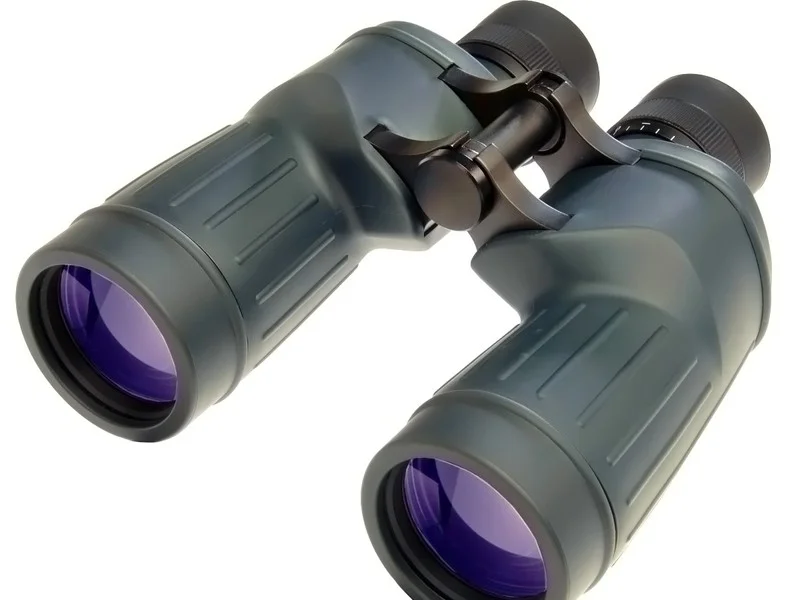
Steady enough to hand-hold for a full sweep from Cassiopeia down through Cygnus. Plenty of light-gathering to resolve the Milky Way's star clouds and pick out the Double Cluster.
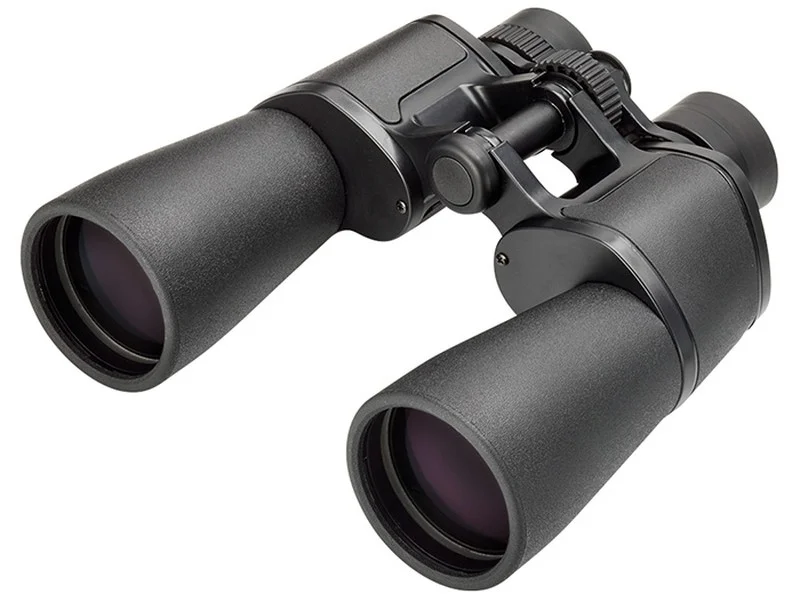
The same 10×50 formula for less outlay. It won't quite match the Helios for contrast on a really dark night, but it still turns the band into a field of individual stars.
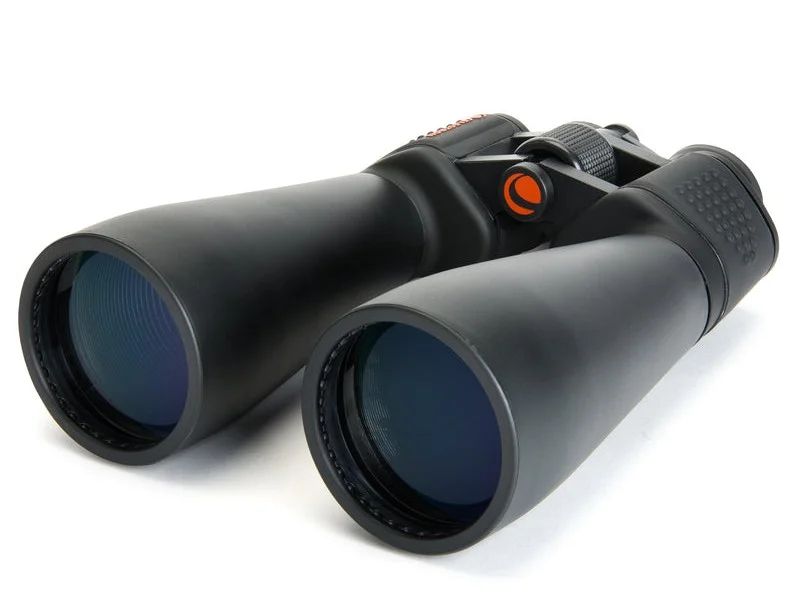
Bigger lenses pull in noticeably more of the fainter star clouds along the band. Best used on a tripod or monopod. 15× magnification is too shaky to hold steady by hand for long.
Browse all binoculars
Every pair we've reviewed, from grab-and-go 8x42s to serious 20x80 light buckets.
Browse all →Affiliate links: you pay the same price, we earn a small commission that helps keep WatchTheStars free.
Frequently Asked Questions
Can you see the Milky Way with the naked eye in the UK?
Yes. Away from towns and cities, on a clear moonless night with 20–30 minutes of dark adaptation, the Milky Way is visible to the naked eye as a soft grey band across the sky. You need a truly dark site, Bortle 4 or darker, for it to show up properly.
When is the best time to see the Milky Way in the UK?
August to October evenings are the sweet spot. UK summer twilight, roughly mid-May to late July, never gets properly dark, so the sky can't show the Milky Way at its best even on clear nights. By August, true darkness returns and the bright Cygnus region is well placed overhead.
Where is the best place to see the Milky Way in the UK?
Anywhere rated Bortle 4 or darker, well away from town glow. Galloway Forest Park, Northumberland and Kielder, Eryri (Snowdonia), Bannau Brycheiniog (the Brecon Beacons), Exmoor and the South Downs are all reliable UK dark sky destinations. Check any specific spot's rating at lightpollutionmap.info before you travel.
Why can't I see the Milky Way from my back garden?
Light pollution washes it out. Streetlights, security lights and the general orange glow of a town raise the sky's background brightness enough to hide the Milky Way's faint band, even though the brightest stars and planets remain visible. You typically need to get 20–30 minutes' drive from a town before the difference becomes dramatic.
Do you need a telescope to see the Milky Way?
No, a telescope is actually the wrong tool. The Milky Way is a huge, faint band that spans much of the sky, so it's best appreciated with the naked eye or swept with a wide field of binoculars. A telescope's narrow field only shows you a tiny patch of it at a time.
What does the Milky Way look like without a camera?
To the naked eye it's a soft grey band with texture: patches of glow, dark dust lanes, and a faint mottled quality, rather than the vivid colourful arch you see in photographs. Those colours come from long camera exposures that gather far more light than your eye ever can. Averted vision, looking slightly to one side of it, makes the band noticeably easier to see.
Can you see the Milky Way in London or other UK cities?
Realistically, no. UK cities sit at Bortle 7–9, where sky glow is bright enough to blot out the Milky Way's faint light entirely, even on a clear night. You'll need to travel out to at least a rural Bortle 4 site, and ideally a dark sky park, to see it properly.
What's the best month to photograph the Milky Way in the UK?
August and September give you both true darkness and a well-placed galactic core low in the south, which is what most Milky Way photographers are after. A phone or camera on a tripod will pick up far more colour and detail than your eyes can: see our guide to phone astrophotography for camera settings.