The Chupa-Chupa Attacks
The People the Lights Came For
Every UFO wave produces sightings. The 1977 wave on Brazil's Pará coast produced patients.
They arrived at the Colares health post through the second half of that year with the same story and the same marks: a light had come down on them at night, pinned them, and left burn-like patches and small puncture wounds, usually paired, usually on the neck or upper chest. The victims were fishermen, farmhands, grandmothers. Locals gave the thing the name it still carries: chupa-chupa. The sucker.
What makes this more than a folk panic is who wrote it down. When the Brazilian Air Force's Operação Prato team arrived in October, its investigators took formal statements from the injured (names, ages, dates, symptoms) and its medical officers examined victims directly. Those documents survived, leaked and were later confirmed by official releases. This page is about the people in them.
What Was the Chupa-Chupa?
The pattern barely varied. A light approaches at night (low, silent, fast) and singles someone out: a woman asleep in a hammock, a man outside his house in the heat, someone walking home along the PA-16 road. A beam comes down, white or red, and holds on them. Witnesses describe heat, a jolt like electric shock, and being unable to move while the light is on them. Then it's gone, and the marks appear: reddened, burn-like patches and small punctures, as if the skin had been pierced.
The name came from what people believed the thing was doing, sucking blood, and the fear it generated was total. The Operação Prato reports describe communities that had stopped functioning at night: nobody fishing after dark, families sleeping in groups of twenty or thirty around fires, fireworks set off through the small hours to keep the sky away. In November 1977 the town council of Maracanã formally petitioned the Air Force, Navy and Army for protection. This was not a rumour passing through; it was a region under something it could not name.
The Victims the Military Interviewed
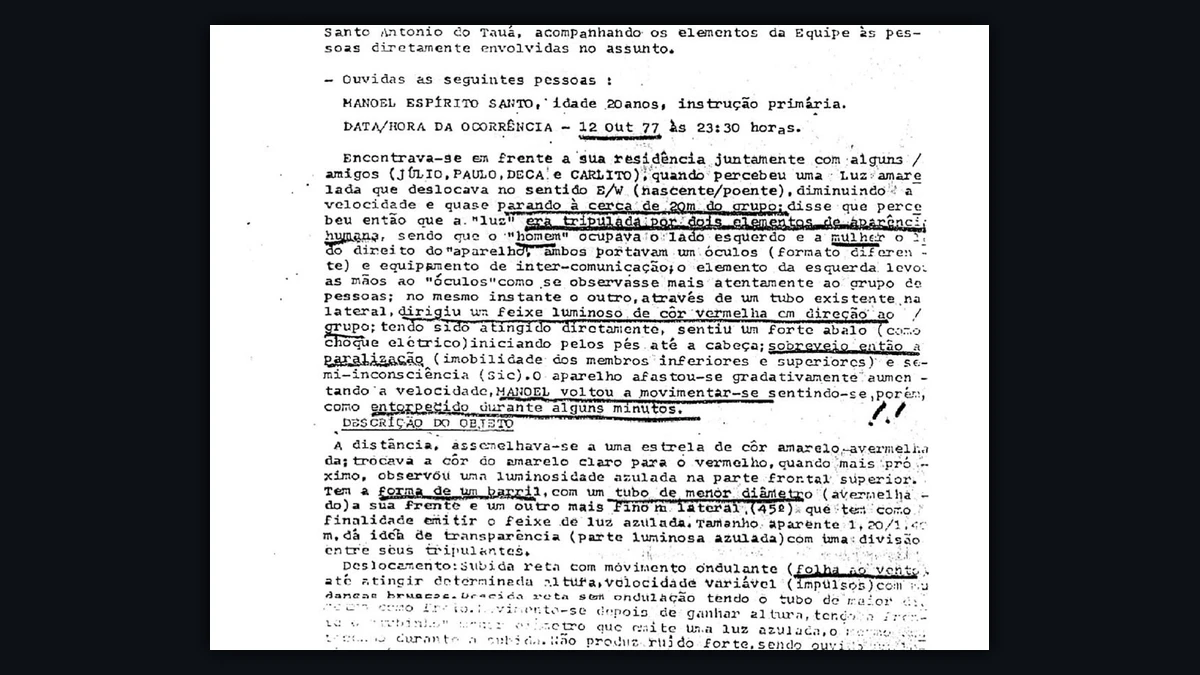
The first mission report of Operação Prato contains a witness section taken by Air Force investigators in the field. These are not stories collected by enthusiasts years later. They are statements recorded by a military intelligence team within weeks of the events, and they read like it: ages, occupations, education levels, exact dates and times. Four of them carry the case.
Manoel Espírito Santo, 20
Outside his house with four friends when a barrel-shaped object approached with a tube at the front and a finer tube on its side. Through a transparent section he saw two occupants wearing visor-like eyepieces and what he took for intercom equipment. The side tube fired a red beam at the group; struck directly, he felt a jolt 'like electric shock' run from his feet to his head, then paralysis of his arms and legs and semi-unconsciousness as the object pulled away. He was numb for several minutes.
Manoel dos Santos, 40
Asleep at home with his young children, lamps out, when he woke to a strange brightness filtering through the roof. He tried to get up and couldn't, paralysed, and tried to shout for help and couldn't manage it at first. When neighbours reached him minutes later the light was gone. For about eight days afterwards, the report records, the left side of his body remained numb and his voice hoarse.
Amélia Martins da Silva, 77
Walking home along the PA-16 with her daughter Odete when an intense yellow-red light, bright as a car headlight, came down the road towards them, cutting across at an angle. The two women ran and sheltered under a tree as it passed. Hers is the earliest dated statement in the report's witness section, weeks before the operation existed.
Raimundo Francisco das Chagas, 36
Returning to his house on a side road when he encountered a light he compared to a bonfire of tucumã palm. His statement records a mild numbness after the encounter. Like the others he is identified in the report by name, age and literacy: a semi-literate working man with, as the Colares doctor later put it about her patients, nothing whatsoever to gain.
Beyond the military file, the best-known victim account belongs to Claudomira Paixão, a Colares woman struck in mid-October 1977. In interviews with researchers she described waking in her hammock to a beam that hit her chest three times in nearly the same spot (hot, like needles going in) while a figure in what she compared to a diver's suit pointed something at her. She could not move her legs while it happened. Her account, repeated over decades of interviews, matches the military statements she never read.
Dr. Wellaide Cecim Carvalho: The Doctor Who Wouldn't Play Along
Every account of the chupa-chupa wave runs through one person. Wellaide Cecim Carvalho was in her early twenties, newly qualified, running the state health post on Colares, which made her the only medical professional standing between the phenomenon and its victims at the epicentre of the wave.
Her testimony, given consistently from a recorded 1984 statement through decades of later interviews, comes down to this: she treated dozens of patients with the marks. The burns were superficial but real: reddened skin that in some cases darkened and lost its hair, which to her resembled radiation injury more than anything else. The puncture marks clustered on the upper chest, near the carotid. The patients were poor fishing families who gained nothing from the attention and were visibly afraid. She checked for the obvious (insect bites, infection, invention) and the explanations didn't fit what she was looking at.
"All of them had suffered lesions to the face or the thoracic area. The lesions began with intense reddening of the skin in the affected area. Later the hair would fall out and the skin would turn black."
· Dr. Wellaide Cecim Carvalho, describing her chupa-chupa patients in later interviewsTwo more things give her account its weight. She has said that visiting officials pressured her to tell the community the events were mass delusion, and she refused. And she became a witness herself: watching a silent object from the Colares waterfront during the wave. She has never claimed to know what the phenomenon was. She has only ever insisted that her patients' injuries were real, which is the one claim she was uniquely qualified to make.
The Air Force's Medical Verdict
The military heard the sceptical case too: from its own doctors. Operação Prato's medical mission, Lieutenant Pedro Ernesto Póvoa and Aspirant Augusto Sérgio Santos de Almeida, worked the same villages as the field team, interviewing residents who described being bitten or stung at the neck, losing the use of their limbs, losing speech. They examined two people immediately after claimed beam strikes and recorded racing pulses, muscle tremors, rapid breathing, crying and stammering. They treated one with a tranquiliser and one with a placebo. By the next day, both patients reported only tiredness.
Their two-page report concludes that everything they saw was a normal adrenaline discharge, the body's fight-or-flight response, triggered by fear of the unknown and spread "epidemically" through a community where everyone knows everyone, "circulating a climate of collective hysteria". What people attributed to the rays of the OVNI, the doctors wrote, was the organism reacting normally to terror.
It's a serious explanation, and parts of the file support it: panic was certainly real and certainly contagious. But it answers a different question to the one the case asks. Adrenaline explains racing pulses and stammering. It does not explain paired puncture marks, burns that shed hair, or a man numb down one side for eight days, and the medical report doesn't engage with the marks at all. The field team noticed the gap: their own reports treat the victims' physical accounts as too consistent to dismiss. The two halves of the operation looked at the same villagers and wrote down different conclusions, and both are in the file.
The Deaths That Were Never Investigated
No death has ever been officially attributed to the chupa-chupa. The qualifier matters, because "officially attributed" is not the same as "none reported". Researcher Jacques Vallée, who studied the case on the ground in the 1980s, wrote that local accounts linked at least two deaths to the wave. Dr. Carvalho has described a patient with severe chest burns who died the same evening: the death certificate said heart attack, made no mention of the burns she had examined that morning, and no autopsy was performed. And the Navy's intelligence file from November 1977, released decades later, notes a body found at a river mouth near a reported sighting location, flagged as a possible connection and then never mentioned again.
None of this is proof of anything. It is, though, a documented pattern of cases that were never followed up, in a region where death certificates for poor fishing families did not attract second opinions.
The Evidence
Confirmed
Victim statements in the military's own fileNamed, dated, formal statements taken by Air Force investigators in 1977: beam strikes, electric-shock effects, paralysis, an eight-day injury. Verified against the document scans, downloadable on this page.
Confirmed
A treating physician who never waveredDr. Wellaide Cecim Carvalho has described the same injuries consistently since 1984: real burns, real punctures, patients with nothing to gain, and official pressure to call it delusion, which she refused.
Confirmed
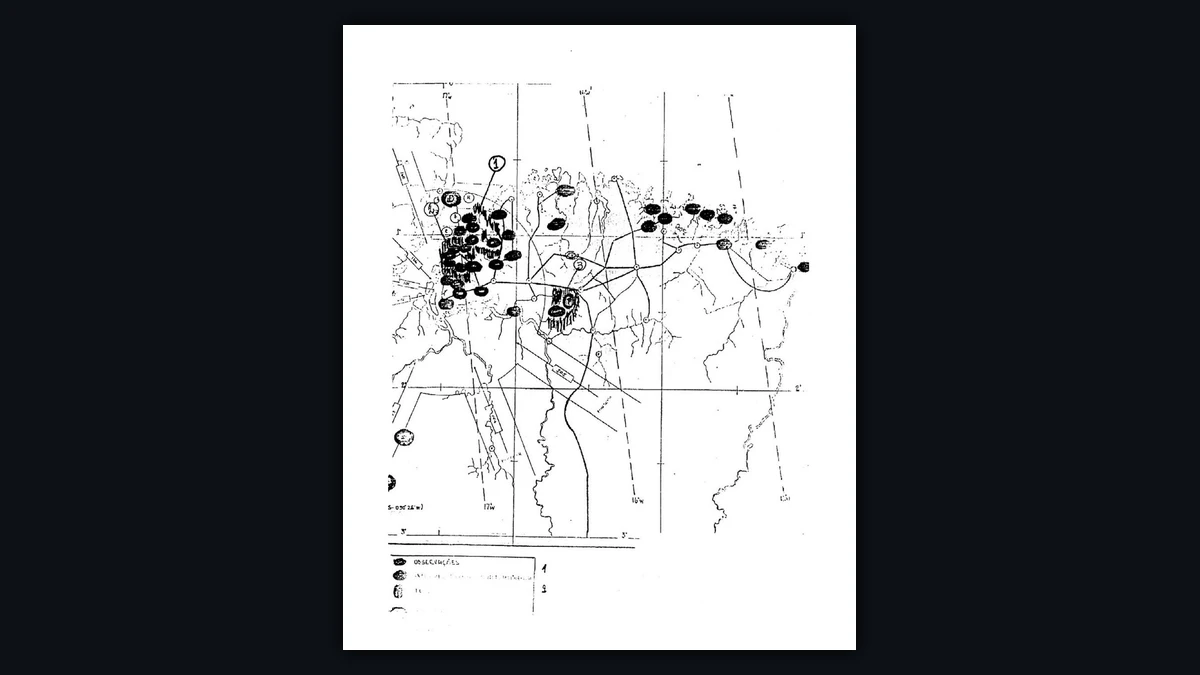
The military mapped the injuredThe operation's own charts plot sighting locations and 'atingidos', people struck, as separate categories across the Pará coast. The injuries were an official data set.
Official position
Adrenaline and collective fearThe Air Force medical report attributes the symptoms it examined to a normal fight-or-flight response spread through a terrified community. It is the strongest conventional reading, and it never addresses the marks.
Unresolved
The reported deathsAt least two deaths were linked to the wave by local accounts, including a burns patient certified as a heart attack without autopsy. Never investigated, never attributed, never explained.
Unknown
What caused the injuriesNo mechanism was ever established. The marks were real enough to treat and consistent enough to map. What made them remains an open question half a century later.
The Bottom Line
Strip the case down to what's documented and it is still remarkable. In 1977, on one stretch of Brazilian coast, enough people were physically marked by something in the night sky that a doctor spent months treating them, a town council begged three armed services for protection, and a military intelligence team took formal statements from the injured and mapped them as a category of data. The institution's doctor said fear; the institution's field team said the accounts held up; the institution itself said nothing for thirty years and then released the file.
Maybe the marks have a mundane cause that was simply never found: the area was poor, remote, and full of things that bite, burn and infect. But that explanation has to get past Dr. Carvalho, who lived there, treated the patients, knew the local hazards, and says it wasn't any of them. The chupa-chupa is what a UFO case looks like when the evidence is people: imperfect, unprovable, and very hard to wave away.
Keep a proper set of eyes on the sky
Kit we've tested and reviewed in full
The chupa-chupa reports came from people caught off guard after dark. Binoculars won't stop a beam of light, but they'll tell you a lot more about what's actually up there before you decide what to call it.
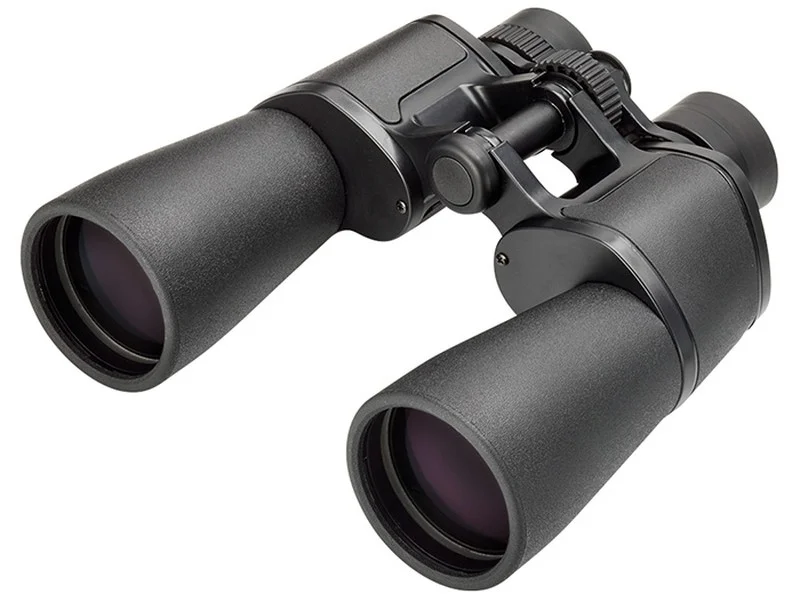
Bright and quick to aim in low light, enough to see shape and colour on something low and fast before it moves on.
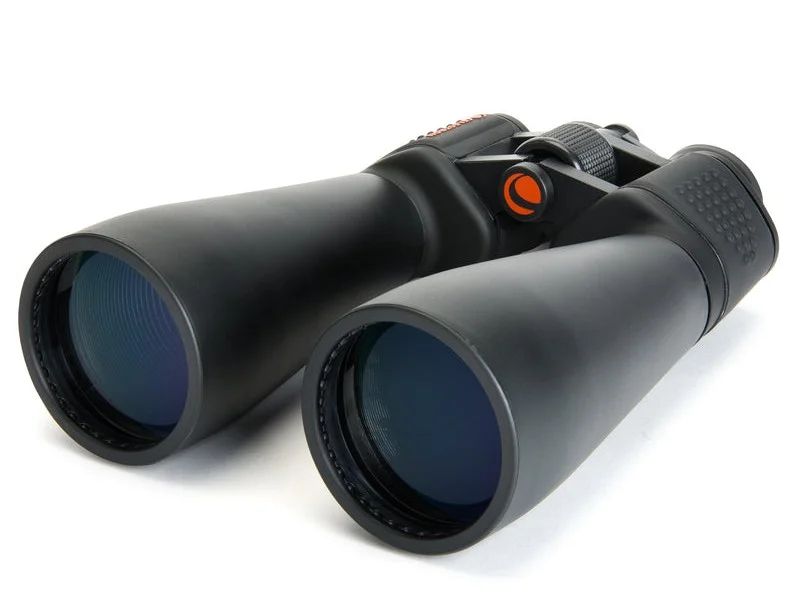
Bigger objectives pull in more light after dark: the difference between a smear on the horizon and something you can actually describe.
Affiliate links: you pay the same price, we earn a small commission that helps keep WatchTheStars free.
Download the Original Documents
The victim statements and both medical perspectives are in the files we host. All are scans of the original 1977 documents, in Portuguese.
First Mission Report: Witness Statements
40 pages · 4 MB PDF
The leaked Operação Prato first mission report, including the formal victim statements quoted on this page, Manoel Espírito Santo's beam strike among them.
Download PDFThe Medical Mission Report
2 pages · 3 MB PDF
The Air Force doctors' examination of the victims and their conclusion: adrenaline, fear of the unknown, collective hysteria. The official sceptical reading.
Download PDFSNI Intelligence Report (1977)
5 pages · 3 MB PDF
Brazil's national intelligence service reporting on the wave to Brasília: confirmation that the chupa-chupa reached the dictatorship's security apparatus.
Download PDFRelated Cases
The chupa-chupa attacks are the human story inside Operação Prato: the Brazilian Air Force operation that investigated them. For Brazil's other great documented case, see Varginha.
More UAP cases
- The 1976 Tehran UFO Incident: F-4 Jets, Weapons Failure and the Declassified DIA Report
- Operação PratoOctober–December 1977 · Colares, Pará, Brazil · Status: Files Released
- Apollo 17's Unknown CompanionTranslunar Coast · 9 December 1972 · Mission Elapsed Time 02:18:47
- The 1978 Amazon Pilot Encounters6 & 28 November 1978 · Amazon airspace, Brazil · Status: In the Official Records
- The RB-47 Encounter: 700 Miles, Three Sensors, No ExplanationMississippi → Texas → Oklahoma → Kansas · 17 July 1957 · ~0200–0340 CST
- The Rendlesham Forest IncidentDecember 1980 · RAF Woodbridge, Suffolk, England