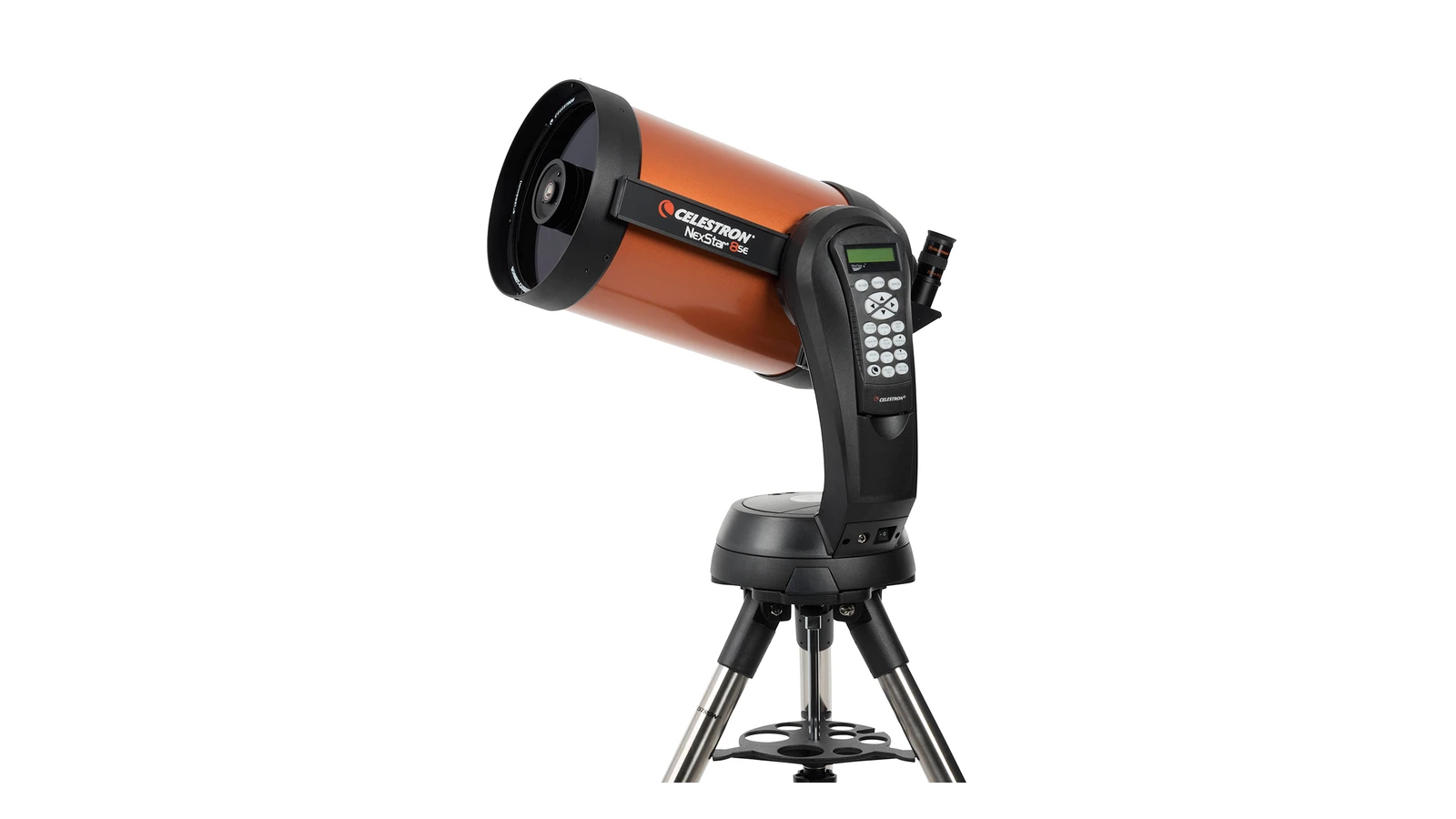
Celestron NexStar 8SE
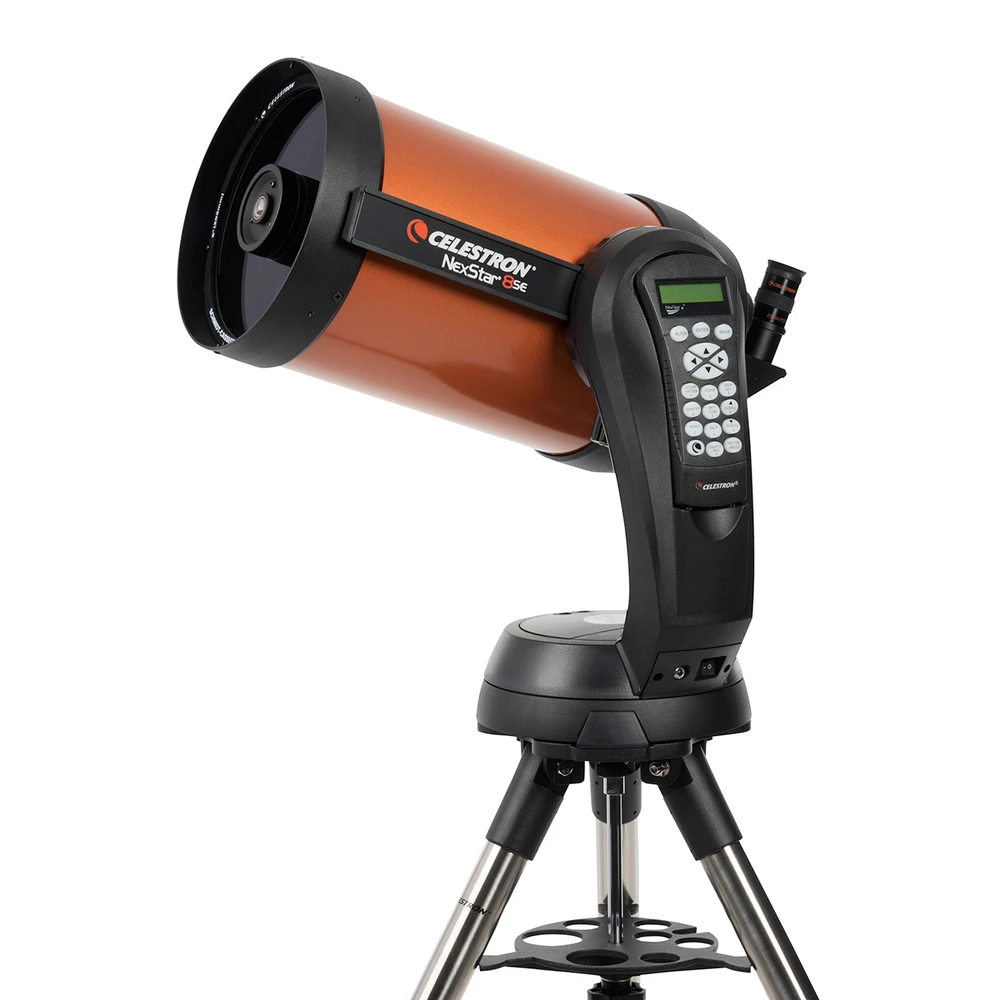
The NexStar 8SE has been one of the world's best-selling serious telescopes for nearly two decades, and the reason is simple: 8 inches of excellent Schmidt-Cassegrain optics that find and track everything for you. If you want maximum aperture with minimum effort and the budget stretches to £1,615, it delivers. If £1,615 is painful, know that an 8-inch Dobsonian shows you the same sky for £449: you're paying for the computer, not the view.
Celestron NexStar 8SE Specifications
| Key Specifications: Celestron NexStar 8SE | |
|---|---|
| Price (UK) | £1,615 at First Light Optics |
| Aperture | 203mm (8") |
| Optical Design | Schmidt-Cassegrain (SCT) with StarBright XLT coatings |
| Focal Length | 2032mm (f/10) |
| Mount | Single fork arm, computerised alt-azimuth GoTo |
| Object Database | 40,000+ objects, SkyAlign three-object alignment |
| Included Eyepiece | 25mm Plössl (81×) |
| Finder | StarPointer red dot |
| Optical Tube Weight | ~5.7kg |
| Total Weight | ~15kg fully assembled |
| Power | 8× AA batteries or 12V external supply (external strongly recommended) |
| Tube Length | ~43cm: the big advantage of the SCT design |
| Warranty | 2 years via First Light Optics |
What Is the Celestron NexStar 8SE?
The NexStar 8SE is Celestron's signature orange-tube telescope: an 8-inch Schmidt-Cassegrain on a computerised single fork arm mount. It's been in production since 2006, the optical design goes back decades further, and it has probably introduced more people to deep-sky observing than any other telescope at its price.
The Schmidt-Cassegrain design folds a 2032mm focal length into a tube barely 43cm long. That's the whole appeal in one sentence: you get the focal length of a telescope over two metres long in something that fits on a car seat. The trade-off is a focal ratio of f/10, which gives narrow, high-magnification views rather than wide starfields.
The mount is the other half of the story. Centre any three bright objects in the eyepiece, you don't even need to know what they are, and SkyAlign works out where the telescope is pointing. From then on, pick anything from the 40,000-object database and the scope slews to it and tracks it. On a night when you only have an hour, you spend that hour observing rather than hunting.
What's Included with the NexStar 8SE?
The box contains the optical tube, the fork arm mount and steel tripod, a NexStar+ hand controller, a 25mm Plössl eyepiece (81×), and a StarPointer red dot finder. Everything you need for the first night, with two exceptions worth budgeting for upfront.
Power is the first. The mount runs on 8 AA batteries and eats them: a couple of evenings of slewing and tracking and they're done. Nearly every owner buys an external supply: a Celestron PowerTank, a 12V lithium power bank with a 2.1mm tip-positive plug, or a mains adapter if you observe from the garden. Plan on £40–90.
A second eyepiece is the other. The 25mm Plössl is decent, but 81× is the scope's only magnification out of the box. A 32mm Plössl (63×, the widest practical view at f/10) and something around 10–13mm (156–203× for planets) transform what the scope can do. The included StarPointer red dot finder works but feels basic on a £1,600 instrument, many owners upgrade to a 9×50.
What Can You See with the NexStar 8SE?
An 8-inch aperture under UK skies is a serious instrument. The 8SE shows you the same objects as any 200mm telescope: the difference is it takes you straight to them.
The Planets
This is where the f/10 focal length earns its keep. Saturn's Cassini Division is clean and obvious on steady nights. Jupiter shows multiple cloud belts, the Great Red Spot, and shadow transits of its moons. Mars near opposition shows polar caps and dark surface markings. The long focal length means high magnification comes easily: 200× needs only a 10mm eyepiece.
The Moon
Spectacular at any magnification. At 200× you're cruising along crater walls and mountain ranges. The tracking makes lunar observing relaxing: the Moon stays put in the eyepiece while you study it, which a manual scope can't offer at high power.
Globular Clusters
M13 in Hercules resolves into individual stars across the core. M15, M5, M22, and M2 are all showpieces. Globulars are arguably the best deep-sky targets for an 8-inch SCT: bright, compact, and they reward the high magnification the focal length provides.
Galaxies
From reasonably dark skies the brighter Messier galaxies all show structure: M82's dust lane, M51 and its companion, M104's edge-on profile. From suburban gardens stick to the bright ones. The GoTo helps enormously here, because faint galaxies are exactly the objects beginners give up trying to find manually.
Nebulae
The Orion Nebula shows the Trapezium and extensive nebulosity. The Ring (M57) and Dumbbell (M27) are excellent. The narrow field works against the largest nebulae: the Veil and North America Nebula need a wider view than f/10 can give. For everything compact, the contrast is lovely.
Double Stars
A strength. The long focal length and tracking make splitting close pairs comfortable: the Double-Double in Lyra, Albireo's gold and blue, and tighter tests like Porrima on good nights. Light pollution barely affects double stars, which makes them ideal targets from town gardens.
NexStar 8SE vs 6SE: Which Should You Buy?
The most common question about this telescope. Both use the same mount, same hand controller, and same database: the difference is the tube on top.
| NexStar 8SE | NexStar 6SE | |
|---|---|---|
| Price | £1,615 | ~£1,199 |
| Aperture | 203mm | 150mm |
| Light gathering | ~80% more ✓ | N/A |
| Focal length | 2032mm (f/10) | 1500mm (f/10) |
| Mount stability | At its limit | Comfortable ✓ |
| Total weight | ~15kg | ~13.5kg |
The 8-inch tube gathers about 80% more light than the 6-inch, and you can see the difference at the eyepiece: globulars resolve deeper, galaxies show more, and you get roughly half a magnitude of extra reach. That's why the 8SE is the one everyone aspires to.
The counterargument: the single fork arm was designed around the smaller tubes, and with the 8-inch on top it's working at its limit. Touch the focuser at 200× and the view shakes for a second or two. The 6SE feels noticeably steadier and saves around £400, which buys an excellent set of eyepieces and a power supply.
If the budget covers the 8SE plus accessories, get the 8SE, aperture wins. If it means skipping the accessories, the 6SE spent well beats the 8SE spent bare.
Read our full NexStar 6SE guide →NexStar 8SE vs an 8-Inch Dobsonian: The £1,100 Question
The StellaLyra 8" Dobsonian costs £449 and collects exactly the same amount of light as the 8SE. Optically, on most objects, the views are comparable. So what does the extra £1,100 buy?
Finding and tracking. The Dobsonian shows you anything you can find, but you do the finding, and at high magnification you nudge the tube every 30 seconds as the Earth rotates. The 8SE finds everything and keeps it centred. If you observe with children, share views with guests, or have limited time and patience for star-hopping, this matters more than any spec.
Compactness. The 8SE's tube is 43cm long; the Dobsonian's is 1.2 metres. The 8SE packs into a small car much more easily.
What the Dobsonian buys you instead: no batteries, no alignment, a 30-second setup, a wider maximum field of view, and £1,100 still in your pocket. For pure value per pound of aperture, the Dobsonian wins and it isn't close.
Our steer: if the GoTo is the thing you actually want, buy the 8SE and don't look back. If you're choosing it just because it looks more advanced, read our StellaLyra 8" Dobsonian guide before you spend the difference.
Celestron NexStar 8SE: What Buyers Say
The optics get near-universal praise. Celestron has been making this optical tube for decades and it shows. Owners consistently describe sharp, contrasty planetary views, and the StarBright XLT coatings hold their own against far newer designs. It's common to read owners saying the same tube has been in use for ten or fifteen years.
SkyAlign does what it promises. The three-object alignment is regularly singled out as the easiest in any GoTo system: no star names needed, and it'll accept the Moon and planets as alignment objects. Once aligned, pointing accuracy across the sky is good enough that objects land in the eyepiece of the 25mm consistently.
The AA battery situation is the most common complaint. Eight AAs disappear fast under GoTo use, and low power makes the mount behave erratically before it dies: random slews and lost alignment are classic symptoms. The fix is an external 12V supply, and most owners say they wish they'd bought one on day one.
Dew catches UK owners out. The corrector plate at the front of an SCT points at the open sky and fogs readily on UK nights. A flexible dew shield (~£30) is the minimum; many owners add a heated dew band. Treat a dew shield as part of the purchase, not an optional extra.
The single fork arm divides opinion. It's what makes the 8SE portable and affordable, but with the 8-inch tube aboard it's at the top of its rated capacity. Vibration settles in a second or two, and most owners simply learn to take their hand off the focuser and wait. Those who upgrade often go to the Evolution series or an equatorial mount.
Celestron NexStar 8SE: Known Limitations
- Needs external power in practice. The 8 AA batteries are a backup at best. Factor a PowerTank or 12V lithium supply into the real cost.
- Narrow maximum field of view. At f/10, the widest practical true field is a little under a degree. The Pleiades won't fit in one view, and large nebulae are out of reach. An f/6.3 focal reducer (~£100) helps but doesn't turn it into a wide-field scope.
- Mount is at its payload limit. The single fork arm handles the 8-inch tube, but only just. Expect brief vibration after touching the scope at high magnification, and don't plan on hanging heavy accessories off the back.
- Not a deep-sky imaging platform. Alt-azimuth tracking causes field rotation, so long exposures are off the table without a wedge, and even then, the mount is a compromise for imaging. Planetary video is the photographic strength here.
- Dew magnet. All SCTs are, and UK humidity makes it worse. A dew shield is essential equipment.
- Cool-down time. The closed tube takes 30–45 minutes to reach ambient temperature on cold nights. Planetary views before then will be soft. Put it outside while you have dinner.
Can You Do Astrophotography with the NexStar 8SE?
The most-asked question about this scope, so here's the straight answer.
Planetary and lunar imaging, yes, and it's good at it. 2032mm of focal length is exactly what planetary imaging wants. Drop a planetary camera like the ZWO ASI662MC into the eyepiece holder, capture a few thousand frames of video, stack the best ones, and the results from a garden in the UK can be seriously impressive. The tracking is easily good enough for this.
Long-exposure deep-sky imaging, no. The alt-az mount rotates the field as it tracks, which smears stars on any exposure much beyond 20–30 seconds. An equatorial wedge (~£250+) works around the rotation, but at 2032mm focal length the guiding demands are brutal, and you'd be building an imaging rig on a mount that was never designed for it. If deep-sky photography is the real goal, a HEQ5 Pro with a small refractor like the Evostar 72ED costs about the same as an 8SE and will produce dramatically better images.