The Newfoundland KC-97 Incident
The Radar-Visual Case the Air Force Admitted It Couldn't Explain
On 6 July 1955, the crew of a US Air Force KC-97 tanker over Newfoundland reported an unidentified object, and at the same time, ground radar picked up a return that appeared to be the very same thing. A committee of Air Force intelligence colonels reviewed the case and wrote down a sentence rarely seen in official files: they were 'unable to explain' it. The full file, including the Air Force's secret review of a real flying saucer project, was released on 10 July 2026.
| Date | 6 July 1955 |
| Location | Newfoundland area, Canada · approximately 49°N 59°50'W |
| Platform | USAF KC-97 Stratofreighter tanker, multiple crew witnesses |
| Corroboration | GCI ground radar return of an object 'apparently identical' to the crew's visual contact |
| Evaluated by | USAF Directorate of Intelligence committee (AFOIN-2C), convened 8 July 1955 |
| Conclusion | 'Unable to explain the simultaneous ground radar returns and aircrew visual sightings' |
| Classification | UFOB: official unidentified flying object report |
| Follow-up | Fighter scrambles 'without delay' recommended for future incidents; increased collection on Soviet R&D |
| Document | DOW-UAP-D095, full file released 10 July 2026 |
The Newfoundland KC-97 incident is a textbook radar-visual UFO case from the height of the Cold War: on 6 July 1955, a US Air Force tanker crew watched an unidentified object while ground radar tracked what appeared to be the same thing. The Air Force committee that investigated wrote that it was "unable to explain" the match, classified the case as an official unknown, and told commanders to scramble fighters next time. The full file sat in the archives for 71 years until its release on 10 July 2026.
What makes the file remarkable isn't just the sighting. It's the company the sighting keeps. The same folder contains the Air Force's secret review of an actual flying saucer, the disc-shaped Avro aircraft the US and Canada were building at that moment, signed off by Jimmy Doolittle, and intelligence reports chasing rumours of German saucer engineers behind the Iron Curtain. Read together, the documents show exactly why a strange light over Newfoundland worried the Pentagon: they thought discs could be built, because they were building one.
What Happened Over Newfoundland on 6 July 1955?
The KC-97 Stratofreighter was the US Air Force's workhorse tanker: a big, four-piston-engine aircraft that refuelled the bombers of Strategic Air Command. Newfoundland sat under the North Atlantic air routes, ringed with US bases (Harmon, Pepperrell, Goose Bay) and covered by ground-controlled intercept radar.
On 6 July, a KC-97 crew in the area of 49°N 59°50'W, over the Gulf of St Lawrence, west of Newfoundland, reported an unidentified object. By itself, that report might have gone the way of hundreds of others. But at the time of the sighting, a GCI radar station in the same area recorded a return from an object which, in the words of the Air Force's own summary, "apparently was identical to the one the KC-97 crew had under visual observation."
"At the time of the sighting a GCI radar in the same area obtained a radar return of an object which apparently was identical to the one the KC-97 crew had under visual observation."· USAF Directorate of Intelligence summary, July 1955 (DOW-UAP-D095, released 10 July 2026)
Eyes and radar, same place, same time. Within two days, the Directorate of Intelligence at Air Force headquarters had a committee on it.
The Committee That Couldn't Explain It
The committee (designated AFOIN-2C, and staffed by colonels of the Air Force's intelligence directorate) was ordered on 8 July to evaluate the sighting. It reviewed the incident summaries, the crew interrogations, and the evaluation done by Northeast Air Command. Notably, it also weighed "certain new U.S. and Canadian developments in high performance unconventional aircraft", the flying disc programmes, before writing its conclusions on 11 July 1955.
"The committee was unable to explain the simultaneous ground radar returns and aircrew visual sightings, and tentatively accepts the NEAC evaluation attributing the incident to electrical phenomenon on the one hand and misinterpretation of the sightings by aircrew members on the other. It was further concluded that this incident should be classified as UFOB."· Memorandum for Record, AFOIN-2C4 · 11 July 1955 (DOW-UAP-D095, released 10 July 2026)
It's worth reading that carefully, because both halves matter. The committee couldn't explain the case, and said so in writing. The fallback it "tentatively" accepted asks a lot: an electrical phenomenon on the radar scope at the same moment trained aircrew misread something in the sky, in the same piece of airspace. The committee didn't pretend that was satisfying. It classified the incident as UFOB, the Air Force's formal designation for an unidentified flying object, and kept the item out of the policy books and the daily staff digest.
On one question the committee was direct: there was no evidence either way about whether the Soviets had a disc aircraft of their own. "No intelligence is available to support or deny the existence of unconventional Soviet aircraft comparable to those under consideration in the US and Canada and providing performance such as reported."
'Fighter Scrambles Without Delay': What the Air Force Did Next
The committee's recommendations show how seriously the case landed. First, intelligence collection: because of "the serious technological threat should unfriendly nations succeed in developing high performance unconventional aircraft," collection agencies should push harder into Soviet research and development programmes, to give the US "adequate warning."
Second, interception. A companion memorandum from Colonel Frank B. Chappell of the Directorate of Intelligence concluded that the method "possessing the most likelihood of success" for identifying such objects was to send fighters after them, and attached a proposed order to the commander of Northeast Air Command directing exactly that.
"It is further recommended that in the event of future incidents of this nature fighter scrambles be effected without delay."
· AFOIN-2C committee recommendation, 11 July 1955This is the quiet significance of the file. In public, through the 1950s, the Air Force downplayed flying object reports. In private, days after an unexplained radar-visual contact, it was arranging for jets to be launched at the next one.
The Avro Flying Saucer Connection: Doolittle Reviews Project Y2
The first document in the released file has nothing to do with Newfoundland, and everything to do with why the sighting mattered. It's the US Air Force Scientific Advisory Board's report on Avro Project Y2, dated November 1954, the American review of the disc-shaped, vertical take-off aircraft being developed at Avro Canada's plant in Malton, Ontario. The covering letter, addressed to Lieutenant General Donald Putt, is signed by James H. Doolittle, the man who led the 1942 Tokyo raid, in his role as the Board's acting chairman.
Doolittle's panels were unimpressed: their tentative view was that the saucer "warranted no more than limited support," a judgement history would vindicate when the project dwindled into the hovering Avrocar. But the point is what the Air Force believed in 1955: that disc-shaped, high-performance aircraft were at the edge of the possible. The intelligence assessment in the same file spells the fear out.
"We have presented to you some evidence that flying saucers are within the capabilities of the existing state of the art, in this country and Canada... It is possible that German projects for flying saucers existed at the end of the war... We have reports on eyewitnesses of flying saucers in Soviet territory."· Intelligence assessment on unconventional aircraft, mid-1950s (DOW-UAP-D095, released 10 July 2026)
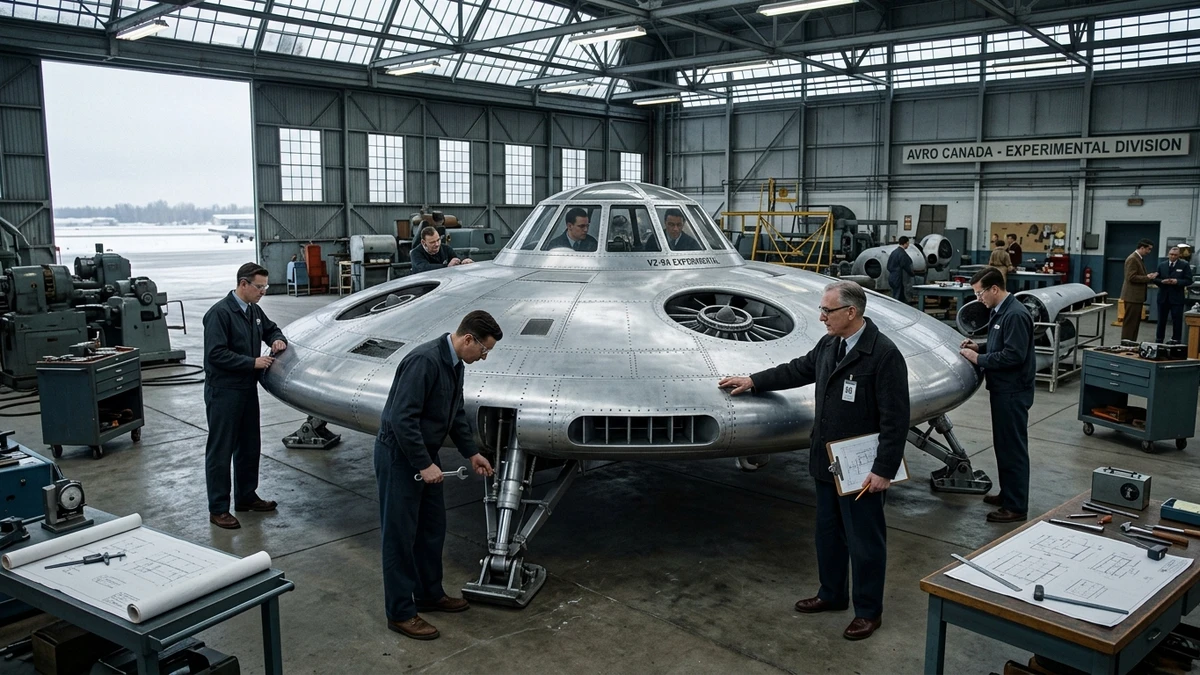
The same assessment recommends alerting the entire intelligence community to possible Soviet saucer work, reviewing every foreign flying saucer file, and tracking down a German engineer named Miethe, thought to be a wartime disc designer who might have changed his name and gone east. The committee that reviewed the KC-97 sighting was working inside that mental world. When radar and a tanker crew agreed on an unidentified object near the Atlantic air routes, "Soviet saucer" was a hypothesis the Air Force was obliged to take seriously.
Avro Canada Starts Disc Aircraft Work
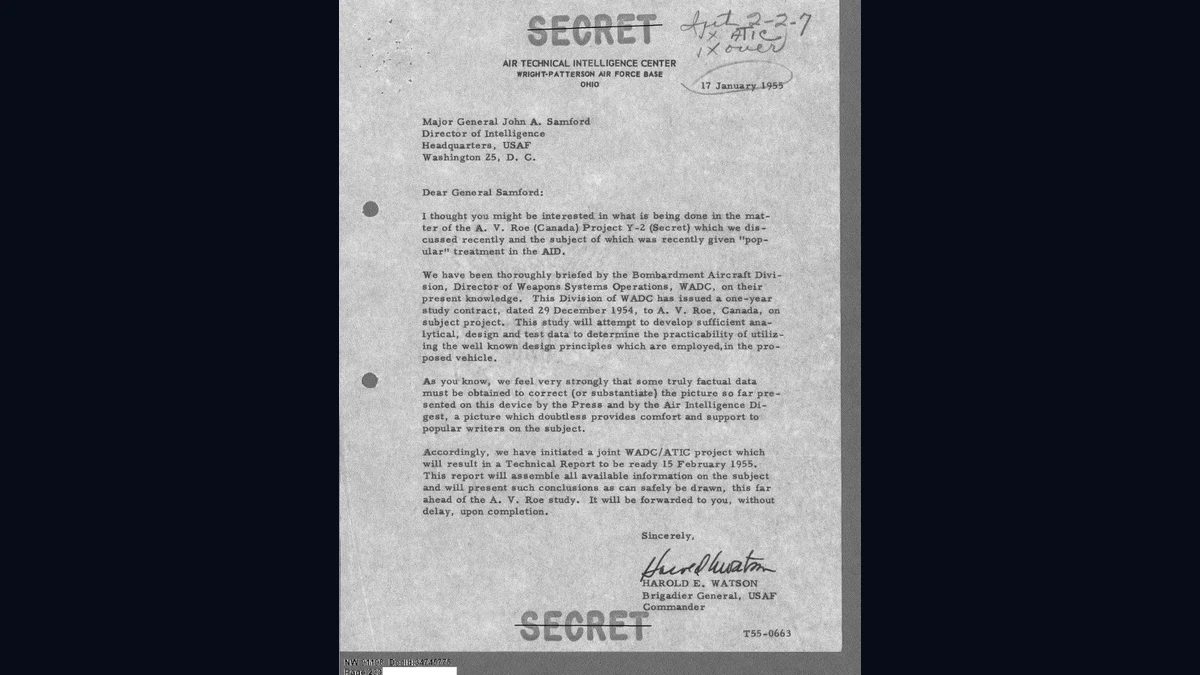
Avro Canada begins developing a circular vertical take-off aircraft under designer John Frost, later Project Y2, funded by the US Air Force. A 1954 memo in the file notes that circular VTOL aircraft could be mistaken for UFOs by observers unfamiliar with the technology.
Doolittle's Board Reviews the Saucer
The USAF Scientific Advisory Board reports on Avro Project Y2. Covering letter signed by acting chairman James H. Doolittle. The panels judge the project worth 'no more than limited support.'
The Sighting
A KC-97 crew near 49°N 59°50'W reports an unidentified object while GCI radar in the same area tracks an apparently identical target. The reports go up through Northeast Air Command the same day.
Committee Convened
USAF's Directorate of Intelligence orders its AFOIN-2C committee to evaluate the incident, reviewing crew interrogations, radar data and the NEAC evaluation, alongside the current US-Canadian disc aircraft work.
'Unable to Explain'
The committee records that it cannot explain the simultaneous radar and visual contacts, classifies the incident as UFOB, and recommends fighter scrambles 'without delay' for future incidents plus deeper collection on Soviet R&D.
Senator Russell's Sighting
Three months later, Senator Richard Russell watches a disc rise vertically over Soviet territory. The CIA's analysis leans on the same Avro Project Y context. The two files read as chapters of the same Cold War story.
File Released
The complete 57-page file (Doolittle's Avro review, the saucer intelligence assessments and the KC-97 committee memoranda) is published as DOW-UAP-D095 in the fourth PURSUE release.
Evidence Assessment
CONFIRMED
Simultaneous radar and visual contactThe Air Force's own summary states GCI radar tracked an object 'apparently identical' to the one the KC-97 crew was watching. This is documented in official memoranda, not witness recollection.
CONFIRMED
The Air Force could not explain it'The committee was unable to explain the simultaneous ground radar returns and aircrew visual sightings', written by the committee itself, 11 July 1955.
CONFIRMED
It changed Air Force postureThe file contains a drafted order for fighter scrambles 'without delay' against future objects of this kind, an operational response, not a filing exercise.
TENTATIVE
The official fallback explanationElectrical phenomena on radar plus aircrew misinterpretation was 'tentatively' accepted, a coincidence of two independent errors that the committee itself did not present as a finding.
UNRESOLVED
What the object wasNo Soviet, American or Canadian system was matched to the sighting. The committee found no intelligence to support or deny a Soviet disc aircraft with the reported performance.
UNKNOWN
The crew's full accountThe detailed crew interrogations referenced by the committee (CAF IN 15592 and CAF IN 90703) are summarised but not reproduced in full in the released file.
Why the KC-97 Case Still Matters
Nineteen fifties UFO files usually resolve into one of two shapes: a sighting explained away, or a sighting talked up. The KC-97 file is the rarer third kind: an unexplained case the system handled with complete seriousness and complete honesty, in private. The colonels didn't believe in flying saucers from elsewhere; every recommendation in the file points at the Soviet Union. But they wrote "unable to explain" when they were unable to explain, and they changed interception policy because of it.
Seventy years on, that's the same posture found in AARO's modern "unresolved" case files, and the same lesson. A radar return with a witness attached is hard evidence of something. In 1955 the something was probably not a Soviet saucer, whatever the Air Force feared. What it actually was, nobody ever established. The file went into a vault with the question still open, and it came out of the vault in 2026 the same way.
Scan the skies yourself
Kit we've tested and reviewed in full
The KC-97 case turned on trained observers describing exactly what they saw. Binoculars are how you do the same from the ground: resolving a distant light into an aircraft, a planet, a satellite, or a genuine puzzle.
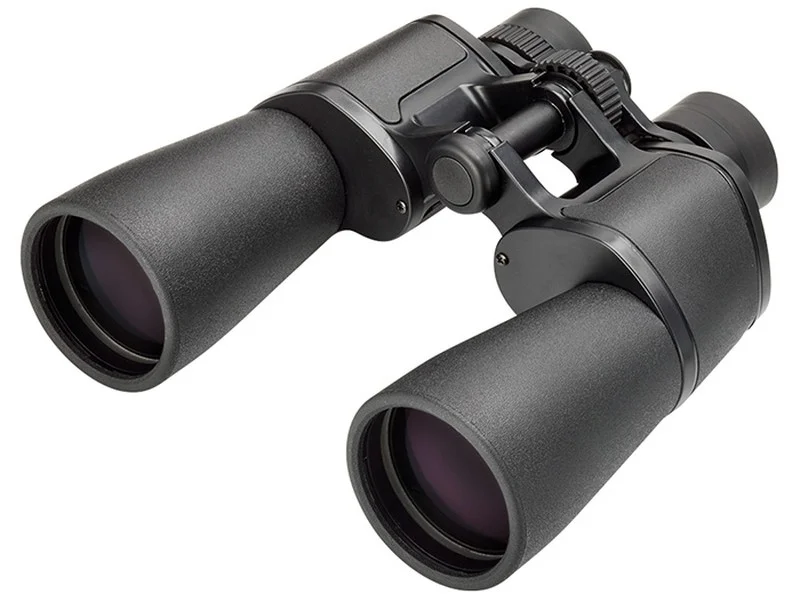
Sharp, bright and quick to aim, enough to pick out navigation lights, engine count and direction of travel on high-altitude aircraft.
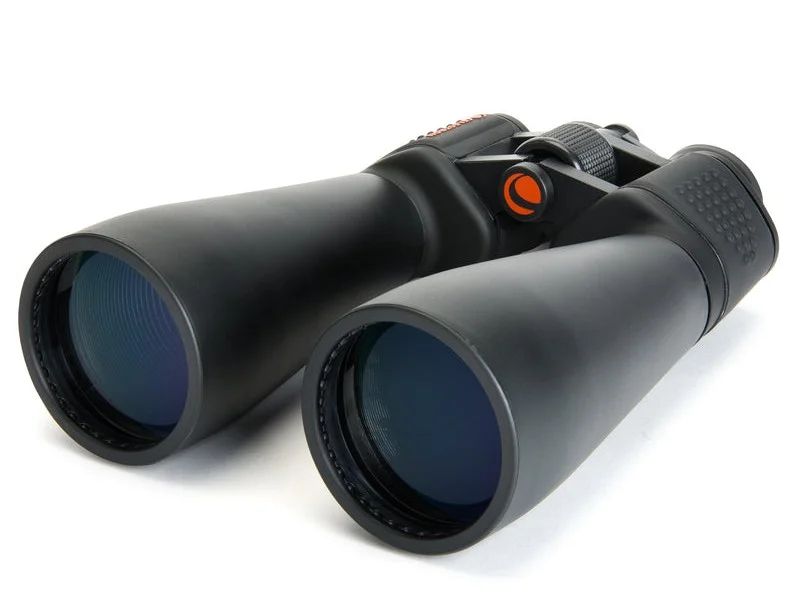
The extra aperture and magnification that turn "a light on the horizon" into something you can actually describe, which is where every good report starts.
Affiliate links: you pay the same price, we earn a small commission that helps keep WatchTheStars free.
Primary Source Documents
Key Pages from the File
DOW-UAP-D095 excerpt · 6 pages · released 10 Jul 2026
The pages quoted on this page, hosted here: Doolittle's covering letter on Avro Project Y2, the flying saucer intelligence assessment, and the KC-97 committee memoranda of 11 July 1955.
Download PDFThe Complete 57-Page File
DOW-UAP-D095 · war.gov/ufo · 31 MB
The full declassified file at the official Department of War release site, including all Avro Project Y2 technical pages and correspondence.
Read at war.gov ↗📌 Note: These are official Department of War records released through the PURSUE declassification programme (Release 04, 10 July 2026). The key pages are hosted here to ensure permanent availability; the complete file is too large to mirror and links to the official release site.
Related Cases
More UAP cases
- The Green Fireball IncidentsDURATION: DEC 1948 – 1952 · LOCATION: LOS ALAMOS / SANDIA / KIRTLAND / WHITE SANDS · STATUS: UNEXPLAINED
- The Senator Russell Sighting4 OCTOBER 1955 · SOVIET TRANSCAUCASUS (PRESENT-DAY AZERBAIJAN) · FULL CIA FILE RELEASED 10 JULY 2026
- The Roswell IncidentJuly 1947 · Foster Ranch, New Mexico · Status: Unresolved
- RAF Lakenheath: The Night Britain's Air Defences FailedSuffolk, England · 13–14 August 1956 · 2130–0330 hrs
- UAP Document Archive: Official UFO Files from the US, UK & BrazilUS DoD PURSUE Releases · UK MOD & National Archives Files · Brazilian Air Force Records · NSA UMBRA Files
- The RB-47 Encounter: 700 Miles, Three Sensors, No ExplanationMississippi → Texas → Oklahoma → Kansas · 17 July 1957 · ~0200–0340 CST