The 1978 Amazon Pilot Encounters
The Two Reports That Closed Brazil's UFO File
The Brazilian Air Force's UFO file doesn't end with a frightened village. It ends in the cockpit of a light aircraft.
Through 1977, the file that would become the famous "130 records" filled up with reports from the Colares wave: fishermen, farmhands, and the military's own Operação Prato observers. The operation shut down that December. The records kept coming anyway, and the last two entries, from November 1978, are different in kind from everything before them: two professional pilots, on two routine flights over the Amazon, reporting structured metallic objects that approached, paced, and outran their aircraft in broad daylight.
Three months later, the commander of the 1st Regional Air Command sent the complete folder to Air Force headquarters under a confidential cover letter. Records 129 and 130 are where it stops. This page is about those two flights, verified against the released file, which you can download below.
A Near-Collision Over the Xingu: 6 November 1978
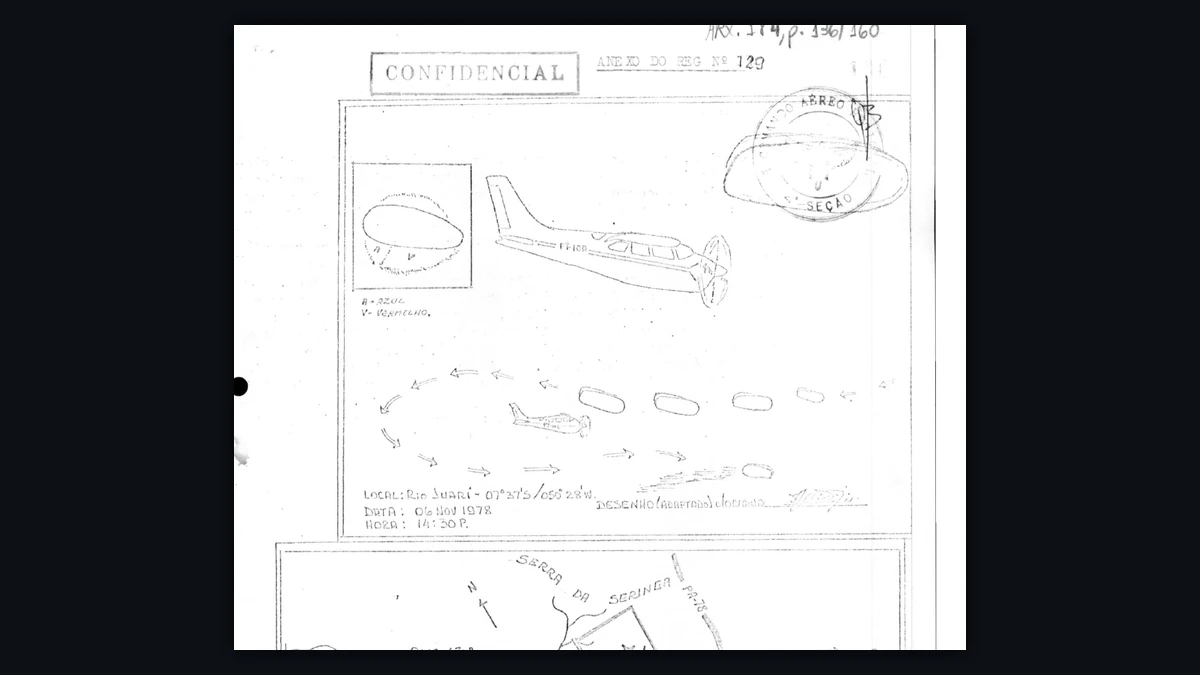
Record 129 describes an afternoon flight on the São Félix do Xingu route, deep in southern Pará. The aircraft was a Cessna 210L Centurion cruising on autopilot at 4,500 feet, heading 300 degrees. At about 14:30, the pilot (named in the record as José Rodrigues dos Santos, and noted by the Air Force as a holder of long professional experience) found something coming at him.
The record describes an oval object with a smaller oval superimposed on top, about six metres across, sky blue verging on light grey, with a metallic shine that gave off blue light. It approached in a dive (the annexe to the record calls the pass "quase colisão", a near-collision) then stabilised roughly 100 metres in front of the aircraft and held there for about ten seconds, matching course. Then it accelerated away in a climbing right turn the record judges supersonic, keeping its flat attitude as it went, and was gone.
"Passagem muito próxima (quase colisão com a aeronave), mantendo-se à frente a distância estimada de 100m por curto espaço de tempo (10 segundos), quando então animado de velocidade supersônica efetuou curva à direita. (A very close pass, near-collision with the aircraft, holding position an estimated 100m ahead for a short time, ten seconds, then, moving at supersonic speed, it executed a turn to the right.)"· Annexe to Record 129, Registros de Observações de OVNI, Brazilian Air Force, 1978
The record carries an unusual closing note. The Air Force recorded that the pilot suffered real distress from the encounter and sought medical attention immediately. Whatever crossed his nose that afternoon, the man flying the aircraft did not treat it as a curiosity.
Four Minutes Over Tomé-Açu: 28 November 1978
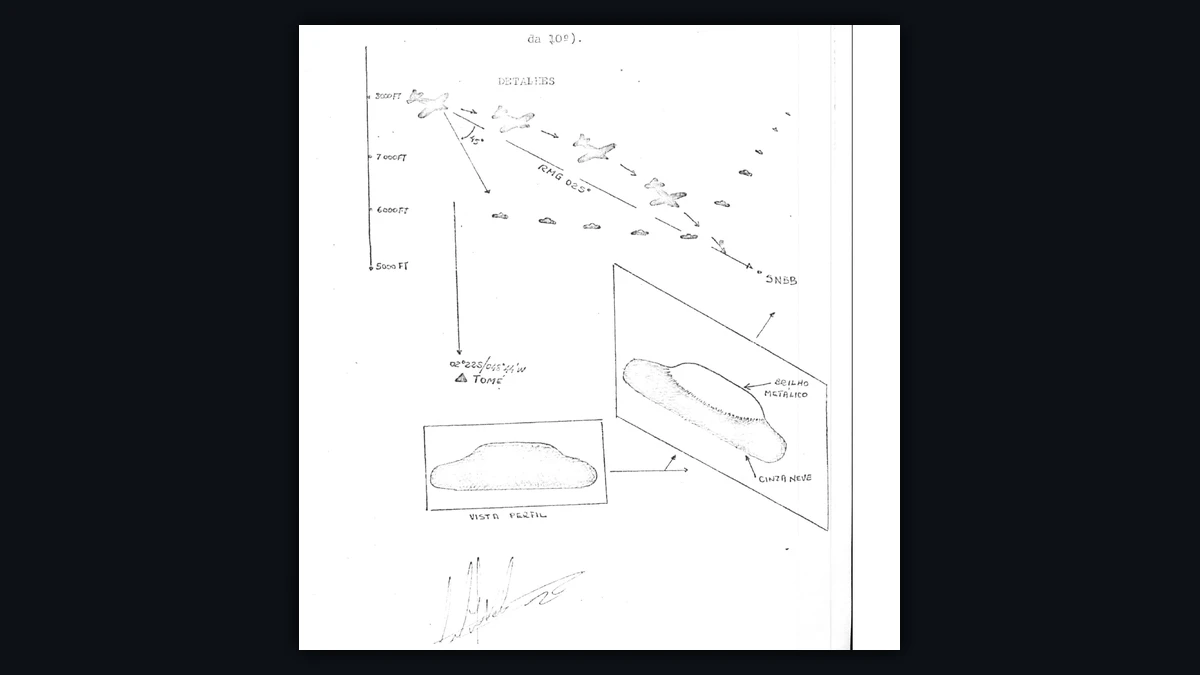
Three weeks later, and the file's final entry. Record 130 puts an EMB-710, a Brazilian-built Piper single, over the municipality of Tomé-Açu, southeast of Belém, at 15:15 on 28 November 1978, flying at around 260 km/h. The pilot, Luiz Carlos Gomes Freitas do Vale, watched a light grey oval with a metallic shine (he compared its size to an Opala, the Chevrolet saloon every Brazilian knew) holding position relative to his aircraft.
It stayed with him for four minutes. Not a glimpse, not a glint: four minutes of a structured object maintaining station on a powered aircraft at a known airspeed, in daylight. Then it did what the object over the Xingu had done: climbed vertically while staying flat, as if altitude were a setting rather than a manoeuvre, and left. The pilot drew what he saw (an altitude diagram of the encounter and profile views of the object, annotated "brilho metálico", metallic shine) and his drawings went into the file with his report.
The Last Record in the File
Record 130 matters beyond its own details, because of where it sits. When Brigadier Protásio Lopes de Oliveira signed the confidential letter forwarding the folder to the Chief of the Air Force General Staff on 14 February 1979, he described its contents precisely: 130 records of OVNI observations covering 2 September 1977 to 28 November 1978. That end date is the Tomé-Açu flight. The EMB-710 encounter is literally the last thing Brazil's Air Force put in the file before sending it up the chain: where, as we cover on the Operação Prato page, a staff officer filed it under "Arquivo da 'Discoteca'" and it vanished for thirty years.
The two pilot reports also quietly answer the tidiest sceptical reading of the Colares wave: that it was a panic phenomenon of a poor, frightened coastal population, amplified by press and rumour. That reading was always available for 1977, and the Air Force's own medical report made it. It has nothing to say about 1978: two unconnected professional pilots, hundreds of kilometres apart, in daylight, with no surrounding panic, describing the same family of object: metallic ovals that pace aircraft and depart in flat vertical climbs at impossible speed.
What Makes Pilot Cases Different
Pilot testimony isn't proof: pilots have misidentified Venus, balloons and each other since flying began. But it's the strongest class of eyewitness evidence this subject has, for reasons the records themselves illustrate. Both pilots could reference their own instruments: altitude from the altimeter, airspeed from the dial, heading from the compass, which is why Record 130 can say the object held station on an aircraft doing 260 km/h rather than "it seemed to follow me". Both were observing from the one environment where the usual culprits (reflections on water, lights on a horizon, ground vehicles) don't apply. And both had every professional reason to stay quiet, one of them visibly paying a personal price for what he saw.
That's the same logic that makes the RB-47 encounter and the Tehran F-4 case pillars of the serious literature. The Amazon encounters are their civilian cousins: smaller aircraft, same shape of story, and, unusually, the original records sitting in a public archive.
The Evidence
Confirmed
Both reports are in the official released fileRecords 129 and 130 of the Air Force's OVNI folder, verified against the National Archives scans: names, dates, times, coordinates, aircraft types, object descriptions. Downloadable on this page.
Confirmed
The file's own end date is the second encounterThe brigadier's 1979 cover letter defines the folder as running to 28 November 1978, the Tomé-Açu flight. The pilot encounters are how Brazil's official UFO file ends.
Confirmed
Original sketches and diagrams surviveThe Cessna approach sketch, the route map, the altitude diagram and the object profiles are filed with the records and reproduced on this page.
Documented
One pilot sought medical helpThe Air Force's own note on Record 129 records the pilot's distress and immediate medical attention, an unusual detail for a military intelligence file to volunteer.
Unresolved
No identification was ever madeNo conventional aircraft, balloon or phenomenon was ever offered as an explanation for either encounter. The records were filed, forwarded, and shelved.
The Bottom Line
Two flights, three weeks apart, at the far end of a file full of village terror. A near-collision with a double oval that held a hundred metres off a Cessna's nose, and a metallic shape the size of a family car that flew formation with a Piper for four minutes. Both reported through official channels, both sketched by the men who saw them, both catalogued without explanation by a military command that had spent a year watching this corner of the sky.
However you read the Colares wave that preceded them, the 1978 pilot records resist the easy answers. They are short, dry, technical documents, and they are the note Brazil's Air Force chose to end its UFO file on.
See it before the cockpit does
Kit we've tested and reviewed in full
The Amazon pilots had no warning and no time to get a proper look. A decent pair of binoculars by the door means you get a longer, steadier view than any of them managed.
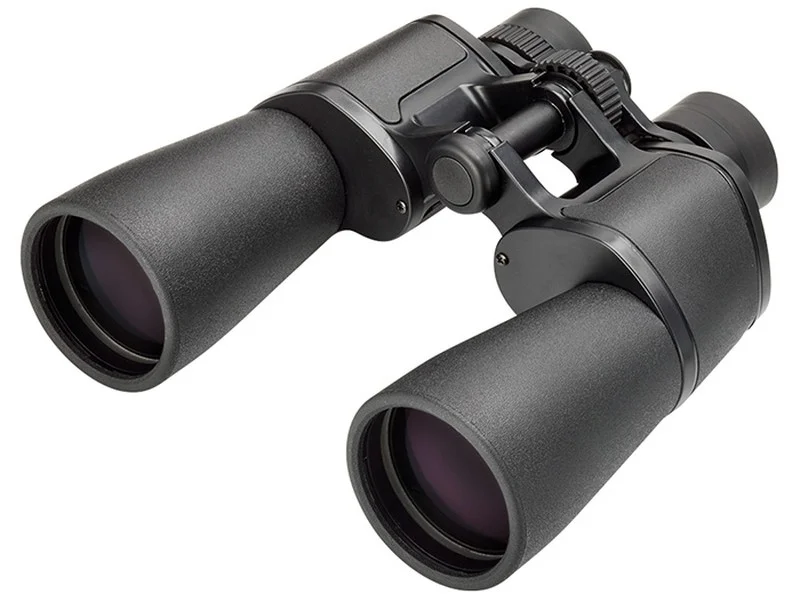
Bright and quick to aim: enough to pick out shape, lights and direction of travel on anything crossing the treeline.
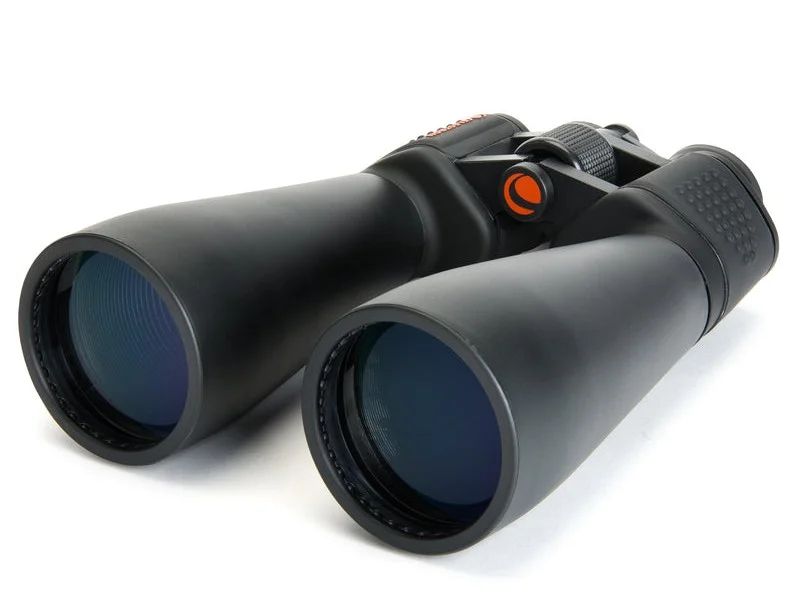
Extra aperture for anything further off or fainter: the difference between a shape and a genuine description.
Affiliate links: you pay the same price, we earn a small commission that helps keep WatchTheStars free.
Download the Original Records
We host the relevant pages of the official file: both pilot records with their sketches, diagrams and maps, in Portuguese. The complete 130-record folder is at Brazil's National Archives (BR DFANBSB ARX 184).
Records 129 & 130: The Pilot Encounters
6 pages · 3 MB PDF
The two record sheets plus annexes: the Cessna near-collision narrative and sketch, the route map, and the EMB-710 altitude diagram with object profiles.
Download PDFThe Brigadier's Letter (1979)
2 pages · 1 MB PDF
The confidential cover letter that defines the folder these records close: 130 OVNI observations, 2 September 1977 to 28 November 1978.
Download PDFRelated Cases
These records close the file that Operação Prato opened, and they belong to the same family as the great military aviation encounters.
More UAP cases
- Operação PratoOctober–December 1977 · Colares, Pará, Brazil · Status: Files Released
- The Rendlesham Forest IncidentDecember 1980 · RAF Woodbridge, Suffolk, England
- The Chupa-Chupa AttacksSeptember–December 1977 · Colares, Vigia & the Pará coast · Status: Documented, Unexplained
- The Ariel School Incident16 September 1994 · Ariel School, Ruwa, Zimbabwe · Status: Unexplained · Disputed
- The 1976 Tehran UFO Incident: F-4 Jets, Weapons Failure and the Declassified DIA Report
- The Varginha Incident20 January 1996 · Varginha, Minas Gerais, Brazil · Status: Officially Explained · Disputed