Key takeaways
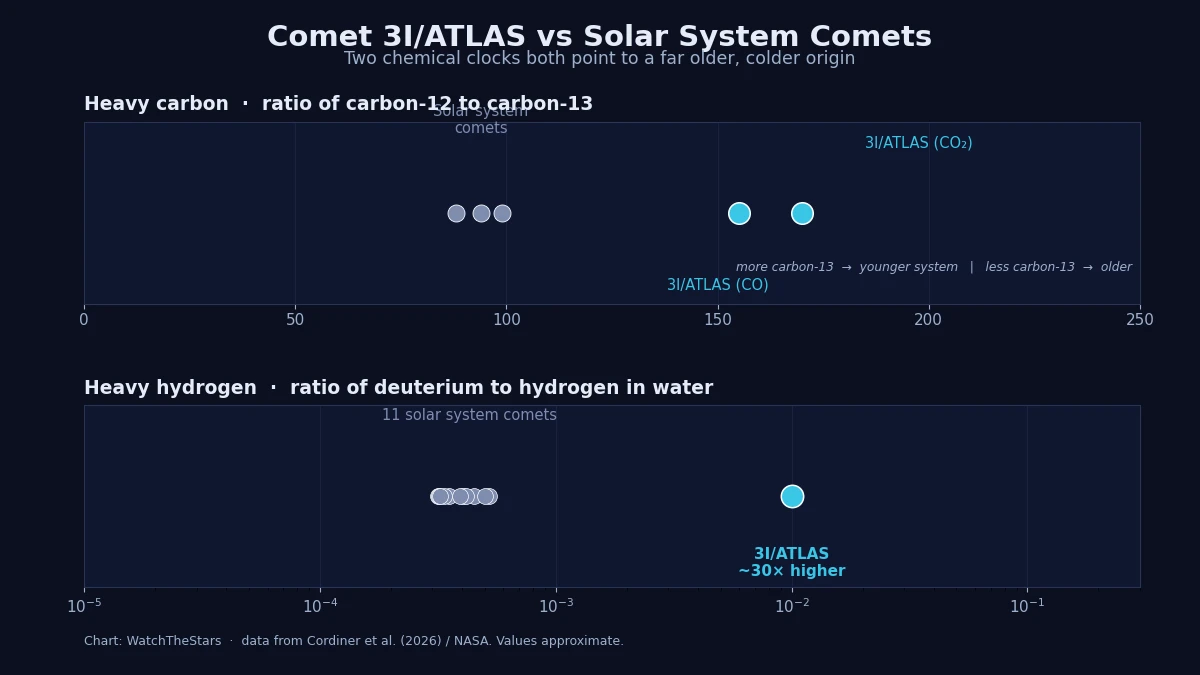
- Webb's NIRSpec found 3I/ATLAS holds about 30 times more deuterium (heavy hydrogen) in its water than any comet from our own solar system.
- It also showed only traces of carbon-13, another marker of a very old, chemically primitive origin.
- Together those clues suggest the comet formed 10 to 12 billion years ago, well before the Sun, and not far off the age of the universe itself.
- It likely formed in a deeply frozen, dense cloud during 'cosmic noon', when the galaxy was building stars at its fastest rate.
- The findings were published on 22 June 2026 in the journal Nature, led by NASA Goddard astro-chemist Martin Cordiner.
Jump to section 8 sections
What Did JWST Discover About 3I/ATLAS?
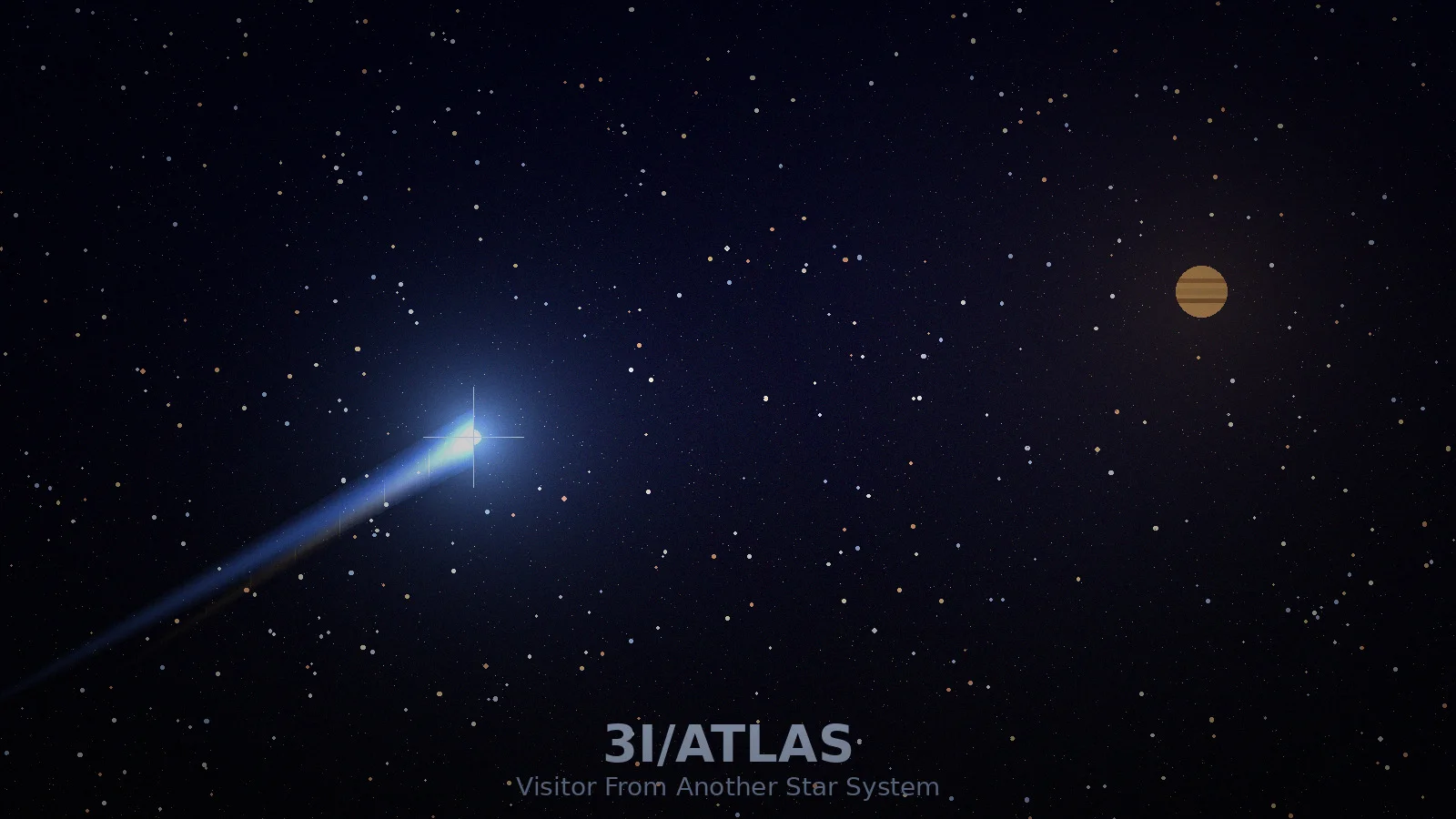
Back in March we wrote about 3I/ATLAS, the third interstellar comet ever found, and the strange alien chemistry it was carrying through our solar system. Unlike the long-period comets that swing in from our own Oort Cloud, this one never belonged to our solar system at all. At the time the headline was its water and its alcohol. Now the James Webb Space Telescope has gone a step further, and the new result is even bigger: this comet may be one of the oldest objects we have ever measured.
As 3I/ATLAS began pulling away from the Sun in December 2025, freshly warmed from its closest pass, astronomers got approval to interrupt Webb's planned schedule and point its NIRSpec (Near-Infrared Spectrograph) instrument at it. The comet's ancient ice had boiled off into a bright cloud of gas, which is exactly what you want for reading chemistry. Webb measured the ratios of carbon and hydrogen isotopes in that gas, and the numbers came back unlike anything seen in a comet before.
The findings were published on 22 June 2026 in the journal Nature, in a study led by astro-chemist Martin Cordiner of NASA's Goddard Space Flight Center. "This was a unique opportunity to study an ancient object from the distant galaxy, probably pre-dating our Sun and solar system," Cordiner said.
How Old Is Comet 3I/ATLAS?
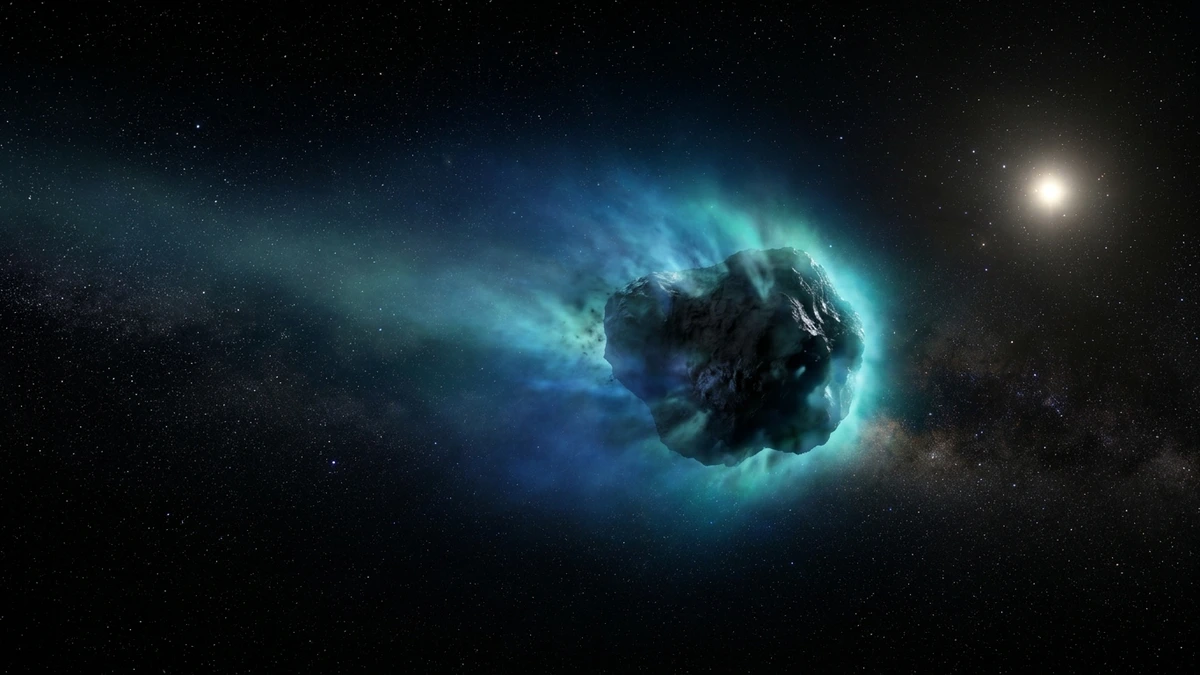
The research team estimates 3I/ATLAS could have formed as long as 10 to 12 billion years ago. That is a number worth sitting with for a moment.
Our Sun and everything in our solar system formed about 4.5 billion years ago. The universe itself is roughly 13.8 billion years old. So if these estimates hold, 3I/ATLAS predates the Sun by something like seven or eight billion years, and it has been drifting between the stars for almost the entire history of the galaxy. It is, in effect, a frozen sample from a time when the Milky Way was still young.
This is not a direct measurement, like reading tree rings. Nobody can put an age stamp on a comet. Instead the age comes from its chemistry, and specifically from two isotope clues that both point in the same direction: a very old, very cold beginning.
What Is Deuterium, and Why Does It Matter?
The first clue is deuterium. Deuterium is a heavier version of hydrogen with an extra neutron in its nucleus, which is why it is often called heavy hydrogen. When deuterium takes the place of ordinary hydrogen inside a water molecule, you get what is known as heavy water.
The ratio of deuterium to ordinary hydrogen in a comet's ice is one of the most reliable fingerprints astronomers have. It records the temperature and conditions of the place where that ice first froze, billions of years ago, and it tends to stay locked in unless the ice is later warmed and reprocessed.
Webb measured roughly 30 times more deuterium in the water of 3I/ATLAS than is found in any comet from our own solar system. That is an enormous gap. It tells scientists the comet's water froze in an extraordinarily cold environment and was then left alone, exposed to plenty of radiation but never to the long-term warmth that would have converted its heavy-water ice into the more familiar kind we have on Earth. In other words, it has been kept in deep freeze, chemically untouched, since it formed.
The Carbon Clue
The second clue comes from carbon. Webb found that 3I/ATLAS contains only traces of carbon-13, the heavier form of carbon, compared with ordinary carbon-12.
This matters because of how the galaxy enriches itself over time. Heavier isotopes like carbon-13 are forged and scattered by generations of stars as they live and die. The longer a galaxy has been making and recycling stars, the more carbon-13 ends up in the gas that later forms new stars and planets. Our Sun, which formed relatively recently at 4.5 billion years old, carries a healthy amount of it.
A comet with almost no carbon-13 must have formed when the galaxy was still chemically young, before many generations of stars had a chance to seed it with heavier elements. That fits neatly with the deuterium result. Two independent isotope clues, both saying the same thing: this object is very, very old.
You won't see 3I/ATLAS, but here's what's up tonight instead
Kit we've reviewed in full
This one needed the James Webb Space Telescope to read its chemistry, so no backyard kit was ever going to show it to you. The good news is there's still plenty worth pointing your own gear at. A solid pair of binoculars or a small starter telescope will get you real views of comets, star clusters and planets whenever the next one swings by.
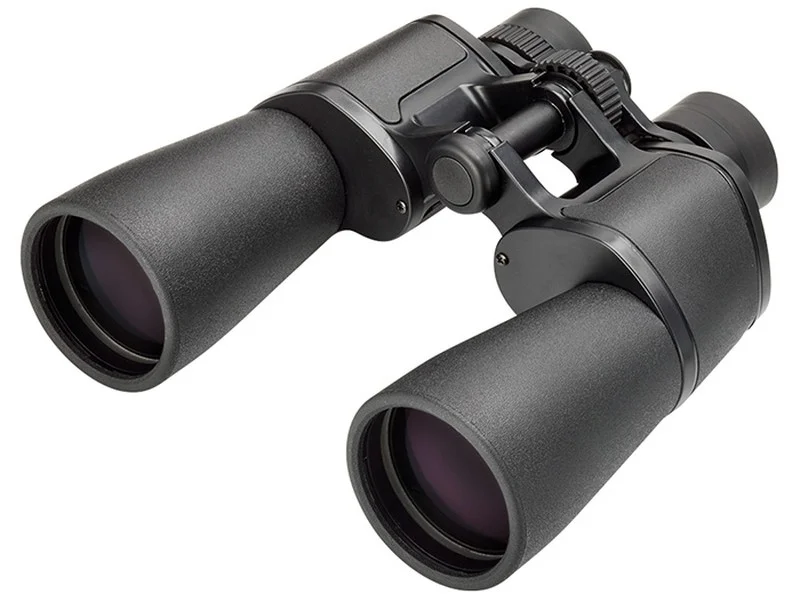
A sensible first step up from naked eye. Won't show you an interstellar comet's chemistry, but it'll show you plenty of the solar system's own comets when they pass through.
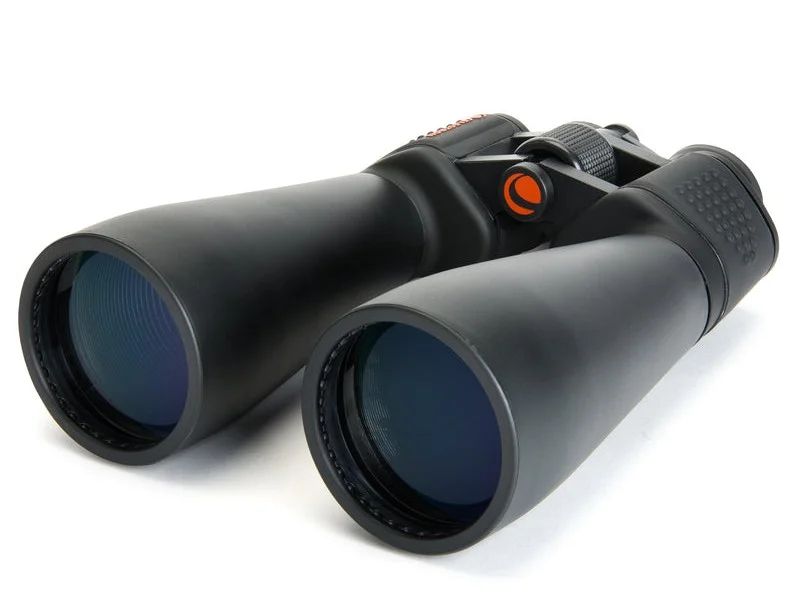
If a bright comet does turn up in our own solar system, this is the pair that'll actually show you a tail rather than just a smudge.
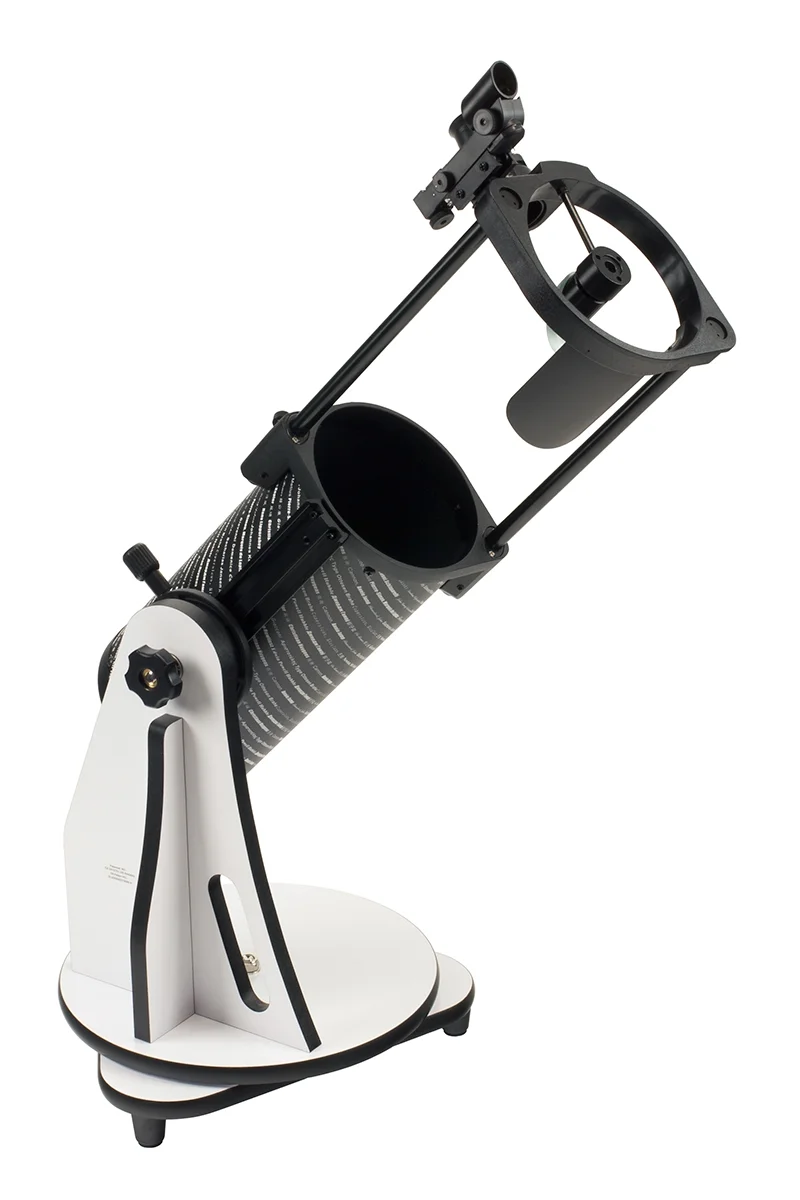
A proper step beyond binoculars if this kind of story has got you curious about deep space. It folds down small and still gathers enough light for galaxies and star clusters from your garden.
Affiliate links: you pay the same price, we earn a small commission that helps keep WatchTheStars free.
What 'Cosmic Noon' Means
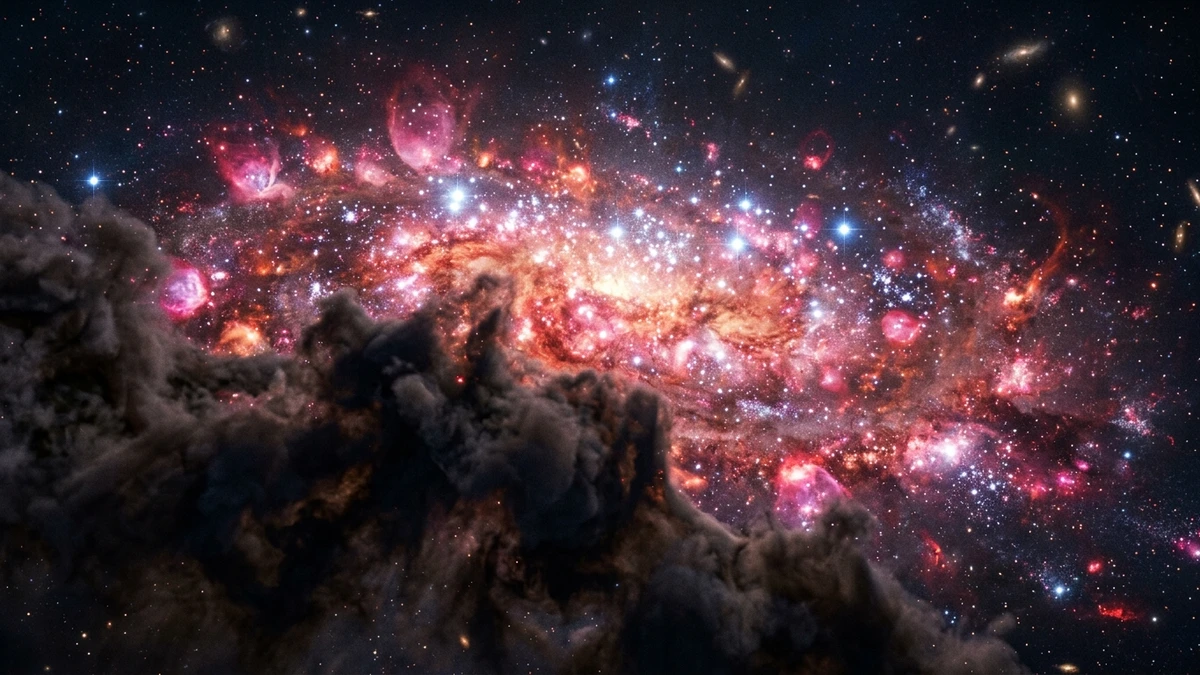
The team places the comet's likely birth during a period astronomers call "cosmic noon": the stretch of cosmic history, several billion years after the Big Bang, when galaxies were forming stars at their highest rate. If midday is when the Sun is at its peak, cosmic noon is when the universe was at its busiest building stars.
3I/ATLAS probably took shape in a cold, dense cloud of gas and dust somewhere in that early, fast-growing galaxy, around a star we will never identify. The abundance of heavy water tells us it spent its formative years deeply frozen, and it has carried that frozen chemistry across the galaxy ever since. When it dropped through our solar system, it brought a near-perfectly preserved sample of conditions from the dawn of star formation straight to Webb's instruments.
How This Builds on the Earlier 3I/ATLAS Findings
If you read our March piece on 3I/ATLAS, some of this will sound familiar, and that is the point. Earlier observations had already flagged that this comet's water carried an unusual deuterium ratio, a few times higher than Earth's oceans, alongside its strange load of methanol and water vapour. Those were the first hints that 3I/ATLAS had formed somewhere very different from home.
What the new Webb study does is sharpen that hint into a much harder claim. With NIRSpec able to measure the isotopes far more precisely, and with the carbon-13 data added alongside the deuterium, the picture has shifted from "this formed somewhere unusual" to "this formed at a specific, astonishingly early moment in the galaxy's life." It is a good example of how science tightens over time: the same object, observed again with the right instrument at the right moment, gives up a far deeper part of its story.
A separate study using the European Southern Observatory's Very Large Telescope, led by astronomer Cyrielle Opitom of the University of Edinburgh, looked at the comet's carbon and nitrogen through its cyanide gas, and supports the same broad conclusion.
Why It Matters for the Search for Life
It is easy to file "very old comet" under interesting trivia, but the researchers are after something larger. Comets like this are carrying the raw chemical ingredients (water, carbon compounds, the building blocks of organic chemistry) that, in our own solar system, eventually fed into the story of life on Earth.
"So far, we know of only one place in the vast cosmos where chemical ingredients led to life, our solar system, our Earth," said Stefanie Milam of NASA Goddard, a co-author of the study. "Analysis of these interstellar objects is a major step towards learning how common, or uncommon, the conditions for the evolution of life are in the universe."
Finding those ingredients already assembled in an object that formed near the dawn of the galaxy suggests the chemistry that matters for life has been in place for a very long time, and in places utterly unlike our own corner of space.
Where Is 3I/ATLAS Now?
Sadly for anyone hoping to point a telescope at it, the show is essentially over. 3I/ATLAS made its closest pass of the Sun on 30 October 2025 and its closest approach to Earth on 19 December 2025, and it is now climbing back out of the solar system on a one-way hyperbolic path. It will never return. By now it has faded well beyond the reach of backyard telescopes, and within a few years it will be too faint for even the largest observatories on the ground.
The June 2026 results came from data Webb gathered as the comet was already moving away from us, not from a fresh sighting. In a sense that makes them more remarkable: a brief visitor that is already gone has left behind a chemical message from the early galaxy, and we are still reading it. Three interstellar comets in, the lesson keeps repeating: the universe sends samples, and each one we manage to catch tells us we know less than we thought, and that there is far more out there to find.
Sources:
- NASA's Webb Finds Clues to Ancient, Distant Origin of Comet 3I/ATLAS · NASA Science
- Webb finds clues to ancient, distant origin of Comet 3I/ATLAS · ESA/Webb
- Interstellar Comet 3I/ATLAS Is Almost as Old as the Universe Itself · Scientific American
- Cordiner et al., published in Nature, 22 June 2026
Frequently Asked Questions
Equipment guides
Related topics

Ian ClaytonAmateur astronomer and founder of WatchTheStars.co.uk, dedicated to helping others explore the wonders of our universe. Full profile →