Key takeaways
- Declassified file DOE-UAP-D002, released in the Pentagon's second PURSUE batch, contains four pages of James Tuck's UFO correspondence from the 1970s
- Tuck was a Manhattan Project physicist who helped design the implosion system for the plutonium bomb, then spent his career at Los Alamos pioneering fusion research
- A 1970 letter in the file describes green lights seen at Los Alamos between 1948 and 1951, reported to security and logged at the time
- Tuck's own letter shows him testing a mundane explanation: atmospheric vortex rings from simulated atomic bomb demonstrations, an idea from the Condon Report
- The file never claims aliens. Its value is showing a senior weapons scientist treating UFO reports as a problem worth solving
Jump to section 6 sections
- Who Was James Tuck? The Physicist in File DOE-UAP-D002
- Los Alamos Green Fireballs: What the 1970 Letter Describes
- James Tuck's UFO Theory: Atmospheric Vortices and the Condon Report
- Ball Lightning and UFOs: The Third Letter in the File
- Green Fireballs and Project Twinkle: Why the Sightings Mattered
- How to Read the James Tuck UFO File Yourself
In May 2026 the Pentagon's second PURSUE release quietly included a four-page file catalogued as DOE-UAP-D002 (archive reference A-83-001-2-1): the UFO correspondence of James L. Tuck, a Manhattan Project physicist who spent his career at Los Alamos. Inside is a first-hand account of the famous Los Alamos green fireballs of 1948–1951, and Tuck's own attempt to explain them. It's one of the smallest documents in the whole release, and one of the most telling. It proves nothing exotic. What it shows is one of the men who built the atomic bomb treating UFO reports at America's most secret laboratory as a serious scientific question.
This is the first in our Document of the Week series: each week we take one file from our declassified UAP document archive and set out, in plain English, what it actually says.
Who Was James Tuck? The Physicist in File DOE-UAP-D002
James L. Tuck (1910–1980) was a British physicist from Manchester who joined the British Mission to Los Alamos during the Second World War. His speciality was shaped charges, and he helped develop the explosive lenses that made the implosion design of the plutonium bomb work. After the war he stayed at Los Alamos and led some of the world's earliest controlled fusion research, founding the Project Sherwood effort in the 1950s and building early fusion devices with names like the Perhapsatron.
In other words, this wasn't a fringe figure. Tuck was a senior scientist at the laboratory that designed America's nuclear weapons. And in later life he had a well-documented fascination with one of physics' strangest loose ends: ball lightning. He even appeared on Arthur C. Clarke's Mysterious World in 1980 describing his attempts to create ball lightning in the lab using a submarine battery.
That's the man whose UFO file the US government declassified this year.
Los Alamos Green Fireballs: What the 1970 Letter Describes
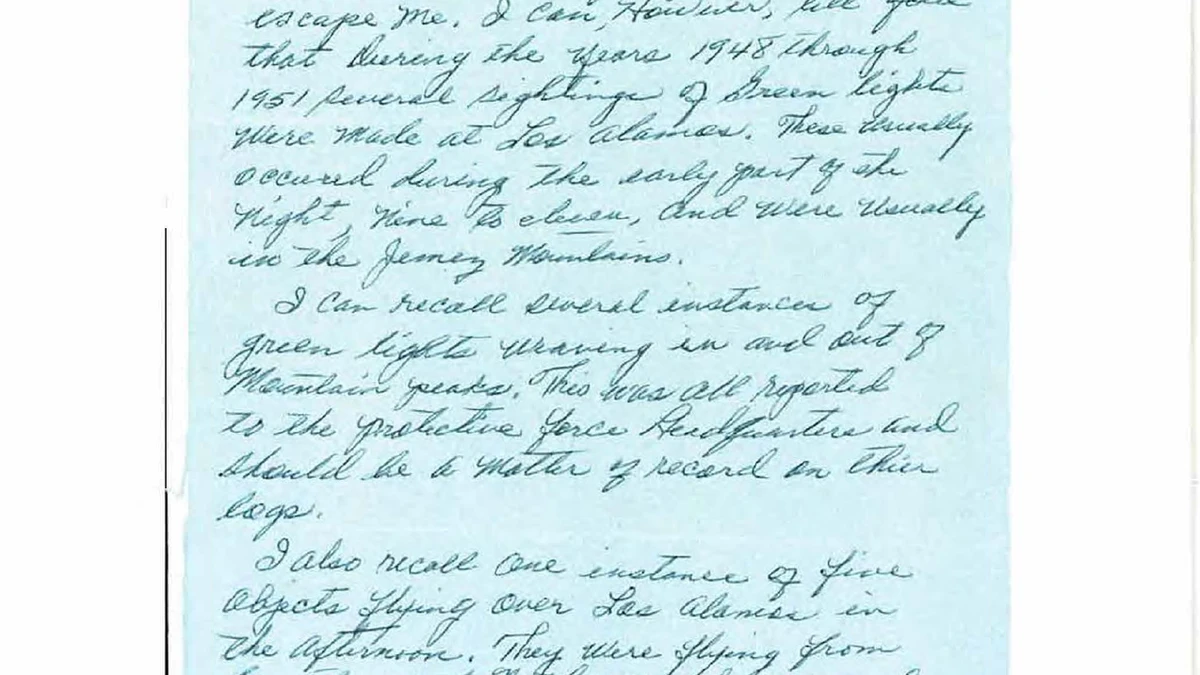
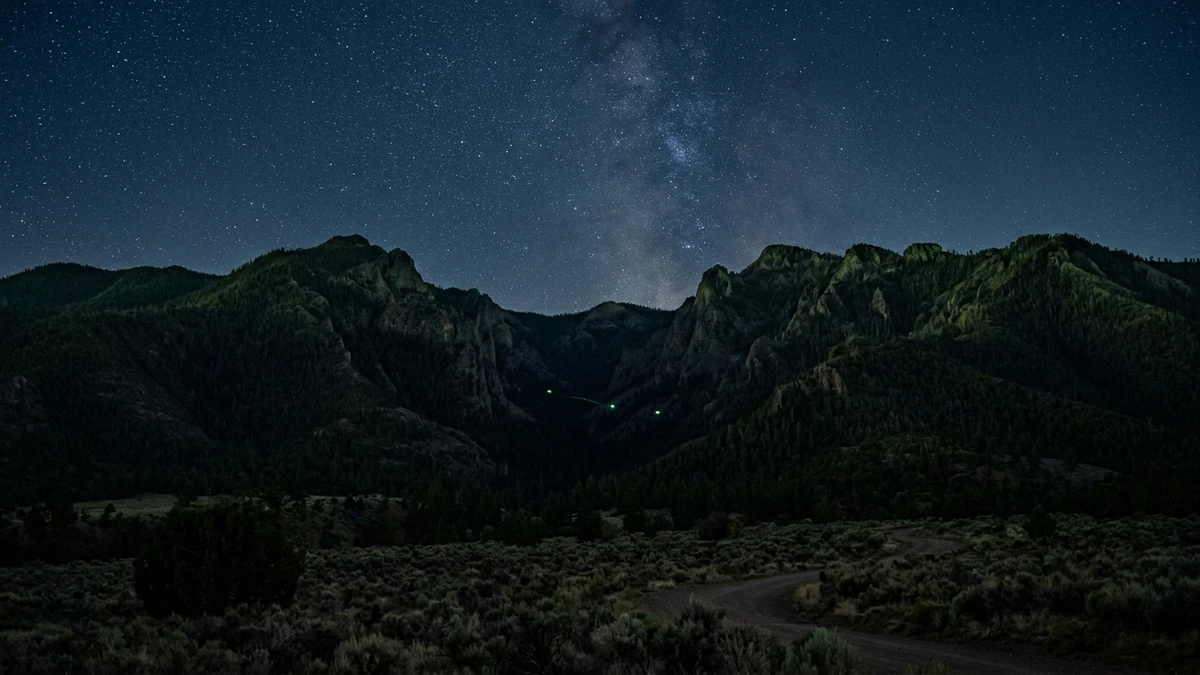
The 1970 letter describes green lights seen repeatedly at Los Alamos between 1948 and 1951, usually between nine and eleven at night, over the Jemez Mountains behind the laboratory. It's handwritten, dated 23 November 1970, and addressed simply "Dear Mr. Tuck". The writer's name is blacked out, but the content makes their old job clear: they were connected to the Protective Force, the armed security unit that guarded Los Alamos.
The writer apologises for not being able to fill out an attached sighting report form, because the exact times and dates escape them. But they remember the pattern well. Between 1948 and 1951, they say, several sightings of green lights were made at Los Alamos. The lights usually appeared in the early part of the night, between nine and eleven, and were usually seen over the Jemez Mountains, the volcanic range that rises directly behind the laboratory.
One line stands out. The writer recalls, in their words, "several instances of green lights weaving in and out of mountain peaks". Weaving, not falling the way a meteor would. And every instance, they add, was reported to Protective Force Headquarters and should be a matter of record in their logs.
The letter also describes a separate daytime sighting: five objects flying over Los Alamos one afternoon, moving from southeast to northwest, appearing to fly in formation. The writer names another Protective Force member as one of five or six witnesses, the name is redacted, and suggests that anyone who served on "the Hill" in the early 1950s would remember the reported sightings.
So why was a fusion physicist collecting sighting forms two decades after the event? The second letter answers that.
James Tuck's UFO Theory: Atmospheric Vortices and the Condon Report
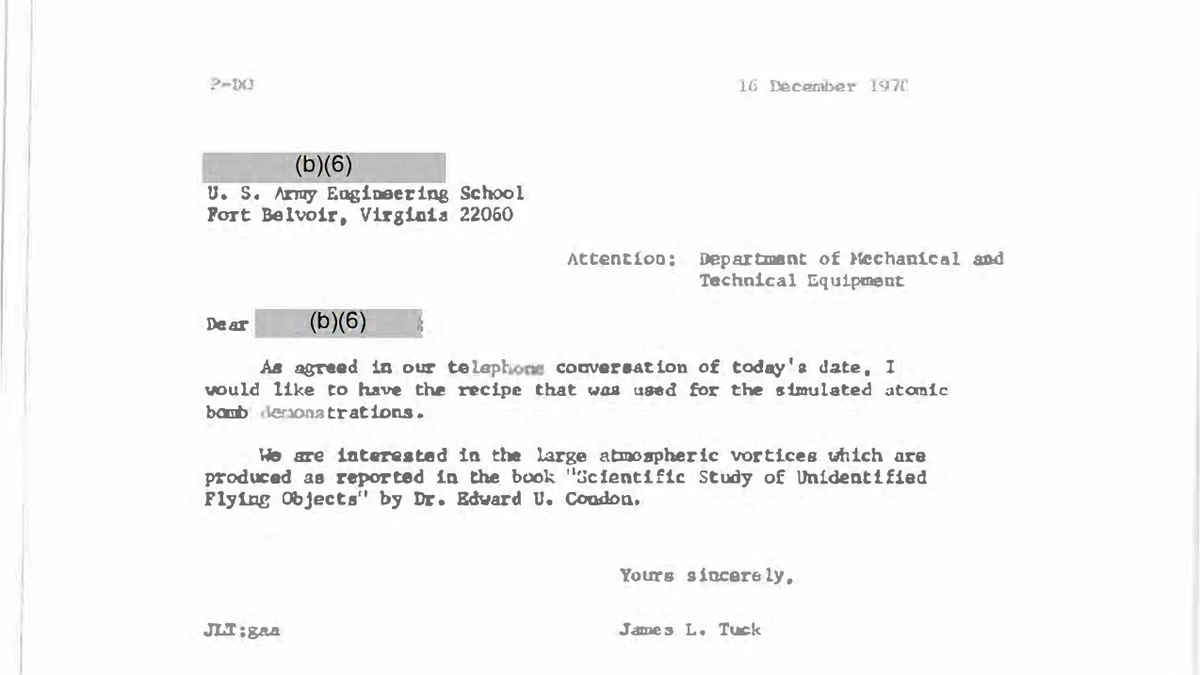
The only letter in the file written by Tuck himself is typed, dated 16 December 1970, and addressed to the US Army Engineering School at Fort Belvoir, Virginia, marked for the attention of the Department of Mechanical and Technical Equipment. It's three sentences long, and it's the key to the whole file.
Following up a phone call that day, Tuck asks the school for "the recipe that was used for the simulated atomic bomb demonstrations". He explains that he is interested in the large atmospheric vortices these demonstrations produce, as reported in the Scientific Study of Unidentified Flying Objects by Dr Edward U. Condon.
That book is the famous Condon Report, the University of Colorado study commissioned by the US Air Force and published in 1968. Among its case studies were luminous vortex rings, doughnuts of hot, glowing gas thrown up by large explosions, which can rise, drift and hang in the air looking very unlike anything familiar.
Read the two letters together and Tuck's thinking becomes clear. The Army ran simulated atomic blast demonstrations for training. Simulated blasts make glowing vortex rings. Los Alamos had years of reports of green lights behaving strangely in the night sky. Could one explain the other? Tuck wasn't writing to a UFO group; he was writing to the people who mixed the explosives, asking for the recipe so he could understand the physics. It's exactly how you'd want a scientist to respond to a mystery: take the report seriously, then hunt for the most boring explanation available.
Ball Lightning and UFOs: The Third Letter in the File
The final page is a handwritten note to "Jim", dated 28 November with no year, though it can't be earlier than 1976: the writer mentions a book that had just appeared on the new non-fiction shelf of the Mesa Library, the public library in Los Alamos.
The note thanks Tuck for an interesting report on ball lightning and encloses comments on it from James M. McCampbell's 1976 book UFOLOGY, pointing Tuck to the chapter on flight and propulsion. The writer adds their own thought: that Einstein's late-career pursuit of a unified field theory, often seen as a wrong turn, might one day prove relevant to how such objects could fly.
It's a small page, but it fills in the picture. Tuck's ball lightning work was circulating among colleagues who were also reading the UFO literature, and the conversation between mainstream plasma physics and the fringe was happening by hand-written letter, inside one of the most security-conscious towns in America. A decade after this note, the town's astronomy club was still at it: a 1986 newsletter in the same release advertises a talk by a Los Alamos weapons division scientist titled "Why Should a Scientist be Concerned about UFO's?".
Fancy checking the skies over your own hills?
Kit we've reviewed in full
The Los Alamos witnesses had one advantage over most of us: they looked up a lot. A decent pair of binoculars turns a strange light into a known object in seconds, or tells you it's worth a second look.
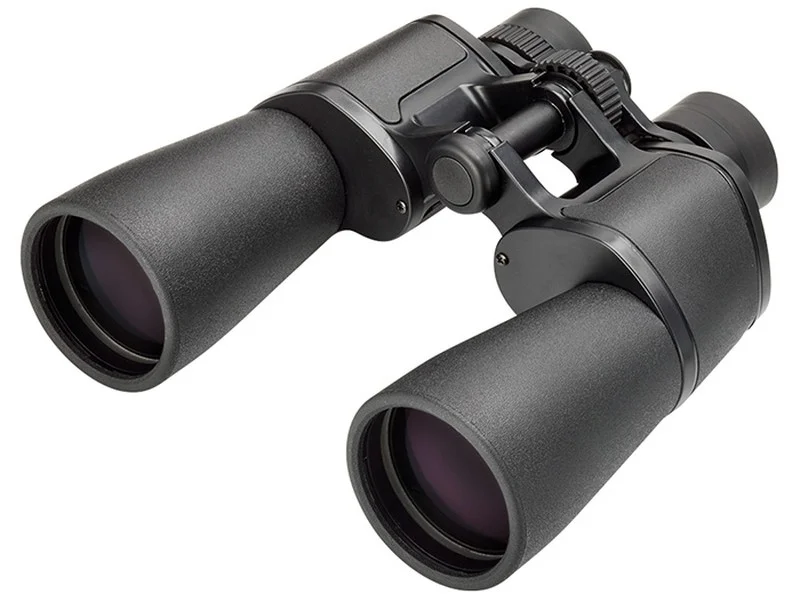
Bright 50mm lenses, wide field, light enough to hand-hold. The quickest way to tell a satellite from something stranger, and our usual first pick for UK beginners.
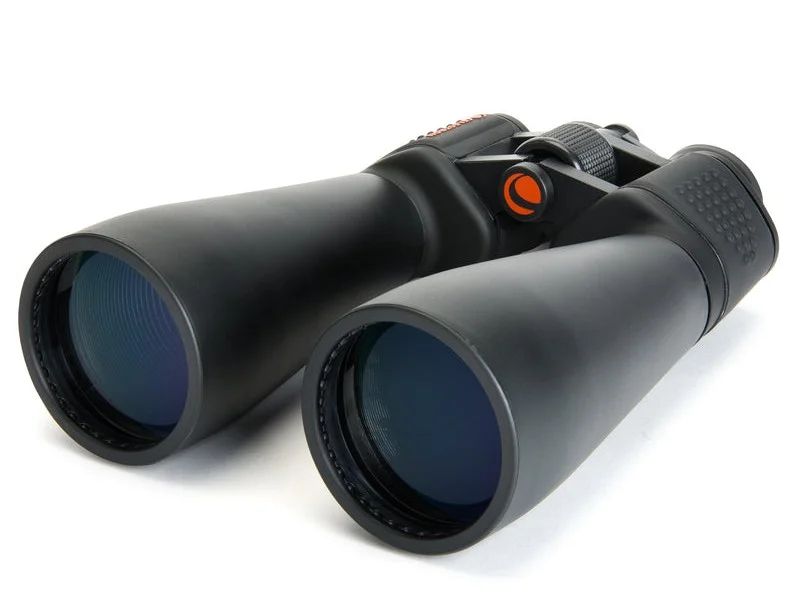
15× magnification pulls a distant light much closer. You'll want a tripod, but nothing near this price gives you a better look at something low on the horizon.
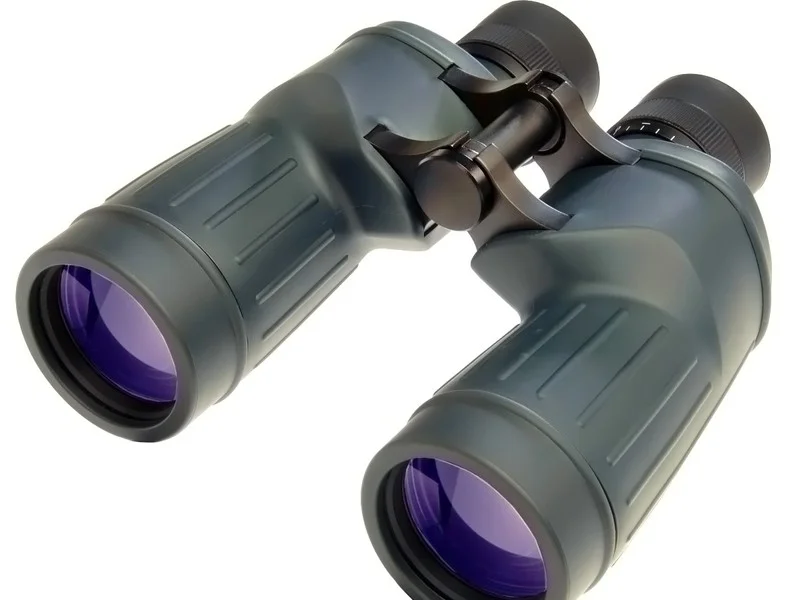
Cleaner contrast and tighter star points than budget pairs, so a point of light stays a point instead of a smear. A buy-once pair.
Affiliate links: you pay the same price, we earn a small commission that helps keep WatchTheStars free.
Green Fireballs and Project Twinkle: Why the Sightings Mattered
The green lights in the 1970 letter weren't a one-off memory. From 5 December 1948, a wave of green fireball sightings swept New Mexico, reported by airline crews, military pilots, weather observers and scientists, and concentrated uncomfortably around Los Alamos and Sandia, the heart of America's nuclear weapons complex.
The Air Force took it seriously enough to bring in Dr Lincoln LaPaz, the University of New Mexico meteor expert, who witnessed one himself and concluded the objects didn't behave like meteors: they appeared at full brightness instantly, flew nearly horizontal paths and showed a green he considered unnatural. In 1949 the Air Force set up a classified instrumented watch, Project Twinkle, to photograph and triangulate the fireballs. It closed in 1951 without a firm answer.
That's the context that makes DOE-UAP-D002 more than a curiosity. Twenty years after the fireball wave, a senior Los Alamos physicist was still gathering first-hand accounts from the site's own security force and testing explanations against them. The 116-page Sandia green fireball correspondence file released in the same PURSUE batch shows the FBI, the Atomic Energy Commission and the Fourth Army doing the same in 1949. Whatever the green fireballs were, the people responsible for America's nuclear weapons never quite closed the book on them.
How to Read the James Tuck UFO File Yourself
File DOE-UAP-D002 was published on 22 May 2026 in the second batch of the US government's PURSUE releases, the ongoing declassification programme we've been covering since the first 162 files landed in May. It's four pages, free to download from the official release site, and readable in five minutes, though the 1970 handwriting takes a little patience.
If you want the wider picture, our UAP document archive hub indexes every collection we hold, from the UK Ministry of Defence files to Brazil's Operação Prato, and each Document of the Week post will take on one file at a time.
What you won't find in this file is a conclusion. Nobody in it claims the green lights were alien, and nobody proves they were vortex rings either. What you find instead is rarer: a first-hand witness whose reports went into official logs, and a Manhattan Project scientist who thought the question deserved an answer. On the evidence of this file, it still doesn't have one.
Sources:
- File DOE-UAP-D002 (archive ref. A-83-001-2-1), US Department of War PURSUE Release 2, 22 May 2026, primary source
- James L. Tuck · Wikipedia
- James Tuck profile · Atomic Heritage Foundation, Nuclear Museum
- When Mysterious Green Fireballs Worried the US Government · History.com
- Green fireballs · Wikipedia
Frequently Asked Questions
Equipment guides
Related topics
Ian ClaytonAmateur astronomer and founder of WatchTheStars.co.uk, dedicated to helping others explore the wonders of our universe. Full profile →