Key takeaways
- On 10 July 2026 the Department of War released a fourth batch of UFO files, 40 in total: 14 documents, 19 videos, four audio files and three images, at war.gov/ufo
- An Energy Department report describes an unidentified object flying over the Pantex nuclear weapons facility in Texas in 2015, silent and with no visible propulsion, while the site went into lockdown
- A 1949 transcript shows Manhattan Project physicists, including Edward Teller, trying and failing to explain 'green fireballs' seen over Los Alamos
- A military aviator with 28 years of service reported a high-speed rectangular object over the eastern US in 2019 that was 'unlike anything I had seen'
- The newest footage, from 2025, shows a six-pointed star shape tracked by a military sensor over the Yellow Sea near China, and the Pentagon says more releases are coming
Jump to section 7 sections
- What's in the Fourth UFO File Release
- Pantex Nuclear Facility Intrusion: The Object That Caused a Lockdown
- Navy UFO Video 2019: 'Unlike Anything I Had Seen' in 28 Years
- The Atlantic 'Balloon' the Navy Couldn't Identify
- Green Fireballs: The 1949 Los Alamos Conference
- Six-Pointed Star Over the Yellow Sea: The 2025 Footage Near China
- When Is the Next UFO File Release? What the Pentagon Says
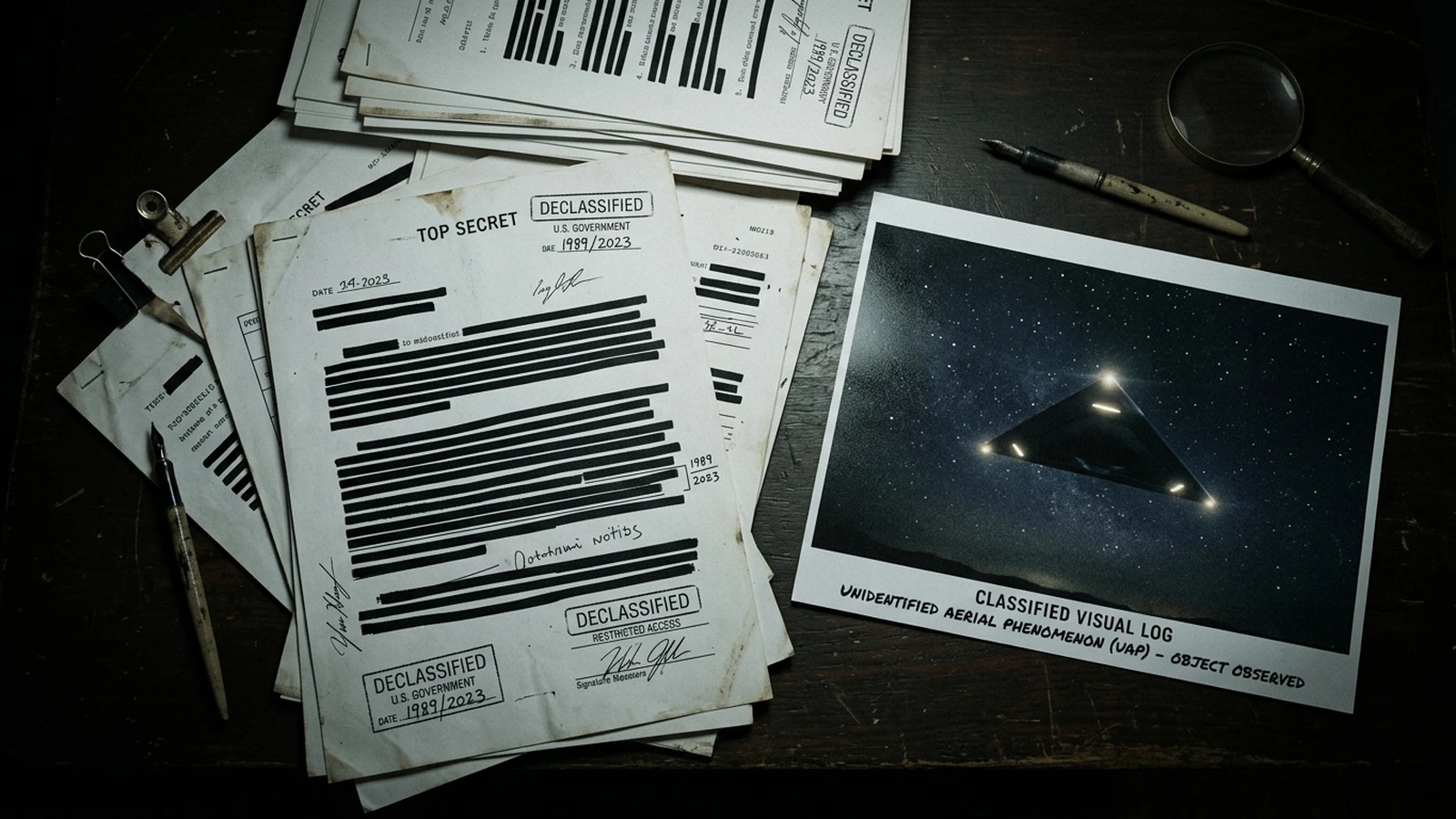
On 10 July 2026, the Pentagon, now formally the Department of War, posted its fourth batch of declassified UFO files to war.gov/ufo. It's a smaller release than June's, but it might be the most interesting yet: an unidentified object over a nuclear weapons facility, a room full of Manhattan Project physicists arguing about green fireballs in 1949, and military sensor footage from 2025 that nobody has explained.
The files come from the Pentagon, NASA, the CIA, the FBI and, for the first time in a big way, the Energy Department. As with the earlier batches, I've been through the documents and the footage. Here's what's actually in there, and what's being oversold.
What's in the Fourth UFO File Release
The fourth Pentagon UFO file release, published on 10 July 2026, contains 40 files: 14 documents, 19 videos, four audio files and three images, spanning cases from 1949 to 2025. It's the fourth release under PURSUE, the Presidential Unsealing and Reporting System for UAP Encounters, which has been publishing files on a rolling basis since 8 May. The second batch came on 22 May, the third on 12 June, and now this one on 10 July. If you're new to the programme, my earlier piece on how the 2026 release scheme works covers the background.
About half the new files date from 2010 or later. Those are mostly infrared videos from military cameras, grainy and hard to read, covering encounters from the western Pacific to the Middle East. The other half is historical, and this time the star of the archive is the Energy Department, the agency that runs America's nuclear weapons complex. That matters, because the thread running through this whole batch is nuclear sites and the strange things people keep reporting above them.
One more thing worth saying up front. The Pentagon's line hasn't changed: nothing here is claimed as proof of non-human technology. Several of the files, though, carry the department's own label of "unresolved". These are cases that were looked at properly and left open. Let's start with the one that made the headlines.
Pantex Nuclear Facility Intrusion: The Object That Caused a Lockdown
Pantex, near Amarillo in the Texas Panhandle, is where the United States assembles and dismantles its nuclear warheads. It is about as sensitive as a site gets. In September 2015, according to a newly released Energy Department incident report, something flew over it that nobody could identify.
Two security officers, a lieutenant and a security police officer, spotted the object at around 7am, moving north over the site at a gentle 10 to 15 miles per hour. The report describes it as flying "in a non-threatening manner", which is an odd phrase to need. The facility went into lockdown, and the officers gave chase in their vehicle.
They couldn't catch it. So they stopped, got out and watched it through binoculars. What they describe is the strange part. The object was roughly four feet tall and two feet wide at the base. It made no sound at all. And even through binoculars, they could see no propulsion system. Nothing holding it up, nothing pushing it along. Witnesses couldn't even agree on the colour: some said black, others silver, red and blue. After a minute or two, it drifted north off the site and was gone.
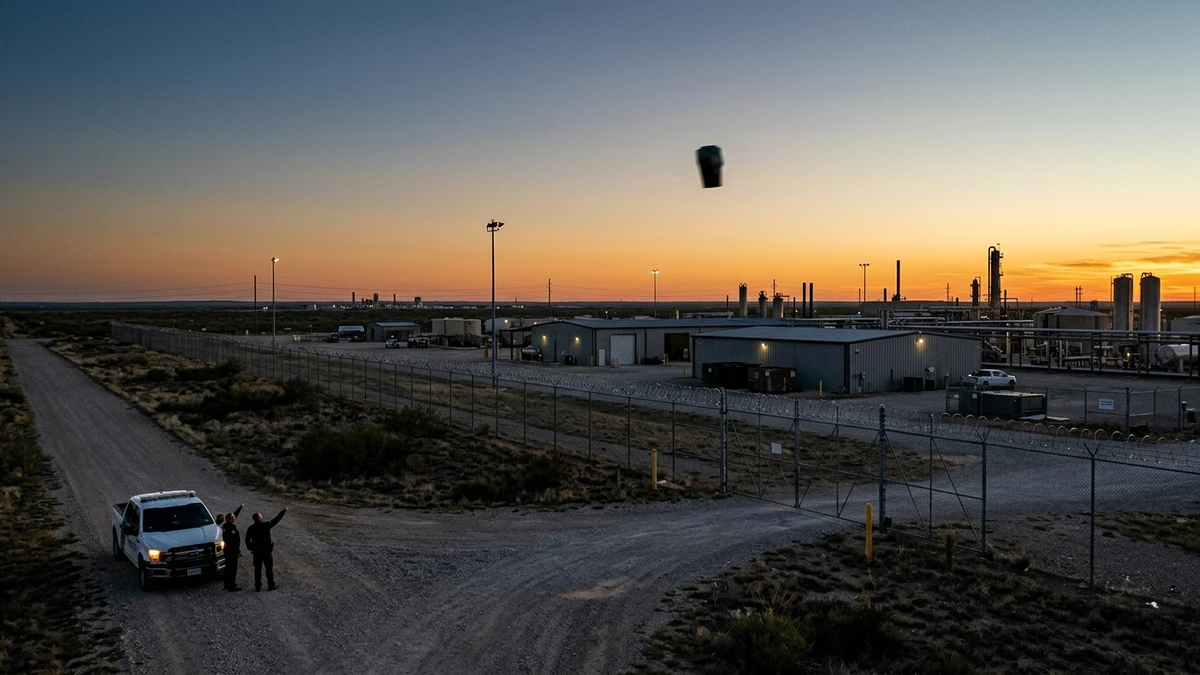
A slow, silent object of that size sounds like a balloon or a drone, and in 2015 consumer drones were everywhere. But a drone of that era made noise, and a balloon doesn't hold a steady northward track at 10 to 15 mph in a straight line unless the wind does exactly that. The report doesn't resolve it. What it does confirm is a pattern that runs right through UFO history: unidentified objects over nuclear facilities, taken seriously enough to lock the site down, and never explained. We've written a full deep dive into the Pantex incident if you want the complete picture. Which is exactly the theme the oldest document in this release picks up, 66 years earlier and 300 miles west.
Navy UFO Video 2019: 'Unlike Anything I Had Seen' in 28 Years
The quote in every headline comes from a "range fouler debrief": the Navy's standard form for reporting an unauthorised intrusion into controlled airspace during training. This one was filed after an incident over the eastern United States in 2019, witnessed by five military personnel.
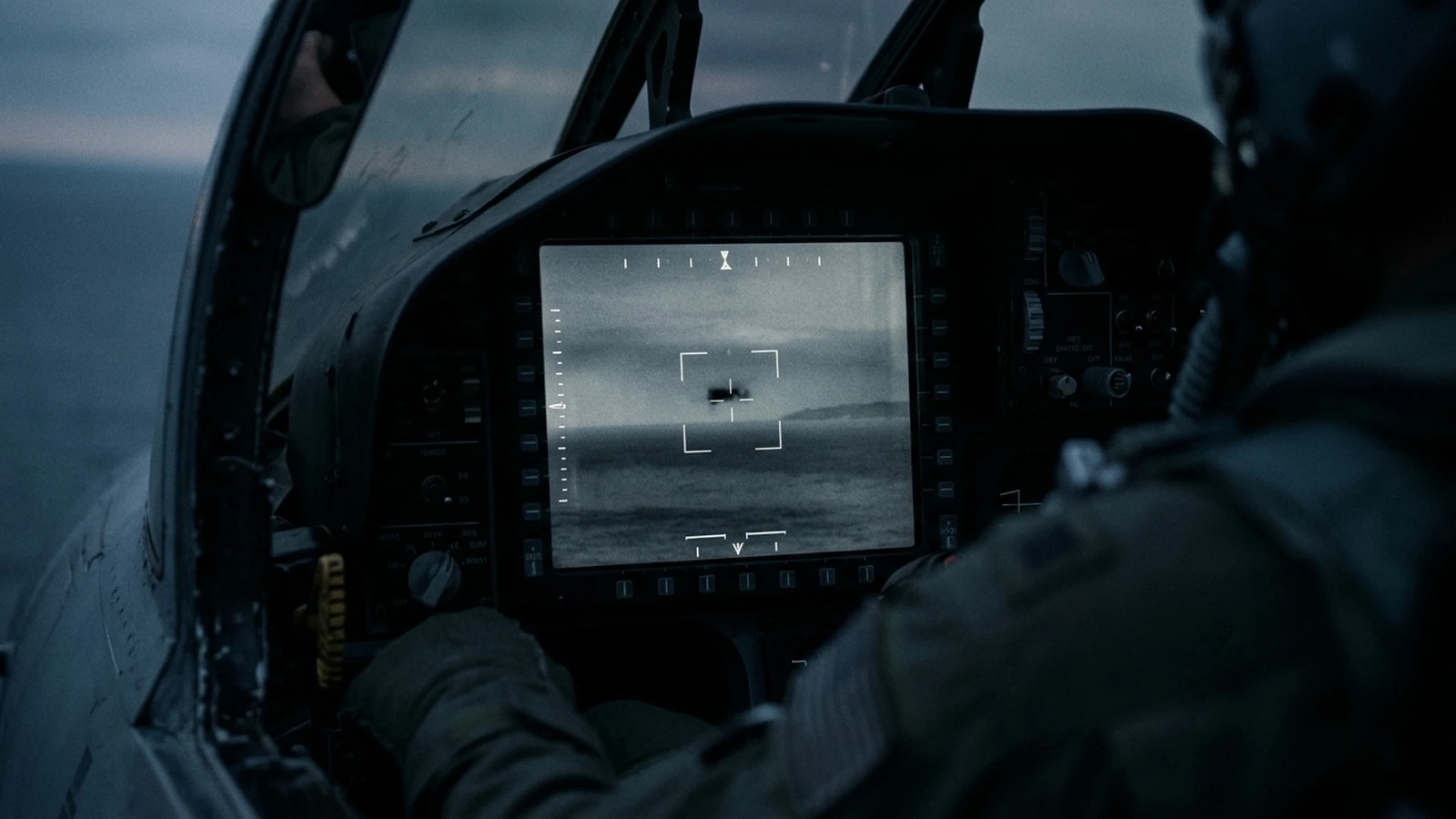
The aviator who wrote it up had 28 years of flying for the US military. "I noticed an object with flight characteristics unlike anything I had seen in my 28 years," the report reads. A small object passed below the aircraft, travelling the opposite direction at high speed. The aviator tracked it by eye for 10 to 15 seconds before switching the recorder on, which is why the released video only catches the end of the encounter. When they zoomed in for a better look, the object shot out of the camera's field of view and couldn't be found again.
Analysis after the flight suggested the object was rectangular. The debrief adds that others "with equal or more experience" reviewed it and were just as stuck. The 20-second video is in the release, and it shows a small shape crossing the frame fast. It doesn't show much else. That's the honest description of most of this footage: the reports are compelling because of who wrote them, not because the video wows you.
The Atlantic 'Balloon' the Navy Couldn't Identify
A second range fouler debrief, from the Atlantic in 2020, is a useful contrast, because this one shows the system working as it should. A Navy weapons systems officer describes closing on an object that "traveled with the wind": a dark, maroonish thing, 12 to 15 feet tall, that "appeared as a large, somewhat deformed balloon".
So, a balloon then? Probably. But the crew passed it too quickly to confirm, two lines of the report are redacted, and the infrared video cuts off abruptly just as the object comes into focus. The Pentagon still lists it as unresolved. If you want to understand what "unresolved" actually means in these files, this is the case to remember. It doesn't mean mysterious. It means nobody ever pinned it down, and honest paperwork records that rather than guessing.
I went through the earlier declassified footage in the same spirit in What the DoD's UAP videos actually show, and the pattern holds here: most of it has a plausible mundane answer, and a stubborn few don't.
Want to scan the skies yourself?
Kit we've tested and reviewed in full
The Pantex officers did the single most sensible thing you can do with a strange light: they got binoculars on it. Most odd lights turn out to be satellites, planets or aircraft, and a decent pair of binoculars sorts the ordinary from the genuinely odd in seconds. Here's what we'd start with.
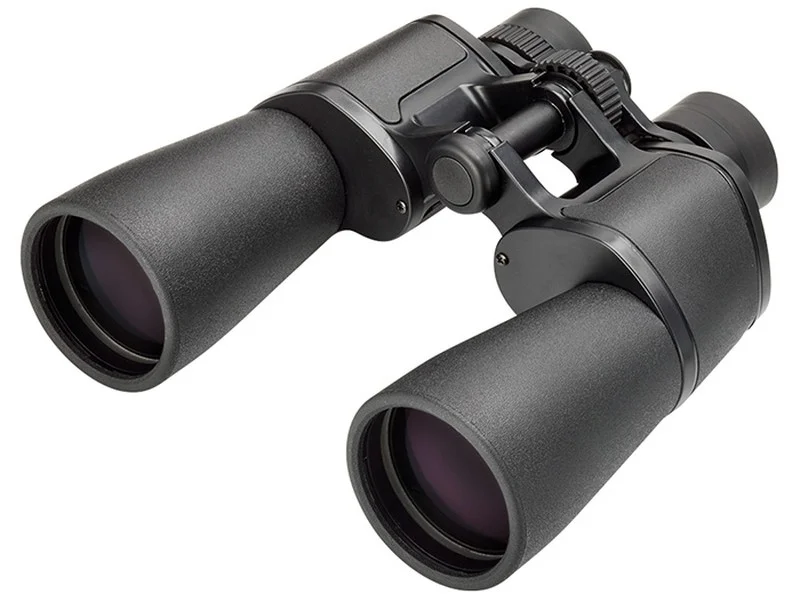
A wide field and 50mm lenses let you sweep a patch of sky quickly, so a mystery light resolves into a satellite, a star or a planet before it's gone. Light enough to hand-hold, and the pair we point most UK beginners to first.
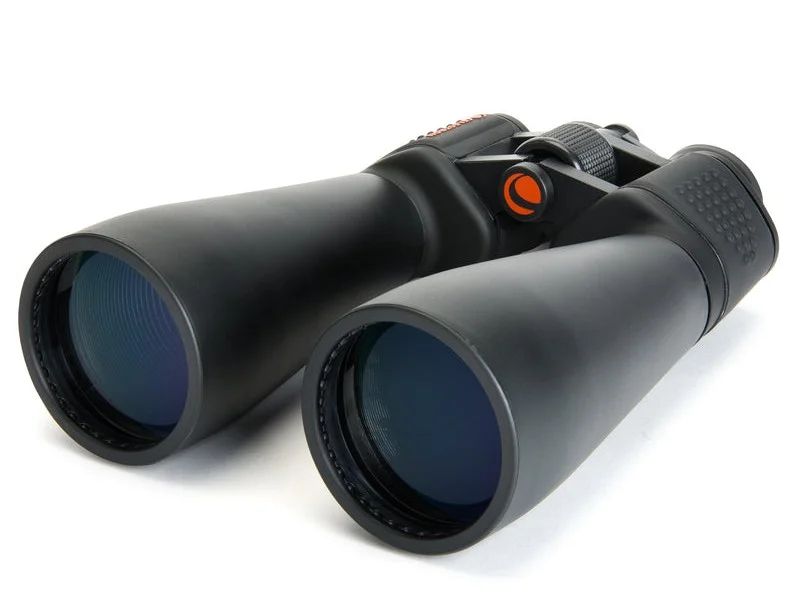
15× magnification pulls a distant light much closer and the 70mm lenses gather enough light for faint objects. You'll want a tripod at this power, but it's the pick for anything low on the horizon.
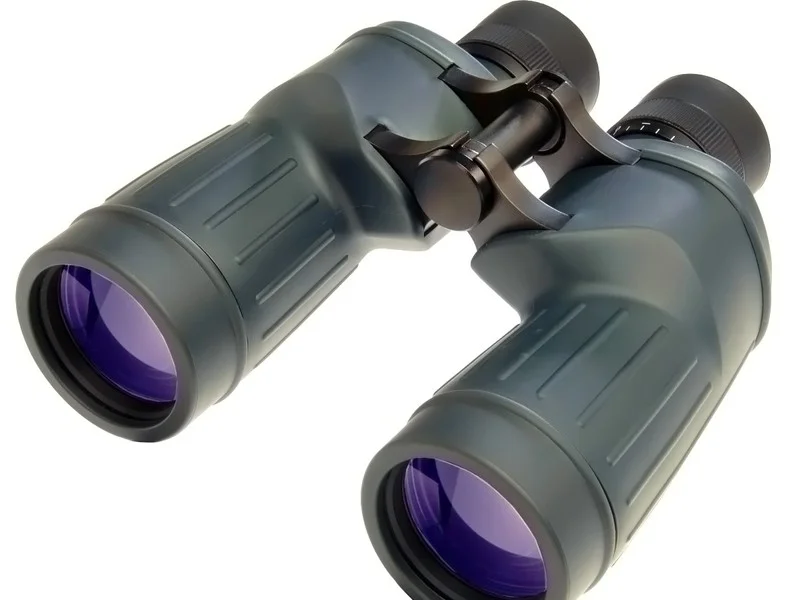
A step up in contrast and edge sharpness, so points of light stay clean and tight rather than smearing. The one to buy if you want a single pair to last years.
Affiliate links: you pay the same price, we earn a small commission that helps keep WatchTheStars free.
Green Fireballs: The 1949 Los Alamos Conference
The best document in the release, for my money, is the oldest. In February 1949, the US Atomic Energy Commission called a conference at what was then Los Alamos Scientific Laboratory in New Mexico. In the room were some of the sharpest physicists alive, several of them Manhattan Project veterans, including Edward Teller, who would go on to father the hydrogen bomb. The subject: green fireballs.
For months, brilliant green objects had been streaking over Los Alamos and other nuclear installations in New Mexico. Not the odd one. Repeatedly, and seen by the kind of people whose job was to watch the sky. The transcript of that meeting is now public in full, and it reads like a locked-room mystery where the detectives are Nobel-calibre physicists.
The obvious answer was meteors, and the panel took it seriously. Lincoln LaPaz, the era's leading meteor expert and a witness himself, had run the numbers: the fireballs travelled at somewhere between 3 and 12 miles per second, which is meteor territory. But almost everything else was wrong. "95 percent of the observations indicate a very nearly horizontal path," LaPaz told the room. Meteors fall; these things flew flat. They were silent, when a fireball at that speed should boom and crackle. And they left no debris, when LaPaz had built a career recovering meteorites from exactly this kind of event.
Teller worked through the physics and floated the idea that the fireballs might not be solid objects at all but "an electron phenomenon", something electrical happening in the atmosphere. LaPaz's reply is the line of the whole release: "You see why I'm puzzled, Dr. Teller." He added that nothing like it "has ever been observed in the case of meteorite drops." The meeting broke up without a conclusion. One attendee summed it up: the long horizontal path was puzzling, and the silence was puzzling too.
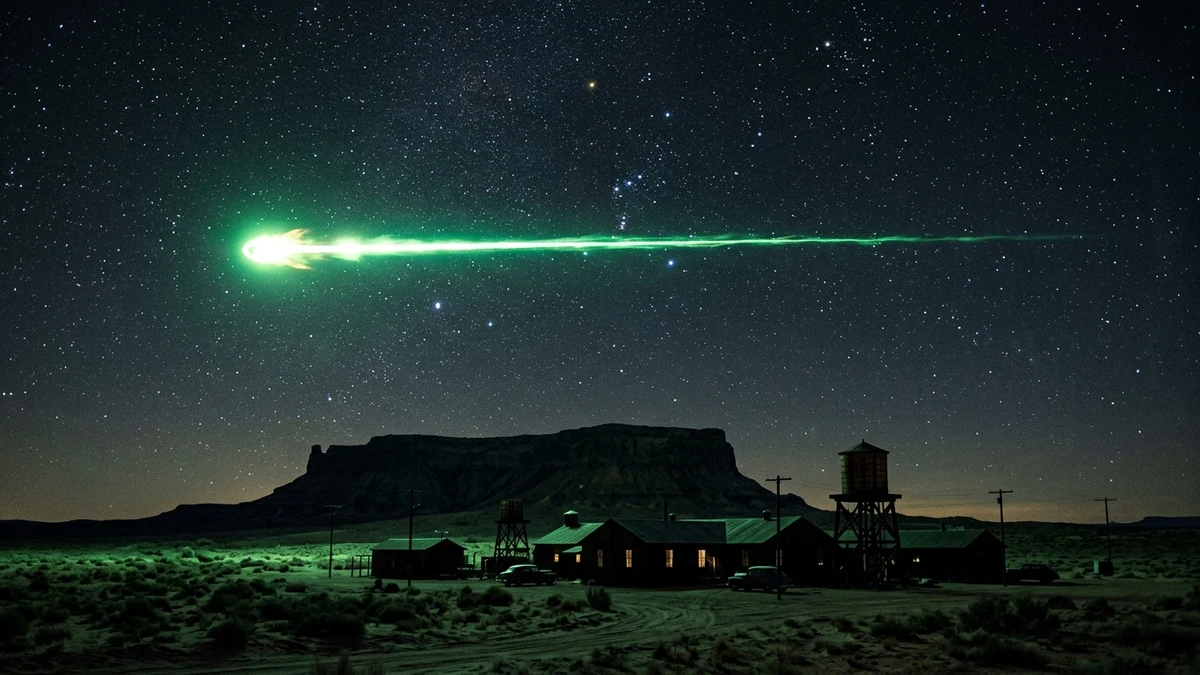
Seventy-seven years on, the green fireballs still don't have an agreed explanation. And notice the echo: strange objects over nuclear sites, seen by expert witnesses, and never explained. In 1949 it was Los Alamos. In 2015 it was Pantex. The files keep landing on the same square. Our full investigation into the green fireball incidents covers the complete history, including documents that didn't make this release.
Six-Pointed Star Over the Yellow Sea: The 2025 Footage Near China
The newest material comes from US Indo-Pacific Command, and it's the strangest-looking footage in the batch. A 12-second infrared clip from 2025, taken over the Yellow Sea near China, shows what the Pentagon describes as "an area of contrast resembling a six-pointed star" holding steady in the sensor's view.
If that sounds familiar, it should. The very first PURSUE release back in May included a 2013 video from US Central Command showing an "eight-pointed star with arms of alternating length". Two sensors, twelve years apart, on opposite sides of the world, picking up the same kind of spiky geometric signature. The sceptical explanation is that this is an optical artefact: a point of light blooming into a star shape inside the sensor itself, the way bright stars grow spikes in telescope photos. The files don't say either way. Both clips are labelled unresolved.

Two more 2025-era clips round out the Indo-Pacific set. One tracks an object over the East China Sea for nearly five minutes, which is a long time for something to sit in a military sensor without being identified. Another, from the South China Sea in 2024, shows multiple areas of contrast moving in formation, curving across the sky like a vast, fast flock of birds. Birds are, of course, one candidate explanation. The Pentagon hasn't offered one.
It's worth noting where all this is happening. The Yellow Sea and East China Sea are among the most heavily watched airspaces on Earth. Whatever these sensors caught, they caught it in a region where the US military has every incentive to identify absolutely everything that flies.
When Is the Next UFO File Release? What the Pentagon Says
The official position is unchanged. Nothing in this release, the Department of War says, establishes extraterrestrial origin or non-human technology. On the evidence of the files themselves, that's fair. A deformed balloon is probably a balloon. A star-shaped blob may well live inside the sensor rather than the sky.
But the fourth batch sharpens the pattern the first three set. Serious witnesses (security officers at a nuclear weapons plant, an aviator with 28 years in the cockpit, a room of Manhattan Project physicists) reported things they could not explain, and the institutions around them investigated and couldn't explain them either. The label on those files is "unresolved", and it was chosen carefully. Unresolved is not aliens. It's also not nothing.
The releases keep coming. Pentagon spokesman Sean Parnell confirmed the department and its agency partners are "actively working on the next release of UAP files". On current form that means another batch in early August. Update: it arrived on 7 August 2026: 41 records including the Bagram triangle, the Gulf of Oman gunship encounter and a 245-page Project SIGN file from 1947–48. Our full read-through is in the fifth UFO file release. The whole archive so far is free to browse at war.gov/ufo, and if you want to know how we got here, my rundowns of the first, second and third batches cover the story from the start, along with what it all means from a UK perspective.
For more on the cases that keep surfacing in these releases, browse our UAP case study investigations, including deep dives into the Pantex nuclear intrusion, green fireball incidents, UAPs over nuclear sites, and the Nimitz encounter that started the modern disclosure era. You can also search the primary source material yourself in our UAP document archive.
Sources:
- Pentagon releases new batch of UFO files: "Unlike anything I had seen" · CBS News
- Key Revelations From 4th Batch of Pentagon UFO Files · The Epoch Times
- Pentagon releases fourth batch of UFO files · NewsNation
- Department of War UAP file release (PURSUE)
Frequently Asked Questions
Equipment guides
Related topics

Ian ClaytonAmateur astronomer and founder of WatchTheStars.co.uk, dedicated to helping others explore the wonders of our universe. Full profile →