Key takeaways
- File DOW-UAP-D017 runs to 116 pages and records 209 sightings of green orbs, discs and fireballs around Sandia Base and other atomic sites between December 1948 and May 1950
- The core document is a 25 May 1950 summary from Lt Col Doyle Rees of the 17th District OSI at Kirtland Air Force Base, sent to the Director of Special Investigations at USAF headquarters
- Every sighting was sorted into one of three buckets: green fireball phenomenon, disc or variation, or probably meteoric
- At a classified Los Alamos meeting in February 1949, Edward Teller calculated that a solid object moving that fast would have made a bang audible ten kilometres away, and no one heard a thing
- Chemists spent eight days sampling New Mexico air for copper dust after a fireball, because copper burns the same green and is almost never found in meteorites
Jump to section 8 sections
- What Is File DOW-UAP-D017?
- How the US Air Force Logged UFOs Over Its Nuclear Sites
- Green Fireballs: What Witnesses Actually Described
- Camp Hood UFO Sightings 1949: The Night Guards Measured the Lights
- Edward Teller and the Green Fireballs: Why He Said They Weren't Solid
- Green Fireballs and Copper Dust: The 1949 Air Sampling Tests
- What the Sandia UFO Files Prove, and What They Don't
- How to Read the Sandia UFO File Yourself
In December 1948, staff at America's atomic weapons sites in New Mexico started seeing green lights in the sky. Within weeks the Air Force had set up a formal reporting chain for them. File DOW-UAP-D017, released in the Pentagon's PURSUE Release 2 on 22 May 2026, is what that chain produced: 116 pages of typed carbon copies logging 209 sightings of green orbs, discs and fireballs around Sandia Base and its sister installations between 1948 and 1950. It is not a UFO book. It is the military's own paperwork, complete with column headings.
This is the third post in our Document of the Week series: each week we take one file from our declassified UAP document archive and set out, in plain English, what it actually says.
What Is File DOW-UAP-D017?
DOW-UAP-D017 is a 116-page US Department of War file catalogued as "UAP Reported at Sandia Base, 1948-1950". It records 209 sightings of green orbs, discs and fireballs near American atomic weapons installations, and it was published in the PURSUE Release 2 batch on 22 May 2026.
It's a bundle rather than a single report, pulling together paperwork from the Armed Forces Special Weapons Project, the successor organisation to the Manhattan Project, and from the US Air Force.
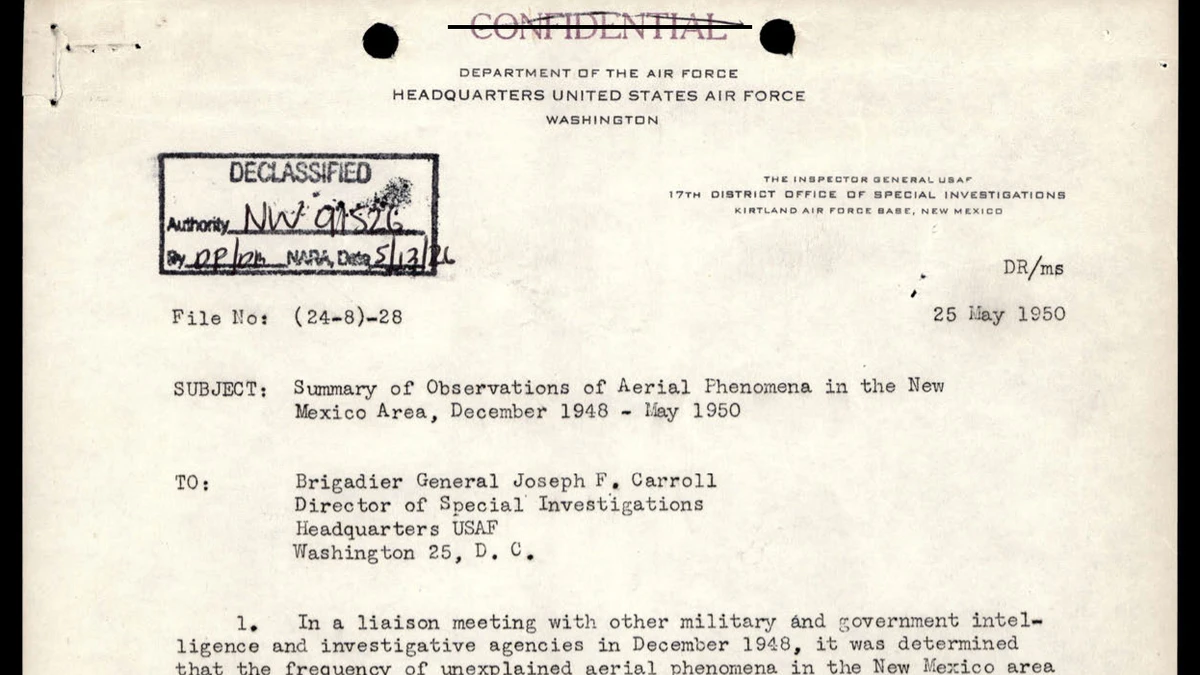
The spine of the file is a document dated 25 May 1950, File No. (24-8)-28, "Summary of Observations of Aerial Phenomena in the New Mexico Area, December 1948 – May 1950". It was signed by Lt Col Doyle Rees, District Commander of the 17th District Office of Special Investigations at Kirtland Air Force Base, and addressed to Brigadier General Joseph F. Carroll, Director of Special Investigations at USAF headquarters in Washington. Around it sit trip reports, laboratory analyses, letters from a university meteoriticist, sighting overlays drawn on Army map sheets, and one photograph.
Rees explains in his opening paragraph how the whole thing started. At a liaison meeting in December 1948 with other military and government intelligence agencies, it was decided that unexplained aerial phenomena in New Mexico were frequent enough to need "an organized plan of reporting these observations". His district drew the job because of where its units happened to sit.
How the US Air Force Logged UFOs Over Its Nuclear Sites
The short answer: like anything else it had to account for. There is no breathless language anywhere in the file. There is a table.
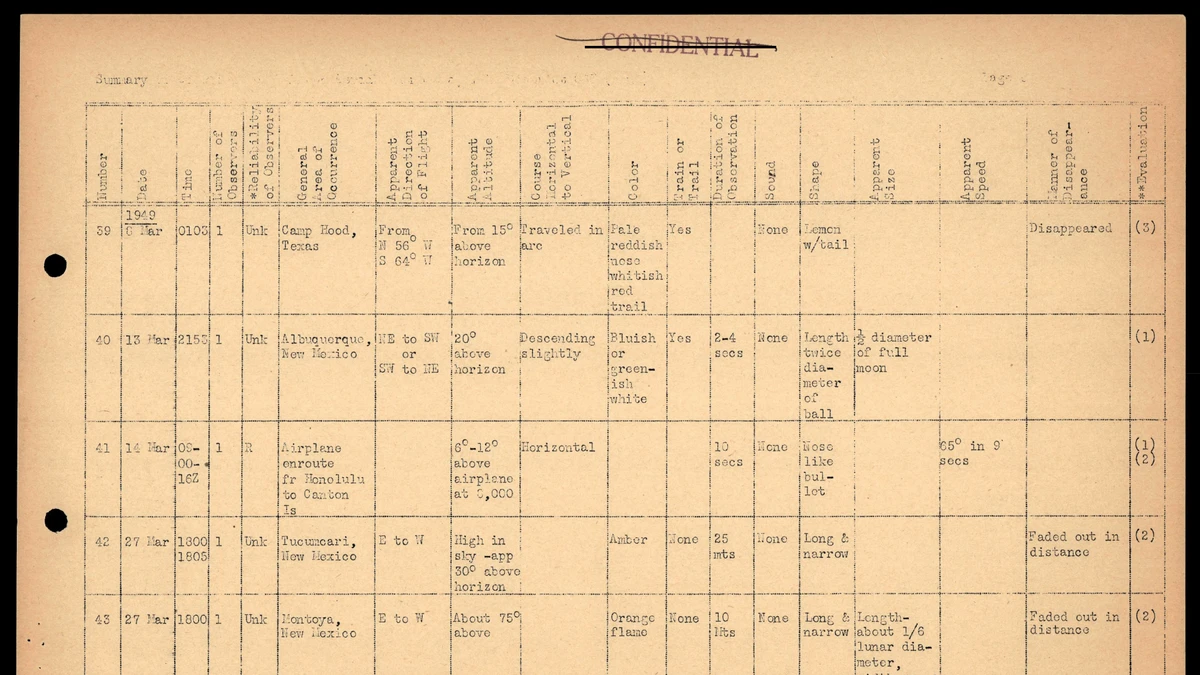
Each sighting gets a numbered row and eighteen columns: date, time, number of observers, reliability of observers, general area of occurrence, apparent direction of flight, apparent altitude, whether the course was horizontal or vertical, colour, train or trail, duration of observation, sound, shape, apparent size, apparent speed, manner of disappearance, and an evaluation. That last column holds a single digit, because paragraph 2 of the summary says every sighting was evaluated "into one of three classifications, (1) green fireball phenomenon, (2) disc or variation, and (3) probably meteoric".
Read that again. By May 1950 the US Air Force had a standing category on its forms for green fireballs, separate from meteors, and another for discs.
Rees is also careful about who was doing the looking. The observers, he writes, "include scientists, Special Agents of the Office of Special Investigations (IG) USAF, airline pilots, military pilots, Los Alamos Security Inspectors, military personnel, and many other persons of various occupations whose reliability is not questioned". And he flags what the table leaves out: it "is not a complete record of all reported observations, but includes only those in which sufficient information was available to justify their inclusion".
Green Fireballs: What Witnesses Actually Described
Witnesses described brilliant green lights that crossed the sky on near-horizontal paths for one to five seconds, made no sound at all, and left no trail or dust cloud behind them. An earlier summary in the same file, dated 19 April 1949, boils the accounts down to six shared characteristics:
- Green colour, sometimes described as greenish-white, bright green, yellow-green or blue-green
- A horizontal path, sometimes with minor variations
- Speed less than that of a meteor, but more than any known type of aircraft
- No sound
- No persistent trail or dust cloud
- Visible for one to five seconds
Then comes the line that anyone quoting this file should quote: "In none of the reported incidents has any natural or man-made object been determined to be responsible."
The scientific end of the investigation belonged to Dr Lincoln LaPaz, who ran the Institute of Meteoritics at the University of New Mexico and consulted for the district without pay. LaPaz was not a fringe figure. He had been a research mathematician at the New Mexico Proving Grounds and technical director of an Air Force operations analysis section during the war, and he was one of the best-known meteorite specialists in the world.
His seventh report, dated 23 May 1950, lists eleven ways the green fireballs differed from ordinary meteors. The paths were horizontal, which real meteors almost never are. They appeared at full brightness instantly instead of building up. They made no noise, even the ones tracked down to eight or ten miles altitude, where a genuine meteorite is always violently loud. They left no spark train and no dust cloud. And they clustered: the frequency peaked around 8:30pm local time, nowhere near the 3am peak for ordinary meteors, with most incidents falling on Fridays, Saturdays, Sundays and Mondays.
Of everything reported to him, LaPaz accepted 72 objects as belonging in the green fireball category. That was, by his own reckoning, nearly half the incidents in the summary table and under five per cent of everything people had told him about. He was screening hard.
Camp Hood UFO Sightings 1949: The Night Guards Measured the Lights
In March 1949 the same phenomenon turned up over Camp Hood in Texas, above the "Q" Area at Killeen Base, another atomic weapons storage site. Army investigators interviewed each guard separately, walked him back to where he had stood, and had him fix the object's position with a surveying instrument. It is the closest thing to a controlled experiment in the whole collection, and the least reported part of the file.
Fourth Army intelligence sent investigators to check the reports of 6 to 8 March. Nobody was given advance notice that he would be questioned. Vertical angles and magnetic azimuths were recorded for each account and plotted on a 1:62,500 map sheet.
The soldiers all said the same thing: they saw falling stars over the reservation nearly every night, and this was different.
On the evening of 17 March, the alert guard of the 2nd Armored Division was standing by with tank-mounted sights, ready to fire flares and record elevation and azimuth readings to test the observers. Before they could start, another eight lights appeared. The report logs each one by map coordinate and time, from 19:52 through to 21:52. Captain McCullough, the assistant G-2, watched three of them personally. One burst into a green cluster; one was reddish, another white.
The follow-up is brisk and unglamorous. It was established that nobody in the "Q" area was responsible. An ordnance check confirmed no pyrotechnics had been issued or used. The FBI in San Antonio and the Office of Naval Intelligence were notified, and the summary went out to Air Materiel Command, the Office of Special Investigations at Kirtland, and the commanding general at Sandia.
The 1949 witnesses had nothing but their eyes
Kit we've tested and reviewed in full
Half the columns in that Air Force log say "Unk" because nobody could judge size, height or speed by eye. A decent pair of binoculars answers most of those questions in seconds, and they're the one bit of kit we recommend to everybody.
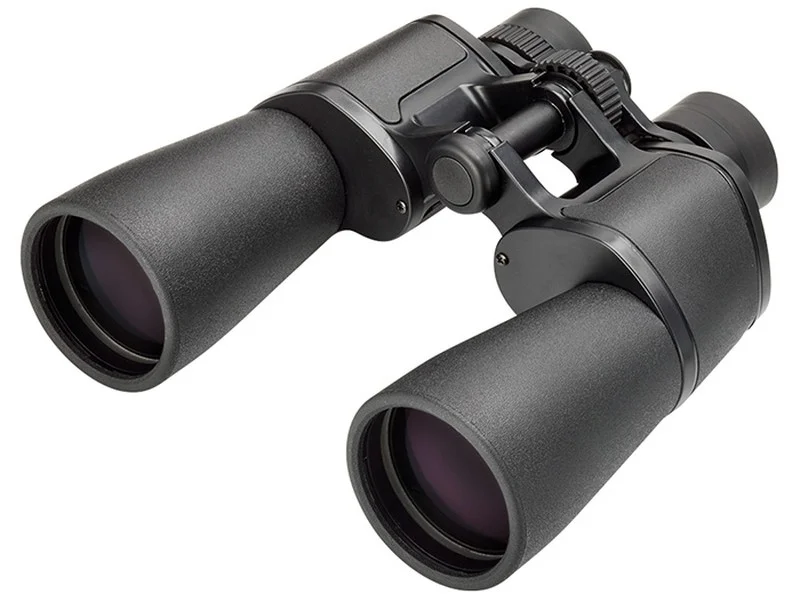
Wide field of view and bright 50mm lenses, light enough to grab and point at something moving before it's gone. Our usual first pick for UK beginners.
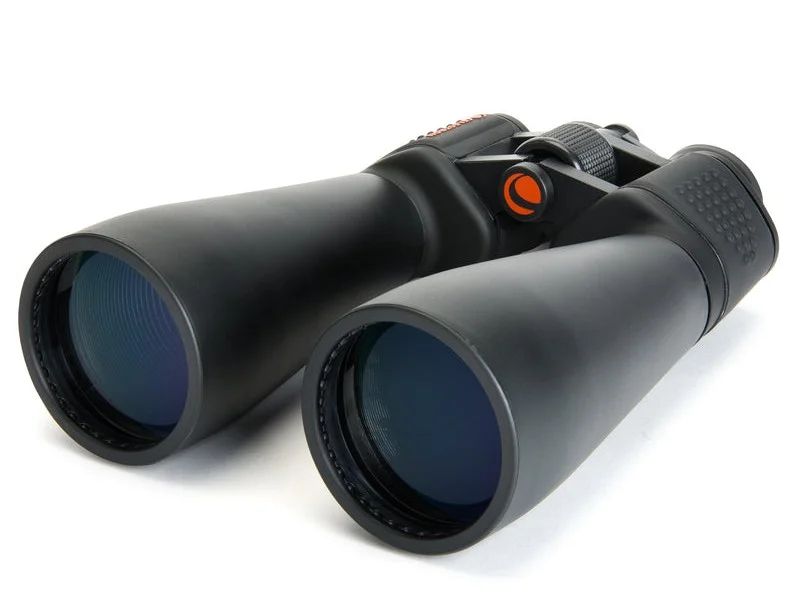
15x magnification pulls a distant light much closer. Use a tripod for longer sessions, but nothing near this price shows you more.
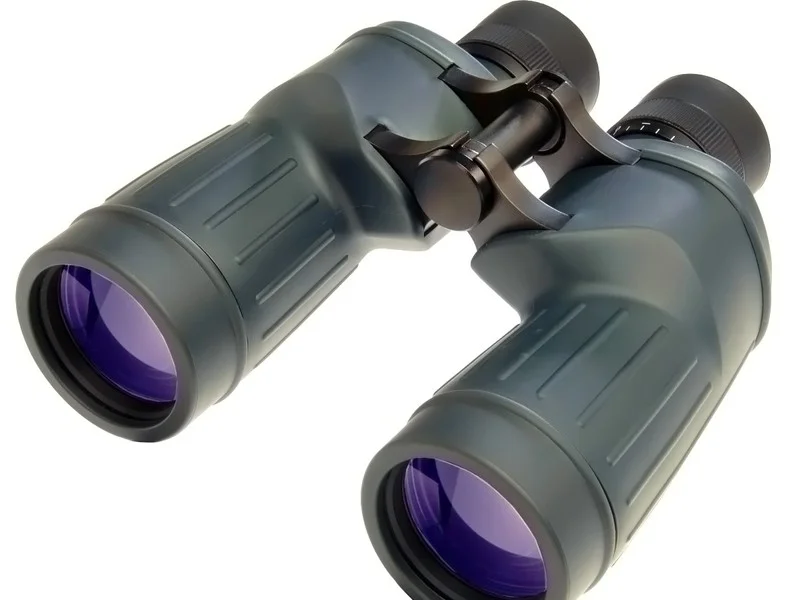
Better contrast and tighter star points than budget pairs, so a satellite stays a clean point rather than a smear. A buy-once pair.
Affiliate links: you pay the same price, we earn a small commission that helps keep WatchTheStars free.
Edward Teller and the Green Fireballs: Why He Said They Weren't Solid
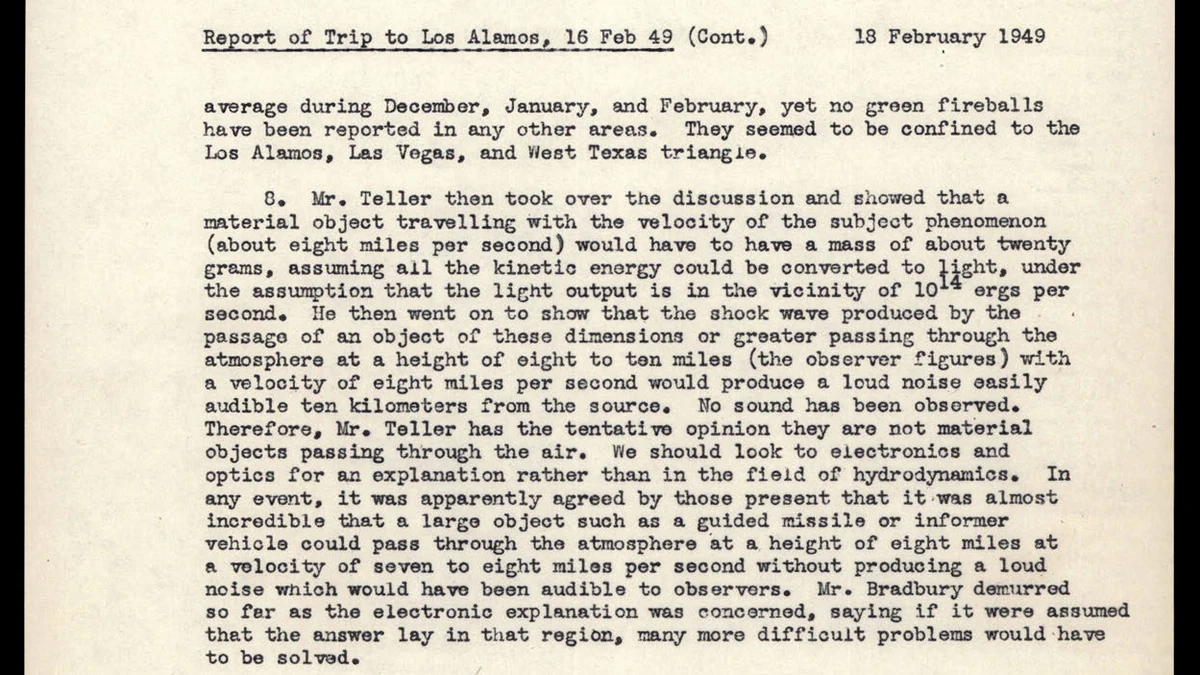
Edward Teller's view was that the green fireballs could not be solid objects, because an object that fast would have produced a bang audible ten kilometres away and nobody ever heard one. He reached it at a classified conference held at Los Alamos on 16 February 1949 to work out what these things were. The attendance list, preserved in a trip report written two days later by Commander Richard Mandelkorn of Sandia Base, is remarkable: Norris Bradbury, the director of Los Alamos; Edward Teller; Fred Reines, who would later win a Nobel Prize for detecting the neutrino; John Manley; Marshall Holloway; officials from the Atomic Energy Commission and Fourth Army intelligence; Captain Neef of the Air Force; and LaPaz.
Neef opened by telling the room that the question had been classified SECRET under the name Project "Grudge", and that it was now the primary responsibility of the Air Force's Air Materiel Command. Then he handed over to LaPaz, who described the Starvation Peak incident he had witnessed himself: instant full brightness, yellow-green at about 6,200 angstroms, essentially horizontal, constant angular velocity, about two seconds, no noise.
Teller then took over and did the arithmetic. If the light output was around 10¹⁴ ergs per second and all the kinetic energy went into light, an object moving at eight miles per second would need a mass of about twenty grams. But a body of those dimensions or larger, passing through the atmosphere at eight to ten miles up at that speed, would produce a shock wave "easily audible ten kilometers from the source". No sound had ever been observed.
Teller's tentative conclusion, in Mandelkorn's words: they "are not material objects passing through the air. We should look to electronics and optics for an explanation rather than in the field of hydrodynamics."
Bradbury pushed back on the electronic explanation, saying it would raise more problems than it solved. And Mandelkorn's own conclusion, written for his own chain of command rather than for publication, is the sentence that has kept this file alive: "there is cause for concern of the continued occurrences of unexplainable phenomena of this nature in the vicinity of sensitive installations."
Green Fireballs and Copper Dust: The 1949 Air Sampling Tests
Copper salts burn a distinctive green in a flame, and LaPaz had measured the fireballs' green at a matching wavelength of about 5218 angstroms. So in the summer of 1949 two chemists went looking for copper falling out of the New Mexico sky.
After a fireball crossed the sky near Socorro at 8:26pm on 24 July 1949, William Crozier and Ben Seely of the New Mexico School of Mines set up aerosol sampling gear. The equipment drew air at about 34 litres a minute and caught particles on adhesive-coated microscope slides, using a reagent that turns colour in the presence of copper. The first run started thirteen and a half hours after the sighting. They kept sampling for eight days.
They found copper. Large particles at first, up to a hundred microns, then a shift over the following days towards a flood of much smaller ones. They were also careful to undercut their own result. Nobody knew how much copper is normally floating around Socorro, and one of the heaviest samples had been taken beside a highway where passing cars might have stirred up dust.
LaPaz, reviewing the work in August 1949, accepted that the results were "negative or at best inconclusive". But he set out exactly what was at stake in a memo to Colonel Rees. Copper, he wrote, "is one of the rarest of the elements found in meteorites", and he knew of no case where even the tiniest copper particle had been reported in a dust collection of meteoritic origin. If future work showed the copper really was falling from the green fireballs, "then the fireballs are not conventional meteorites."
Nobody ever settled it. Picture what that meant, though. In the summer of 1949 the United States government had two chemists standing in the New Mexico desert with air pumps, sampling the sky for eight days to find out what a UFO was made of.
What the Sandia UFO Files Prove, and What They Don't
They prove the reports were real, and that capable people spent eighteen months trying to explain them. There was a dedicated Air Force reporting chain, physicists of Nobel calibre doing the sums, chemists sampling dust, and a formal category for "green fireball phenomenon" printed on official forms. None of that is in dispute.
They do not prove the objects were craft, and the file itself is the best argument against jumping to that conclusion. LaPaz, who chased these things harder than anyone, concluded in February 1950 that the reports split into two categories: most were meteorite falls of unusual but not impossible character, and a minority were American guided missiles being tested near the installations they were designed to defend. He had proposed exactly that to Teller at the Los Alamos conference a year earlier and, in his own dry phrase, it "was not taken seriously then". He also noted a letter from Dr Joseph Kaplan of the Air Force Scientific Advisory Board: "Frankly, I don't know of any U.S. experiments that would result in the appearance of these unconventional objects, and neither does Von Karman."
There is one more caution in the file's own numbers. LaPaz screened out more than 95 per cent of what people reported to him. Sighting No. 175 shows the standard he applied: a photograph taken at Datil, New Mexico by Corporal Lertis E. Stanfield of Holloman Air Force Base on 24 and 25 February 1950. LaPaz worked out the object's angular diameter at about a quarter of a degree and its angular velocity at over half a degree per minute, and ruled out the Moon (too small), Venus or any planet (too large), and a defocused bright star (moving twice as fast as the Earth's rotation would explain). That is the level of scrutiny a single frame got.
What survives all that screening is a small core of observations nobody could explain, over the most closely guarded ground in America, at a moment when the Soviet Union had just tested its first bomb. Nobody in Albuquerque was in a position to rule anything out. The same pattern turns up in the Los Alamos green fireball letters we covered a fortnight ago and, on the other side of the Iron Curtain, in the CIA's report from the Sary Shagan missile range.
How to Read the Sandia UFO File Yourself
DOW-UAP-D017 is free to download from the official US release site, published on 22 May 2026 as part of the second PURSUE batch. Be ready for what a 1940s file actually looks like: faded carbon copies, pencil annotations, security stamps struck through at declassification, and pages where the typewriter ribbon gave up. The archival markings NND 58378 and NW 91526 appear at the foot of the pages.
If you only read three parts, make them these. Pages 20 to 22 give you the 1950 summary letter and the classification system. Pages 90 to 93 give you Mandelkorn's Los Alamos trip report with Teller's calculation. Pages 63 to 67 give you LaPaz's seventh report and his eleven differences from ordinary meteors. The rest is the log itself, and it rewards slow reading.
Our UAP document archive hub indexes every collection we hold, from the UK Ministry of Defence files to Brazil's Operação Prato. Next week: another file, in plain English.
Sources:
- File DOW-UAP-D017, "UAP Reported at Sandia Base, 1948-1950", US Department of War, PURSUE Release 2, published 22 May 2026 · primary source, 116 pages
- Summary of Observations of Aerial Phenomena in the New Mexico Area, December 1948 – May 1950, File No. (24-8)-28, 17th District OSI, Kirtland AFB, 25 May 1950 · within DOW-UAP-D017
- Report of Trip to Los Alamos, New Mexico, 16 February 1949, by Commander Richard S. Mandelkorn, USN, Sandia Base, dated 18 February 1949 · within DOW-UAP-D017
- Anomalous Luminous Phenomena (Seventh Report), Dr Lincoln LaPaz to Lt Col Doyle Rees, 23 May 1950 · within DOW-UAP-D017
- "An Attempt to Collect Airborne Particles Associated with the Fireball of July 24, 1949", W. D. Crozier and Ben K. Seely, 10 August 1949 · within DOW-UAP-D017
- When Mysterious Green Fireballs Worried the US Government · HISTORY
- Declassified 'green fireball' records raise questions about 1949 sightings · Newsweek
Frequently Asked Questions
Equipment guides
Related topics
Ian ClaytonAmateur astronomer and founder of WatchTheStars.co.uk, dedicated to helping others explore the wonders of our universe. Full profile →