Key takeaways
- Hubble has detected ultraviolet light from a galaxy, MXDFz4.4, that existed just 1.4 billion years after the Big Bang
- It's the first clear example caught this early of a galaxy actively clearing the 'fog' of neutral hydrogen that once filled the universe
- The galaxy is about 100 times smaller by area than the Milky Way but is forming stars 10 times faster, packing hot young stars tightly together
- An estimated 50 to 100% of the stars' ionizing light is escaping to clear the surrounding gas: exactly what's needed to explain cosmic reionization
- Hubble made the find, but NASA's Webb and the European Southern Observatory's VLT were needed to confirm the galaxy's mass, age and distance
Jump to section 7 sections
For its first billion years, the universe was foggy. Not cloudy in the way a night sky is: genuinely opaque, filled with a haze of cold hydrogen gas that swallowed light before it could travel far. Then, gradually, the fog lifted, and the cosmos became the transparent place we see today. Astronomers have spent decades trying to catch the culprits in the act of clearing it.
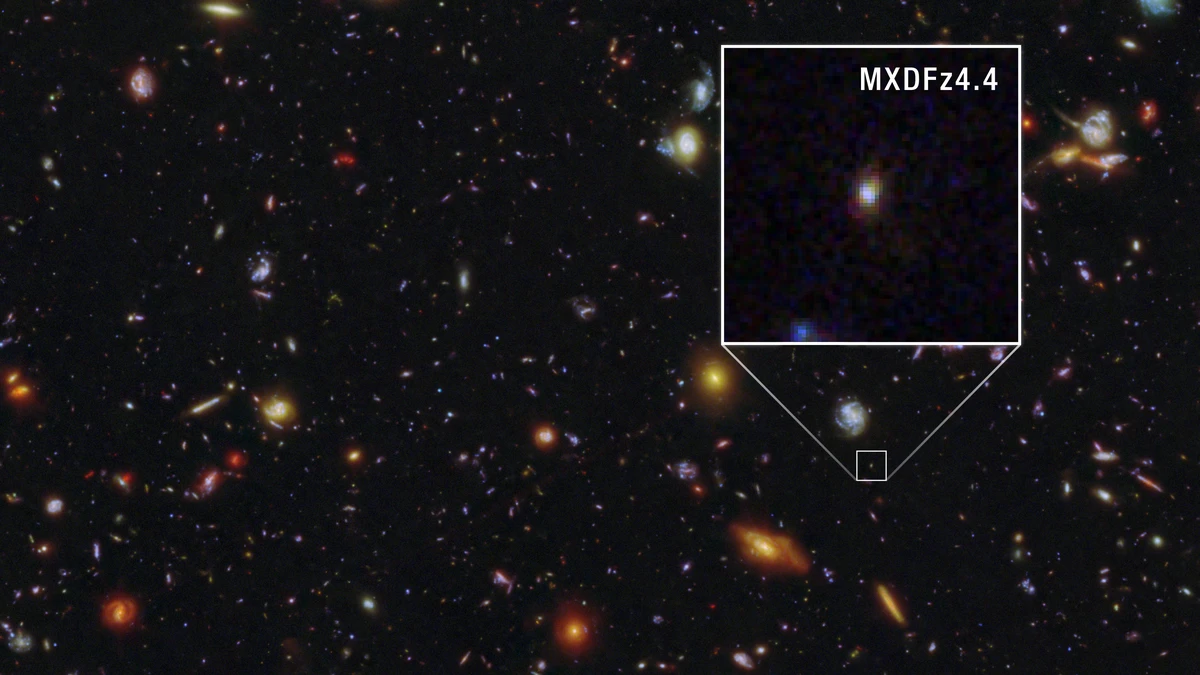
Now Hubble has caught one. In a result published on 23 June, a team using the NASA/ESA Hubble Space Telescope reported ultraviolet light from a small galaxy that existed just 1.4 billion years after the Big Bang: the first clear example, this early in cosmic history, of exactly the kind of galaxy that burned the fog away. Here's why a faint blue dot in a 25-year-old patch of sky is one of the most satisfying discoveries of the year.
Hubble Spots a Light That Shouldn't Have Escaped
The galaxy has a catalogue name only an astronomer could love: MXDFz4.4. It sits in one of the most-studied scraps of sky in all of astronomy: a deep-field region where telescopes stare for hundreds of hours to collect light from the faintest, most distant objects.
What makes MXDFz4.4 special isn't that we can see it. Astronomers have catalogued plenty of galaxies from this era. It's what kind of light Hubble detected: ionizing ultraviolet light, the high-energy radiation that can strip electrons from hydrogen atoms and turn opaque gas transparent. Crucially, this light escaped the galaxy entirely and travelled across the cosmos to reach us.
"Observing a galaxy like this was thought to be impossible," said lead author Ilias Goovaerts of the Space Telescope Science Institute in Baltimore. "Researchers expected the 'fog' of neutral hydrogen that filled the early universe would be too thick and obscure our view of its ionizing light. Hubble not only spotted that light, but it also helped reveal incredible details about the galaxy's characteristics."
That light left MXDFz4.4 more than 12 billion years ago. As it crossed the expanding universe, it stretched: what started as ultraviolet arrived at Hubble as visible light, an effect called redshift. And here's the quietly remarkable part: Hubble's particular combination of wavelength coverage, sensitivity and its perch above the atmosphere makes it the only telescope capable of capturing this kind of ultraviolet light from the early universe. Not even Webb can do this bit. At 36 years old, Hubble is still the only tool for the job.
What Was the Cosmic Fog?
To see why this matters, rewind to the early cosmos. After the Big Bang, the universe cooled enough for electrons and protons to pair up into neutral hydrogen atoms. That neutral gas filled all of space, and neutral hydrogen is very good at absorbing ultraviolet light. So the young universe was, in effect, fogged in. Starlight at energetic wavelengths simply couldn't get far.
Then something cleared it. Over a stretch called the Era of Reionization, that neutral hydrogen was steadily ionized, its electrons stripped away again, until the gas everywhere became transparent. This wasn't a flick of a switch; it likely took hundreds of millions of years, with bubbles of clear space growing and merging until the fog was gone for good.
The big question has always been: what supplied the energy? The leading suspect is the first generations of galaxies, glowing with hot young stars. But suspecting isn't proving. To nail it, astronomers needed to actually catch a galaxy from this era leaking its ionizing light out into space, and measure how much was escaping. That's precisely what MXDFz4.4 delivers.
Meet MXDFz4.4: Small, Furious and Bright
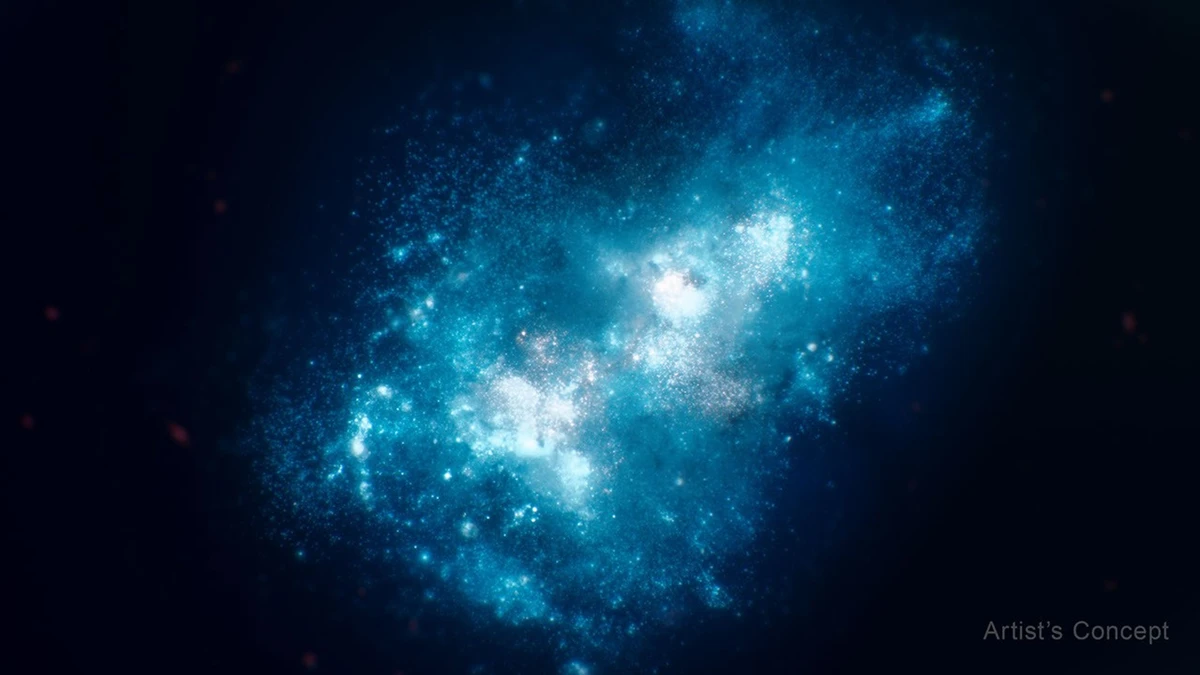
If you pictured the galaxy that helped clear the cosmos as some colossal beast, think again. MXDFz4.4 is a tiddler. By area, it's roughly 100 times smaller than our Milky Way.
But it punches absurdly above its weight. Despite its size, it's forming new stars about 10 times faster than the Milky Way does today. Cram that much star formation into that small a space and you get an intensely crowded furnace of young, hot, massive stars: exactly the stars that pour out ionizing ultraviolet light.
That combination is the secret. It isn't the biggest galaxies that clear the fog most effectively; it's these compact, frantically star-forming dwarfs. As Goovaerts put it: "A lot of young, hot, massive stars in a small space do a better job of blasting through opaque gas." MXDFz4.4 is a textbook example of the type, only now it's a real galaxy with real measurements, not a theoretical sketch.
How a Tiny Galaxy Punches Through the Fog
So how does a galaxy that small clear gas on a cosmic scale? It comes down to two things: concentration and violence.
First, concentration. The galaxy's young, massive stars formed in bursts within just the last few million years of the snapshot we're seeing, and they're packed tightly together. When you bunch that many ultraviolet-blasting stars into a small volume, their combined radiation overwhelms the gas around them, ionizing it and carving out a transparent pocket. The researchers estimate that somewhere between 50 and 100% of the stars' ionizing light is escaping the galaxy entirely, an extraordinarily high fraction, and exactly what models of reionization need.
Second, violence. Massive stars live fast and die young, lasting only a few million years before exploding as supernovae. Each blast releases enormous energy and punches colossal holes in the surrounding gas, and those holes act like windows, letting even more ultraviolet light leak out. So the galaxy doesn't just shine through the fog; it physically blows openings in it.
Put together, you have a small, dense, rapidly churning galaxy that both floods its surroundings with ionizing radiation and tears escape routes for that radiation to flood out. Multiply that across countless similar dwarf galaxies in the early universe, and you have a plausible engine for clearing the entire cosmos.
Three Telescopes, One Answer
One of the nicest things about this result is that no single observatory could have produced it. It took three of the world's great telescopes working together.
Hubble did the headline job: detecting the escaping ultraviolet light, which only it can capture from this era. NASA's James Webb Space Telescope then chipped in with near-infrared data, which the team used to weigh the galaxy, study its older and cooler stars, and reconstruct its star-formation history, confirming that the recent activity really did come in bursts. "Without Webb to clarify what we saw in Hubble's images, we couldn't make these conclusions," said co-author Marc Rafelski.
The third partner is European: the galaxy's odd name comes from the MUSE eXtremely Deep Field, a marathon observation by the European Southern Observatory's Very Large Telescope in Chile. That data pinned down exactly when MXDFz4.4 existed: 1.4 billion years after the Big Bang. For context, before this find the earliest galaxy ever caught leaking ionizing light dated to 1.6 billion years, with only a handful of others at around 2 billion years. MXDFz4.4 pushes that frontier meaningfully closer to the reionization era itself.
Why This Discovery Matters
Reionization is one of the last great unsolved chapters in the story of the universe. We know it happened; we've struggled to pin down precisely how and what drove it. Back in 2023, Webb showed that early galaxies collectively emitted enough light to ionize their surroundings around 900 million years after the Big Bang. That was a milestone, but it described the crowd, not an individual.
MXDFz4.4 is the individual: a single galaxy caught in the act, showing exactly how high-energy starlight escapes a galaxy's own gas and dust to go and clear the wider cosmos. It turns a statistical argument into a worked example. And because it's a small, ordinary-looking dwarf rather than a rare giant, it strongly suggests the universe was cleared by vast numbers of unremarkable little galaxies just like it.
"Hubble's observations of MXDFz4.4 let us test our hypotheses much closer to the Era of Reionization than ever before," Rafelski said. The team suspects more galaxies like it are waiting to be found, and finding them, especially at slightly later cosmic times, where larger samples are within reach, would let astronomers measure the whole process in detail. One faint blue dot, in other words, has just shown everyone where to look next.
Want to photograph galaxies and nebulae yourself?
Kit we've reviewed in full
You'll never resolve MXDFz4.4 from the back garden, but a modern smart telescope can capture the glow of other galaxies, nebulae and star clusters in minutes, stacking the light automatically while you watch on your phone. These are the deep-sky performers we'd reach for.
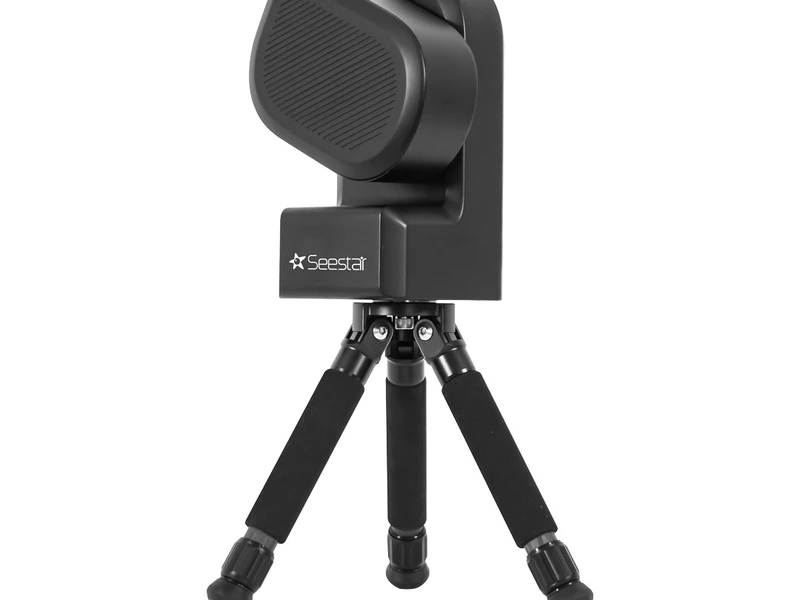
The 50mm aperture makes it the strongest deep-sky grab of the bunch: galaxies, nebulae and clusters all come through with real detail. The most popular smart scope in the UK for good reason.
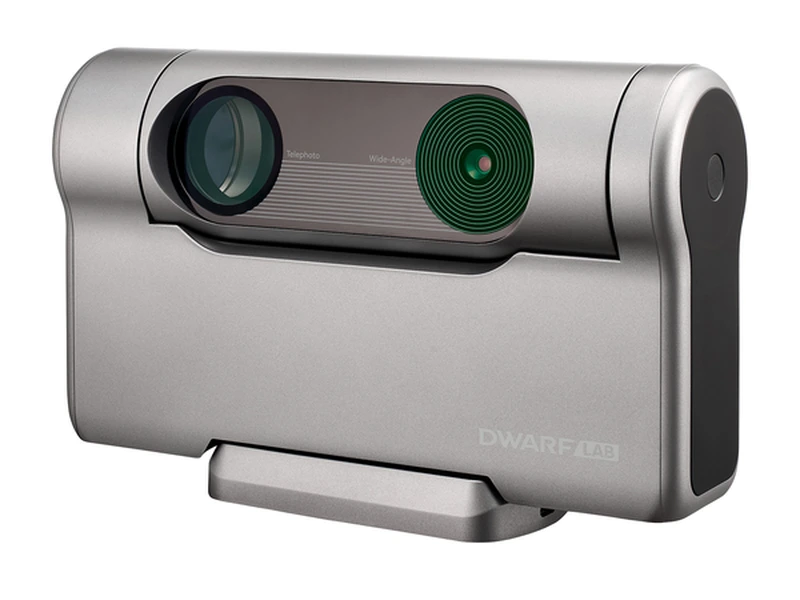
Its wide field of view is ideal for big targets: sprawling nebulae and large galaxies that won't fit in a narrower scope. A favourite for framing the showpiece objects of the summer Milky Way.
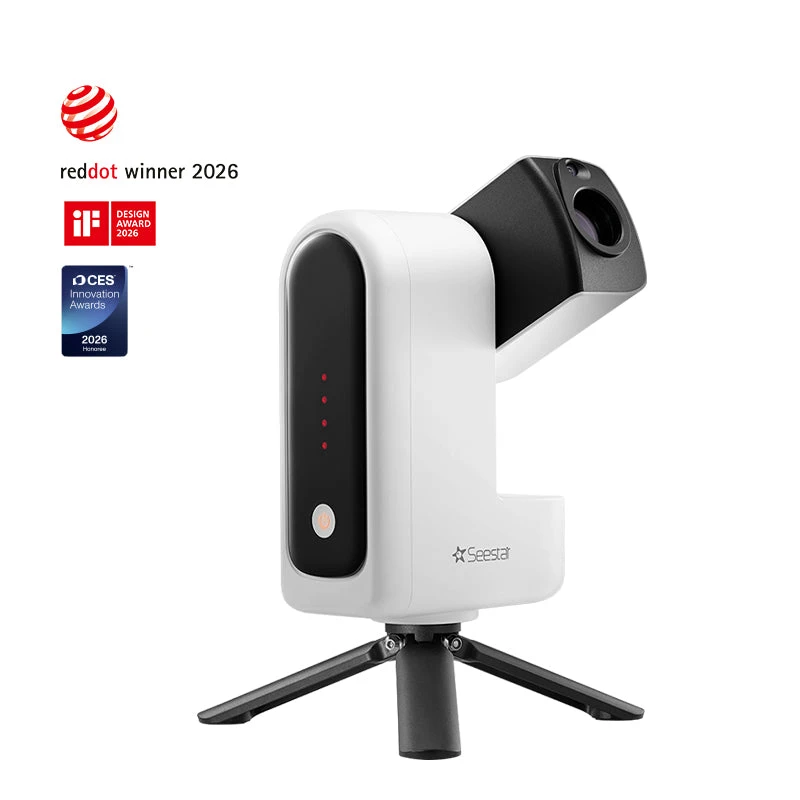
The most portable way in. A smaller 30mm aperture than the S50, but seriously compact and quick to set up, perfect for grabbing deep-sky shots on a clear night without any fuss.
Affiliate links: you pay the same price, we earn a small commission that helps keep WatchTheStars free.
The Bottom Line
Hubble has detected ultraviolet light from a galaxy that existed 1.4 billion years after the Big Bang: light that, by rights, the fog of the early universe should have swallowed. The galaxy, MXDFz4.4, is small but ferociously productive, forming stars ten times faster than the Milky Way and leaking up to all of its ionizing light into space. It's the clearest single example yet of the kind of galaxy that lifted the cosmic fog and made the transparent universe we live in.
It's also a lovely reminder that a 36-year-old telescope still has unique tricks no newer instrument can match, and that the biggest questions in cosmology are sometimes answered by the smallest, faintest objects. Next clear night, when you look up through perfectly transparent air at the stars, you can thank galaxies like this one for clearing the view. Clear skies.
Sources:
- Hubble Details Early Galaxy Transforming Neighborhood, NASA Science
- This release on the ESA/Hubble website, ESA/Hubble
- The science paper by Ilias Goovaerts et al., The Astrophysical Journal
- Hubble details early galaxy transforming neighborhood, Phys.org
Frequently Asked Questions
Equipment guides
Related topics

Ian ClaytonAmateur astronomer and founder of WatchTheStars.co.uk, dedicated to helping others explore the wonders of our universe. Full profile →