The short answer
Mercury and Venus orbit closer to the Sun than Earth does, so they can pass between us and the Sun. From Earth we sometimes see their sunlit side, sometimes their night side, and everything in between. Mars, Jupiter and Saturn orbit further out than Earth, so we always look at them from roughly the same side the sunlight is coming from. That means we only ever see them fully lit, or very nearly so.
If you've ever watched the Moon go from crescent to full and back, you already understand the mechanism. A planet doesn't glow on its own. Half of it is always lit by the Sun and half is in darkness. What we call a "phase" is just how much of the lit half happens to face Earth at the time.
So the question isn't really "why do some planets have phases?" Every planet has a day side and a night side. The real question is: from where Earth sits, can we ever get a good look at the night side? For Mercury and Venus, yes. For Mars and beyond, not really.
Why Does Venus Have Phases?
Venus orbits inside Earth's orbit, at about 72% of our distance from the Sun. That means Venus can be anywhere on the near side or the far side of the Sun relative to us, and the angle we view it from changes enormously.
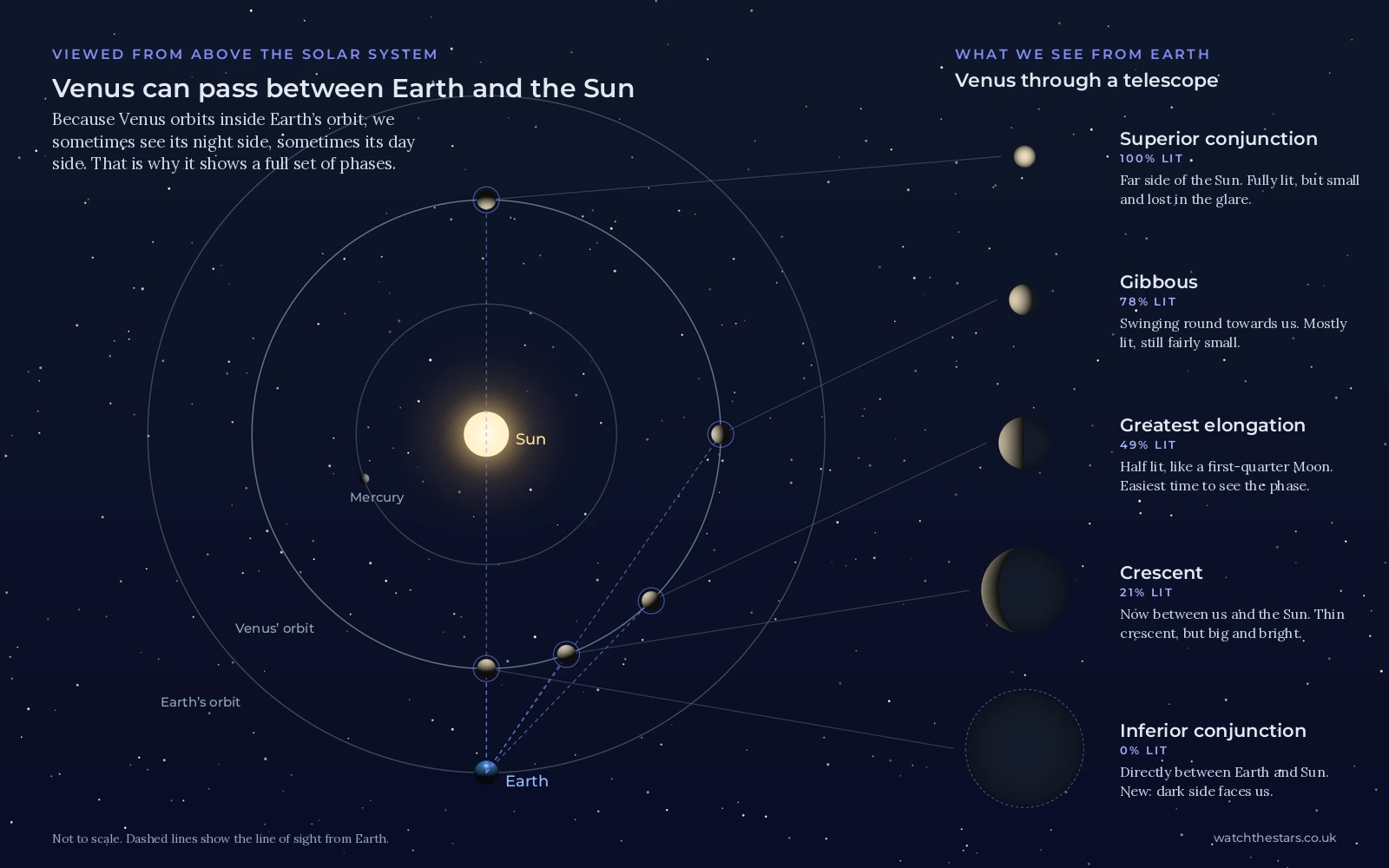
Walk round the orbit and you can see how it works. When Venus is on the far side of the Sun, which astronomers call superior conjunction, its sunlit face points straight at us. It's "full", but it's also at its most distant, so it looks tiny, and it's lost in the Sun's glare anyway.
As Venus swings round towards us it becomes gibbous, then half lit at greatest elongation, when it's furthest from the Sun in our sky. Then it moves between us and the Sun. Now we're mostly looking at its night side, so it shrinks to a crescent, while at the same time it gets much closer and much bigger. At inferior conjunction, directly between Earth and Sun, we're looking straight at the dark side and it's effectively invisible.
Then the whole thing runs in reverse on the other side: crescent, half, gibbous, full. Venus goes through the complete cycle every 584 days. Our guide to seeing Venus through 2026 has the dates for the current cycle.
Does Mercury Have Phases Too?
Yes. Mercury orbits even closer to the Sun, so exactly the same geometry applies and it shows the same full run of phases. Its cycle is faster, roughly every 116 days.
The catch is that Mercury is small, never gets far from the Sun in the sky, and is usually seen low down through a lot of unsteady air. So its phases are much harder to see than Venus's. In a telescope you'll typically catch it as a small half or fat crescent around greatest elongation, and that's about it. Our guide to catching Mercury in 2026 covers when to try.
Why Doesn't Mars Show Phases?
Mars orbits outside Earth's orbit, at about 1.5 times our distance from the Sun. It can never get between us and the Sun, so we can never see its night side face-on. From Earth we're always looking outwards at Mars, more or less along the direction the sunlight is travelling. That means the day side is always turned towards us.
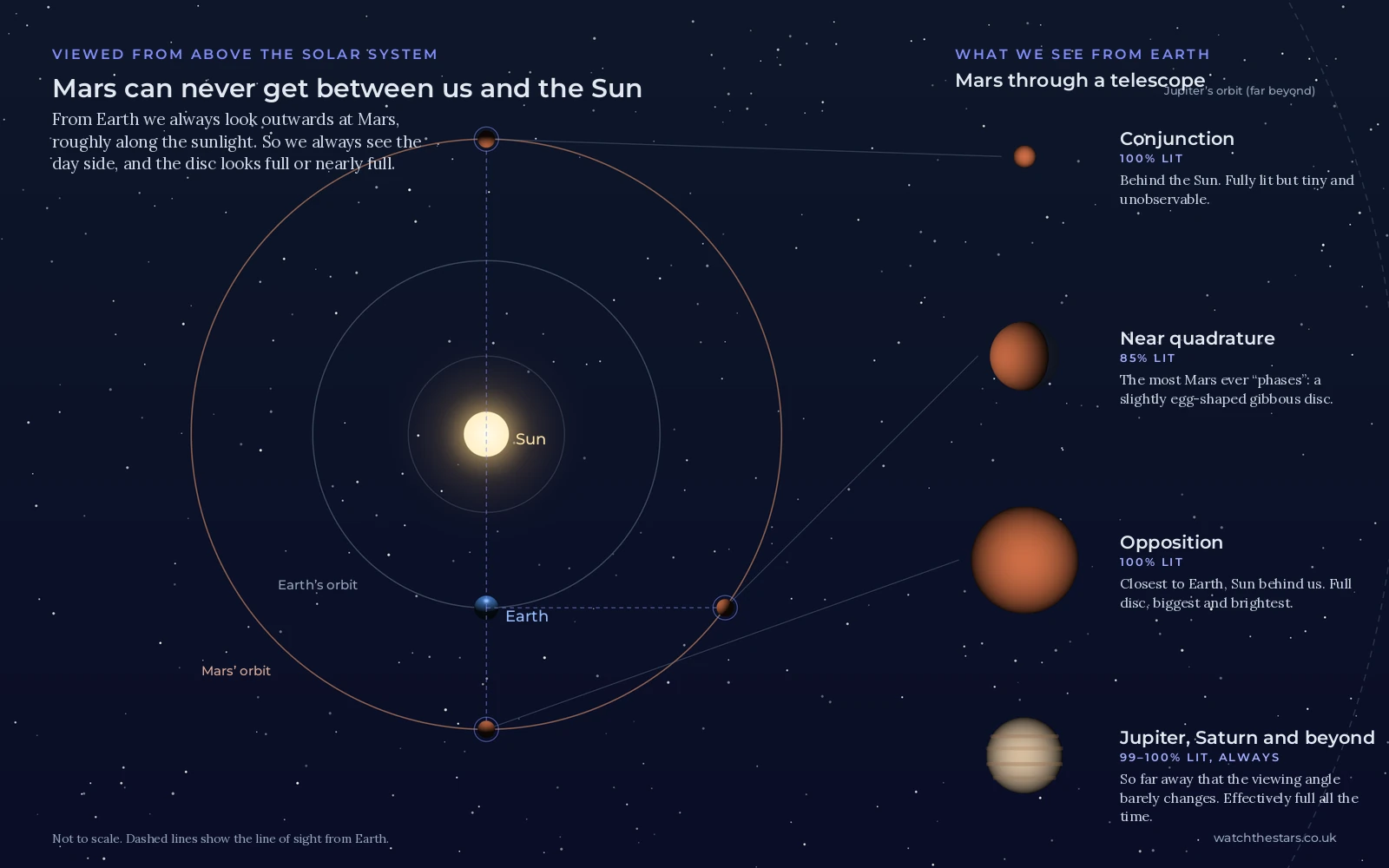
Mars does show some phase, though. Because it's relatively close, the viewing angle changes enough that near quadrature, when Mars sits 90° from the Sun in our sky, we see it slightly less than fully lit. At its most extreme Mars appears about 84% to 88% illuminated, which gives it a distinctly egg-shaped look in a decent telescope. It's subtle, but it's real, and it's a nice thing to look out for a few months either side of an opposition. It never gets anywhere near a half phase, and it certainly never shows a crescent. There's more on the current apparition in our Mars observing guide for 2026.
Do Jupiter, Saturn and the Outer Planets Have Phases?
Technically yes, but so slightly that you'll never see it. The further out a planet is, the smaller the difference between the direction to the Sun and the direction to Earth, so the smaller the possible phase effect. Jupiter never drops below about 99% illuminated. Saturn, Uranus and Neptune are effectively 100% all the time. Only spacecraft that have flown past them, like Voyager, Cassini and Juno, have ever photographed their crescents. If you want to see how the distances stack up, our tour of the Solar System lays them out in order.
What Do the Phases Look Like Through a Telescope?
This is where the geometry becomes something you can actually watch. Venus is the star of the show. It's big, bright and easy to find, and its phase changes noticeably over just a few weeks.
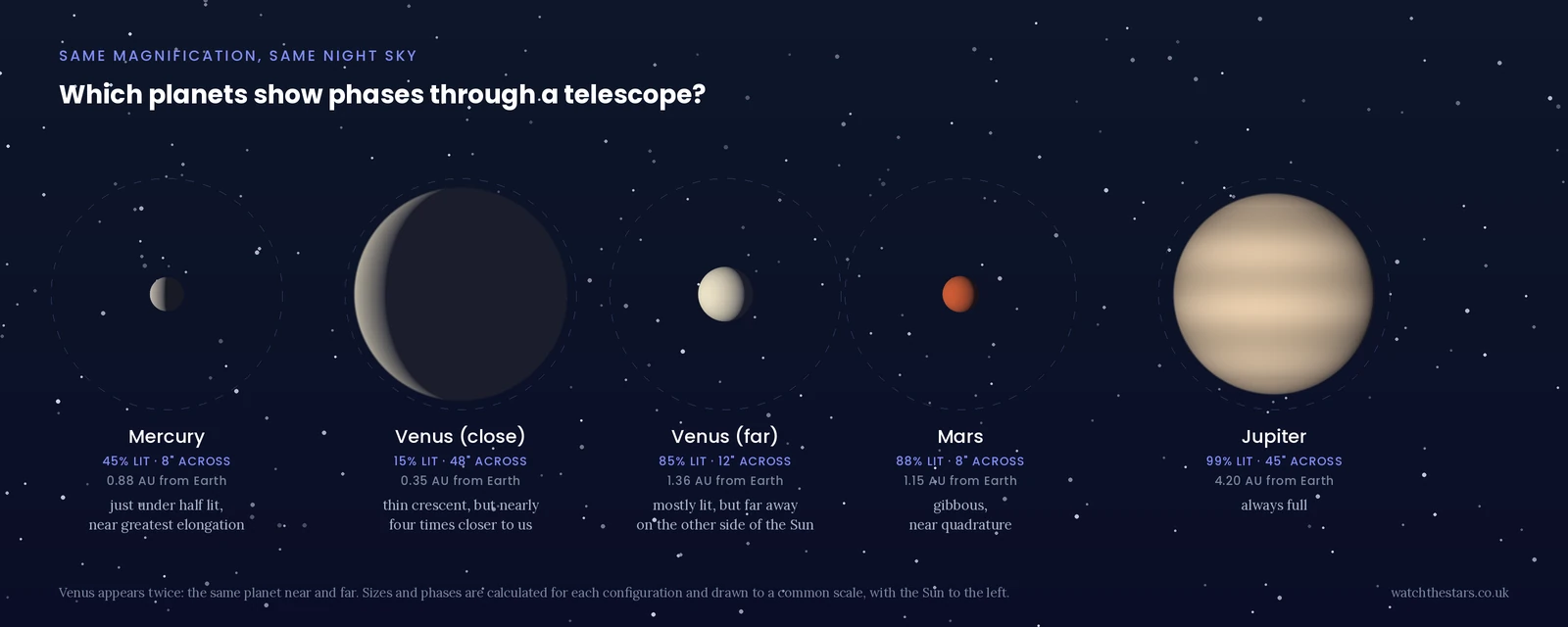
One thing surprises almost everyone the first time they see it. A crescent Venus looks far bigger than a gibbous one, because the phase and the distance are tied together. When Venus is a thin crescent it sits between us and the Sun, only about 0.35 AU away. When it's gibbous it's round the far side, nearly 1.4 AU off. That's four times the distance, so four times smaller in the eyepiece. It's why a crescent Venus is easy in binoculars while a gibbous Venus really wants a telescope.
| Planet | Phases seen from Earth | Apparent size | Best time to look |
|---|---|---|---|
| Mercury | Full cycle, crescent to full | 5″ to 13″ | Around greatest elongation, at dusk or dawn |
| Venus | Full cycle, crescent to full | 10″ to 66″ | The weeks either side of greatest elongation, and the crescent phase running up to inferior conjunction |
| Mars | Full to about 85% gibbous | 4″ to 25″ | Near opposition for size, a few months either side for the gibbous look |
| Jupiter | Effectively always full (99% or more) | 30″ to 50″ | Any time it's well placed |
| Saturn and beyond | Always full | Saturn 15″ to 20″ (globe) | Any time it's well placed |
A couple of practical points. Even a modest telescope, or steadily held binoculars, will show the phase of Venus when it's a crescent. It's one of the most satisfying easy targets in the sky, and a good first project if you're new to binocular astronomy. Because Venus is so bright, you'll often get a better view in twilight, or even in daylight, when the contrast isn't so harsh. Just be very careful whenever Venus is close to the Sun: never sweep around near the Sun with a telescope or binoculars. Our guide to observing the Sun safely explains why that matters.
Watching the phase change from one week to the next is a great little project. Sketch or photograph it on the same setup each time and you'll see the crescent thin out and grow, exactly as the diagram above predicts. Check our astronomy events calendar for the next Venus elongation, or tonight's stargazing score if you just want to know whether it's worth going out.
Why the Phases of Venus Changed Astronomy
There's a good reason this particular topic gets taught in every astronomy course. In late 1610, Galileo turned his new telescope on Venus and watched it go through a full set of phases, from a small gibbous disc to a large crescent. That was a problem for the old Earth-centred model of the universe. In that model Venus sat between Earth and the Sun and could only ever appear as a crescent or new. A full or gibbous Venus meant it had to be going round the far side of the Sun.
It didn't settle the argument on its own, but it was one of the first pieces of hard observational evidence that the planets orbit the Sun rather than the Earth. The next time you see a half-lit Venus in the eyepiece, you're looking at the same thing that helped tip the balance towards the modern view of the Solar System.
Where to Go Next
Kit for watching a planet change shape
Kit we've tested and reviewed in full
A crescent Venus is one of the easiest wins in the sky, and you don't need much to see it. The trouble is brightness rather than magnification: Venus is dazzling, so cutting the glare does more for the view than a bigger telescope.
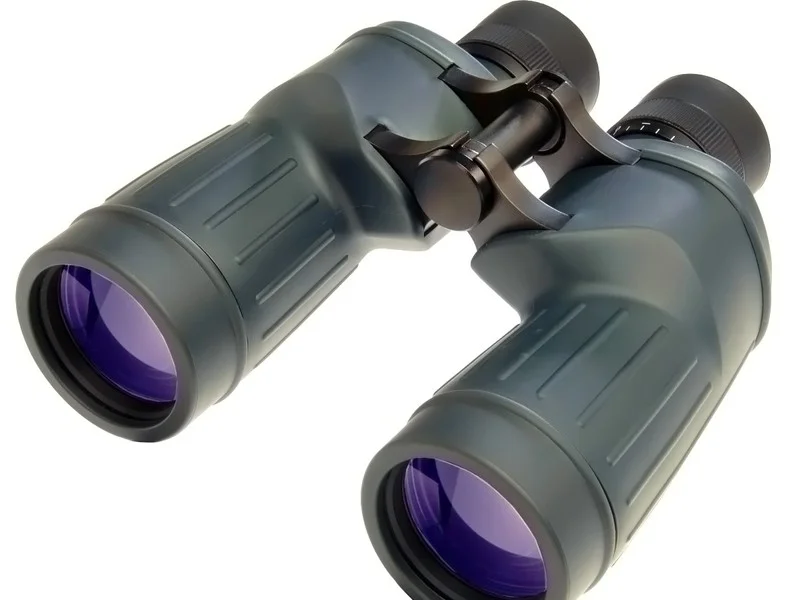
Sharp, high-contrast 10×50s with enough resolution to turn Venus from a blazing dot into an obvious crescent. Brace them on a fence post and the shape jumps out.
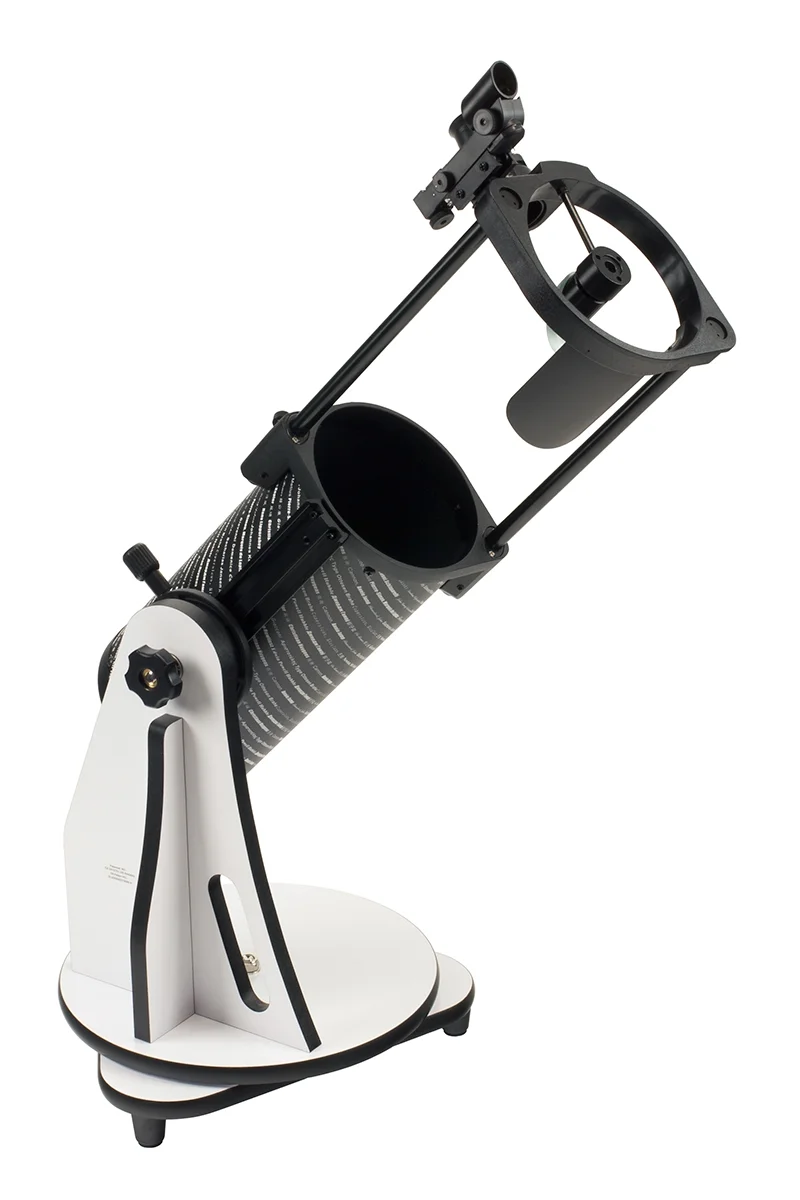
Enough aperture to show Mercury's half phase and the slight egg shape of a gibbous Mars, not just the easy crescent Venus. Sits on a table, so it gets used.
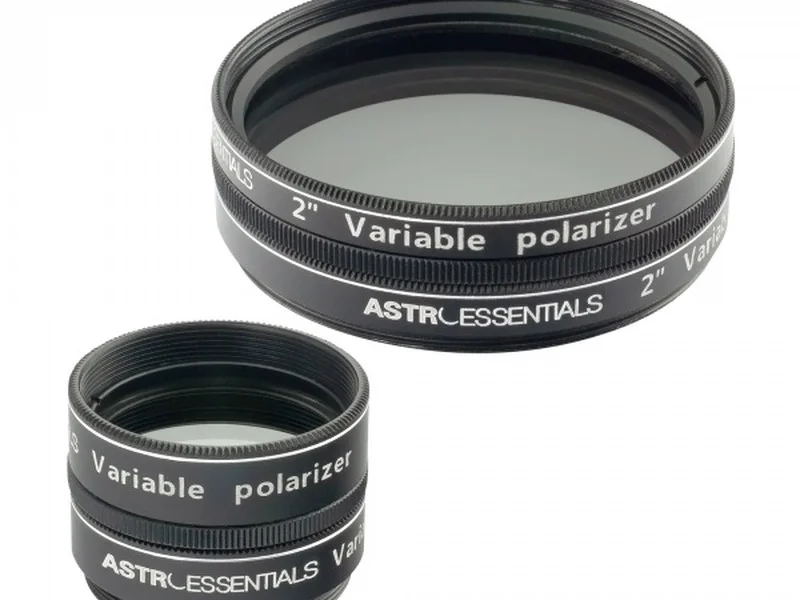
Astro Essentials Variable Polarising Moon Filter
Venus is so bright it floods the eyepiece and washes out the terminator. Dial this down and the edge between lit and unlit snaps into focus. The single best value upgrade for this particular target.
Affiliate links: you pay the same price, we earn a small commission that helps keep WatchTheStars free.