How do we search for alien intelligence?
Mostly by listening. Since 1960, radio astronomers have pointed some of the world's biggest dishes at nearby stars and waited for a signal that nature could not make. They have had some false alarms, and one of them came from a star next door. Here is what SETI has tried, what fooled it, and what it is doing now.
What is SETI, and what is it looking for?
SETI, the Search for Extraterrestrial Intelligence, looks for evidence of technology rather than evidence of life. A microbe on Mars or a whiff of oxygen in an exoplanet's air would tell us life exists. A radio tone that nature cannot make would tell us someone built a transmitter. Astronomers call these clues technosignatures.
The classic technosignature is a narrowband radio signal. Stars, gas clouds and planets give off radio waves, but they spread them across a wide range of frequencies. A transmitter can squeeze its power into a band a few hertz wide, like a single pure note in a room full of hiss. Nothing natural is known to do that, which is why SETI searches spend most of their effort hunting for thin, steady lines in the radio spectrum.
There is a second clue. Anything on a planet is moving: the planet spins and orbits its star. That motion makes a genuine signal drift slowly in frequency through the Doppler effect, the same thing that changes the pitch of a passing siren. A tone that drifts at a believable rate, and only appears when the telescope points at one star, is the kind of thing that gets SETI researchers out of bed.
Why radio? Radio waves pass through dust and gas that block starlight, are cheap to make, and travel across the Galaxy without fading into the background. Some searches also look for brief laser flashes, heat from giant structures, or alien objects in our own Solar System, even in Moon dust, but radio has carried the search for 66 years.
What is the Drake equation?
A year after his first search, Frank Drake hosted a small meeting at the National Radio Astronomy Observatory in Green Bank, West Virginia, in 1961. There were ten people in the room, among them a young Carl Sagan. To give the meeting an agenda, Drake wrote down a sum that has carried his name ever since.
The Drake equation breaks one impossible question, "how many civilisations in our Galaxy could we hear?", into seven smaller ones. How fast do stars form? What fraction have planets? How many of those planets could support life? How often does life actually start? How often does it become intelligent? How often does it build technology we could detect? And how long does that technology keep transmitting?
In 1961 only the first number was known. The group's guesses gave anything from about a thousand to a hundred million civilisations, and the answer came out roughly equal to the last factor: how many years a civilisation keeps broadcasting. Since then the planet terms have firmed up a lot. The rest are still guesses, which is why the Drake equation is best read as a list of what we do not know.
A short history of SETI: what have we tried so far?
From one 26-metre dish in 1960 to arrays, supercomputers and millions of home PCs. The search has grown enormously, but compared with the whole sky and every possible frequency, it has barely started.
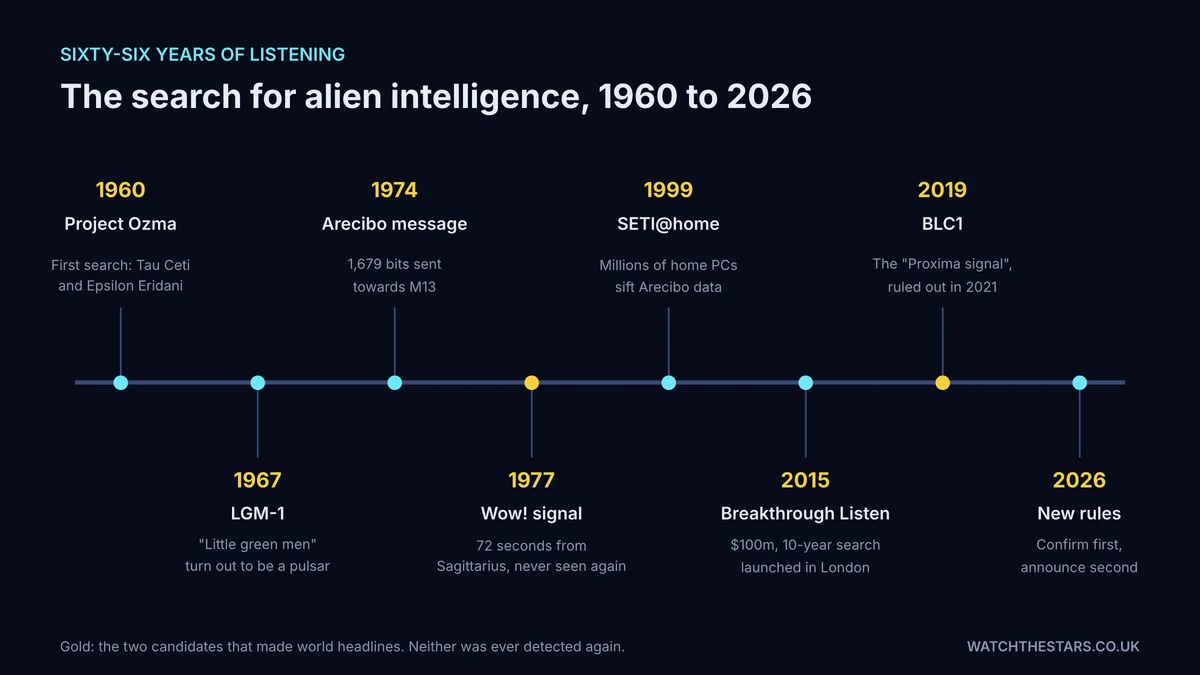
1960: Project Ozma, the first search
On 8 April 1960 Frank Drake turned the 26-metre (85 ft) Tatel telescope at Green Bank towards Tau Ceti, a star a little smaller than the Sun 11.9 light-years away in the constellation Cetus. His second target was Epsilon Eridani, about 10.5 light-years away. He tuned to around 1,420 MHz, the natural radio frequency of hydrogen, on the logic that any radio astronomer anywhere would know that number.
Project Ozma ran for about 150 hours. It found one exciting signal, which turned out to come from a high-altitude aircraft. That was the first SETI false alarm, and it set the pattern for everything since.
1967: LGM-1, the "little green men" that were stars
The best-known false alarm came from Britain. At Cambridge in 1967, the PhD student Jocelyn Bell noticed a bit of "scruff" in her chart recordings. On 28 November she and Antony Hewish slowed the recorder down and saw a pulse every 1.337 seconds, as regular as a clock. Half joking, they labelled it LGM-1, for Little Green Men.
A second pulsing source turned up on 21 December in a different part of the sky. Two alien civilisations signalling on the same odd schedule seemed far less likely than a new kind of star, and so it proved. The paper in Nature on 24 February 1968 announced the first pulsar: a spinning neutron star sweeping a beam of radio waves past Earth like a lighthouse.
1974: The Arecibo message, our turn to talk
Searching is listening. On 16 November 1974 astronomers at the 305-metre Arecibo telescope in Puerto Rico did the opposite. They sent a 1,679-bit picture, designed by Drake with help from Sagan and others, towards the globular cluster M13 in Hercules. It took under three minutes to send. M13 is about 25,000 light-years away, so the message has covered a tiny fraction of its journey. Arecibo itself collapsed on 1 December 2020, after two of its support cables failed.
1977: The Wow! signal
On the night of 15 August 1977, Ohio State University's Big Ear radio telescope recorded a strong, narrow signal near the hydrogen frequency. Big Ear swept the sky as the Earth turned, so any spot stayed in view for 72 seconds. The signal rose and fell over exactly that time, as a real point in space should. A few days later the astronomer Jerry Ehman read the printout, circled the code "6EQUJ5" and wrote "Wow!" beside it.
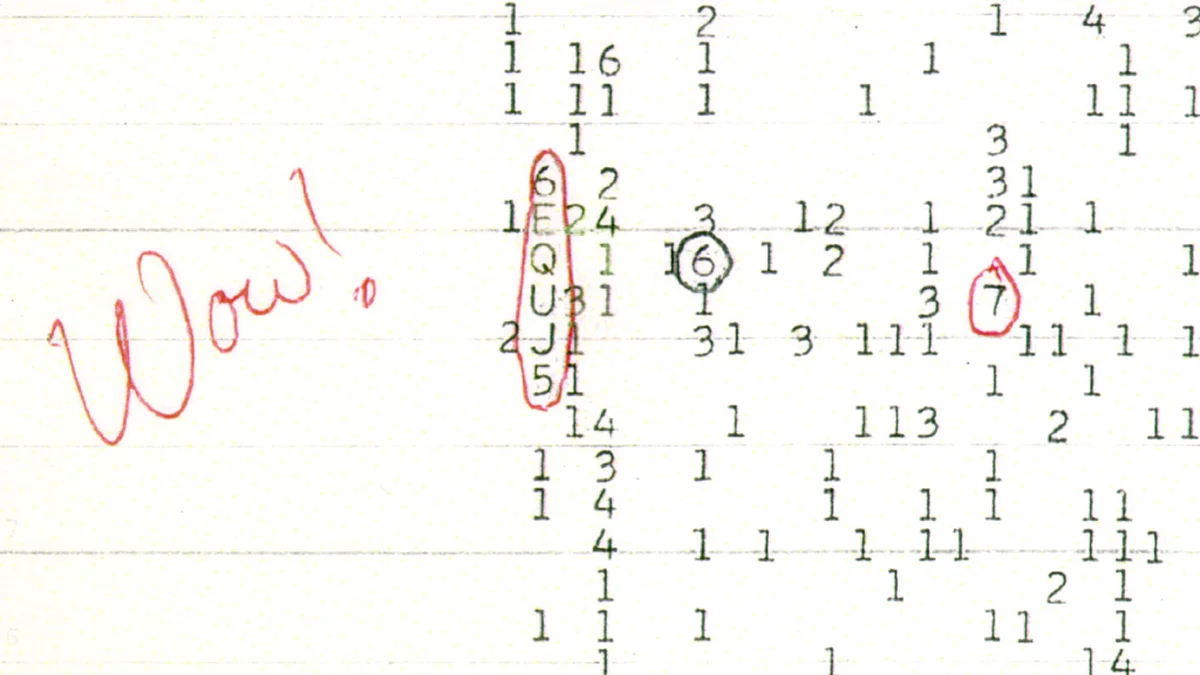
It came from the direction of Sagittarius, and it has never been seen again, despite dozens of searches. In 2024 a team led by Abel Méndez of the University of Puerto Rico at Arecibo, working through old Arecibo data, found much fainter signals with the same narrow shape coming from cold clouds of hydrogen. They proposed that the Wow! signal was one of those clouds briefly flaring up after a blast of energy from a magnetar, a type of highly magnetised dead star. A 2025 follow-up refined the signal's frequency and position. It is a promising idea, not a proven one.
1999 to 2020: SETI@home
On 17 May 1999 the University of California, Berkeley, launched a screensaver that borrowed home computers to sift Arecibo data. The team planned for about 50,000 volunteers. "Pretty quickly, we had a million," as Berkeley later put it, and in the end several million people took part. SETI@home stopped sending out data on 31 March 2020.
Its final results, accepted for publication in 2025, whittled about 12 billion detections down to around 100 signals worth a second look. China's 500-metre FAST telescope has been re-observing them since July 2025. None has been confirmed.
2015: The microwave oven at Parkes
For 17 years the Parkes radio telescope in Australia kept picking up short bursts that swept down in frequency, a bit like the fast radio bursts that come from distant galaxies. Astronomers named them perytons. Between 1998 and 2015 Parkes recorded 46 of them, nearly all during the working day. In 2015 Emily Petroff and her colleagues found the cause: microwave ovens in the observatory's kitchen, when someone opened the door before the timer finished. It is the best lesson in SETI. Before you look to the stars, check the kitchen.
The Proxima Centauri signal (BLC1): what a false positive looks like
BLC1 passed every test the search threw at it. It came from the direction of the nearest star to the Sun, and it still turned out to be made on Earth. That is why it is the best example of how SETI works.
What was BLC1?
Between 29 April and 4 May 2019, the Parkes telescope, now known by its Wiradjuri name Murriyang, watched Proxima Centauri for just over 26 hours. Proxima is a small red dwarf 4.24 light-years away with at least one planet in its habitable zone. The main aim was to study flares from the star. Breakthrough Listen recorded the data too, and a student intern from Hillsdale College, Shane Smith, began sifting it in June 2019. In late October he found something.
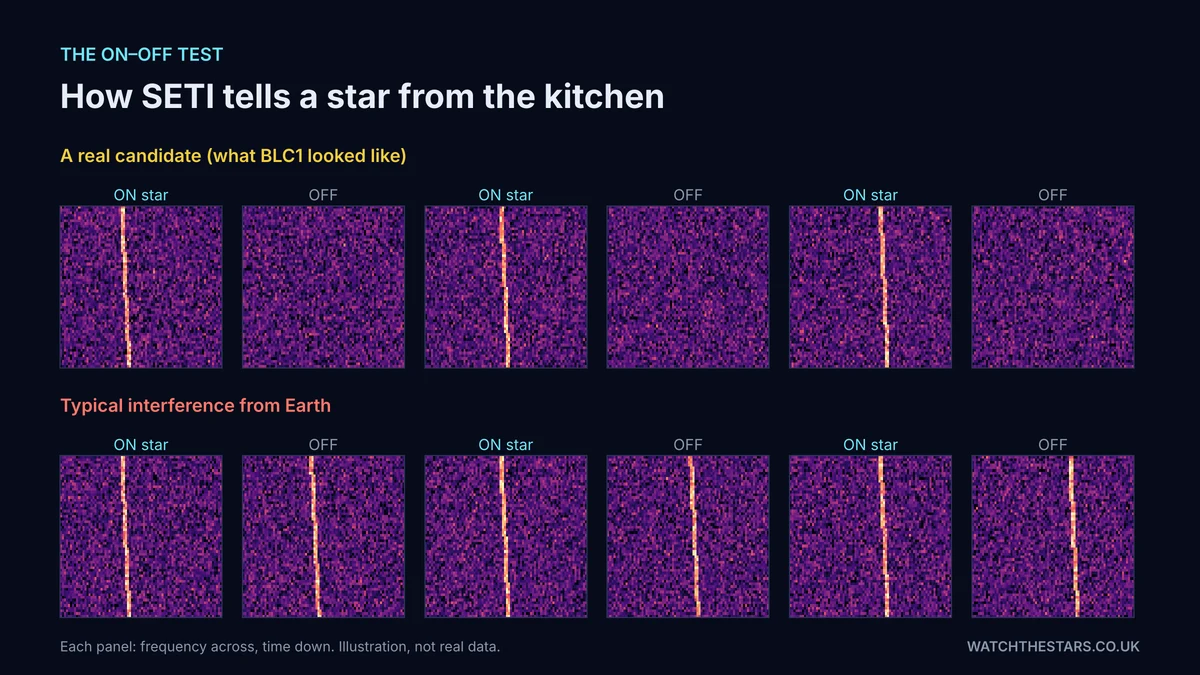
It was a single, very narrow tone at 982.002 MHz. It lasted about two and a half hours and drifted slowly upwards in frequency, at 0.038 Hz per second. Above all, it seemed to be there when Parkes pointed at Proxima and gone when the dish looked away. The team named it Breakthrough Listen Candidate 1, BLC1 for short, though the newspapers soon called it the Proxima signal.
Why did BLC1 look like aliens?
It ticked the boxes SETI had spent decades defining. It was narrow, like a transmitter. It drifted, as something on a moving planet would. It appeared in the on-target scans, which ruled out most interference that floods the whole sky. Of roughly 4.2 million hits in the Proxima data, it was the only one that passed every automatic filter.
There were warning signs from the start. The drift ran the wrong way to be explained by Earth's rotation alone, and it did not match the known orbit of Proxima b. Follow-up observations of Proxima never found it again. Then, on 18 December 2020, before the analysis was finished, the story leaked to The Guardian, and "signal from the nearest star" went round the world.
How was BLC1 ruled out?
The answer came in two papers in Nature Astronomy on 25 October 2021, by Shane Smith and Sofia Sheikh with the Breakthrough Listen team. Rather than studying BLC1 alone, they went looking for its relatives. They found dozens of "look-alike" signals in the same data, spaced at frequencies that matched the clock oscillators used in ordinary electronics. Unlike BLC1, those look-alikes also showed up when the telescope pointed away from Proxima.
The verdict: BLC1 was an intermodulation product. When two ordinary radio signals mix inside a piece of electronics, they create a ghost signal at a new frequency. If the original signals drift, the ghost drifts too. BLC1 was almost certainly one of those ghosts, made by equipment on Earth, and it only seemed to follow Proxima because of when it happened to switch on and off.
What BLC1 taught SETI: The on-off test is not enough on its own. A real candidate has to be seen again, ideally by a different telescope on another continent, and checked for relatives in the data. That lesson is now written into the rules for what happens next.
Who is searching for alien intelligence now?
More telescopes, wider bandwidths and machine learning. The search covers far more stars and frequencies than ever before, though still a tiny slice of the whole problem.
Breakthrough Listen
On 20 July 2015, at the Royal Society in London, the investor Yuri Milner and Stephen Hawking announced Breakthrough Listen: $100 million over ten years for the most thorough search yet. Observing began in January 2016 on the Green Bank Telescope in West Virginia and Parkes in Australia, with the Automated Planet Finder at Lick Observatory looking for laser flashes. China's FAST and South Africa's MeerKAT array have joined since, and Jodrell Bank in Cheshire signed up as a partner, adding the 76-metre Lovell Telescope and the e-MERLIN network.
An early survey of 1,327 nearby stars, published in 2020, found nothing. In January 2023 Peter Ma of the University of Toronto showed how machine learning could help, training a program on 150 terabytes of Green Bank data from 820 stars. It flagged eight new signals of interest. None turned up again when the telescope looked a second time.
The Allen Telescope Array
The SETI Institute's own instrument stands at Hat Creek in northern California: 42 dishes, each 6.1 metres across, paid for largely by Microsoft co-founder Paul Allen. It began work in October 2007. The plan had been 350 dishes. Like much of SETI, it runs on far less money than its backers hoped.
Checking the interstellar comet
When the interstellar comet 3I/ATLAS passed through the inner Solar System, SETI groups took the chance to listen to an object from another star system. The Allen Telescope Array tried in July 2025, MeerKAT in November, and the Green Bank Telescope on 18 December 2025, the day before its closest approach to Earth. Green Bank could have heard a transmitter as weak as 0.1 watts. All three heard nothing but nature.
What happens if we find a signal? The 2026 rules
On 5 June 2026 the International Academy of Astronautics issued the first major update in more than 15 years to its rules on what to do after a detection. The work was led by Professor Michael Garrett of the University of Manchester, who chairs the academy's SETI committee. Social media, AI and fast-spreading rumours were a big part of the thinking.
The main points are simple. Nothing should be announced until other groups, using different instruments, have confirmed the signal. Researchers should be protected from harassment while they check. Nobody should send a reply without broad international agreement, and the declaration goes to the United Nations. A new committee of social scientists, lawyers and ethicists will advise on everything that is not physics.
Why haven't we found alien signals yet?
Because the search has barely started. The Galaxy holds a hundred billion stars or more, and SETI has listened carefully to a few thousand of them, usually for minutes at a time, over a limited range of frequencies. Searchers often compare it to scooping a glass of water from the ocean and concluding there are no fish.
There are bleaker readings. Civilisations might be rare, or short-lived, which is the last term in the Drake equation biting. They might not use radio, or might use it so efficiently that it looks like noise. The physicist Enrico Fermi's famous question, "where is everybody?", has no agreed answer. The SETI Institute's Vishal Gajjar put the hopeful case in a Sky at Night interview in October 2026: he sees the "great silence" as a limit of our search methods, not proof that the Galaxy is empty.
For a very different strand of the question, unidentified objects in our own skies, see our UAP research hub, which covers official investigations and declassified files. SETI and UAP research rarely overlap. One is astronomers listening to distant stars, the other is militaries and governments trying to explain things near the ground. Our guide to the types of aliens people report covers the folklore side.
SETI's famous signals compared
Every candidate that made headlines, and how it ended. Dates are when the signal was recorded.
LGM-1
Natural · PulsarThe Wow! signal
UnexplainedPerytons
Human-madeBLC1
Human-madeCan you see SETI's targets from the UK?
Some of them, and they make a good evening's tour. All times below are worked out for central England. Use our UK night sky this week guide to check what else is up, and our stargazing for beginners guide if you are new to finding stars.
Tau Ceti and Epsilon Eridani, Project Ozma's stars
Both are winter stars, low in the south. Tau Ceti reaches about 22° up from Birmingham when it is due south, 24° from Plymouth and 18° from Edinburgh. That happens at about 10pm in mid-November and 8pm in mid-December. Epsilon Eridani climbs a little higher, to about 28° from Birmingham, 30° from Plymouth and 25° from Edinburgh, due south around midnight in mid-November and 10pm in mid-December. Both are around magnitude 3.5, easy in binoculars and visible to the eye away from street lights.
M13, where the Arecibo message is going
The great globular cluster in Hercules is a summer object, nearly overhead at about 11pm in early July. In mid-October it is still about 40° up in the west at 9pm, and by mid-November evenings it has sunk to about 14° in the north-west at 9pm. Ordinary binoculars show it as a small, round, fuzzy star. A telescope begins to break it into stars.
The Wow! signal's patch of Sagittarius
The Wow! signal came from a spot that never rises far over Britain. On late-August evenings it is due south at about 10:20pm, but only around 11° up from Birmingham, 13° from Plymouth and 7° from Edinburgh. You need a flat southern horizon, and there is nothing special to see: the source has never been found.
Proxima Centauri
Not from here. Proxima sits about 63° south of the celestial equator and never rises anywhere in the UK. You would need to be south of about 27° north, the latitude of the Canary Islands, to see it at all, and then only in a telescope. Our Alpha Centauri guide explains why the nearest stars are lost to northern skies.
Can you see the stars SETI has listened to?
Kit we've tested and reviewed in full
Some of them, yes. Tau Ceti and Epsilon Eridani, the two targets of the very first search in 1960, are naked-eye stars low in the south on winter evenings. M13, the star cluster the Arecibo message was beamed at in 1974, is a binocular object high in the summer sky. Proxima Centauri, home of BLC1, never rises over Britain at all.

10×50s make Tau Ceti and Epsilon Eridani easy to pick out low in the south from November, and show M13 as a small round glow in Hercules. It sits high in the west at nightfall in October, and nearly overhead on July evenings.
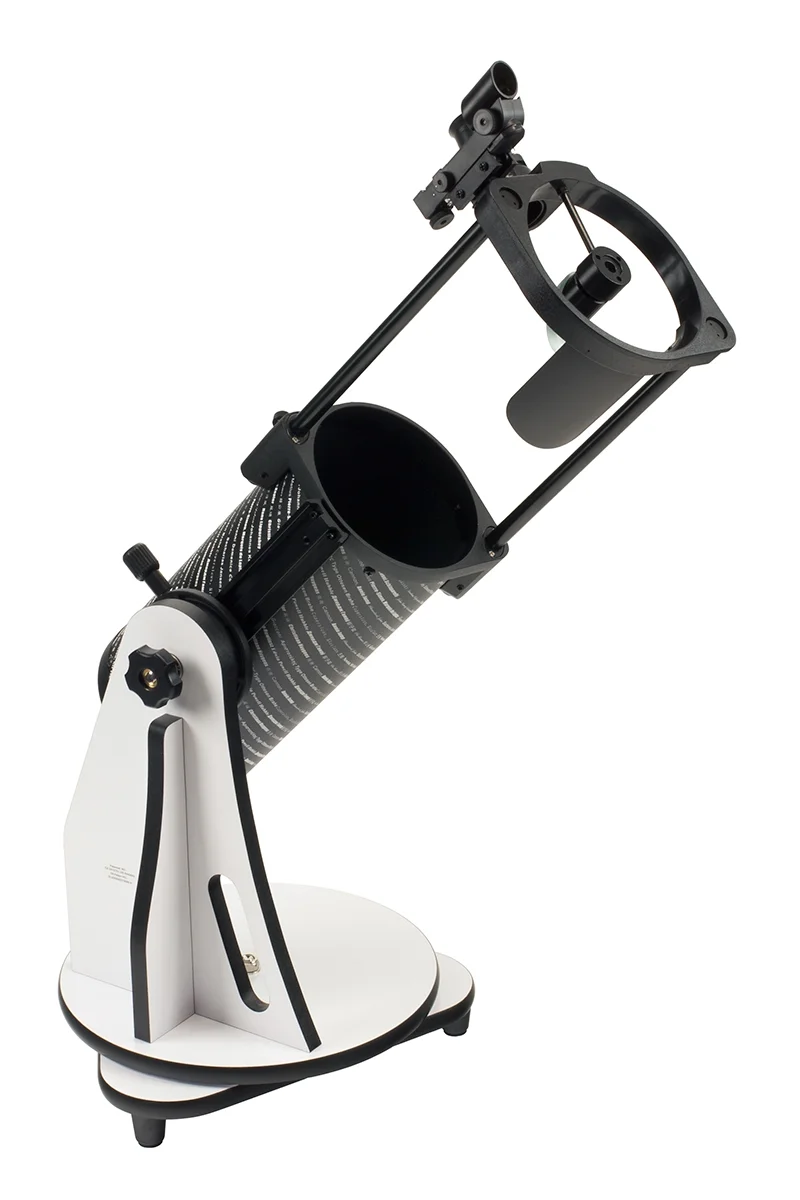
A 130mm tabletop Dobsonian at 65× starts to break the edges of M13 into separate stars. That ball of several hundred thousand suns, about 25,000 light-years away, is where humanity's best-known message is still heading.
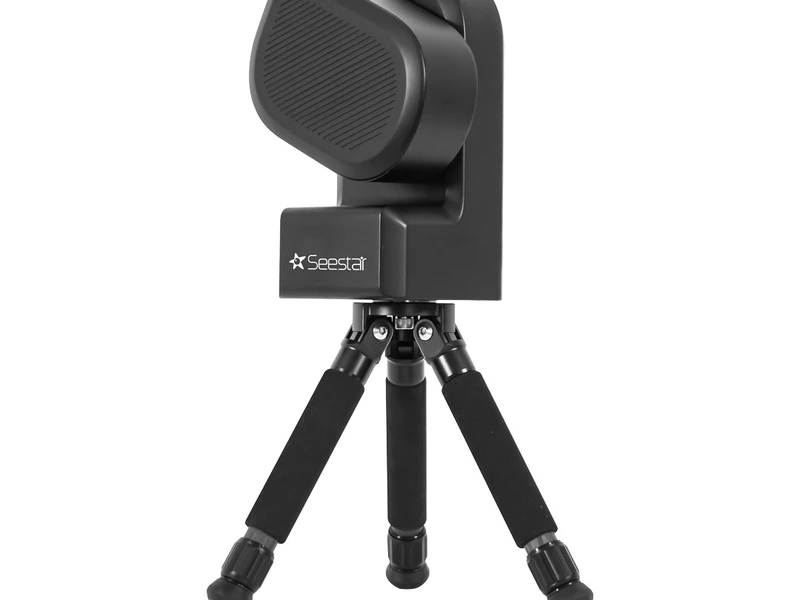
A smart telescope stacks M13 into a sharp, star-filled image in a few minutes from a garden, even under town skies. A nice way to see the cluster the Arecibo message will reach in about 25,000 years.
Affiliate links: you pay the same price, we earn a small commission that helps keep WatchTheStars free.
For the targets on this page, binoculars come first. A 10×50 pair will show you Tau Ceti, Epsilon Eridani and M13, and our guide to the best binoculars for stargazing compares the options. To see M13 as a ball of stars rather than a smudge, look at the best beginner telescopes UK buyers will get the most from, and take them somewhere properly dark with our UK dark sky sites map.
Top image: the Parkes radio telescope (Murriyang) in New South Wales, which recorded BLC1. Credit: CSIRO, CC BY 3.0, cropped.