Eclipse Glasses UK: Which Ones Are Safe and Where to Buy Them
Eclipse glasses are safe to use only if they are certified to ISO 12312-2, undamaged, and bought from a supplier you trust. That's the whole answer, and everything below is detail. Certified glasses cost about £3 a pair from UK astronomy retailers, block more than 99.999% of the Sun's light, and let you look straight at it for as long as you like. Anything else, sunglasses included, can damage your eyes in seconds.
The next solar eclipse visible from the UK is a partial on the morning of 2 August 2027. Glasses sold out nationwide in the week before the 2015, 2025 and August 2026 eclipses, so if you want a pair, buy them well ahead and put them somewhere you'll find them.
Eclipse glasses we recommend
Kit we've tested and reviewed in full
Both pairs are certified to ISO 12312-2 and sold by First Light Optics, a UK astronomy specialist, so you know they're the real thing. They sold out nationwide before the 2015, 2025 and 2026 eclipses, so buy early and keep them somewhere you'll find them.
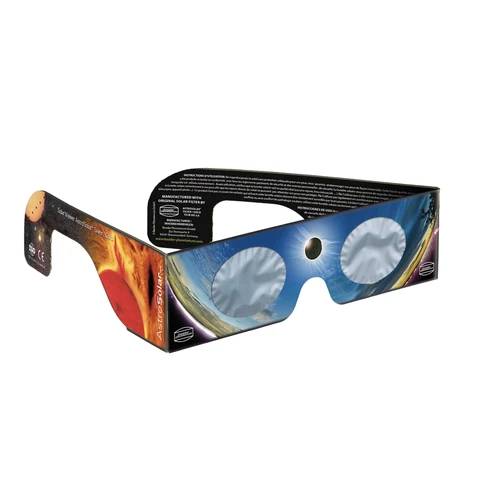
Baader Solar Eclipse Observing Glasses
Baader's own AstroSolar film in a card frame, about the price of a coffee. The pair most UK astronomy clubs hand out.
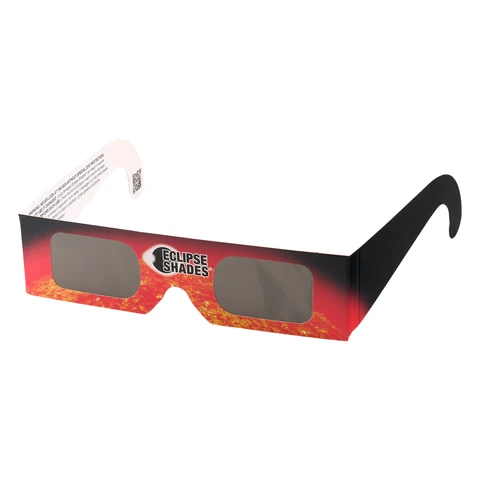
Astro Essentials Safe Solar Eclipse Handheld Viewer
The same certified film in a handheld paddle rather than glasses. Easy to share round a group, and there is nothing to fall off your face.
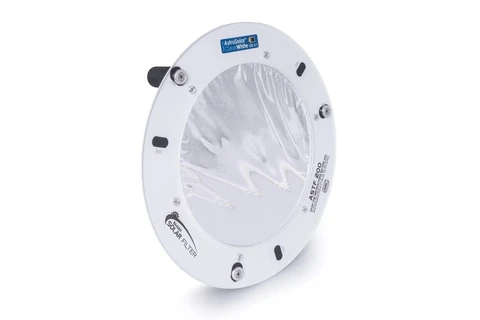
Baader AstroSolar Telescope Filter (ASTF)
A proper front-mounted solar filter for any scope up to 280mm. Turns an eclipse into a close-up, and shows sunspots on any clear day of the year.
Every safe way to watch the Sun
Honest, research-based recommendations for every budget.
Browse all →Affiliate links: you pay the same price, we earn a small commission that helps keep WatchTheStars free.
How to check eclipse glasses are safe
Counterfeit glasses turn up before every eclipse, usually on general marketplaces with a made-up brand name and a copied certification logo. Four checks tell you what you've got:
- The marking. Genuine glasses print "ISO 12312-2" (sometimes "ISO 12312-2:2015") and the manufacturer's name and address on the frame. No marking, no deal.
- The indoor test. Put them on indoors. You should see nothing at all, except very bright sources like a bare LED bulb, which should look dim. If you can make out furniture, a window or your hand, they are not eclipse glasses.
- The seller. Buy from an astronomy specialist (First Light Optics, Rother Valley Optics, the Widescreen Centre), a science museum or an observatory. The American Astronomical Society's list of trusted suppliers is the standard reference worldwide.
- The condition. Scratches, pinholes, creases or a filter coming loose from the frame all mean the pair goes in the bin. At £3 a pair, replace rather than risk it.
What is not safe to look at the Sun through
Every eclipse produces a wave of eye injuries from people improvising, and the list of things that don't work is long. Sunglasses, however dark, even several pairs stacked. Welding glass below shade 14. Smoked glass, exposed film, CDs, DVDs, crisp packets, space blankets and polarising filters. Camera phones held up to the Sun, which can be damaged themselves and don't protect the eye looking at the screen anyway. None of these block enough visible light, and none block the infrared that heats the retina without you feeling a thing.
The one free method that is completely safe is projection. Make a pinhole in a piece of card, let the Sun shine through it onto a second card a metre away, and a small image of the eclipsed Sun appears. A colander projects dozens at once, and the gaps between leaves on a tree scatter crescent suns across the ground. Our guide to observing the Sun safely has the step-by-step.
Binoculars and telescopes need a front filter, not glasses
Eclipse glasses behind an eyepiece are not protection. Binoculars and telescopes concentrate sunlight, and the film will melt or burn through in seconds, with your eye behind it. The only safe way to use optics on the Sun is a purpose-made solar filter fitted securely over the front of the lens, so the light is cut before it enters the instrument. Baader AstroSolar film is the standard: it comes as ready-made filters for common telescope sizes (from about £88) or as sheets you can mount yourself for binoculars. Check the filter is firmly attached and undamaged every single time, and remove or cap any finderscope so nobody looks through it by mistake.
The upside is that a filtered telescope is useful all year, not just on eclipse day. Sunspots, faculae and the Sun's slow rotation are visible on any clear afternoon, and we're near the peak of the current solar cycle, so there is usually something to see. Smart telescopes such as the Seestar S50 come with their own solar filter and track the Sun automatically.
When you'll use them
A pair of eclipse glasses bought now will see you through the 2 August 2027 partial solar eclipse (shallow from the UK, total from southern Spain), the partial eclipses of the early 2030s, and any sunspot big enough to see with the naked eye, which happens a few times a year near solar maximum. They are also the right tool for the transit of Mercury on 13 November 2032, though you'll need a filtered telescope to see the planet itself. Keep them flat in their sleeve and they'll last as long as the film stays intact. The old "replace every three years" advice came from earlier standards and no longer applies to ISO 12312-2 glasses.
For everything else the eclipse calendar holds, from lunar eclipses that need no protection at all to the meteor showers that follow them, see our astronomy events calendar.