Solar Eclipse 2027 UK: What You'll See on 2 August
A partial eclipse for the whole country, with exact times and coverage for 30 UK towns
When is the 2027 solar eclipse in the UK?
Monday 2 August 2027, roughly 09:00 to 11:00 BST, with maximum eclipse around 10:00 BST. It is a partial eclipse everywhere in the UK: nowhere sees totality. Coverage ranges from about 47% in the south-west down to 23% in the far north, depending on your location.
Certified eclipse glasses are needed for the entire event, wherever you are. Even at maximum coverage, the exposed sliver of Sun is far too bright to look at directly.
This is the UK-focused guide to the 2 August 2027 eclipse. The full 2027 eclipse guide covers the total eclipse itself. It crosses southern Spain and North Africa, reaching 6 minutes 23 seconds in Egypt, the longest anyone will see until 2114. From British soil, this page is what you actually need. If you want to compare notes with last year, our guide to the August 2026 UK eclipse covers the much deeper event the UK just had.
What time is the solar eclipse in the UK?
Start and end times vary by only a few minutes across the country, but maximum coverage varies a great deal. The table below covers 30 towns and cities from Penzance to Inverness. Times are BST (British Summer Time), and "Sun covered" is the fraction of the Sun's disc hidden at maximum eclipse.
| City | Starts (BST) | Maximum | Ends | Sun covered |
|---|---|---|---|---|
| Penzance | 08:57 | 09:54 | 10:54 | 47% |
| Truro | - | 09:55 | - | 46.6% |
| Plymouth | 08:59 | 09:56 | 10:56 | 46% |
| Exeter | - | 09:56 | - | 45% |
| St Helier (Jersey) | - | 09:57 | - | 50.6% |
| Bournemouth | - | 09:58 | - | 45% |
| Southampton | - | 09:58 | - | 44% |
| Brighton | - | 09:59 | - | 44% |
| Dover | 09:03 | 10:01 | 11:01 | 43% |
| Cardiff | 09:01 | 09:57 | 10:56 | 42% |
| Swansea | - | 09:57 | - | 42% |
| Bristol | - | 09:58 | - | 42% |
| London | 09:03 | 10:00 | 10:59 | 42% |
| Oxford | - | 09:59 | - | 41% |
| Birmingham | 09:04 | 09:59 | 10:56 | 39% |
| Cambridge | - | 10:00 | - | 39% |
| Norwich | 09:06 | 10:02 | 10:59 | 38% |
| Nottingham | - | 10:00 | - | 37% |
| Sheffield | - | 10:00 | - | 36% |
| Liverpool | - | 09:58 | - | 36% |
| Manchester | 09:06 | 09:59 | 10:55 | 35% |
| York | - | 10:00 | - | 34% |
| Leeds | 09:07 | 10:00 | 10:55 | 34% |
| Belfast | 09:06 | 09:57 | 10:50 | 32% |
| Derry | - | 09:56 | - | 30% |
| Newcastle | 09:09 | 10:01 | 10:54 | 30% |
| Glasgow | 09:10 | 09:59 | 10:50 | 28% |
| Edinburgh | 09:11 | 10:00 | 10:51 | 27% |
| Aberdeen | 09:14 | 10:02 | 10:51 | 24% |
| Inverness | 09:14 | 10:00 | 10:49 | 23% |
Calculated by WatchTheStars from the JPL DE421 ephemeris, cross-checked against the published figure for London (41.92%). Small differences of a minute or two are possible depending on your exact location within each town.
How much of the Sun will be covered where you live?
Coverage falls steadily as you move from south-west to north-east. Cornwall and the Channel Islands see the most, close to 50%. Northern Scotland sees the least, under a quarter. That pattern holds because the Moon's shadow is centred on North Africa. Everywhere in the UK is looking at the eclipse from an angle, and the further north-east you are, the more oblique that angle gets.
The single best spot on British soil is Jersey, at around 51%. It sits further south than anywhere in mainland Britain, which is enough to nudge it ahead of Cornwall. If you happen to be visiting the Channel Islands that week, you have the best seat in the country without needing a passport.
One thing worth understanding before you look at the numbers: "Sun covered" describes the fraction of the Sun's area hidden by the Moon, known as obscuration. That is a smaller number than the fraction of the Sun's diameter covered. The Moon has to travel further across a circle to block the same amount of area near the edges. A 42% eclipse looks less dramatic than the number suggests, which is one reason the change in daylight is so hard to spot.
Sun altitude is not a problem this time. At maximum eclipse the Sun sits 34 to 41 degrees up in the south-east, comfortably clear of rooftops and trees almost everywhere. That is a welcome change from the low autumn and winter eclipses that force you to hunt for an open horizon.
What will a 42% eclipse actually look like?
Honestly, not much: at least not to the naked eye. At 42% coverage, daylight will barely change. You would walk past it without noticing anything was happening unless you already knew to look. This is nowhere near the 89% eclipse the UK saw in August 2026, which dimmed the sky and sharpened shadows noticeably across most of the country.
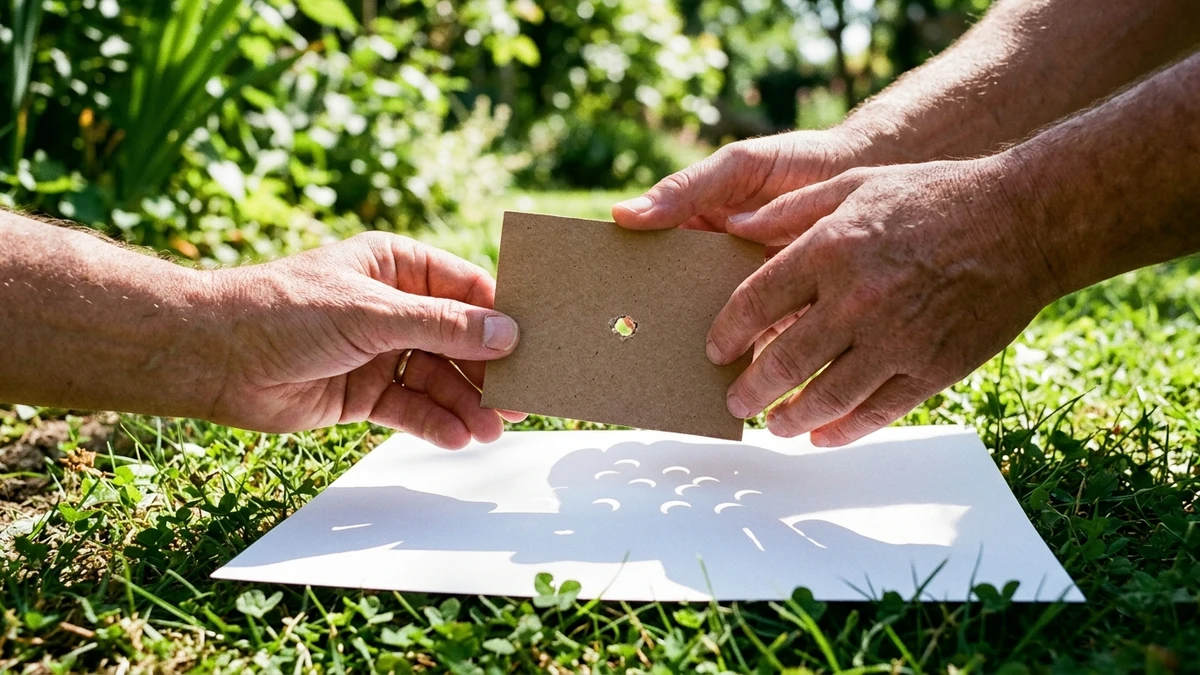
Through a pair of certified eclipse glasses, though, it is striking: a clean, dark bite taken out of one side of the Sun. Shadows under trees fill with tiny overlapping crescents, because every gap between leaves acts as a natural pinhole. If you want a sharper version, punch a small hole in a piece of card and let the light fall onto paper. It takes thirty seconds to set up. It works well with kids too, since nobody needs to look anywhere near the Sun.
It is a good school-holiday event rather than a spectacular one. Eclipse day falls on a Monday morning during the summer holidays, so there is no need to arrange time off school. The shallow coverage also means there is very little that can go wrong for a first-timer.
What you need to watch safely
Kit we've tested and reviewed in full
A 42% eclipse still leaves most of the Sun's surface exposed, so proper eye protection is not optional. Buy now: glasses sold out across UK retailers before the 2026 eclipse and will again.
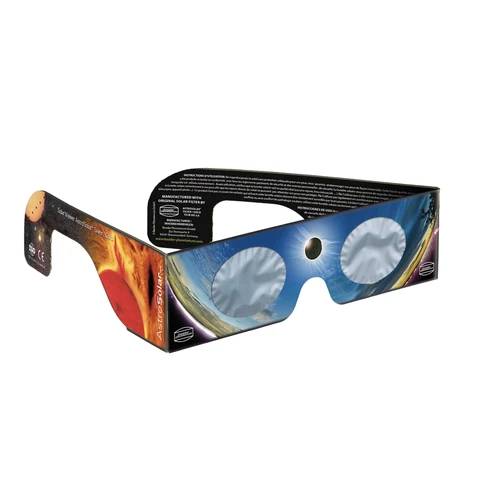
Baader Solar Eclipse Observing Glasses
Certified ISO 12312-2 filters. Keep them on for the whole event, start to finish: there is no safe moment to peek without them.
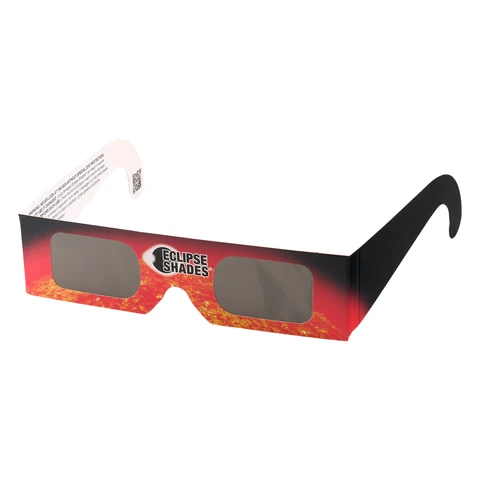
Astro Essentials Safe Solar Eclipse Handheld Viewer
A handheld paddle rather than glasses, easy to pass round if the kids or the neighbours turn up without their own. Cheap enough to keep a spare in a drawer.
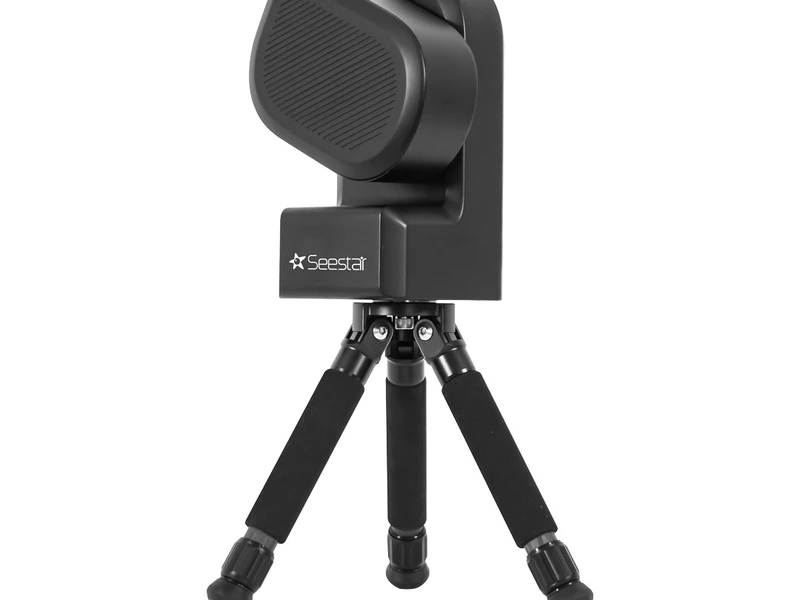
Ships with a clip-on solar filter and a dedicated solar mode, so it is ready for eclipse morning out of the box. Good for sunspots too, on any clear day before or after.
Affiliate links: you pay the same price, we earn a small commission that helps keep WatchTheStars free.
How do you watch it safely?
Wear certified ISO 12312-2 eclipse glasses for the entire event, from 09:00 to 11:00 BST, with no exceptions. Even at maximum eclipse, more than half the Sun's disc remains exposed and dangerously bright. There is no point during a partial eclipse when it becomes safe to look without protection.
Never substitute sunglasses, however dark, or homemade filters. Welding glass needs to be shade 12 or darker, and ordinary welding goggles are usually nowhere near that. Smoked glass, exposed camera film and CDs are not safe either, whatever you may have heard. Check your glasses for scratches or pinholes before use, and bin any that fail.
Pinhole projection is the free alternative, and it needs nothing but a pin, a piece of card and a second sheet to project onto. Point the pinhole at the Sun with your back to it, and look at the projected image rather than the hole. Our guide to observing the Sun safely covers filters, telescopes and cameras in full. If you want to try photographing it, the phone astrophotography guide has tips: hold a pair of eclipse glasses over the camera lens, and never point an unprotected phone at the Sun.
Is it worth travelling for totality instead?
Yes, if you can manage it. A partial eclipse is not a smaller version of totality: it is a different event entirely. Totality brings full darkness, a visible solar corona, and a 360-degree horizon glow that nothing about a 42% partial eclipse hints at.
Southern Spain and Gibraltar are the closest path of totality to the UK, around two and a half hours' flying. Tarifa and Gibraltar's Europa Point both give over four minutes of darkness. Egypt gives the longest and clearest totality anywhere on the track, with Luxor reaching 6 minutes 23 seconds under near-guaranteed clear skies. Our guide to where to watch the 2027 eclipse ranks every realistic destination, with durations calculated town by town rather than by country.When is the next solar eclipse visible from the UK?
A partial eclipse on 26 January 2028 will actually cover more of the Sun than 2027's does. But with the Sun low in a winter sky, it is a harder watch than this one. After that, the UK's next total solar eclipse from its own soil is not until 23 September 2090. That makes 2027's total eclipse across Spain and North Africa the more practical trip for anyone who wants to see totality in the next generation.
Check our astronomy events calendar for everything else worth watching between now and then. Use our tonight's sky tool to check cloud cover as eclipse morning gets closer. The eclipsed Sun sits in Cancer that morning, and our night sky guide has more on what else is up if you stay out past sunset.