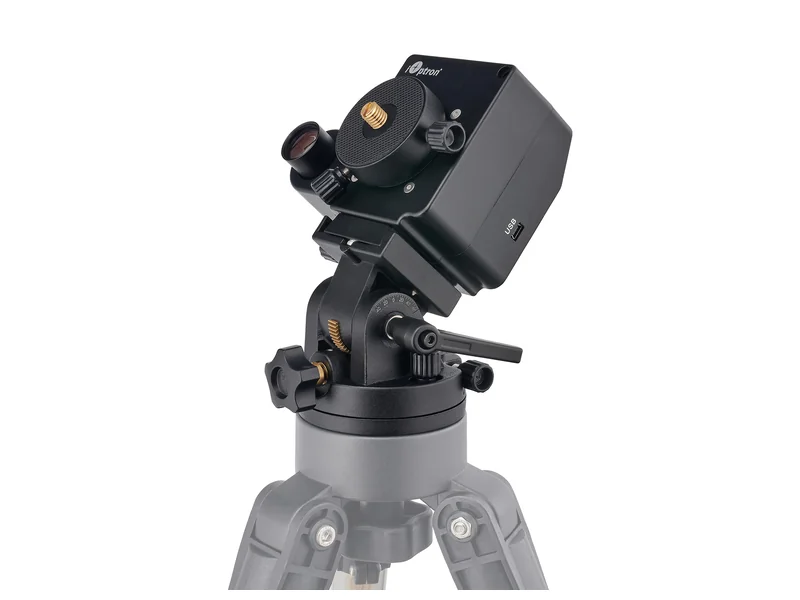
Head Weight
685g (1.15kg with base)
Tracking Rates
Sidereal, ½ speed, solar, lunar
Power
Built-in 2000mAh Li-Po, Micro USB
Battery Life
Up to 24 hours at 20°C
Polar Scope
Illuminated, 8 brightness levels
Worm Gear
144 teeth, 600-second period
Latitude Range
-30° to 65°
Tripod Thread
3/8" and 1/4"
In the Box
Head, alt-az base, polar scope, bag, USB cable
iOptron SkyTracker Pro Review: What Is a Star Tracker?
A star tracker is a small motorised mount that sits between your tripod and your camera. Once you point its axis at the celestial pole (Polaris, near enough, from the UK) it turns the camera at the same speed the Earth rotates. Stars that would smear into trails after 15 seconds stay as pin-points for minutes. That is the whole trick, and it is how people photograph the Milky Way, the Andromeda Galaxy and the Orion Nebula with an ordinary camera and lens.
The iOptron SkyTracker Pro is one of the two trackers UK beginners actually buy. The other is the Sky-Watcher Star Adventurer 2i. Most of this page is about which one you should get.
Who the SkyTracker Pro suits
Photographers who already own a camera and a wide lens and want to try astrophotography without buying a telescope. Anyone who hikes or flies to dark skies: the head weighs 685g and fits in a coat pocket. People who want the lowest-cost route into tracked exposures that still works properly.
Who should look elsewhere
If you want to carry a telephoto lens over 200mm or a small refractor, the 3kg limit and lack of a declination axis will frustrate you. See our guide to telescope mounts and star trackers for the heavier options.
SkyTracker Pro vs Star Adventurer 2i: Which Should You Buy?
These two are priced £60 apart and aimed at the same person. Here is where they differ.
SkyTracker Pro wins on: price (around £189 against £249), weight (685g head against 1.2kg), and power. The built-in lithium battery charges over Micro USB and runs 24 hours; the Star Adventurer uses four AAs or a USB power bank. The SkyTracker is quieter, and its latitude base is included rather than an extra.
Star Adventurer 2i wins on: payload (5kg against 3kg), WiFi control from the SynScan app, an ST-4 auto-guider port for longer exposures, a declination bracket and counterweight in the Pro Pack, and a much larger UK user base, which means more second-hand parts and forum advice.
The decision in one line
Wide lenses up to about 100mm and a budget to protect: SkyTracker Pro. Telephoto lenses, a small scope, or ambitions to add auto-guiding later: Star Adventurer 2i. Nobody who picks the right one for their lens regrets it.
What about the Star Adventurer GTi?
The Star Adventurer GTi at around £435 is a different class: a two-axis GoTo mount that carries 5kg and finds targets for you. If the GTi is in budget and you want to image with a small telescope, skip both single-axis trackers and go straight there.
What Can You Photograph with the SkyTracker Pro?
Milky Way and constellations (14mm to 35mm)
This is the sweet spot. Three to four minute exposures at ISO 800 to 1600 bring out the dust lanes through Cygnus and the Scutum star cloud in a way no untracked shot can. The half-speed mode splits the difference between sky and ground so landscape foregrounds stay reasonably sharp. Our UK dark sky sites map will tell you where to drive for the darkest skies.
Wide nebula fields (50mm to 85mm)
Orion from belt to sword, the North America Nebula in Cygnus, the Andromeda Galaxy with its companions. Two to three minute subs stacked over an hour give real colour and detail. A FLO customer reports 300-second subs at 85mm with pin-point stars, which is as good as this class of tracker gets.
Short telephoto (135mm to 200mm)
Possible with care. The 600-second worm period means a slow back-and-forth error that shows at longer focal lengths. Keep subs to 60 to 90 seconds, take more of them, and add the counterweight kit. Andromeda, the Pleiades and the Rosette Nebula are all within reach at 135mm.
Moon and Sun
Lunar and solar tracking rates keep the Moon or an eclipsed Sun in frame during a long sequence. With a certified solar filter this is a neat way to time-lapse a partial eclipse, and worth remembering for the 2027 solar eclipse from the UK.
The tracker is only as good as your polar alignment. Spend five minutes getting Polaris exactly on the reticle using the iOptron Polar Scope app, and your usable exposure time doubles.
How Do You Set Up the SkyTracker Pro?
- Charge it indoors. Five hours on Micro USB gets 80%. The battery is rated for 24 hours of tracking, so one charge covers a weekend.
- Level the tripod. The alt-az base has a bubble level. Set the latitude scale to roughly your latitude (52° for the Midlands, 55° for Edinburgh).
- Point north. Use a compass app. Then look through the polar scope and use the altitude and azimuth knobs to put Polaris on the correct spot of the reticle. The iOptron app shows you where that spot is for the current time.
- Fit the ball head and camera. Balance matters: with a heavy lens, rotate the mounting ring so the weight sits over the axis, or add the counterweight bar.
- Switch to sidereal and shoot. Take a 60-second test frame, zoom in on a star at the corner, and lengthen the exposure until trailing just starts to show.
If you are new to night photography, read stargazing for beginners first: knowing what is up and where saves a lot of cold standing around.
What Buyers Say About the SkyTracker Pro
Reviews on First Light Optics and the UK forums agree on a few things.
- Easy to set up. Most owners are tracking on their first night out. The illuminated polar scope and app get repeated praise.
- The battery is the standout feature. No AAs, no cable to a power bank, and it lasts all night in UK temperatures (iOptron rates it at 20°C, so expect less in January).
- Buy the counterweight kit for a DSLR. With a mirrorless and a small prime it is fine without. With a full-frame DSLR and a 70-200mm it is not.
- A flimsy tripod ruins everything. Owners who mounted it on a lightweight travel tripod report wobble and lost frames. Use something solid or iOptron's own £87 tripod.
- Not a telescope mount. A few buyers tried to carry a small refractor and gave up. The single axis and 3kg limit are real.
Known Limitations
3kg payload
Enough for a camera and prime lens, or a 70-200mm with the counterweight. Not enough for a telescope. The Star Adventurer 2i's 5kg gives you more room to grow.
No auto-guider port
You cannot add a guide camera to correct tracking errors, so exposure length is capped by the worm gear's accuracy. The 2i and the GTi both accept a guider.
Single axis only
There is no declination control. You frame by rotating the ball head, which is fine for wide fields and fiddly at 200mm.
Battery is not replaceable in the field
The internal battery can be swapped by the user (a £14 spare is available) but not quickly on a hillside. Charge before every session and carry a USB power bank as backup; the tracker runs from USB power while charging.
One-year warranty
FLO cover it for two years, which matters more than iOptron's own one-year term, but it is shorter than some rivals.
Essential Companions and Accessories
Ball head (£45): iOptron's own is cheap and solid. Any ball head rated for 3kg with a 3/8" or 1/4" thread works.
Sturdy tripod (£80 to £150): A heavy aluminium photo tripod is better than a light carbon one here. iOptron's tripod is £87 and matches the base.
Counterweight kit (£69): Essential above 500g of camera and lens. It also lets you balance the load for smoother tracking.
Red torch (£10 to £15): You will be adjusting knobs in the dark. A red light torch keeps your night vision.
Intervalometer or app: To fire a run of 2-minute exposures without touching the camera. Many cameras now do this in-body.
Upgrade Path
- Stay and improve technique: Better polar alignment, stacking software (DeepSkyStacker or Siril, both free) and a faster lens will improve your results more than a new mount for the first year.
- Move to the Star Adventurer GTi: Two axes, GoTo, 5kg payload, around £435. The step up when you want a small telescope on the mount.
- Go to a full equatorial mount: The HEQ5 Pro at around £1,000 carries a proper imaging telescope and is the classic UK astrophotography mount.
- Keep it as the travel rig: Plenty of imagers with a big mount at home keep a SkyTracker Pro for holidays. At 685g it costs nothing in luggage.
iOptron SkyTracker Pro: Is It Worth It?
Yes, for the right photographer. At around £189 the SkyTracker Pro is the cheapest tracker that does the job properly, and the built-in battery makes it the easiest to live with. For Milky Way, constellation and wide nebula photography with lenses up to about 100mm it matches the Star Adventurer 2i and costs £60 less.
Where it loses is headroom. If you think you will want a 200mm lens, a small telescope or auto-guiding within a year, the Sky-Watcher Star Adventurer 2i is the better buy, and the GTi better still. If you know your lenses are wide and your bag is small, buy the SkyTracker Pro, add the counterweight kit and a solid tripod, and go and find some dark sky.
Affiliate disclosure: This guide is community-sourced research from UK astronomy forums (Stargazers Lounge, BBC Sky at Night forums) and verified First Light Optics customer reviews. I do not have personal hands-on experience with this tracker. Specifications verified against official iOptron documentation. This page is not affiliated with iOptron or any retailer, though links may contain affiliate codes.
Back to Telescope Mounts and Star Trackers • Home